

Mormon history & truth claims • BYU sports • politics
Joined August 2013
- Tweets473
- Following81
- Followers84
- Likes16.5K






I’ve been doing a deep dive into the language of the Book of Mormon recently, with a focus on word choice as the dictation progressed.
The following chart is from that analysis. As a reminder to the reader - because of the lost 116 pages, the translation of the Book of Mormon was begun in Mosiah, continues through the end (Moroni), and then wraps back around beginning in 1 Nephi.
One of the incredible observations (with credit to Brent Metcalfe) is watching how Joseph Smith changes from using “Therefore” in the initial chapters before switching to almost exclusively using “Wherefore”.

Instead of the free ice cream BYU typically gives to visiting fans, they should give out free Pop Tarts this weekend. @BYUfootball
2
159
A surprising amount of members of the Church of Jesus Christ of Latter-day Saints have never read the first vision account that was written by Joseph Smith in 1832, 6 years before the more official 1838 account:
Therefore, I cried unto the Lord for mercy, for there was none else to whom I could go and obtain mercy. And the Lord heard my cry in the wilderness, and while in the attitude of calling upon the Lord, in the sixteenth year of my age, a pillar of light above the brightness of the sun at noonday came down from above and rested upon me. I was filled with the spirit of God, and the Lord opened the heavens upon me and I saw the Lord.
And he spake unto me, saying, “Joseph, my son, thy sins are forgiven thee. Go thy way, walk in my statutes, and keep my commandments. Behold, I am the Lord of glory. I was crucified for the world, that all those who believe on my name may have eternal life. Behold, the world lieth in sin at this time, and none doeth good, no, not one. They have turned aside from the gospel and keep not my commandments. They draw near to me with their lips while their hearts are far from me. And mine anger is kindling against the inhabitants of the earth, to visit them according to their ungodliness and to bring to pass that which hath been spoken by the mouth of the prophets and apostles. Behold and lo, I come quickly, as it is written of me, in the cloud, clothed in the glory of my Father.”
My soul was filled with love, and for many days I could rejoice with great joy. The Lord was with me, but I could find none that would believe the heavenly vision. Nevertheless, I pondered these things in my heart.
1
190
This is one of the songs that has hit a little extra hard this last year for me. While it’s not an exact match, I love the sentiment of being willing and able to hash things out with my believing family members and reconcile the tension that our religious differences have caused.
open.spotify.com/track/6pk6E…

122
I find it fascinating that many members of the Church try so hard to preserve this idea of Joseph Smith’s polygamy being “for eternity only” and that he didn’t have sex with any of his polygamous wives.
Even if we grant the entire premise of that historically flawed position, the following prophets/presidents of the Church certainly practiced polygamy in all its glory.
Given that Brigham Young, John Taylor, Wilford Woodruff, etc practiced polygamy - why try so hard to keep Joseph’s sexual reputation clean?
2
4
312
The Isaiah chapters are interesting, but at least the Book of Mormon tells you it’s quoting Isaiah.
The harder problem is when unmistakable New Testament/KJV language shows up with no citation at all.
Moroni 7:45–46 ≈ 1 Corinthians 13:4–8
“charity suffereth long, and is kind … beareth all things, believeth all things, hopeth all things, endureth all things … charity never faileth”
Moroni 7:48 ≈ 1 John 3:2–3
“when he shall appear we shall be like him, for we shall see him as he is … purified even as he is pure”
Helaman 10:7 ≈ Matthew 18:18
“whatsoever ye shall seal on earth shall be sealed in heaven; and whatsoever ye shall loose on earth shall be loosed in heaven”
Alma 40:14 ≈ Hebrews 10:27
“an awful, fearful looking for of the fiery indignation of the wrath of God”
These aren’t vague similarities. The wording tracks the KJV far too precisely to just be coincidence.
BYU Professor Royal Skousen’s Critical Text Project identifies 36 extended KJV quotations and 83 paraphrastic biblical quotations in the Book of Mormon.
So the question isn’t whether biblical language is there. It obviously is.
The question is why an allegedly ancient American record repeatedly contains the wording of a much later English New Testament—especially in places where it never tells you it’s quoting anything.
Source: Royal Skousen with Stanford Carmack, The History of the Text of the Book of Mormon, Part Five: The King James Quotations in the Book of Mormon (FARMS/BYU Studies, 2019).
byustudies.byu.edu/article/r…

1
3
357
This is Wilford Woodruff’s original 1834 journal entry describing Zelph the white Lamanite.
While traveling with Zion’s Camp, members of the group dug into an ancient mound and uncovered a human skeleton. Woodruff recorded that Joseph Smith identified the man as Zelph, “a white Lamanite,” and said that “the curse was taken from him, or at least in part.”
According to Woodruff, Zelph had been a warrior who was killed in battle by an arrow, and one of his thigh bones had earlier been broken by a stone from a sling. Woodruff also wrote that Zelph served under a great prophet named Onandagus, who was known across a vast region from the eastern sea toward the Rocky Mountains. He concluded: “The above knowledge Joseph received in a vision.”
Source: Wilford Woodruff Journal, June 3, 1834, Wilford Woodruff Papers.

1
1
180
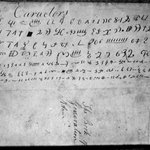
One of the Eight Witnesses, John Whitmer, had a copy of the Reformed Egyptian characters from the Golden Plates on this surviving “Caractors” document.
Whitmer claimed he had personally seen and handled the gold plates.
So take a look at the characters he preserved: do these resemble Egyptian—or any known Semitic writing system—to you?
Source: Appendix 2, Document 1. Characters Copied by John Whitmer, circa 1829–1831, p. 1, The Joseph Smith Papers

With everyone celebrating Moroni Day today I felt a little left out…
So happy Nephi Day for those who know! 👀
2
164
Emma said Joseph “could neither write nor dictate a coherent and well-worded letter.”Unfortunately for that narrative, we have the letters.
This follows Kolby Reddish’s work on Mormon Stories / LDS Discussions, where he put Joseph’s earliest letters next to the quote the Church has used for decades.
Joseph Smith III asked whether his father could have dictated the Book of Mormon after first writing it or reading it from a book. Emma answered:
“Joseph Smith could neither write nor dictate a coherent and well-worded letter; let alone dictating a book like the Book of Mormon.”
— “Last Testimony of Sister Emma,” Saints’ Herald, 1 Oct. 1879
That line still shows up in manuals, conference talks, and the Gospel Topics essay. The interview was 35 years after Joseph died and 50 years after the Book of Mormon was dictated.
Joseph, 22 October 1829
Four months after the dictation finished, while the book was at the printer, Joseph wrote Oliver Cowdery. What survives is a copy Frederick G. Williams entered into Letterbook 1 in 1832–33.
Harmony — Oct. 22d — 1829
“Respected sir I would in form you that I arrived at home on sunday morning the 4th after having a prosperous journy, and found all well the people are all friendly to us except a few who are in opposition to evry thing unless it is some thing that is axactly like themselves and two of our most formadable persacutors are now under censure and are cited to a tryal in the church for crimes which if true are worse than all the Gold Book business. we do not rejoice in the affliction of our enimies but we shall be glad to have truth prevail. there begins to be a great call for our books in this country the minds of the people are very much excited when they find that there is a copy right obtained and that there is really books about to be printed … and now dear brother be faithful in the discharge of evry duty looking for the reward of the righteous and now may God of his infinite mercy keep and preserve us spotless untill his coming and receive us all to rest with him in eternal repose through the attonement of Christ our Lord Amen”
Joseph Smith Jr
The spelling is 1829. The letter still does the job: news, enemies, book sales, greetings, a blessing. Several lines could sit in the Book of Mormon without anyone blinking.
August and December 1830
Within a year of publication, Joseph and John Whitmer wrote the Colesville saints two pastoral letters packed with Bible.
The August letter has “fight the good fight of faith,” “consume it upon your lusts,” “ravening wolves,” “thrust in your sickle,” and “the lion shall lie down with the Lamb.”
The December letter quotes 1 Thessalonians 5 almost straight through and, as Reddish counted, loads dozens of phrases from about twenty biblical books into a few paragraphs. Same habit you see in the Book of Mormon.
What we’re left with:
Emma said he couldn’t. The 1829–1830 letters show he could.
The Church still printed these letters in the Joseph Smith Papers and kept using her sentence anyway.
Watch Reddish’s episode. Read the letters.
Joseph Smith Papers: Letter to Oliver Cowdery, 22 Oct. 1829; Letter to Newel Knight and the Church in Colesville, 28 Aug. 1830; Letter to the Church in Colesville, 2 Dec. 1830. Mormon Stories Ep. 2089 with Kolby Reddish. “Last Testimony of Sister Emma,” 1879.
I served an LDS mission for 23.5 months, coming home “early” so I could make it back in time for the school semester to start.
At no point did I feel like I was cheating the Lord, the system, or that I was somehow “less than” for not serving a full 24 months.
However - there were some Pharisaic missionaries and members of the Church who felt like it was their responsibility to let me know what they thought about leaving my mission two weeks early.
I think the members would do well to worry a little more about themselves and a little less about how others choose to serve.
1
159
Before the gold plates, Joseph Smith participated in treasure digging.
In 1825, Josiah Stowell hired Joseph to help search for a supposed Spanish silver mine near Harmony, Pennsylvania. Joseph’s role was connected to his claimed ability to locate buried objects using a seer stone.
This isn’t just an anti-Mormon story. Joseph Smith’s own 1838 history acknowledges working for Stowell and says this is where the story that he was a “money-digger” originated.
In 1826, Joseph was brought before a local magistrate in Bainbridge, New York, in connection with his “glass-looking.” Though this was a well known scam at the time, Stowell was so convinced Joseph could see treasure that he testified on the side of Joseph Smith, despite no treasure ever being located.
The faithful interpretation: Joseph genuinely believed he possessed a spiritual gift, common within the folk-religious culture of his time, and his treasure-seeking helped prepare him to receive revelation.
The skeptical interpretation: Joseph was already claiming supernatural powers to locate hidden treasure before claiming to locate and translate gold plates with a seer stone.
The treasure digging isn’t really the disputed part anymore.
The question is what it tells us about the origins of Joseph Smith’s prophetic claims.
148
The Book of Mormon we read today isn’t quite the text Joseph Smith originally dictated “by the gift and power of God”
BYU professor Royal Skousen documents 3,168 changes for the 1837 edition alone.
Most cleaned up grammar/folksy English:
“as I was a journeying” → “as I was journeying”
“as I was a going thither” → “as I was going thither”
But some had theological implications. In 1 Nephi 11, for example:
“the Lamb of God, yea, even the Eternal Father” → “the Lamb of God, yea, even the Son of the Eternal Father”
And “the mother of God” → “the mother of the Son of God.”
Was the original translation most correct? Or the later version? And why the difference?
byustudies.byu.edu/article/r…
2
3
222
The first documentation of Joseph Smith writing about his “First Vision” is in 1832, 12 years after the event, and he only mentions one Personage: “The Lord”.
It’s not until the 1838 version that the story includes two personages: God and Jesus Christ.
1
3
163
Most scholars agree Mark 16:9–20 was added after the original Gospel was written.
Yet Mormon 9:22–24 reproduces Mark 16:15–18 almost verbatim, including distinctive KJV wording.
This textual anachronism deserves just as much if not more attention than the horses or steel.
5
117
Joseph Smith lost the first 116 pages of the Book of Mormon and never retranslated them.
What I didn’t learn growing up: when translation resumed, Joseph picked up around Mosiah, finished through Moroni, and only then returned to the beginning with 1 Nephi
1
1
128
At some point I allowed myself to wonder if there might be an alternate explanation other than what I was taught my whole life, and it opened up my eyes to a whole world of history that I had no idea existed as a practicing Mormon
2
111
Before Joseph Smith was known as a prophet, he was known locally as a seer.
He used stones to search for lost objects and buried treasure. In 1825, Josiah Stowell hired him to help locate a supposed Spanish silver mine for $14 a month.
1
2
120