

Jo / Joel | They/Them | Swedish game and sometimes comic person | Probably thinking about robots 🤖🌺 COMMISSIONS: Open https://nitter.cf/t.co/Rtsg6y0hd1
- Tweets3.3K
- Following724
- Followers391
- Likes24.4K








ALT A banner for the videogame, 'What in Carnation?!' The two main characters, Flora and En are stood in their university club room. En is wearing an extremely cute frog hoodie. There are plants, frogs and books in the background. Honestly the whole thing is pretty cool and it definitely makes you want to play the game.

ALT An image split into two halves advertising two videogames. On the left, A title card for the visual novel, 'What in Carnation?!' One of the main characters, Flora, is looking surprised! She's probably grabbing your attention and making you want to play the game. On the right, a well-dressed person stands smiling in front of a supermarket. This is the title card for the game 'Market Meltdown'. The logo for the game is in red and contains a drawing of a shopping basket containing fruit.


ALT Many autistic people choose not to pursue a formal diagnosis from a medical professional and instead diagnose themselves with autism. In the past, self-diagnosis has been controversial both within and outside of the autistic community, but these days many people are advocating for the validity of self-diagnosis. One of the strongest arguments in support of it is that a formal diagnosis is not accessible to everyone. Marginalised people often face medical bias which can get in the way of a formal diagnosis. The diagnostic process can also take several years which can be stressful for a lot of autistic people. A diagnosis can also be expensive. Even in places with subsidised healthcare, a private diagnosis may be better than going through the healthcare system. Unfortunately, there are still many medical professionals who don't understand autism and make their diagnoses or lack therof based on outdated and harmful stereotypes.

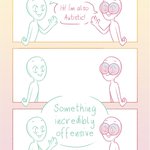
ALT One of the main arguments against the validity of self-diagnosis is that someone may misdiagnose themselves, but it is just as common to be misdiagnosed by a medical professional. Marginalised people especially are commonly misdiagnosed with ADHD, PTSD, BPD etc. Person 1: I don't think you're autistic. I think you have ADHD and you're misdiagnosing yourself. Person 2: Even if that were true, many of the coping scills I've learned to manage my autism are applicable to ADHD because they're similar. This diagnosis has helped me so what's the problem? Person 1: You're taking resources away from people who are ACTUALLY autistic! Person 2: In my country, there are literally no resources for autistic adults that I could take from you. Person 3: There are some resources in my country, but because I don't have a formal diagnosis, I can't access them so I can't take them from you either.

ALT Ultimately, a person's diagnosis - whether formal or self-diagnosed - is nobody's business but their own. Gatekeeping autism only serves to deny an identity to those who belong to it and to deny a community to those who would benefit from being a part of it. With all of this said, self-diagnosis does not and should not happen overnight. It should be done after a period of research which can take weeks, months or even years. It's also important to have a mixture of medical sources and first-hand accounts from autistic people. At the end of the day, you know your own brain and your own needs better than anyone else. If you're sure that you're autistic and you don't feel that you would personally benefit from being formally diagnosed, your self-diagnosis is just as valid as a formally diagnosed autistic person's.


ALT A four page comic about how stereotypes affect autism diagnosis. The comic has a muted colour palette of primarily oranges, pinks and greens. Page 1: Our narrator (Leesha) appears at the top of the page and asks “If I asked you to describe an autistic person, what would they look like? Maybe you’d describe someone like Sheldon Cooper? Rainman?” Next to the question is a picture of Sheldon from the big bang theory. The next panel shows a man (who may or may not be Simon Baron-Cohen) infront of a blackboard. His speech bubble is a graph with a ratio of 1:3 girls to boys. Text says “The media and many autistic academics would have you believe autism is a ‘boys condition’” Below is a pile of books and articles with post it notes that show question marks and strikethroughs. One of the books is “The essential difference” by Simon Baron-Cohen. To the right, Leesha pops out of the corner saying “The reality is, of course, very different.”

ALT Page 2: Block of text: “It’s hard to know the true numbers of autistic people and one of the reasons is because marginalised people are significantly underdiagnosed. A lot of us are missed during doctors appointments and school years, instead actively seeking diagnosis / self diagnosing as adults after years of distress” Next to this is a Black woman in box braids, looking confused, with question marks above her head. Below are two graphs showing autism diagnosis from 2008-2018. The first shows a general upward trend, the second shows exponential growth of “female” diagnosis. Text reads: “In recent years, there has been a rise in calls to recognise “female autism”, often characterised by high levels of masking and social skills” Three smiling faces, one waves an enby flag. Text reads “Even this step forward misses the reality of autism presentation, as it puts a binary gender expectation on a group of people who express gender diversity at a higher rate than the general population"


ALT An image announcing an art contest. The image is a picture of Bex pointing at a graphics tablet. The text reads: Win an XP pen artist 12 second generation graphics tablet. Details are in the thread below!



ALT Panel 1: Features a fluffy anthropomorphic ram, surrounded by dumplings, saying: “The contents of dumplings are different, depending on who makes them”. A bit of smaller text next to them reads: “A comic about the underdiagnosis of people of colour, from the perspective of an autistic Asian American.” Panel 2: Features cartoony ram heads. The first says: “There are many misconceptions about autistic people, who we are, what we look like, how we work.” The second head continues: “Among other things, it gives way to false concepts about who can or can’t be autistic, like the idea that autistic people of colour are somehow rare.” Panel 3: Shows the ram, now distressed, next to text which reads: “Truth is, people of colour aren’t less likely to be autistic, but they ARE less likely to be diagnosed.”

ALT Panel 1: The ram stands between four ram-like silhouettes. The text reads: “There are several reasons for this. One of them is bias. As a person of colour in the US, you always have to deal with the hurdle of being seen as someone “outside the norm”.” Panel 2 reads: “Most discussions about autistic signs and behaviors center around identifying it in people who are white (and male)”. A deflated ram next to the panel has an arrow pointed to it, indicating it is neither. Panel 3 continues: “So it’s hard to get a diagnosis when you’re already considered an unusual case the moment you walk into the doctor’s office.” Panel 4: A goat faces the confused-looking ram, holding a medical clipboard with a large question mark on it. The goat has a speech bubble, filled with a large X. Text below reads: “Prejudice, cultural barriers and a narrow standard of evaluation for a broad spectrum are all things that can contribute to a person of colour’s case being dismissed or misdiagnosed.”

ALT Panel 1 reads: “And that’s assuming you even get that far”, showing a backpacking ram, facing mountains in the distance. Panel 2 reads: “A lot of autistic POC are missed during childhood, as different cultural backgrounds can affect the way autistic traits are perceived and the likelihood of a family seeking an early diagnosis. Traits that are considered “staples” of autism may be unremarkable.” Text below, surrounded by dumplings, read: “In Chinese culture, for example…” A small panel shows a baby ram, quietly sitting below two checkmarked speech bubbles. Text reads: “Quiet just means well behaved”. A second panel shows two rams waving at each. Text reads: “Physical contact is less expected.” A third panel shows to rams, looking away from each other. Text reads: "And excessive eye contact may cause discomfort." Below them, text reads: "Things like difficulty with language may be chalked up to being a bilingual household, struggles with social norms, a cultural barrier, and so on."


ALT There’s an idea floating around trans-exclusionary circles that autistic people don’t understand gender. TERF: “Oh, these poor autistic children, having the Trans Agenda forced on them like this!” This is far from the truth. Let me explain… Gender-diverse people are three to six times as likely to be autistic as cisgender people are (1). Though estimates for the trans population in the US are tricky to come by due to the lack of studies, fluidity of gender labels, and hesitancy to self-report (2), some estimates from the past decade say that around 0.6% of adults in the US are transgender (3). Studies show that gender-affirming care for teenagers is associated with better long-term mental health (4). So what does this all mean?


ALT page 1 When I was in high school, someone was jokingly insulting another. They called them, “autista”, which means “autistic” in spanish. I called them out. And they jokingly responded, “oh, so YOU are una autista”. While I’ve never been called “autista” as an insult, it was used very often as a synonym for antisocial, someone that didn’t interact with others or didn’t care about others.


ALT "Hi I'm Cy!" Says the red-haired person, holding a flashlight. "And today I want to shine a spotlight on a less frequently discussed autistic trait: Autistic Inertia." "I think I learned about inertia in physics class!" says the boy. Image of two balls, one in motion and one not. "Yep! An object in motion, stays in motion!" says the red-haired person. "Basically, autistic inertia means we have difficulty starting, stopping, and switching tasks." The redhead is shown working on the computer and saying "I was supposed to eat dinner.. I have to stop... why am I still doing this?" The boy says, "Well, maybe autistic people just don't wanna do those tasks!" And the redhead says "That's a misconception! Wanting seems to have little to do with it. Autistic Inertia affects us even if we want to switch to a fun task. It's like... our brains resist!" Redhaired person's brain exposed in the next panel, screaming "nooooooo"

ALT "But why?" says the boy. "Well, some of us have a disconnect between our body and mind." Says the redhead. "Studies show that while autistic people do tell our bodies to move, they don't always listen." Redhaired person in front of a sink, staring at toothbrush, thinking "brush teeth" many times. Redhaired person's internal voice starts screaming: "Brush your teeth! The toothbrush is right there! Do it!" But redhead keeps just staring at toothbrush. Redhead says: "People report feeling "stuck" in an inactive state. Like time has slowed down. Difficulty finding the first step can also contribute to getting stuck! Regardless of why it happens, it seems that... and Autistic in motion stays in motion, and an autistic at rest stays at rest. This impacts productivity, which makes many people feel stressed." Image of the ball in motion and at rest, with the redhead on the computer and brushing teeth. The boy says: "omg we have to help these people! I've got calendars, alarms..."

ALT Redhead says: "unfortunately, those things don't help people experiencing autistic inertia." Autistic inertia was studied for the first time in 2021 by an autistic researcher, after autistic people called for a study on it. More research is needed to understand how to fully support it. People holding up neurodiversity signs. Redhead says: "here's what may help!" The best thing according to current research is a buddy who can... Be an example and prompt you. Redhead and boy brushing teeth, boy says, "grab your brush!" Provide (gentle) external pressure. Redhead on computer, boy says, "hey it's time to stop for dinner!" Boy says, "wow! So I can help with autistic inertia!" The redhead says: "yes!" Redhead says: "Also, here's some solutions that help me when I'm alone. I minimize task switching in my daily life. If I get stuck, I try to focus on moving just one finger! I hope you learned that we aren't lazy. We have autistic inertia, and sometimes.. we just aren't in motion."
