

Delivering on the Promise of the Human Proteome
San Carlos, CA
Joined July 2019
- Tweets941
- Following37
- Followers3.5K
- Likes64




Pinned Tweet
📰 Nautilus to Measure Proteoforms Driving Alzheimer’s Disease and Cancer in ARPA-H-Funded SEEDS Consortium
Nautilus expects to receive up to $6 million to bring its Voyager™ Platform to a multidisciplinary team integrating protein science, AI, and computational modeling to develop new diagnostics and therapeutics.
Read the press release:
globenewswire.com/news-relea…
And read our latest blog post to discover how the Nautilus Voyager™ Platform may advance the identification of biomarkers and drug targets as part of the SEEDS Consortium:
nautilus.bio/blog/advancing-…


#ICYMI - In our recent blog post, we discuss how we hope to advance the identification of biomarkers and drug targets as part of the APRH-H-funded SEEDS Consortium:
nautilus.bio/blog/advancing-…

Textbooks teach us that a protein’s sequence determines its structure, and that single structure determines its function. Intrinsically disordered proteins don’t follow that paradigm. Instead of folding into one stable shape, IDPs move through many context-dependent shapes. That flexibility lets them take on diverse roles in the cell. It can also make them prone to aggregating in diseases like Alzheimer’s.
On the latest episode of Translating Proteomics, Parag Mallick talks with Professor Priyanka Joshi, Ph.D., of Georgetown University about:
🔵 What intrinsically disordered proteins are.
🔵 Why they’re so hard to study and to drug.
🔵 How the new ARPA-H-funded SEEDS Consortium aims to learn the “grammar” of IDPs.
🎧 Listen now:
nautilus.bio/blog/intrinsica…
#Proteomics #IntrinsicallyDisorderedProteins #Neurodegeneration #ProteinScience

EGFR and AKT1 are often "active" in cancer, but what does "active" mean? How do we detect and target the wrongs kinds of "active"? We hope you can use our AKT1 and EGFR proteoforms assays to find out.
Apply to use them at not charge through the Iterative Mapping Grant Program - Oncology:
nautilus.bio/iterative-mappi…

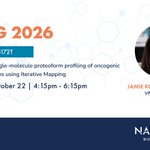
Visit our poster at #ASHG2026 to explore the latest data from the development of our oncology proteoforms assays:
📊 Poster Number: 8172T
🕓 Time: 4:15pm - 6:15pm
🔵 Title: Quantitative single-molecule proteoform profiling of oncogenic signaling proteins using Iterative Mapping
🗣️ Presenter: Jamie Rose Kuhar, Ph.D., Nautilus VP of Marketing

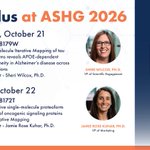
Today at #ASHG2026, join Sheri Wilcox, PhD at Poster 8179W at 2:30pm ET to discover how, “Single-molecule Iterative Mapping of proteoforms reveals APOE-dependent heterogeneity in Alzheimer’s disease.”
And drop by Booth 1425 if you’d like to learn more about incorporating the Nautilus Voyager™ Platform and single-molecule proteoform analysis into your research.

Nautilus Biotechnology retweeted

Once AI can read the proteome, the human condition changes forever.
$NAUT CEO Sujal Patel and CFO Anna Mowry join me on the podcast to discuss what it takes to get there.
We record November 2. Community members watch first.
Nautilus is proud to be at #ASHG2026 where we’re sharing how you can use the Nautilus Voyager™ Platform to explore the functional roles of proteins in cancer and neuroscience at the single-molecule level.
Drop by Booth 1425 to:
🔵 Explore a virtual model of the Nautilus Voyager Platform.
🔵 Discover how you can be one of the first to use the Voyager Platform to quantify AKT1 and EGFR proteoforms in your samples at no charge through the Iterative Mapping Grant Program.
🔵 See the power of proteoform analysis through our LEGO® demonstration.
🔵 Discuss what proteins you’d like to study at the proteoform level with Nautilus team members including Jamie Rose Kuhar, Ph.D., Sheri Wilcox, PhD, Sejal Desai, and Peter Graf.
Later this week, visit posters 8179W (Wednesday) and 8172T (Thursday) to explore the latest tau and oncology proteoform data generated on the platform.
Can’t make it to the conference but still want to participate in the Iterative Mapping Grant Program? Apply here:
nautilus.bio/iterative-mappi…

The latest Nautilus Newsletter is out! Dive in to discover why you should incorporate single-molecule proteoform analysis into your workflows:
nautilus-21430832.hs-sites-n…
Takeaways:
🔵 Proteoforms drive functional biology, and you can measure those derived from AKT1 and EGFR at no charge through the Iterative Mapping Grant Program.
🔵 Taylor Bertucci shows how proteoform analysis can reveal insights into disease biology in our latest webinar.
🔵 Proteomics leaders Birgit Schilling, Bernd Wollscheid, and Jochen Schwenk described how they think proteoforms can change our understanding of biology at our HUPO 2026 panel.
🔵 You can find us at #ASHG2026 later this week to learn more about the Nautilus Voyager™ Platform and proteoform analysis.
On the latest episode of Translating Proteomics, Nautilus Co-Founder and Chief Scientist Parag Mallick dicusses the role of multiomics in transplant medicine with Professor Brendan Keating from the NYU Grossman School of Medicine. They cover:
🔵 The current state of transplant medicine including xenotransplantation.
🔵 How multiomics is changing transplant medicine.
🔵 The future of transplant medicine.
nautilus.bio/blog/multiomics…

At #ASHG2026, we're excited to invite you to explore either AKT1 or EGFR proteoforms on the Nautilus Voyager™ Platform at no charge through the Iterative Mapping Grant Program. Apply through the link below and drop by Booth 1425 with any questions.
nautilus.bio/iterative-mappi…
For a closer look at the single-molecule functional biology data you can generate on the platform, visit our posters:
🔵 Poster 8179W covering tau proteoform analysis work with the Allen Institute.
🔵 Poster 8172T covering the development of the oncology proteoforms assays.
Finally, if you'd like to have a more in-depth conversation about incorporating the Nautilus Voyager Platform into your work, please set up a meeting with us here:
nautilus-21430832.hs-sites-n…
See you at the conference!

We are proud to announce our expected participation in SEEDS, an Advanced Research Projects Agency for Health (@ARPA_H)-funded research consortium co-led by the @BuckInstitute and @Georgetown, to measure how disease-causing proteins misfold before irreversible damage occurs in Alzheimer's disease and cancer.
Many diseases begin with protein dysregulation, misfolding, and aggregation. Today, most treatments arrive only after irreversible damage has occurred. SEEDS aims to predict harmful changes in disease-causing proteins before that point and to use those predictions to develop new ways of detecting, slowing, and treating neurodegenerative diseases and cancer.
The four-year consortium has been awarded up to $51.7 million through ARPA-H's BIOGAMI program. Upon completion of contracting, Nautilus would be expected to receive up to $6 million over the course of the program to deploy the Voyager™ Platform to quantify proteoforms of tau, implicated in Alzheimer's disease, and EWS::FLI1, implicated in the pediatric cancer Ewing sarcoma. The work would be anticipated to then extend to a larger set of intrinsically disordered proteins. The resulting data would be expected to be used to train AI models to predict how proteoforms push a protein toward aggregation.
"We believe that the highly differentiated data from the Nautilus Voyager Platform has the potential to unlock a new generation of proteoform-enabled diagnostics and therapeutics." – Parag Mallick, Ph.D., Co-founder and Chief Scientist, Nautilus.
medicine.georgetown.edu/news…
#Proteomics #Proteoforms #AlzheimersDisease #EwingSarcoma

If you’re ready to explore how proteoforms can change our understanding of biology, don't miss your chance to apply to the Iterative Mapping Grant Program - Oncology. Grant awardees will analyze either AKT1 or EGFR proteoforms in 12 of their samples at no charge.
By participating in the program, you'll be one of the first to use the Nautilus Voyager™ Platform to establish functional associations between proteoforms and cancer phenotypes.
Applications accepted through November 6, 2026.
nautilus.bio/iterative-mappi…

“We operate under the assumption, like everybody else, that proteins don’t exist, but proteoforms do.” – Bernd Wollscheid, ETH Zürich
Key takeaways and the full recording from our #HUPO2026 proteoforms panel:
nautilus.bio/blog/will-prote…

Following a very successful HUPO World Congress, we're getting ready for #ASHG2026 in Montréal. At the event, we're excited to share how researchers can use the Nautilus Voyager™ Platform to deepen their understanding of the connections between the genome, proteome, and function. Specifically, we'll:
🔵 Present a poster covering how the Voyager Platform is revealing the tau proteoform landscape underlying Alzheimer's disease (Poster 8179W at 2:30 pm on Wednesday, October 21).
🔵 Present a poster covering the latest data on the development and uses of the AKT1 and EGFR Proteoforms Assays (Poster 8172T at 4:15 pm on Thursday, October 22).
🔵 Invite attendees to apply for Iterative Mapping Grants and be among the first to use the AKT1 or EGFR Proteoforms Assays in their work.
🔵 Invite attendees to explore an interactive model of the Nautilus Voyager Platform at Booth 1425.
If you'd like to incorporate the Voyager Platform into your workflows, set up a meeting with us here:
nautilus-21430832.hs-sites-n…

Tomorrow at 8am PDT, attend our webinar to discover how you can interrogate protein function with single-molecule resolution on the Nautilus Voyager™ Platform.
You'll hear directly from Taylor Bertucci, Principal Investigator at the Neural Stem Cell Institute, who is using the platform to study the roles of tau proteoforms in frontotemporal dementia. In addition, Sheri Wilcox will share how you can use the Nautilus Tau, AKT1, and EGFR Proteoforms Assays in your own work.
Register here:
labroots.com/webinar/high-re…

The same protein can exist as many proteoforms that may behave very differently. For AKT1 and EGFR, patterns of phosphorylation on their proteoforms may drive cancer-specific signaling.
Our new blog post walks through how you can measure AKT1 or EGFR proteoforms at no charge through the Iterative Mapping Grant Program – Oncology.
🔵 3 awardees.
🔵 12 samples each.
🔵 Applications close November 6.
Read more and apply:
nautilus.bio/blog/announcing…
#Proteoforms #CancerResearch #Proteomics
