



ö retweeted

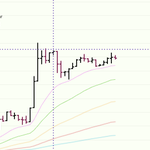
$RGTI (Update) - This is a +43R trade at pre-market now at full position size @Qullamaggie , zero violation of 10-MA. Very comfortable holding for swing traders if you stick to a simple 10-MA sell rule (even without calibration). If you can get in tighter by 50% from LoD of ATR, it is +86R (+100%).
This reflects the parabolic effect of R-multiple returns that comes with accepting a reduced win rate — a concept @stamatoudism emphasized in his interview with @traderlion 2025 annual conference, and one that can be highly rewarding.


$RGTI - This is how tight @Qullamaggie executes his trade, hallmark of tight risk for asymmetrical idea
A few pointers to also observed,
1. Liquidity
2. RS
3. High ADR%
4. Price traded out of 5 days consolidated price action (0 anticipation trade)
5. Entry is not extended from MA. ATR% from 50-MA was only 0.6 x
At least a +3R position now on T+3 based on close.

ö retweeted

Well since this post the 'parabolic' option definitely played out...wanted to show how the nature of this works but this isn't likely sustainable. Monalert now showing massive extension vs 1yr historical and we've had multiple consecutive up gaps in the last week or so. I'm completely out at this point and moved to the sidelines. Pretty classic short term blow off action, interested to see where we close today as well, looks like BIG volume on GLD daily/weekly.


Well Gold/$GLD has had quite a nice run since what my pal @Upticken called the 'mona lisa' of charts broke out.
A couple interesting things I'm watching. First is just observing that we've had three bases and it has been very orderly and now we are on the verge of going parabolic while spot gold hit 4K for the first time.
IF gold goes parabolic we could be getting closer to a longer term top however we've nearly seen a doubling in the price which was my base case. That would be a classic/normal type run and it's been going about 18 months also normal from a perspective of time.
I generally loathe the cyclical vs secular labels because they are usually used by people who don't trade/manage money as talking points that don't mean much. That said gold has recently made new all time highs on an inflation adjusted basis since the first time in my life (I was born in 82' last major peak was end of the inflation era of 1980). Most investors have NOT seen a major (secular) gold bull market and everyones Dad (at least mine) or grandpa has probably told them about the gold market of the 70s.
I don't think gold goes 20X but we could definitely see it go quite a bit higher over time if we're in the earlier innings. If the trend is your friend you probably don't want a parabolic move and if we get one I'll sell my last piece into it, for now holding small remnant and watching how this plays out.


ö retweeted

Levels over Fear.
The last 2 Fridays have offered opportunities when most have been fearful.
BUT First, understanding the tape you’re in-
1- Clear Uptrend ❌
2- Clear Downtrend ❌
3- Chop ✅
Chop = Sit in cash or buy lower levels of ranges.
You can’t buy breakouts in chop, very low success rate. Breakouts are for clear uptrends, not chop or downtrends.
Everything else is noise.
There’s nuances to understanding chop. See the bigger picture- low volume, leaders got overheated often putting in extensions, volatility with no major breakdowns, patches of leadership, no major high volume 10wk MA breakdowns, clear base building in some leaders, shakeouts, reversals at breakouts, failed breakdowns, news driven. Secondary indicators- Fintwit is all over the place, and often overly bearish, fearful & frustrated often subtly throwing shade at others.
Understand, there’s always a chance chop leads to clear downtrends so cut things quickly if they don’t follow your expectations & get stops close to flat or in the $ if levels work. Newer traders should probably just sit in cash in chop or start w 1 name only and low exposure. Chop kills the inexperienced and even the best traders can get beat up.
Study levels and the types of days the lows of ranges often happen & the psychology behind it. Try to have a good memory of similar periods & prior leaders who honored key max pain levels during choppy periods. Be open minded & curious to new strategies. One of those new strategies may be realizing “this is all too much. I’m better off in cash until an easier tape” and that’s ok too. Read this several times & bookmark it. $TSLA

ö retweeted

I am a Bayesian
I deal in possibilities, not probabilities and certainly not certainties
At any given time I have binary TA and macro narratives playing in my head - $250k Bitcoin or $60k Bitcoin
I consider all possibilities and look for asymmetrical bets in either direction
ö retweeted

Market Wizard Linda Raschke's 12 Technical Trading Rules:
1. Buy the first pullback after a new high. Sell the first rally after a new low.
2. Afternoon strength or weakness should have follow through the next day.
3. The best trading reversals occur in the morning, not the afternoon.
4. The larger the market gaps, the greater the odds of continuation and a trend.
5. The way the market trades around the previous day’s high or low is a good indicator of the market’s technical strength or weakness.
6. The previous day’s high and low are two very important “pivot” points, for this was the definitive point where buyers or sellers came in the day before. Look for the market to either test and reverse off these points, or push through and show signs of continuation.
7. The last hour often tells the truth about how strong a trend truly is. “Smart” money shows their hand in the last hour, continuing to mark positions in their favor. As long as a market is having consecutive strong closes, look for up-trend to continue. The up trend is most likely to end when there is a morning rally first, followed by a weak close.
8. High volume on the close implies continuity the next morning in the direction of the last half-hour. In a strongly trending market, look for resumption of the trend in the last hour.
9. The first hour’s range establishes the framework for the rest of the trading day.
10. A greater percentage of the day’s range occurs in the first hour then was the case in the past, and thus it has become increasingly important to trade aggressively if there are early signs of a strong trend for the day.
11. There are four basic principles of price behavior which have held up over time. Confidence that a type of price action is a true principle is what allows a trader to develop a systematic approach.
The following four principles can be modeled and quantified and hold true for all time frames, all markets. The majority of patterns or systems that have a demonstrable edge are based on one of these four enduring principles of price behavior.
Charles Dow was one of the first to touch on them in his writings. Principle
One: A Trend Has a Higher Probability of Continuation than Reversal Principle
Two: Momentum Precedes Price Principle
Three: Trends End in a Climax Principle
Four: The Market Alternates between Range Expansion and Range Contraction!
12. In the world of money, which is a world shaped by human behavior, nobody has the foggiest notion of what will happen in the future. Mark that word – Nobody!
Thus the successful trader does not base moves on what supposedly will happen but reacts instead to what does happen.

ö retweeted
There is a proven and reportable VERY HIGH correlation between traders making decisions and placing orders during active market hours and becoming long term losers
Then they start selling day trading classes on You Tube
ö retweeted

The feedback from your own trades should dictate how aggressive or passive you are in the markets. It comes down to your positions, your entries, and your execution.
If your portfolio is acting well & names holding the 10-day, trending with volume, setups working — then keep pressing.
If your positions are starting to break down, showing weakness, violating key levels like the 21-day…that’s your signal to step back, slow down and protect gains.
This is a personal feedback loop.
The market is always talking to you — through your equity curve, your trades, your winners and losers. That feedback should shape how much risk you’re taking on, not noise, not headlines, not narratives.
If you’re in a name that’s gone parabolic, that’s where you apply separate rules like scaling into strength, managing exposure tighter, knowing it’s not sustainable and locking in gains accordingly.
At the end of the day, your portfolio is the only real-time scorecard that matters. Build your judgment and rhythm off of it.
ö retweeted

JPMorganChase has announced it wil invest $1.5 trillion into 27 "critical industries" in America.
They include:
‣ Advanced Bulk Materials
‣ Advanced Manufacturing
‣ Artificial Intelligence
‣ Autonomous Mobile Robots
‣ Battery Storage
‣ Command & Control Tech
‣ Critical Components
‣ Critical Minerals Mining & Processing
‣ Cybersecurity
‣ Distributed Energy
‣ Edge Computing
‣ Grid Resilience
‣ Mesh Networks
‣ Mission Critical Real Estate
‣ Munitions, Missiles & Hypersonics
‣ Nanomaterials and Microelectronics
‣ Nuclear Energy
‣ Pharmaceutical Precursors
‣ Quantum Computing
‣ Secure Communication
‣ Sensor Hardware
‣ Shipbuilding
‣ Solar
‣ Space Launch
‣ Spacecraft
‣ Unmanned Systems
‣ 6G


ö retweeted

Once again the Tradingview Hotlist Volume gainers list is dominated by tickers we trade. Volume drives price. IYKYK 🧐

ö retweeted

"If I’m up I play much more aggressively. I see a lot of managers when they are up 20%, let’s book the year, and go to the beach. I’m the opposite and I learned that from George. If you are up 20-30% and you’re playing with house money – That’s when you try to get up 60% or 70% because your usually hot at the time. I don’t know why streaks happen, but they happen in baseball, golf, and investing. If you manage money you need to manage yourself and know when you're hot and when you're cold." - Druckenmiller
youtu.be/AJqLuMo9GPY?si=PCL1…


ö retweeted

"Don't ever bet big just because you think this is the way to get out of a mistake you've made."
- Druckenmiller

ö retweeted

Qullamaggie shows Exit Strategy for Long Swings
“What’s your exit strategy for such long swings? How do you decide this? Okay, that’s easy. Let’s take an example, ROKU. So I bought it here, on the opening range size. It gapped up on earnings, huge volume. All the things I’m looking for. You know, long range break had like a 6, 7-month range break had surprising good earnings. Great growth, etc.
I sell some, maybe 15 to 20%. A quarter of my position, and then I trail it. Then I just start trailing it like the first close below this purple line. That’s the 10-day moving average. I sell maybe say a quarter or a third of what I still have left. The shares I have left after the ones I bought. Sold into strength, and then I sell another third or quarter when it hits the first close below the 20-day moving average, which is the yellow line. And then the next level is the red line, which is the 50-day, etc.
So that’s how I scale out. So that’s what I use these moving averages for. I wait for them to be my stop pretty much. So I wait until the end of the day and I sell it.
Then I also have a level. Let’s just take an example right here. I usually use the previous swing’s lows as my stop. Then I would get out at 79. Even though it turns up intraday and closes above this yellow line, I would have to stop. You know, you can get stopped out because you know. I can, so you know. Sometimes stocks, they go, they can go down, you know, 20%.50% in a day, even. You know mid and large cap names can do that sometimes. So, you know, if it hits my last resort stop, it is my last resort stop. I just sell it.
If that was helpful, those are my sell rules, sell into strength and I trail the rest.”
ö retweeted

THE REAL EXPLANATION OF WHY SO MANY CRYPTO TRADERS BLEW UP
I’ve been fascinated by the crypto saga and also people’s reactions to it. Many people try to rationalize the action and paint those involved as idiots or unskilled.
There is no better book to explain what occurred than Psychology of Money by @morganhousel
Most traders think blowups happened because of bad risk management or the leverage. Sure, but that’s only the first-level cause. Or if anything, it’s the symptom.
The real cause is psychology. Even the best traders build risk systems, but those systems can often fail when the mind that built them starts overriding them. Risk management fails because human nature takes over when money, ego, and the social media-fueled comparison enter the equation.
One notable crypto whale was on a race to $100M in profits. In anchoring to that arbitrary goal, much like I took my biggest less anchoring to an arbitrary goal, he proceeded to blew up over $60M.
Neither of us are idiots or unskilled. Psychology truly drives most lapses in decision making and the biggest losses of money, not a lack of intelligence or strategy (case study - read about the Long-Term Capital Management saga)
Morgan Housel wrote, “Financial success is not a hard science. It’s a soft skill, where how you behave is more important than what you know.” That single line explains why so many smart, experienced traders still blew up during the crypto boom.
As crypto has been on a year-long surge, Crypto Twitter became filled with traders posting seven-figure or even eight and nine-figure profits. Your friends, your community, and your social comparisons in that world started to get rich very quickly - especially the most levered ones!
When that happens, it triggers the most dangerous emotion of all… envy. As Housel says, “People don’t want to be rich, they want to be richer than their neighbors.” Social media makes that worse. Suddenly your “neighbors” weren’t just people you knew, they were anonymous avatars showing 100x gains and exotic cars. That comparison game normalized leverage and extreme risk.
Stories of traders turning $100k into $50m weren’t warnings, they became goals. Wallstreetbets does similar. But those traders do it with massive leverage, and now many of them are gone.
“The hardest financial skill is getting the goalpost to stop moving,” Housel wrote. In crypto, the goalposts were moved so far back that risk of ruin for many became an inevitability.
Nothing is more powerful than ego and status. Judging our own place in that world versus where others stand comes to replace self-worth. Especially in youth and those that are most financially vulnerable.
Friday’s collapse wasn’t manipulation. It wasn’t Trump’s fault. He was just the spark. It was an inevitability due to the amount of leverage built up in the system.
That leverage was the result of unchecked psychology multiplied by social contagion and leverage. “Wealth is built quietly and destroyed fast,” Housel wrote. And crypto proved it.
If you don’t master your psychology, no system will save you. Markets don’t punish ignorance as much as they punish emotional inconsistency.
If you haven’t read The Psychology of Money, it’s one of the most important books for traders to understand why behavior, not intelligence, determines survival. And Morgan Housel’s new book The Art of Spending is out now. I’m reading it and loving how it explores what to do once you finally master making money.
Stay safe this week everyone 🙏


ö retweeted

How to Read an Annual Report?
Reprint from The Lamp for Winter, 1957-1958
I love how easy to understand this article feels.
🧵[1/7]

ö retweeted

One of the things I learned from my trading mentors way back when was, on days like today, to note the %B BBand on the $VIX. As the old saying goes, when "the VIX is high it's time to buy." Maybe not today, but anytime the VIX pierces the top of the Bbands (i.e., any %B read over 1.0) is NOT the time to short. Note that today's reading is 1.5. Same as 12/18/24 and higher than the April panic low.


