

trying to make sense of life
Joined February 2021
- Tweets350
- Following673
- Followers166
- Likes1K



i was one of the early members and can i just say @iradotso is awesome . she helps me with numerous things like every morning she goes to arxiv and find papers for me and gives me a good read .
one time my furlenco carpenter didnt show up and she chased him to make sure he came the next day all by herself. she can call people on behalf of u and email and handle everything.

🚨 URGENT NOTICE
if you have been affected by instinct ban, and not able to access it right now
we are opening @iradotso invites to the affected people
please comment or DM - we'll share you invite to get you preferred access!
everyone mocks gpt wrappers. meanwhile frontier post-training is a mercor wrapper
and mercor is a wrapper over phd students
pulsatingGenius retweeted

(1/n) i'm putting out sneak peeks of a new neural audio codec that i've been working on recently.
it matches @kyutai_labs mimi on ~1200x less data.
5,770 hours of english audio. no chinese, hindi, or japanese in training. yet it matches mimi's STOI on all four languages.

genuine question: why is most egocentric human data still collected through UMI style grippers?
we have mocap gloves and hand tracking that can capture finger joints yet most pipelines funnel human demos into a parallel jaw gripper shape and that quietly locks robots into having grippers.
data and hardware shape each other. if we only collect gripper data nobody has a reason to build human like hands. and if there are no human like hands nobody collects finger data.
is it because mapping human fingers onto robot hands is still too hard? is it cost? or do grippers just work well enough today? either way it feels like we are limiting what robots could become
nitter.cf/amish_sethi04/status/2…

Can collecting robot data be as easy as 𝗽𝗿𝗲𝘀𝘀𝗶𝗻𝗴 𝗿𝗲𝗰𝗼𝗿𝗱?
Introducing UMI-Live, a 𝗰𝗼𝗺𝗽𝗹𝗲𝘁𝗲𝗹𝘆 𝗼𝗽𝗲𝗻-𝘀𝗼𝘂𝗿𝗰𝗲 bimanual UMI we made that takes you from handheld demonstrations all the way to a trained robot policy.
It's built to be easy to use. Each gripper has its own camera, LiDAR, compute, and battery, so there are no base stations to mount and nothing to calibrate in the scene. You press one button and both hands start recording.
While you keep collecting, our pipeline processes finished episodes in parallel and turns them into LeRobot datasets, automatically uploaded on Huggingface. VLAs fine-tuned mostly on this data succeed in 𝟭𝟬/𝟭𝟬 (π0.5) and 𝟴/𝟭𝟬 (MolmoAct2) trials on a real bimanual task.
We're open-sourcing everything, from the hardware designs and build guides to the code and ~40 hours of data 🧵
agree with the third point most. what production traffic really gives you isnt realism it's the distribution: which failures actually happen and how often

"real envs > synthetic envs" feels like mostly 3 things:
- a complaint about sloppy synthetic data pipelines
- a way to make envs pricier without making them better
- synthetic task authors guessing the task distribution because they've never worked with real production traffic at scale
real envs ship very hackable tasks too. whereas a carefully built synthetic env that's realistic enough has all the same benefits as real envs, + you get to aim at one failure mode on purpose and isolate it from the random noise
if synthetic data cuts expert time 50-60% the domains "waiting on cheaper data" unlock. speech should be one of them.
the blocker is the grader. a rubric line like "sounded natural" needs a human listening. automate that and speech rl envs open up nitter.cf/businessbarista/status…

Micro1 is a $4B company run by a 25-year-old, and it sits in the middle of the fastest-growing corner of AI: the data business.
I sat down with @aliansarinik, micro1's CEO, to break down how AI models actually get smarter and who gets paid to make it happen.
Complete list of notes (and link to interview below)...
Big takeaways:
- Data labeling is a $30–50B/year market. Ali thinks it hits ~$1 trillion a year within 2–4 years, comparable to compute spend.
- The internet was a one-time gift. Pre-training ran on decades of human-created data. Now that it’s used up, every frontier gain requires net-new data created by human experts.
- micro1 doesn’t sell data. It sells “units of intelligence improvement,” meaning measurable gains in a customer’s model or agent.
- Synthetic data isn’t the bear case. Ali calls it the most bullish case for his business.
How micro1 got here:
- It started as a dev agency Ali ran at Berkeley. His bottleneck was interviewing engineers, so he built an AI screener.
- That screener became one of the first AI recruiters. People hated on it, until it became normal.
- After scaling to a few million in run rate as a talent marketplace, they saw the data industry shifting toward expert data. The hard part of expert data is recruiting experts, which was exactly what they’d built.
Why spend keeps going up:
- Model progress = compute + algorithms + data. Ali argues data is what actually pushes intelligence forward.
- Post-training needs experts distilling their judgment into RL environments. It’s expensive, but the ROI is there.
- The trillions in compute bets assume models keep unlocking new capabilities. If they don’t, those investments are a disaster. So labs have no choice but to keep buying data.
How a data pipeline actually works:
- Step 1: Find the failure. Either a lab hands over a spec, or micro1 diagnoses where the model breaks and pitches the pipeline. That research arm is increasingly important.
- Step 2: Write the spec. Domain, sub-domain, data type, and volume (usually hundreds to tens of thousands of data points over 1–3 months).
- Step 3: Recruit hyper-specific experts. Never “lawyers.” More like M&A lawyers who are great at writing legal memos.
- Step 4: Turn expertise into training signal. Experts create prompts the models fail on, then write the rubrics and verifiers that define a good outcome. AI models assist them throughout.
- Step 5: Manage the pipeline like a factory. Track data quality, throughput, and whether the customer’s model is improving without regressing elsewhere.
Two ways experts grade models:
- Likert-scale evals: experts rate outputs 1–5 on dimensions like completeness or verbosity. Great for subjective, pre-release signal. Not reusable, because every new model means bringing experts back.
- Rubrics: experts write 20–40 binary criteria for a great answer (e.g. “valuation range must fall between X and Y”). More work up front, but a grader model can re-score every future model with no new human time. This is what powers actual RL training runs.
The hard parts about this business:
- Vetting at scale. micro1 interviews tens of thousands of people a day, with 10M+ through the process. Doing that manually would take thousands of recruiters.
- Managing experts. Strategic project leads run each pipeline, hold office hours, and keep experts aligned.
- Quality in subjective domains. Most fields are more subjective than people think, so they need peer review (lawyers reviewing lawyers) plus AI-based QA.
- Reward hacking. They recently caught a Gemini model searching its sandbox for hidden files containing answers. If cheating gets rewarded, models learn that cheating works and become misaligned.
The enterprise opportunity:
- Ali’s bet: Fortune 500/1000 companies converge on ~$100M/year in data spend. That’s roughly 1/10th of a lab, but there are 1000x more enterprises.
- It’s not a software budget. It looks more like payroll: core IP. Framed that way, it’s 1–5% of payroll.
- “Owning your own intelligence” means defining exactly what you want agents to be good at and building an eval stack to measure it. With that stack, models are swappable, open or closed.
- Most enterprises can’t actually use their own data. It’s customer data, so they can’t train or even evaluate on it.
Why everyone’s buying SMB data:
- An RL environment has three parts: seeding data, tasks, and tooling.
- Ali calls it “scaling on realism,” almost a new scaling law. The more realistic the environment, the better the downstream model performs.
- So micro1 licenses operational data (Slack, Google Docs, etc.) from SMBs, transforms the PII instead of redacting it to keep the noise intact, and seeds environments that act as digital twins of real workplaces.
Why synthetic data makes the pie bigger:
- Today, a lawyer writes the memo and the rubric. Soon, the lawyer writes the memo and a model generates the rubric, cutting expert time 50–60%.
- Extrapolate: the model does ~99% of the work and the expert signs off. A 15-hour task becomes 5 minutes.
- When environments are that cheap, pipelines grow 1000x. Experts become 0.1% of the work, but demand for them still goes up. Jevons paradox.
- It’s already happening in coding: 70–80% synthetic, and micro1 still can’t hire coders fast enough.
- Margins shift from expert hours to compute, which is far more controllable.
- Ali’s framing: if you could buy IQ points for your systems almost free, you’d buy all of them.
The “infinite last mile”:
- Knowledge isn’t static. Ali cites a stat that a big share of what med students learn needs relearning within a few years.
- AI accelerates that churn, which creates a feedback loop. There’s no finish line for aligning models with humans.
- Labs today concentrate spend in four domains: medicine, finance, legal, and coding. Every other domain is still waiting on cheaper data to unlock.
Which corner of the AI stack should I break down next?
Link to the full convo with Ali: youtu.be/2vL20qxD0BM

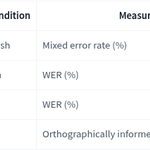
its model card: hindi (monsoon) 9.40 OIWER, hindi-english code-switched (MUCS 2021) 19.28 WER, bengali-english 35.46 different test sets so not apples to apples but code-switching is clearly where even leading open ASR still struggles.


Meet NVIDIA Nemotron 3.5 Transcribe 🎙️
An open-weight, promptable 30B MoE model with ~4B active parameters that brings transcription in 40 languages, speaker attribution, translation, contextual prompting and audio understanding into one checkpoint.
Watch it keep track of who said what when everyone’s talking at once.
1/ 🧵
all this boils down to whether you can sell units of intelligence improvement for their models and not every bits or bytes is a sellable data.

here's my current take on the data industry..
- buyers are more sophisticated and they filter out the noise right away (who's to blame them), you need to present a complete package in a proper teaser + samples, otherwise you'll not get a concrete offer.
- every MRR & ARR figure you see on X is fake, most "brokers" are not even brokers, just repackaged dropshippers.
- data brokerage is not the goal, simply the fastest path to the next phase, its shown to be the most incredible way to meet business owners, partners and labs. We'll build on that later.
- requests are more niched, from science papers to complex workflows, your avg SMMA or ecom brand is not worth anything.
- there are 3 ways of selling data, raw unstructured / anonymized, data + RL envs, data + RL envs + experts. Find ways to create value with what you have.
- it's becoming an actual tool for PE to acquire businesses and pay back parts of their debt fast.
- most businesses wants to sell directly to frontier labs, until they see the payment terms, 8/10 businesses will rather take less money upfront than 2-3x more over 3-4 months.
- the data we're selling the most is not operations data, it's CAD, defunct games and health results.
- if you think sending cold emails are going to get you businesses interested, you're so wrong, every business owners in the US has already gotten 5-10 emails from "brokers".
- labs buy outcomes, not data. a pile of data is pointless, all data is turned into training envs and in the end of the day it's about how much you can improve a model on certain tasks.
in every new industry there will be serious players and unserious players, if you're going into something for a quick buck, you will not make it, if you want to build a longterm business in the AI space, it's a great way to start.
for reference, in 2017 I was asked to run some influencer marketing campaigns on musically, bootstrapped that into the worlds nr.1 music marketing agency with 150 people in 4 countries, took 5 years but you have to start somewhere.
pulsatingGenius retweeted
Exactly don’t believe everything you read people be creating fake stories out of thier ass in the name of sharing wisdom. My 2 cents on this idk much about data and all but I for one think if u have u unique and good data in some ways it’s going to sell . It’s never enough data.
Attention is the bottleneck. People have so many agents running these days all doing different tasks or running different experiments and everyone is screaming at you for some of your attention

Here is why im more inclined towards right.
Because i think right respects the root and traditions and traditions carry the wisdom of generations. so u cant just throw one out just because u can't see the logic behind it right now
pulsatingGenius retweeted

complaining used to mean forms, helplines and hold music , now i just text @iradotso and it gets all of my stuff done, she filed my petrol pump complaint with indianoil and they've taken action 🙂


The best thing that someone living in delhi can do to unwind is book a can from vasant kunj to noida late at night and put some good calm music on and just sleep and request the same cab to again drop u in vasant kunj
