
Welcome to the official X profile of NeuroOne Medical (NASDAQ: NMTC)
Joined August 2026
- Tweets65
- Following0
- Followers12
- Likes0


$NMTC Our OneRF® Trigeminal Nerve Ablation System brings stimulation, mapping and radiofrequency ablation into a multi-contact probe—innovation we’re proud to bring to neurological care.
Conventional single-tip systems typically require repositioning to map and treat different trigeminal nerve distributions. Our probe lets physicians work across multiple contacts along a single fixed trajectory.
In the initial 15-patient series published in Pain Management, contact-level mapping was achieved in every case, without probe repositioning to map and treat multiple distributions.
Seeing this core capability documented in clinical use is an encouraging step for OneRF. Potential benefits for procedure time, anesthesia cycles and patient comfort, along with long-term outcomes, require further evaluation.
$NMTC Today we announced the publication of initial clinical results with our OneRF® Trigeminal Nerve Ablation System in the peer-reviewed journal Pain Management.
The retrospective study evaluated 15 patients with trigeminal neuralgia whose pain was not adequately controlled with medication:
• 14 of 15 (93.3%) were pain-free immediately after treatment. The remaining patient became pain-free approximately one week later.
• All 15 achieved favorable clinical outcomes at their last follow-up, with a mean follow-up of six months.
• Eight (53.3%) were pain-free without medication at their last follow-up. Six were pain-free while continuing medication; one had residual pain controlled with medication.
Our multi-contact probe also enabled mapping and treatment of multiple trigeminal nerve distributions along a fixed trajectory, without probe repositioning.
These encouraging results strengthen the clinical evidence behind OneRF and our commitment to advancing care. This small series had no comparison group; larger studies and longer follow-up are needed to assess durability and comparative effectiveness.
$NMTC The New York Post feature highlights our OneRF® Trigeminal Nerve Ablation System, which enables physicians to test multiple nerve locations through a single probe insertion, without repeatedly repositioning the probe.
This design offers patients a more comfortable procedure compared with known commercially available trigeminal nerve radiofrequency ablation systems. The article illustrates its clinical use through Tish Long’s experience and insights from Dr. Michael Staudt at University Hospitals.
We are expanding direct sales and distribution efforts to make this technology available to more physicians and patients. Alongside our first pharmaceutical industry purchase order for StereoCED™, these efforts reflect distinct paths for applying our electrode technology—in clinical care and preclinical pharmaceutical research.
Read the full article: nypost.com/2026/10/22/health…

$NMTC Thank you, @nypost, for sharing Tish’s experience with our OneRF® technology at University Hospitals.
Alongside today’s first pharmaceutical purchase order for StereoCED™, this story highlights the distinct ways our electrode technology supports patient care and research.

I spent 7 years battling the excruciating 'suicide disease' - I couldn't even smile without pain trib.al/qGbvFQu

$NMTC The New York Post shared the story of Tish Long, who received treatment with our FDA 510(k)-cleared OneRF® Trigeminal Nerve Ablation System at University Hospitals after seven years of severe facial pain.
The article follows her experience with trigeminal neuralgia and the care provided by Dr. Michael Staudt. After medications and a previous surgery failed to provide lasting relief, Tish reported immediate relief following her OneRF procedure and a return to everyday activities, including smiling.
“Stories like this reinforce our sense of urgency and responsibility to make this technology available to more patients. We are actively expanding our direct sales and distribution efforts to accelerate commercialization and broaden access to our OneRF Trigeminal Nerve Ablation System across the country,” said Dave Rosa, Chief Executive Officer of NeuroOne.
Read the article: nypost.com/2026/10/22/health…
$NMTC Our StereoCED™ platform combines targeted intracranial drug delivery with electrophysiological recording, enabling researchers to monitor the brain’s electrical activity before, during and after drug administration.
Designed to support electrode implantation for less than 30 days, StereoCED enables longitudinal EEG monitoring. This capability could help researchers examine changes in electrical activity and gain additional insights into a therapeutic agent’s effects over time.
These integrated capabilities will support the preclinical program behind our first pharmaceutical industry purchase order, with research in large animals expected to begin in early 2027.
For NeuroOne, this application extends our electrode technology into pharmaceutical research and supports our work to establish StereoCED within the drug development process.
NeuroOne Medical IR retweeted

I spent 7 years battling the excruciating 'suicide disease' - I couldn't even smile without pain trib.al/qGbvFQu
$NMTC We have secured our first pharmaceutical industry purchase order for the StereoCED™ Drug Delivery Platform to support a preclinical research program for a Tier 1 global pharmaceutical company.
Expected to begin in large animals in early 2027, the program will leverage StereoCED’s combination of targeted intracranial drug delivery and electrophysiological recording capabilities.
Following completion of StereoCED’s development, this purchase order marks an important commercial milestone and advances our strategy to engage pharmaceutical partners early in therapeutic development.
As programs progress toward human clinical trials and potentially commercialization, continuity with an established delivery platform may reduce development complexity and create opportunities for long-term collaborations and recurring revenue.
We look forward to building on this first pharmaceutical industry milestone.
$NMTC Advancing our pain portfolio includes connecting directly with physicians to understand their procedural needs.
At The Business of Pain Conference, October 8–11 in Miami Beach, our team engaged with physicians about our commercial OneRF® Trigeminal Nerve Ablation System and gathered design feedback on our Basivertebral Nerve Radiofrequency Ablation System, currently in development.
These conversations supported two priorities: building awareness of our technology for trigeminal neuralgia and incorporating clinical perspectives into the basivertebral nerve development program.
Direct physician engagement supports our broader pain strategy, combining commercial execution with the development of additional ablation applications.


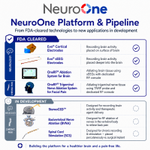
$NMTC Our Evo electrodes and OneRF brain ablation system will be showcased alongside Zimmer Biomet and Monteris technologies at the 2026 CNS Annual Meeting, October 31–November 4 in Washington, D.C., at Booth #649.
Commercialized through our distribution partnership with Zimmer Biomet, these technologies support electrical recording and targeted radiofrequency ablation. OneRF enables diagnostic recording and ablation using the same sEEG electrode, connecting information gathering with treatment.
Together with ROSA Brain’s robotic planning and guidance and NeuroBlate’s laser ablation, our products contribute to a portfolio spanning navigation, localization and ablation.
CNS provides an opportunity for neurosurgeons to explore these complementary capabilities and see the practical role of NeuroOne’s technology within the broader workflow.
$NMTC Our sEEG electrodes record electrical activity in the brain. The Dartmouth-led research project seeks to add another layer of information: neurotransmitter signaling.
Measuring both at the same time could help researchers examine how electrical activity relates to changes in brain chemistry. The goal is to develop tools for real-time monitoring that could support understanding, diagnosis and treatment of neurological and psychiatric disorders.
Our role is to bring our sEEG electrode technology into that research, exploring how it can accommodate neurochemical sensing alongside electrical recording. This capability remains in development toward potential use in humans.
Our platform already supports recording, stimulation and ablation. Working with Dartmouth and the participating medical centers, we are investigating an additional sensing capability through NIH-funded research. The collaboration shows how our electrode technology can support research objectives at established academic and medical institutions.
We look forward to building on this work with Dartmouth and the broader research team.
$NMTC Today, we announced an agreement with Dartmouth to support research into neurotransmitter sensing using our sEEG electrodes.
Dartmouth received approximately $1 million in NIH funding for the project’s first year. Under our subaward agreement, we will receive approximately $200,000 through April 30, 2027, with additional funds expected during the following two years.
The objective is to combine electrical recording with neurochemical sensing, working toward potential use in humans.
This agreement places our sEEG technology within a Dartmouth-led, NIH-funded research project alongside the VA Medical Center and Beth Israel Deaconess Medical Center. It adds a new institutional research collaboration to the commercial progress reflected in our preliminary FY2026 results and open purchase orders entering FY2027.
We’ll continue sharing updates as this research progresses.
$NMTC We enter fiscal 2027 with $5.4 million in open purchase orders as of September 30, following a $4.5 million purchase order secured in September—the largest in NeuroOne’s history.
Approximately $1 million of the record order shipped in September. Remaining shipments are expected to begin in fiscal Q1 and continue into Q2 2027, subject to manufacturing and delivery schedules. This order provides greater visibility into anticipated product shipments and future revenue opportunities.
Across fiscal 2026, product orders increased 24.2% compared with the previous year, adding to the commercial foundation supporting our next phase of execution.
Alongside fulfilling these orders, our growth priorities include commercialization of the trigeminal neuralgia system, international market expansion and advancement of our drug delivery platform. These priorities connect our existing commercial business with opportunities to expand the reach and applications of NeuroOne’s technology.
$NMTC Today, we published preliminary product revenue results for fiscal Q4 and full-year 2026, reflecting continued commercial growth and a strong finish to the fiscal year.
Q4 product revenue is expected to reach approximately $3.8 million, up 38.4% year over year. Full-year product revenue is expected to reach approximately $10.5 million, representing 15.6% growth and landing at the top of our previously announced guidance range of $9.2 million to $10.5 million.
Reaching the upper end of that range marks an important execution milestone as we continue working to expand the commercial reach of our neurotechnology portfolio. The fourth-quarter performance also provides a stronger revenue foundation as we begin fiscal 2027.
Figures are preliminary and unaudited, and remain subject to year-end accounting and audit procedures. Complete financial results are expected in December 2026.
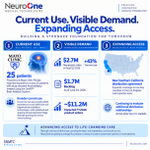
$NMTC We have shared individual patient stories and clinical experiences across the NeuroOne platform over time. Together, they also help tell a broader story about execution.
At Mayo Clinic Florida, physicians reported experience across 25 patients with drug-resistant focal epilepsy treated using the OneRF® Brain Ablation System. We have also shared patient experiences across our brain and trigeminal nerve ablation technologies in different clinical settings.
These examples are important not only as individual patient stories, but because they help illustrate that NeuroOne technologies are already being used in real clinical practice today.
Combined with published experience and continued activity across clinical centers, they provide another view into the growing use of the platform beyond future development milestones.
$CLPT $GMED

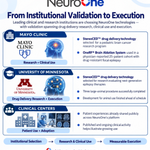
What does institutional validation look like in practice?
Across NeuroOne’s platform, we are seeing that validation take different forms — from leading institutions selecting our StereoCED™ drug delivery technology for research programs, to published clinical experience and patient use across treatment centers.
Each of these milestones represents a different stage of execution: technology being selected for research, advancing into active studies, being used in clinical settings, and generating a growing body of real-world experience.
Viewed together, they help show how external validation is translating into tangible progress across the NeuroOne platform.
$CLPT $GMED $NMTC

$NMTC NeuroOne technologies have been selected by leading institutions across multiple areas of our platform. Mayo Clinic and the University of Minnesota, for example, have selected our StereoCED™ drug delivery technology for research programs evaluating new approaches in pediatric brain cancer and drug-resistant epilepsy.
These relationships help validate the relevance of our technologies in areas where precision, clinical utility and research capability matter. Viewed together with ongoing clinical use, published experience and program advancement, they also help illustrate a broader progression across NeuroOne — from institutional selection to research activity, clinical use and measurable execution.
As more of these milestones come together, they provide a clearer view of how external validation is supporting the continued development of our platform.
$CLPT $GMED

$NMTC Trigeminal neuralgia is a debilitating chronic pain condition that can cause sudden episodes of severe facial pain and significantly disrupt everyday life.
Our FDA-cleared OneRF® Trigeminal Nerve Ablation System provides physicians with a less invasive radiofrequency option for treating the condition.
Its multi-contact probe is designed to enable stimulation, mapping and ablation during the procedure, while potentially reducing probe repositioning and anesthesia cycles.
As we expand commercial access to the OneRF® Trigeminal Nerve Ablation System, we remain focused on bringing this technology to more physicians treating this challenging condition.
$CLPT $GMED