
Stake your ANYONE with me. https://nitter.cf/t.co/OQodU1y1cz https://nitter.cf/t.co/Jm1wN6xgH8
Jungle
Joined May 2018
- Tweets13.1K
- Following742
- Followers326
- Likes28.7K



Node- Chad retweeted
Pause and Rewind live TV — now in base:0xe67f39fbe8c24ef8b3542efed1ee9963cefc1f2a Live.
Live TV has one flaw: it doesn’t wait. The phone rings in the 89th minute, someone asks what the commentator just said, and it’s gone.
Not anymore. Anyone Live now keeps the last ten minutes of whatever channel you’re watching, on your own device. Pause. Go back. Catch the goal again. Then jump to live when you’re ready — one button.
A few things we cared about while building it:
It stays Private. Every second you rewind into still came to you through the base:0xe67f39fbe8c24ef8b3542efed1ee9963cefc1f2a Network. The channel never saw your address when it was live, and nothing changes when you scrub back — the buffer lives on your phone or Fire TV and nowhere else.
It stays sharp. Rewinding doesn’t quietly drop you to a lower quality. If you’re more than 45 seconds behind, the app locks the stream at the quality you had, so a replay looks exactly like the live picture did.
It knows its limits. The buffer sizes itself to the free space on your device (never more than 512 MB, nothing at all when you’re low), and it’s gone the moment you leave the channel. There is no history of what you paused.
It works on every HLS live channel, on Phone and on Fire TV — hold OK on the remote for the options, or press pause like you always wanted to.
Private TV should still behave like TV. Now it does.
The @AnyoneFDN Network does the rest.
Node- Chad retweeted

Everyone is staring at how the money left, but the real question is how the attackers knew where to look.
A pseudonymous wallet doesn’t hide you. The moment you touch the chain, your wallet reaches out to a node and exposes the raw IP behind it. Tie one IP to one wallet, and everything unravels into a real person at a real location.
That’s the first thing a hacker hunts for, and it no longer stops at your funds. Holders are being doxxed through their on-chain activity, and the metadata you leak is the same trail that leads to your front door.
This is only the beginning. AI agents are already probing for weaknesses at machine speed across the same exposed layer you use. And if it’s connected, it’s a target now, from crypto wallets to the supermarket freezers cooked across Europe this week.
So people reach for a VPN and assume they’re safe. They’re not. A VPN just swaps your provider for one company that sees everything and logs it anyway. It’s a centralized target like everything else above, and when a VPN gets breached, it spills the whole backlog at once. Every user, every session, every real identity behind every connection. The thing you trusted to hide you becomes the perfect map.
Anyone removes that point entirely. Your traffic runs through the largest decentralized onion network in the world, where no single operator sees the full picture. No central log to leak, no one to pressure, nothing to seize. Not funded by the US government or any other major sovereign or corporate entities, but built from the ground up.
Your keys keep your funds safe. Anyone keeps the layer beneath them secure.
Anyone is for everyone.

🚨 THE ENTIRE CRYPTO INFRASTRUCTURE IS UNDER ATTACK.
More than $11.4 BILLION has been lost to crypto hacks in 2025 and 2026 so far.
According to DefiLlama's data:
• 2025: $2.7 BILLION lost.
• 2026: $8.7 BILLION lost across 326 incidents.
And the attacks are becoming increasingly alarming.
In February 2025, hackers stole $1.5 BILLION from Bybit in one of the biggest crypto hacks ever.
But look at what has happened in just the last two months:
• Sep 6 : Liquid Network: $320M
• Sep 24 : Bitget: $387M
• Oct 1 : NEAR Intents: $3.8M
• Oct 7 : 79th Vault: $12.5M
• Oct 9 : Ledger reseller attack: ~$93M
• Oct 13 : Gamdom: $4.21M
• Oct 17 : NGRAVE LIQUID: $2.6M
• Oct 21 : CoinDCX: $16M
• Oct 24 : X100: $4.75M
• Oct 26 : Avalanche Safe multisig: $7.45M
• Oct 29 : Binance: $6.36 BILLION
And now, on November 2, Brazil's Mercado Bitcoin has confirmed a security incident after researchers identified over $40 MILLION in suspicious transfers. The full losses are still unconfirmed.
These incidents are exposing weaknesses across exchanges, wallets, bridges and DeFi platforms.
Hackers are exploiting software vulnerabilities, compromising private keys, breaking into internal systems and manipulating transaction approvals.
But the most frightening development is how quickly these attacks can now happen.
In the Binance hack, investigators found that stolen funds were moved through approximately 12,000 wallets across 11 blockchains in less than four days.
That's roughly one new wallet every 25 SECONDS.
And AI could make this situation significantly worse.
Google's security researchers have already documented attackers building and launching an automated credential stealing operation in under SIX HOURS.
Anthropic has also identified AI-assisted cyber operations where attackers completed breaches in just TWO TO THREE HOURS.
AI can help hackers discover vulnerabilities, develop malicious tools, automate attacks and target multiple systems simultaneously.
Attacks that previously required large teams and extensive preparation can now be carried out much faster with fewer people.

Node- Chad retweeted

.@Neuratic from $ANYONE explains how the protocol differs from traditional VPNs and other decentralized privacy solutions...
Instead of routing traffic through a single VPN server, @AnyoneFDN uses three independent hops, ensuring no single server knows both your identity and the websites you visit.
Its goal is to make internet privacy easier to access, with integrations for apps and wallets that work in just two clicks or two lines of code

Today on MCG
$ANYONE | @AnyoneFDN w/@0xneuratic
Anyone Protocol is a decentralized privacy network that uses incentivized onion-routing relays so any app can get built-in, trustless anonymity
Highlights include:
00:59 – Neuratic and Morpho's background
02:37 – Ator was re-branded, top utility project in the Pepe cycle
03:21 – Tor dispute explained, voted off after doubling its network
04:24 – $400M all-time high MC for Ator
05:31 – Tor kick-off candle: $200M to $20M in a day
07:23 – Why VPNs are broken
08:24 – Largest onion routing network by nodes
09:20 – Vs VPN: 3 hops, no one knows who and what
16:18 – Free network, apps and home hardware
16:50 – Hardware from idea to shipping in ~6 months
18:13 – Thousands of node operators, under 3% inflation
18:55 – Agents: private tunnels via SDK
20:23 – Peak 30K daily users, revenue not the goal yet
20:55 – $1 a month math, 100K users is $1M a year
22:08 – DePIN: nodes paid by uptime and bandwidth
23:46 – Token thesis: ETH proxy plus privacy
26:18 – ~90% circulating, no overhang
26:46 – Next: browser extension
27:37 – $ORBIO in talks and political KOL deals waiting
29:12 – What the token does?
Node- Chad retweeted
Today on MCG
$ANYONE | @AnyoneFDN w/@0xneuratic
Anyone Protocol is a decentralized privacy network that uses incentivized onion-routing relays so any app can get built-in, trustless anonymity
Highlights include:
00:59 – Neuratic and Morpho's background
02:37 – Ator was re-branded, top utility project in the Pepe cycle
03:21 – Tor dispute explained, voted off after doubling its network
04:24 – $400M all-time high MC for Ator
05:31 – Tor kick-off candle: $200M to $20M in a day
07:23 – Why VPNs are broken
08:24 – Largest onion routing network by nodes
09:20 – Vs VPN: 3 hops, no one knows who and what
16:18 – Free network, apps and home hardware
16:50 – Hardware from idea to shipping in ~6 months
18:13 – Thousands of node operators, under 3% inflation
18:55 – Agents: private tunnels via SDK
20:23 – Peak 30K daily users, revenue not the goal yet
20:55 – $1 a month math, 100K users is $1M a year
22:08 – DePIN: nodes paid by uptime and bandwidth
23:46 – Token thesis: ETH proxy plus privacy
26:18 – ~90% circulating, no overhang
26:46 – Next: browser extension
27:37 – $ORBIO in talks and political KOL deals waiting
29:12 – What the token does?

Node- Chad retweeted
An AI agent with permission to buy and sell isn’t just a wallet. It’s a standing instruction to move your money, and that makes it a far bigger target than any static address.
If the agent’s traffic is exposed, every key, credential and permission it carries becomes part of the attack surface, all of it traveling across a network that was never built to hide it.
Anyone secures that layer, so the agent can act on your behalf without broadcasting where it is or what it’s connected to.


Node- Chad retweeted
New in @AnyoneFDN Live TV : Data saver, Backup, and your lists on the Fire TV
Two things we’ve shipped over the last weeks, both about making the app yours without giving anything away.
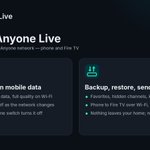
Data saver on mobile data. @AnyoneFDN Live now caps the picture at 480p whenever you’re on mobile data, and goes back to full quality the moment you’re on Wi-Fi. It watches the network change and switches by itself, so a channel you start on the train doesn’t blow through your plan, and the same channel at home plays at the best the connection carries. It’s on by default; one switch in Streaming & playback turns it off.
Backup and Restore. Everything you’ve built up in the app — favorites, hidden channels, the “show restricted” switch, the categories behind your parental PIN, and your own playlists — can be saved to one small file and restored on another phone or after a reinstall. Restoring merges: nothing already on the device is removed. What’s not in the file, on purpose: your account, your PIN, any device id, your watch history. The file doesn’t say whose it is.
Send and receive over Wi-Fi. Typing on a Fire TV remote is nobody’s idea of fun, so you don’t have to. Set everything up on the phone, open “Send my lists to another device”, pick the TV, and type the 4-digit code the TV shows. It travels over your home Wi-Fi only — not through our server, not through the internet — and the TV merges it the same way a restore does.
As always: channels play through the Anyone Network with anonymous passes, so no viewing is ever tied to your account, and the server never learns your favorites or your playlists.
#IPTV
Node- Chad retweeted
The community spoke, and we listened.
Following an investigation into alleged relay operator rule violations, the governance proposal passed with 94.38% voting For and 120% quorum.
The community voted to pause the operator's relay rewards and remove their relays from the Anyone Network.
Full proposal and voting results:
snapshot.box/#/s:daoforanyon…

Node- Chad retweeted
Every time an AI agent touches any chain, it has to talk to an RPC node, and that node sees the IP address behind every single request alongside the wallet making it.
So while everyone obsesses over the pseudonymity of their wallet, the agent running 24/7 is quietly handing a centralised provider a timestamped map of everything it does and exactly where it’s coming from.
Anyone closes that gap at the network layer, masking the IP behind every call so the agent’s origin never meets its onchain identity.
Protecting privacy, for anyone.

Node- Chad retweeted
Ethereum founder @VitalikButerin showed a privacy focused AI agent using Tor, zkAPI and cover traffic.
We built our version with Anyone.
Private AI inference via zkAPI Mainnet. Pi researching the live web through Anyone, with isolated sessions and background cover traffic.
Here it is in action.
Node- Chad retweeted
Trivia is live on @AnyoneFDN Live TV 🧠📺
There's a new tab on your phone and Fire TV. It asks one question: How well do you know Anyone Live?
AnyClip, our little Hexagon host, Runs the show. He reacts to every answer, cheers when you're right and teases you (gently) when you're not.
Pick your level:
🟢 Rookie Channels: buttons, tabs and TV basics
🔵 Stream Captain: how streaming and routes work
🟣 Network Master: settings, privacy and the Anyone network
60 questions in all, 20 per level.
What's inside:
• Built for the remote. Four big answers in a 2×2 grid, and the D-pad goes exactly where you expect. No mouse, no touchscreen needed.
• A 15-second timer for pressure, or turn it off and play relaxed.
• A "Did you know?" fact after every answer. You'll learn how your stream really reaches you: three relays, a hidden service, and no public address.
• Sound effects, with an off switch for late-night games.
• Plays in all 17 app languages.
• It pauses for the screensaver, and your round survives a language switch.
The part we care about most: your best scores stay on your device. No leaderboard, no account profile, no analytics on how you played. A game inside a privacy app should be private too.
We built Trivia for two reasons. It's fun between channels, and the best way to understand what @AnyoneFDN Live protects you from is to play your way through it. By Network Master, you'll know more about anonymous streaming than most people in tech.
Privacy doesn't have to be boring. An app should feel good to use, not just keep you safe. We're building both. More fun is on the way.
@AnyoneFDN #AnyoneLive #Privacy #FireTV
@CryptoWizardd @cz_binance @ZssBecker
Node- Chad retweeted
Live TV, routed through @AnyoneFDN .
I'm watching ESPN 2 America live right from the Anyone app, with my traffic going through $ANYONE onion routing. No guide, no fuss, just tap Watch and go.
Onion routing = your connection is relayed through multiple nodes, so your IP isn't exposed directly.
⚡ Live channels, favorites, and a built-in guide, all in one app.
Privacy and entertainment can go
Together
@AnyoneFDN
Node- Chad retweeted

Encryption protects what you say. But who you speak to, when you speak and where you connect from can still reveal an enormous amount about you.
That is the problem AnonChat is trying to solve.
Powered by the @AnyoneFDN network, AnonChat removes the company sitting between two people. There is no phone number, email, registration or central messaging server. When the app starts, it creates a private .anyone address that becomes your identity.
Your app builds a circuit through multiple Anyone relays to a rendezvous point. Your contact creates a separate circuit from the other side. Messages and voice calls are encrypted end to end, while neither participant needs to expose a direct connection to the other.
Double Ratchet and X3DH provide a new key for every message, while safety-number verification helps detect a potential man-in-the-middle attack. Even voice traffic is transmitted at a steady rate during silence, making it harder to infer when someone is speaking.
And this is not just a basic chat concept.
AnonChat includes private groups, photos, videos, files, voice messages, disappearing messages, replies, reactions and message requests. Its Circuits tab shows every relay carrying your traffic, while the Map displays the complete route across a 3D globe.
It also provides a SOCKS5 proxy, allowing browser traffic to travel through the Anyone network and exit from a country selected by the user.
Everything stored locally contacts, messages, keys and media is encrypted. Access can be protected with a PIN or passphrase, and one button can erase everything.
Free. Open source. No company in the middle.
Windows and Linux are coming first, followed by macOS, with support for ten languages including Italian.
This is why decentralized privacy infrastructure matters. A network becomes valuable when developers can build real products on top of it and users generate real traffic through its relays.
AnonChat turns the Anyone network into something people can actually see, use and understand.
Powered by relay operators around the world including Vitruvio.
@AnyoneFDN $ANYONE
#ANYONE #Privacy #DePIN #OpenSource #AnonChat
🤖 Made with AI

Node- Chad retweeted
Following a recent community report, we uncovered a method of inflating relay consensus weights through artificial bandwidth bursts.
We've introduced a 50k CW cap for relay scoring as an initial response, while working on longer-term improvements to measurement and governance.
What we found, what we've done, and what's next :
medium.com/@anyone-protocol/…

Node- Chad retweeted
Online privacy and safety has never been more important than it is today.
Make sure you do not leave yourself exposed, leave no stone unturned.
Act before it is too late.
Anyone is essential in any online privacy stack.
anyone.io/

Effective Immediately, all organizations using PHP for their systems are advised to be prepared for an update addressing two critical vulnerabilities. PHP is widely used for web applications. These vulnerabilities often provide a direct path to the server's file system or database. If an immediate update is not feasible, it is recommend that organizations take the system offline until it can be fully mitigated. NSA will follow up shortly with more specific guidance.
Node- Chad retweeted
1/ @VitalikButerin @AnyoneFDN @CryptoWizardd
Live TV over an anonymity network. People said it couldn’t be done on Tor, and they were right — not because of cryptography, but because nobody is paid to carry bytes and only ~¼ of Relays will exit. @AnyoneFDN changes the economics. Here’s what that bought, measured.
2/
Anyone Live TV runs every byte through the @AnyoneFDN Network: Phone → 3 Hops → Hidden service → Fetch servers → Broadcaster. Viewers never touch a broadcaster. One circuit per channel. Median time to first picture: 6 s. p90: 12–15 s. Through three hops.
3/
The network today: ~6,000+ relays, 4,036 of them Exits (two thirds; Tor: about a quarter). Top relays measure ~100 MiB/s, bought because it earns. Bandwidth that grows with reward instead of goodwill.
4/
Geo-blocked channels: when a broadcaster refuses our servers, we retry through @AnyoneFDN Exits in that channel’s country, picked from the public Relay map, Fastest first. Result on 70 refused channels: 28% of geo-fenced ones now play. BBC Parliament through a British exit, Galavision through a US one.
5/
What doesn’t work yet, said plainly: Broadcasters that ban hosting IPs ban Anyone exits too — the network’s exits sit on 59 hosting ASNs; residential exits: 2. The app says “Not available in your region” instead of spinning. Fixing it needs residential exits, and that’s a proposal we’ve put to the community.
6/
Everything above is measurable on the public map and reproducible with the app’s own speed lab. That’s the point: An anonymity network can carry live video today, and the remaining gap has a name and a number.
The numbers in it are the ones we can defend if someone checks.
