

Chief Learning Officer for the AI era. Building AI EdTech, advising institutes & companies on AI learning strategy. Notes on Edtech, learning design & startups.
Joined October 2026
- Tweets586
- Following113
- Followers38
- Likes232




Pinned Tweet
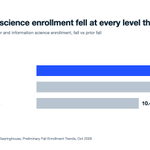
Computer science enrollment at US four-year colleges fell 12.4% this fall.
Purdue now requires AI coursework of every undergraduate, in every major.
Both facts describe the same shift. AI is leaving the computer science department and becoming general education. The universities that see this early are rebuilding their core curriculum around it. The rest are still arguing about detection software.
Four sets of 2026 numbers show how fast it is moving.
1. Students are walking away from the old AI pipeline
The National Student Clearinghouse released preliminary fall data on October 29. Computer and information science enrollment fell 12.4% at four-year colleges, 12.3% at two-year colleges and 10.4% at graduate institutions. Health majors at four-year schools grew 6.2%. Total enrollment held roughly steady, up 0.2%.
The data does not say why. My read is that students watch AI write more of the code and are hedging. They still want AI skills. They are less sure a CS degree is the only way to get them.
2. Purdue made AI a graduation requirement
Beginning with this fall's incoming class, Purdue requires every undergraduate to complete an AI working competency as part of the core curriculum. Within weeks of the trustees' December 2025 decision, a cross-functional team identified, developed and revised 22 courses to satisfy it and updated more than 300 plans of study. Courses run from one to four credit hours.
Purdue frames the requirement around critical thinking, responsible AI use and workforce-ready skills, with tool operation as the smaller part.
The speed is the point. 22 courses and more than 300 plans of study changed in a few months. That is fast for any curriculum process.
3. Indiana built one course for everyone
Indiana University's Kelley School of Business built GenAI 101, a self-paced course with eight modules and 16 lessons. By April 2026, more than 114,000 students, staff and faculty had enrolled. IU then opened it to anyone in the world, free. Kelley says four revised, required IT and AI courses are coming to its undergraduate foundation.
114,000 enrollments in a single course is closer to a platform than a class. It also means IU is running a test most universities have not: whether one shared course can set a floor of AI skill across every major.
4. Cornell put AI into general education
Cornell Bowers announced Everyday AI in October. It is a three-credit course open to every Cornell student, with no technical background required and space for 275 students when it launches in spring 2027. Two weeks later, Arts and Sciences launched a humanities and social sciences AI initiative with five postdoctoral fellows and an AI and Society minor in development.
275 seats is a pilot next to Indiana's 114,000 enrollments. Cornell is betting on depth in a smaller room, and Indiana on reach.
The pattern
Students already learn AI mostly alone. Dartmouth's national survey this fall found 79% of US college students mostly developed their AI skills on their own.
Students are leaving CS. Universities are answering with AI courses for every major, at very different scales: 22 qualifying courses at Purdue, one course with 114,000 enrollments at Indiana, 275 seats at Cornell.
I think general education is the right home for AI literacy, and the hardest part is still ahead. A required course shows that a student completed something. Whether that student can use AI with judgment inside their own field is a separate question, and few universities test it.
The Three-Layer AI Curriculum
Here is how I would build it at any university or graduate school.
Step 1. A shared floor.
One course every student takes in the first year, like Indiana's GenAI 101. Keep it short and practical, and update it every term. It covers prompting, fact-checking AI output and the university's own rules.
Step 2. A discipline layer.
Every major names one required course where AI is used on real disciplinary work, the way Purdue mapped qualifying courses into existing plans of study. Nursing students check AI care plans. History students audit AI sources. The department owns the rubric.
Step 3. A proof layer.
Before graduation, each student completes one assessed piece of work that shows AI use and their own judgment, scored against that rubric. Employers can ask to see it.
For provosts: start with the discipline layer. The floor is easy to buy. The middle layer is where faculty time goes.
For edtech founders: the shared floor is already crowded and often free. The opening is tools that help a department run the discipline layer and score the proof.
For students choosing a major: ask any program which course uses AI on real work in your field, and how it is assessed.
What I'm watching next
1. The Clearinghouse final fall report in January. I expect computer science enrollment at four-year colleges to stay down by more than 10%.
2. At least one more top-50 US research university will announce an AI graduation requirement for all undergraduates before fall 2027.
3. Indiana's next GenAI 101 count. I expect IU to report more than 200,000 enrollments by the end of 2027, now that the course is open to the world.
I'll check each one when the data lands.
Computer science is shrinking while AI education for every major grows. The universities that test judgment inside each discipline will lead that shift.
Sources
National Student Clearinghouse Research Center, Preliminary Fall Enrollment Trends, October 2026
Purdue University, AI competency graduation requirement begins in every undergraduate degree program, August 2026
Indiana University, IU opens its free generative AI course to anyone worldwide, April 2026
Cornell Chronicle and Cornell Bowers, October 2026
Dartmouth, Dartmouth AI Survey 2026, October 2026

75 AI-focused faculty: Rice University's hiring target for this decade, announced Oct 13.
35 already recruited, 40 more to come
Ruler: the 40 new hires would more than double the 35 in place
200+ tenure-track faculty hired since 2021
BS in AI since fall 2025, Master of AI from fall 2027
Ken Kennedy Institute: 140+ faculty across 21 departments
Rice is spending on the slow part, faculty who teach AI inside a discipline. Students should ask which courses those hires will teach.
Source: Rice University, AI initiative announcement, Oct 2026

Agree, and this is where campuses should point AI first. On Monday I argued faculty are spending AI on suspicion instead of feedback. The skill to teach is triage: which AI comments to reject. A writer who accepts every one learned nothing.
nitter.cf/emollick/status/211765…

Microsoft's AI Safety and Privacy Standard for schools, written with the AFT, became available to every US district on November 1.
The headline is no training on student data. I would read clause 9 first: districts control new features, can export their data and can switch providers freely. That makes classroom AI a replaceable supplier. It also bans AI companions.
District CIOs should ask every other AI vendor to sign the same 10 terms this quarter. The fact sheet does not say how many districts have signed on.
Source: Microsoft, AI Safety and Privacy Standard fact sheet, 2026
Detection is a race faculty will keep losing. The faster fix is assignment design: grade the draft history plus a short oral check, and an AI essay stops paying off. What would your course look like with detection off the table?
nitter.cf/SpireJim/status/211717…

Much as AI presents many opportunities in education, it is becoming a nuisance among lazy university students! Unfortunately many teachers haven’t caught up yet with the technology and associated mischief. Much of it passes undetected, with no learning happening. AI essays, AI proposals, AI dissertations, AI drawings, AI diagnoses…
The question elite universities avoid about AI:
If a student can pass your course with a chatbot, what was the course certifying?
Every answer that starts with detection software skips that question.
Inside Higher Ed and Hanover Research published a faculty survey today. Nearly nine in 10 of 1,665 respondents say AI has hurt their confidence that student work is authentic.
67% say it has damaged trust between them and their students. Only 18% say AI has improved their ability to give students timely support.
My read: campuses are spending AI's effect on suspicion and almost none of it on feedback.
Colleges should grade visible process and fund AI for faster feedback before buying another detector.
Source: Inside Higher Ed and Hanover Research, faculty survey, Nov 2026
80% of US employers would prefer a candidate with a college degree, even when the role does not require one.
2,500 hiring decision-makers, opt-in survey, Aug 2026
48% expect AI to make degrees more important within five years
26% expect degrees to matter less
Ruler: 60% of these employers trust higher education vs 38% of all US adults
Information sector: 59% say AI makes degrees more important
Employers are still buying the degree. Universities should prove AI skill inside it before that trust erodes.
Source: Lumina Foundation and Gallup, Employers' Confidence in Higher Education, Oct 2026

Agree, with a twist: redesign usually stalls at the learning step. Once a task changes, someone has to teach people what good output looks like now. Most rollouts fund licenses and skip that. Who owns the new job description?
nitter.cf/kevin__mak/status/2117…

My Sunday night musing about AI:
The majority of companies aren't seeing productivity gains from AI because the predominant use case of AI is to speed up existing human tasks, not to redesign how work gets done.
Using AI isn't going to magically increase large-organization revenues by 10%. The gate on that isn't "my employees aren't doing enough." Revenue gains come from a combination of ideas, implementation and iteration. Much of that takes time, because the humans on the other side (the consumers) have to react and change their decisions. The revenue will come, but it lags.
No, the vast majority of near-term productivity gains come from making your employees more efficient at their existing jobs. At least initially, those gains go to the employees, who spend less time working because AI is making their job easier.
That's why it doesn't show up in the data. Productivity is output per paid hour. If an employee finishes in 6 hours what used to take 8 and takes the other 2 as slack, paid hours don't fall and output doesn't rise. Measured productivity stays flat. The gain is real, but the worker captures it, not the firm.
It also doesn't add up neatly. Saving 60 minutes a day for six people doesn't free up a seventh person.
Over time, companies will reduce headcount and get the same amount of work done by fewer people. That process takes time because AI is currently pretty good at tasks but not great at entire jobs or workflows. (That’s what the next $500b of training is supposed to solve!)
Laying people off due to AI efficiency is also not a good signal right now. So unless you're Microsoft, the likely mechanism is to stop or slow backfilling attrition. Typical white-collar attrition runs 10-15% a year. Leave a quarter of those seats empty and headcount falls a few percent a year with no layoffs.
This may only be the first wave. In his 1990 paper "The Dynamo and the Computer," economist Paul David showed that the first electrified factories simply swapped the steam engine for an electric one and kept everything else the same, and productivity barely moved. The big gains came only when factories were redesigned around electricity, with a motor on each machine. That took decades, because it meant rebuilding factories and power grids. AI won't take that long, since it runs on infrastructure that already exists. But the order will be the same: the efficiency gains come first, and the workflow redesign gains come later and are bigger.
Concluding "AI doesn't increase productivity" from "the data doesn't show productivity gains" is being overly reliant on trailing, imperfect indicators instead of looking at what's fundamentally happening at the worker level.
It's also early. Most companies have only been using AI in earnest for the last 6-12 months, and what they spend on AI models is still a rounding error next to what they spend on people. A tool that costs a fraction of a percent of your overhead, adopted a year ago, isn't going to show up in the national productivity numbers yet.
If I'm right, here's what to watch over the next 2-3 years:
1) Revenue per employee rising at companies with flat or shrinking headcount.
2) Entry-level hiring slowing in the roles most exposed to AI.
It’s crazy because the entire industry is moving so fast, but it’s worth remembering there’s still “real-world bottlenecks” (people, organizations, customers) that don’t behave as nicely as scaling laws.
Demand for basic AI skills in job postings peaked in January 2026, then fell 25%.
Demand for hands-on AI building skills rose 51% over roughly the same stretch.
The prompting course many companies rolled out last year is already losing market value. The skill employers now want takes longer to teach, and companies are asking for less of the people who would teach it.
I read four sets of 2026 workforce numbers this month. Together they describe a skills gap that has moved inside the company.
1. The skill target moved within a year
Workday analyzed skills data on job requisitions at more than 550 employers that use its recruiting software. Demand for basic AI skills, like simple prompting, rose through late 2025, peaked in January 2026 and then fell 25%.
Demand for hands-on skills, like building AI tools, automating workflows and AI engineering, climbed 51% between September 2025 and July 2026.
My read: AI literacy as most companies defined it a year ago is becoming a baseline. Nobody pays a premium for a baseline. The premium has moved to people who can redesign a workflow and build the automation themselves.
That is a much harder thing to teach in a webinar.
2. Employees know the target and get little help
In a September 2026 Workday survey of 6,000 full-time employees, 79% said they know what skills they need to succeed. Only 66% said their employer actually helps them develop those skills. Workday calls it a 13-point gap.
ZipRecruiter's 2026 AI Worker Report points the same way. 62.8% of US workers get some AI training from their employer. Only 28.9% get extensive training. 37.2% learn AI entirely on their own.
So most workers can name the skill. Fewer than a third get serious help building it.
3. Companies are asking for less of the people who teach
This is the number I keep coming back to. In the same job requisition data, mentions of training skills fell 13% between September 2025 and July 2026. Management and leadership skills fell 7%.
At the same time, internal moves to new roles fell at 57% of employers year over year, and promotion rates stayed essentially flat.
Put those together. Companies want builders, they ask new hires for fewer training skills, and the internal ladder that used to carry people into new roles is stalling.
Workday also found the median number of applicants per filled job climbed to 69, up from 58 a year earlier. When the inside path narrows, people try the outside one, and the queue gets longer.
4. The learning function has no mandate
edX Enterprise surveyed 507 L&D and workforce leaders at firms with 500 or more employees. 83% call AI skills a workforce priority. Only 29% say their company has mature AI capabilities. 78% lack a strong mandate to lead AI upskilling.
PwC's 2026 survey of 49,364 workers adds the employee side. The share who say they can access the learning and development resources they need fell from 59% in 2025 to 51%.
The priority is high, and both the mandate and the resources lag behind it.
The pattern
The skill target is moving up, from using AI to building with it. Employees can see the target. The help they get is thin and often self-taught, and the roles that teach and manage are in lower demand. The internal ladder that should carry people up is flat.
I think the most expensive mistake a company can make right now is treating AI upskilling as a content purchase. A library of prompting courses trains for the skill whose demand fell 25%. The skill whose demand rose 51% is learned by doing real work, with someone who has done it reviewing yours.
That requires managers who teach, and internal moves that reward the new skill. Both are heading the wrong way in this data.
The Builder Ladder
Here is how I would run AI upskilling for the next two quarters, in a company or a university career office.
Step 1. Retire the baseline course.
Make basic AI use a short onboarding item and stop counting it as upskilling. Move the budget to the next rung.
Step 2. Give every team one build.
Each team picks one workflow it runs every week and rebuilds it with AI, with a named person accountable. The output is a working automation the team actually uses, plus a short write-up of what changed and what broke.
Step 3. Make the build count for a move.
Tie completed builds to internal mobility. A person who rebuilt a workflow gets first look at the next role that needs that skill. Track internal moves as the outcome, next to cost per person.
For CLOs: put the 25% and the 51% on one slide. Then ask for a mandate in writing, since 78% of your peers lack a strong one.
For edtech founders: the opening is guided builds with expert review. Prompting content is the shelf that is emptying fastest.
For universities: a degree that ends with one real automation, built and reviewed, answers what these employers are now asking for.
What I'm watching next
1. Workday's next Global Workforce Report. I predict demand for hands-on AI building skills keeps rising, and basic AI skill demand stays below its January 2026 peak.
2. ZipRecruiter's next AI Worker Report. I expect the share of workers getting extensive AI training to stay below 40%.
3. Internal mobility. I expect Workday's next report to show internal moves falling at more than half of employers again.
If any of these miss, I'll say so here.
AI made the first rung of skill cheap. The companies that rebuild the ladder above it will keep their best people.
Sources
Workday, Global Workforce Report, October 2026
ZipRecruiter, The 2026 AI Worker Report, October 2026
edX Enterprise and NewtonX, State of Enterprise Learning 2026, October 2026
PwC, 2026 Global Workforce Hopes and Fears Survey, September 2026

I see three kinds of AI edtech startups:
1. Content with a chatbot on top
2. Practice engines that know what you got wrong
3. Proof products a school or employer will trust
The first is a feature that a model update can erase. Investors should spend diligence on the third.
88% of employees say they will need major upskilling in the next five years. Only 36% feel properly trained.
11,749 respondents in 14 markets
Both shares unchanged from 2025
Ruler: a 52 point gap between need and training
74% of frontline employees now use AI regularly, up 23 points from 2025
72% say skill expectations for their role have shifted
Adoption climbed and training stood still. CLOs should move budget from more licenses to practice on the redesigned work.
Source: BCG, AI at Work 2026, Jun 2026

Agree, and I would draw the line at the references. Every citation has to exist and say what the paper claims. Make authors certify that line by line and a reviewer can check it in minutes. Fluent prose was never the evidence.
nitter.cf/SharifiZarchi/status/2…

Submitting AI-generated manuscripts to peer-reviewed journals without responsible review by the authors must be considered "Scientific Misconduct".
I just reviewed a manuscript for a major Springer-Nature journal and was so frustrated that I recommended that the editor reject it immediately and blacklist all 20 authors, including some professors at top universities and institutions of a specific country. The manuscript was AI-generated, full of errors, and evidently none of the authors were responsible enough to carefully review it.
At first glance, it looked great: impressive figures, plenty of mathematical formulas, and a nice structure. On closer reading, it was a word salad, full of hallucinations and errors.
Proper use of AI in research can accelerate scientific discovery, but the scientific community needs stricter rules and meaningful penalties for its misuse. Peer review is unpaid, voluntary work. Without consequences, authors can feed reviewers’ comments back into AI, improve the presentation, and submit elsewhere. Eventually, a baseless paper may look convincing enough to pass review and get published. The authors benefit; while editors, reviewers, and readers pay the price.
I noticed several patterns that editorial systems could check for:
🔹 Extremely imbalanced presentation of the methods: critical parts were missing, while meaningless technical points (e.g. default value of the random seed) were described.
🔹 Long, artificial phrases, such as: “The results were checked using system_08_250.04@v_ai_231_v2 model.”
🔹 Repeated paragraph with 90% of its words identical.
🔹 Sentences packed with numerical values that were easy for AI to generate but hard for humans to read and understand.
🔹 Impressive figures displaying data in so many dimensions that a reviewer might hesitate even to criticize them. On closer inspection, they were meaningless. This is the trickiest part in my opinion.
Journals should catch these obvious problems during editorial screening and stop such manuscripts before they reach reviewers. Further, they should impose significant penalties for cases like this.

One session, one essay task, a few dozen students. That is thin ground for the brain rot headlines this study keeps feeding.
The question for schools is simpler: who writes the first draft. Keep that human, then let the AI argue with it.
nitter.cf/Rainmaker1973/status/2…

An MIT Media Lab study used EEG to track what happens in the brain when people write with ChatGPT rather than on their own. Fifty four students completed essay tasks while wearing electrode caps. One group used ChatGPT, one used a search engine, and one used no tools. Across sessions, the ChatGPT group showed the weakest neural connectivity in networks linked to memory, attention, and analytical work. They also had more trouble recalling what they had just written and produced more generic prose. The authors describe this as a kind of cognitive debt: the tool does the synthesizing, and the brain stays quieter [1].
The same experiment points to a better order of use. Students who first wrote unaided and only later switched to ChatGPT showed stronger recall and more widespread brain activity than students who started with the model and then had to work alone. In other words, the model helped more when it scaffolded thinking that was already underway than when it replaced that thinking from the start. The practical lesson is not that large language models should be banned. It is that they work best as a second pass, after the writer has already done the hard part of forming and remembering an argument [1].
[Kosmyna, N., Hauptmann, E., Yuan, Y. T., Situ, J., Liao, X. H., Beresnitzky, A. V., Braunstein, I., & Maes, P. (2025). Your Brain on ChatGPT: Accumulation of Cognitive Debt when Using an AI Assistant for Essay Writing Task. arXiv. DOI: 10.48550/arXiv.2506.08872]

Every AI tutor demo shows the same moment: the student gets unstuck in seconds.
Nobody shows the moment a week later, when the student has to do it alone.
That second moment is the product. The first one is marketing.
80% of US employers would still prefer to hire someone with a college degree.
Only 38% of US adults say they have confidence in higher education.
That gap is the asset elite universities are protecting this fall. Employers still trust the degree. AI is the test of whether that trust holds.
In October three universities made concrete AI moves, and Gallup and Lumina published what employers think. Read together, they show what a serious campus AI plan looks like in 2026.
1. Employers still buy the degree
Lumina Foundation and Gallup surveyed 2,500 US employers who make hiring decisions, in August. It was an opt-in online survey, so read it as a strong signal and stop short of treating it as a census.
48% expect AI to make college degrees more important over the next five years. 26% expect degrees to matter less.
80% prefer a candidate with a degree even when the role does not require one. 60% of these employers have a great deal or quite a lot of confidence in higher education. Among all US adults, Gallup puts that figure at 38%.
My read: hiring managers are the most loyal customers higher education has left. Their loyalty rests on an assumption that a degree still certifies thinking, and AI puts that assumption under pressure every term.
2. Princeton puts training in front of access
On October 28, Princeton's provost announced a pilot of Princeton ChatGPT. Faculty and staff could request access that day, with ChatGPT Plus and Pro licenses at a fraction of market rates. The agreement bars OpenAI from training its models on content from University users.
Students come later. They can request access in January, and only after completing a training module on AI use built by the University. Faculty and departments still decide what students may do with it.
The memo says the January start gives faculty time to consider how campus-wide licenses may affect their teaching. The whole pilot gets evaluated after one year.
That sequence is the part I would copy. Faculty first, then a required module, then student access, then a formal review. Most campuses did it the other way around, with access first and training as an optional extra.
3. Rice hires the people
On October 13, Rice University announced it is recruiting AI-focused faculty to reach 75 hires this decade. 35 are already in place. 40 more are coming, so the AI faculty would more than double.
Rice has offered a Bachelor of Science in AI since fall 2025. A Master of Artificial Intelligence starts in fall 2027. Its Ken Kennedy Institute already brings together more than 140 faculty across 21 departments.
Licenses can be bought in a semester. Faculty who can teach AI inside a discipline take years to hire. Rice is spending on the slow part.
4. Indiana defines what every graduate should know
On October 14, Indiana University launched a faculty group to define the minimum AI literacy expected of every student, and the human capabilities an IU education must still build.
About 50 faculty from several campuses will work in a seven-week sprint. Draft recommendations go to leadership this fall, with a final framework and implementation plan in the spring.
The question they set themselves is the right one: what should every IU graduate know and be able to do in a world where AI is a routine part of learning and work?
The pattern
Each university is working on a different layer. Princeton is controlling access and attaching training to it. Rice is building faculty capacity. Indiana is writing the definition of AI literacy for every graduate.
Employers are the reason these layers matter. They are still paying a premium for the degree. A university that cannot say what its graduates can do with AI, and prove it, is spending that trust down.
The Degree Proof Stack
Here is how I would run this at any university or graduate school this academic year.
Step 1. Define the floor.
Have faculty write a one-page AI literacy floor for every graduate, the way Indiana is doing. Keep it short enough that every department can map its courses to it.
Step 2. Gate access with teaching.
Tie student access to campus AI tools to a short required module, as Princeton is doing. Update the module each term with real cases from your own courses.
Step 3. Make it visible to employers.
Before graduation, each student completes one assessed piece of work that shows AI use and their own judgment, with the rubric attached. That is the evidence behind the 80% preference.
For provosts: the order matters. Definition and teaching first, then access.
For edtech founders: universities will buy tools that fit a training gate and produce assessed work samples. A plain chat window solves the access step that campuses can already buy cheaply.
For employers: ask graduates for that work sample. Your preference for degrees will push universities faster than any memo.
What I'm watching next
1. Princeton's one-year evaluation. I predict Princeton keeps campus-wide ChatGPT licenses after the pilot, with the student training requirement still in place.
2. At least one more Ivy League university will tie student access to a campus AI license to a required training module before fall 2027.
3. Lumina and Gallup's next employer study. I expect the share saying AI will make degrees more important to stay at 45% or higher.
I'll check each one when the evidence lands.
Employers are still betting on the degree. The universities that keep that bet will be the ones that can show what their graduates do with AI.
Sources
Lumina Foundation and Gallup, Employers' Confidence in Higher Education Undaunted by AI, October 2026
Princeton University Office of the Provost, Announcing Princeton ChatGPT pilot, October 2026
Rice University, Rice launches transformational AI initiative, October 2026
Indiana University, IU launches faculty-led effort to define what students should learn to thrive with AI, October 2026

42% of frontline employees who use AI regularly now save a full workday every week.
66% of them get limited or no guidance on what to do with it.
That gap is where most corporate AI value disappears. The tool works. The organization has no plan for the time it frees.
This month I went back through BCG's 2026 AI at Work survey of 11,749 people in 14 markets, and through Corum's latest count of edtech deals. Together they describe a learning problem that sits inside every AI rollout.
1. The saved day leaks out
Among frontline employees who use AI regularly, 42% report saving at least eight hours a week. For leaders, the share is 60%.
Guidance runs the other way. 66% of frontline users say their organization gives limited or no guidance on how to use the time saved. Among leaders, 52% say the same.
The result is predictable. 58% of frontline users say they do not reinvest the saved time into more strategic work.
These are self-reported hours, so I hold the size loosely. The direction is clear enough. The people closest to the work save time, and nobody tells them what it is for.
My read: a saved day with no plan becomes slack, or more of the same work. Neither builds capability.
2. Use took off and training stood still
74% of frontline employees are now regular AI users. In 2025 the figure was 51%, so that is a jump of 23 points in a year.
Training did not move at all. 88% of respondents believe they will need major upskilling in the next five years. Only 36% feel properly trained. BCG notes that both shares are unchanged from 2025.
That is a 52 point gap between what people expect to need and what they have received.
72% also say the skill expectations for their role have shifted. 52% spend more time reviewing and correcting AI output.
So the job changed, and the training budget behaved as if it had not. Reviewing AI output is a skill. Somebody has to teach what good looks like.
3. Clarity beats tools
This is the number I would put in front of every executive team.
Among regular AI users, 60% of those with strong access to tools but limited strategic clarity report measurable business impact. With strong strategic clarity and limited tools, the share rises to 80%. With both, it reaches 83%.
Clarity added 25 points. Tools on top of clarity added three.
BCG also splits companies by how they use AI. At firms that only deploy tools, 47% of employees experienced a major reskilling initiative. At firms that redesign workflows or build new products with AI, it was 65%.
My read: the companies getting value treat AI as a reason to redesign work and retrain people around it. A license with no direction comes last in this comparison.
4. The market is buying workforce training
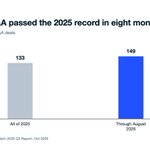
The business side points the same way. Corum counted 149 edtech M&A deals through August 2026, already past the ten-year record of 133 set across all of 2025.
Workforce training was the second most targeted subsector with 36 deals, behind online education at 44. One compliance training company, Training360, made repeated purchases this year, including an acquisition that added 305 courses.
Only 9% of deals disclosed a price, so the money is hard to read. Deal count is easier. Buyers are assembling workforce training portfolios at a record pace.
For an L&D leader, that means more vendors folding into larger catalogs. Content will get easier to buy. Deciding what people should practice will stay your job.
The pattern
Put the four together. AI frees real time for frontline staff. Most organizations give no direction for that time. Training has been flat for a year while the work changed. The companies with clear direction report far more impact than the companies with more tools.
I think the scarce resource in corporate AI is now a plan for the saved hours. The license budget was the easy part.
The Saved-Day Ledger
Here is how I would run it for one quarter, in a company or a school system.
Step 1. Measure the day.
Ask each team to log weekly hours saved with AI for four weeks. Treat the numbers as rough, since they are self-reported. You only need a baseline per team.
Step 2. Assign the day before it arrives.
Pre-commit a share of the saved time, half is a reasonable start, to deliberate practice on the redesigned work. Reviewing AI output, handling the hard cases AI escalates, coaching a junior colleague. Write the plan down at team level.
Step 3. Prove the day.
At quarter end, test the skill the practice was meant to build, on a fresh task. Compare teams that followed the ledger with teams that did not. Report capability gained next to hours saved.
For CLOs: put the 88% and the 36% on one slide. Then ask for budget to close that gap with practice on real work.
For edtech founders: a product that turns saved time into structured practice has a clear buyer. Most organizations have nothing in that slot today.
For managers: you own the saved day. If you do not assign it, the work will absorb it.
What I'm watching next
1. BCG's next AI at Work edition. I predict the share of employees who feel properly trained stays below 50%.
2. The same survey's guidance question. I expect more than half of frontline users to still report limited or no guidance on saved time.
3. Corum's full-year 2026 count. I predict edtech M&A finishes above 180 deals, with workforce training still among the top two subsectors.
If any of these miss, I'll say so here.
AI already gave many of your people a day a week. The question is whether anyone decided what that day should teach them.
Sources
BCG, AI at Work 2026: Strategy Matters More Than Tools, June 2026
Corum Group, EdTech 2026 Q3 Report, October 2026

93% of academics in a UNESCO survey believe students use generative AI to produce assignments.
63% see a decline in students' cognitive capacities
Under 1% favor a complete ban
Ruler: 2% favor unrestricted use, so about 97% want something in between
Two-thirds would value AI guidelines from their professional society
Respondents come from UNESCO's global network of university chairs
Faculty have settled on the middle ground. The next job is assignment-level AI rules, and each discipline should write its own.
Source: UNESCO, Second annual survey on AI in higher education, Sep 2026

149 edtech M&A deals through August 2026, already past the ten-year record of 133 set in all of 2025.
Private equity: 29% of deals
Only 9% disclosed a price, $0.9B in total
Most targeted: online education with 44 deals, workforce training with 36
Largest deal: Qoria, $682M at 9.2x revenue
33% of deals crossed borders
Ruler: 149 deals in eight months vs 133 in twelve
Edtech is consolidating and most buyers hide the price. Founders should know which acquirer's portfolio their product completes.
Source: Corum Group, EdTech 2026 Q3 Report, Oct 2026

About $3.6B: three employer AI training commitments HolonIQ tracked this quarter, from Microsoft, AWS and Caterpillar.
AI and data: 12% of higher-ed partnerships in 2026
Ruler: up from 2.1% in 2021, nearly 6x
AI-native firms now outnumber the online-program partners of the last decade
About four in ten AI initiatives tracked were training programs
HolonIQ reads the employer money as companies going around universities for skills. Universities should build AI courses with employers. Founders should sell into the training layer.
Source: HolonIQ, AI in Education this Quarter, Oct 2026