







O(e^n) 🇮🇹 retweeted

An internal Claude model just found a proof of the algebraic analogue of P vs NP, known as Valiant’s conjecture
Claude is credited as the author of the 70-page paper and the Lean proof passed automated checks.
If you remember the determinant of a 2×2 matrix, it’s ad − bc. Change it to ad + bc and you get the “permanent.” The same idea works for larger matrices. Both expressions grow to billions of terms by the time you reach a 13×13 matrix, yet the determinant has a shortcut that lets you skip writing them all out.›
Could there be a shortcut like that for the permanent? The paper claims that over the real numbers, even the best possible sequence of additions and multiplications eventually takes more steps than any fixed polynomial in the matrix size.
Read here: alphaxiv.org/abs/2611.vp-vnp…

O(e^n) 🇮🇹 retweeted

Yes. We are working on UI SDK for @angular. It will be here soon.
github.com/vercel-labs/ui


O(e^n) 🇮🇹 retweeted

Node.js got faster in May 🧵
This month was about the web platform: Web Crypto and QUIC (the protocol behind HTTP/3) 🔒
Plus faster colored terminal output for CLIs 🔴🟢🔵
All of it ships in Node.js 26.3.0+ and 24.19.0+


The trade-off: it's a fully static Next.js export on GitHub Pages, no server.
So every source is optional: if GitHub, npm or nodejs/node fail during a sync, the last good data is kept. A network hiccup never breaks the build.
2
1
43
Also on the site: Marmotta, napi-go, node-api-stub, quickjs-build and quickjs-napi, with docs, releases and activity, plus the bindings, runtimes and talks of the Node-API ecosystem.
napi-bindings.dev/

36
O(e^n) 🇮🇹 retweeted

Humanity’s most important math problem, the Riemann hypothesis, has just been solved. Mathematician @__alpoge__ used AI to prove it is true, 167 years after Bernhard Riemann posed it in 1859.
I’ve known about the Riemann hypothesis since I was a kid. Five years ago, I wouldn’t have expected to see it solved in my lifetime.
The hypothesis is a statement about the Riemann zeta function, which takes a complex number as input and gives a complex number as output. Riemann was interested in which inputs give an output of zero. The negative even numbers, -2, -4, and so forth, always give an output of zero. Riemann predicted that if you plot all the other zeros of the zeta function, every single one lies on the same vertical line, exactly halfway between 0 and 1.
Miraculously, the positions of those zeros tell us how the prime numbers are distributed. Assuming the Riemann hypothesis is true, you get a very accurate bound on how many prime numbers there are below a given number.
Thus, mathematicians working in analytic number theory have asked for decades what they could prove if they assumed Riemann was right. Many analytic number theory papers start with the words “assuming the (generalized) Riemann hypothesis,” and you can find pages of mathematics that depend on this assumption. Now we know this assumption was right.
AI’s capabilities have accelerated very rapidly in mathematics, where frontier models have gone from the level of an average high schooler to the level of a superhuman researcher within three years. Speculating about the future, I expect similar capability advances to be coming in other fields very soon.


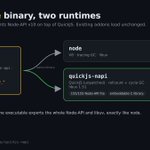
The hard part: V8 has a tracing GC, QuickJS uses refcounting. Addons assume objects live “until the next GC”.
Fix, with no engine patch:
• weak callbacks via a WeakMap of holder objects
• a kept-objects list cleared per macrotask
• finalizers queued on the loop

1
3
Also usable as a C library to embed Node-API in any QuickJS app. 13 release targets, ASan/TSan in CI.
Repo, architecture docs and the full list of differences from Node.js:
github.com/napi-bindings/qui…
If you ship native addons, RT and try yours on it.

5
O(e^n) 🇮🇹 retweeted

Crazy...this is Kubernetes moment for AI Agents.
Run millions of agents on Kubernetes. Idle agents go to sleep and wake up in under 500ms. 10x more agents on the same hardware.
100% Opensource.
github.com/agent-substrate/s…
