

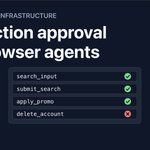







1/ OpenAI added computer use to its Agents API on Sep 29. The agent works in an OpenAI-hosted browser, and the developer’s app handles website access approvals and sign-in.
So the unit of approval is a site. I think that is too coarse for anything with a checkout, an account page or a delete button. Approving the site approves all of it.
2/ What I’d want instead is a list of the page’s actions before the agent acts. Each button, form and input gets an id, a type and a required flag. Manifest API returns exactly that as JSON.
Then the rule can be specific: allow search_input and submit_search, deny delete_account. The decision is made against the list, and the list can be logged.
I wrote up how this works, including where it falls short: omfang.io/blog/approve-actio…

55
WordPress.com’s Oct 2 changelog: its plugin works in Cursor’s marketplace, Grok Bot can connect to sites, and the WordPress Agent can install, activate and update plugins. There is also an MCP server doc for connecting agents to a site.
It makes sense for a platform. One team controls every site, so it can build the agent interface once and handle authorization and logs centrally.
Most sites aren’t hosted on a platform like that. A custom storefront or a booking page has buttons and forms, and an agent has to work out the actions from the rendered page. That is the gap I’m working on at omfang: Manifest API generates a structured JSON manifest of the actions a page offers.
wordpress.com/blog/2026/10/0…

28
Salt Labs published an attack on the Manus agent. One email with JSFuck-obfuscated JavaScript, then the user asks the agent to check their inbox. The agent decodes it with Node.js and runs it. Salt says the guardrail flagged it only after execution, and the attacker got a reverse shell and OAuth tokens.
The detail I keep returning to is the timing. A check on the prompt or content runs before the action, and an encoding can get past it. A check on what the agent is allowed to do doesn't depend on recognizing the payload.
For agents acting on web pages, that argues for a fixed set of named actions with typed inputs, so page text is data and never a command. It is the design reason behind Manifest API.
salt.security/blog/how-we-hi…

2
26
OpenAI added computer use to the Agents API at DevDay on Sept 29. The agent runs in a hosted browser, and the user approves each new site origin.
What caught my attention: the guide says origin approval does not enforce confirmation before individual actions. If the agent can buy something, you add a function tool yourself to get a guaranteed confirmation.
That follows from how the agent sees the page. It gets screenshots and issues clicks and keystrokes. There is no list of what the page can do, so the runtime can't tell search from delete. The only unit it can gate is the site.
With a manifest of a page's actions, each with a name and typed inputs, you can gate per action. That is what I'm building at omfang with Manifest API.
developers.openai.com/api/do…

18
last nudge this month: free key, 5 minutes, and you'll know immediately if this changes anything for what you're building. app.manifest.omfang.io/login
6
quickstart is genuinely 3 requests: health check, POST /manifest with a url, pull one action by id. docs: omfang.io/manifest-docs. would genuinely love feedback if anything's unclear.
8
the web really wasn't built for agents. broken a11y trees on most sites, client-side rendering that makes state unpredictable, anti-bot that flags a well-behaved agent the same as an attacker. that gap is the whole company, honestly.
6
typed errors matter more than people think for agent code specifically — an agent that catches a generic exception can't tell "bad key" from "rate limited" from "server's down," and ends up retrying the wrong one forever.
5
4 lines of code, roughly:
const m = await client.get(url)
m.actions
m.navigation
m.action("id")
that's genuinely the whole integration. js + python sdks both live.
7
I kept watching agents fail on the exact same button, differently, every time. sometimes a broken selector. sometimes a screenshot agent missing by 6 pixels. sometimes just... freezing, no error, because nothing told it what was clickable. that's not an agent problem. that's a "the web wasn't built for this reader" problem.
5
if you signed up for the free tier and it's just been sitting there — 50 calls is genuinely enough to wire up a real prototype against 5-10 pages. go actually try it this week.
6
Spent today chasing a bug where our agent API kept timing out on big pages like LinkedIn's feed – turned out we were sending every element on the page to the LLM, relevant or not. Shipped a fix: add the agents goal to the api call, it filters first. 155s → ~9s on the worst case I tested. manifest-api 0.7.0 is live on PyPI 🚀
16
full pricing table, because I'd rather overshare than have anyone find out mid-integration:
free $0 / 50 calls
starter $29 / 1k calls, $0.08 over
pro $79 / 5k calls, $0.05 over
enterprise: email me
9
where this is going long-term: a tiny JS snippet site owners can drop in, like an analytics tag, so they can hand-annotate their own semantic layer instead of us inferring it. llms.txt but it's alive.
1
17
get asked "how's this different from firecrawl" a lot. firecrawl tells you what's on the page. we tell you what you can do with it. genuinely different problem, most people conflate them until they hit the wall.
6
the honest competitive landscape as I see it: browserbase/playwright mcp = session layer, no semantic layer. firecrawl/jina = semantic-ish, but for reading not doing. nobody's really doing both yet. that's the bet.
22
not trying to solve "understand the entire internet" on day one. trying to solve "this agent needs these 15 sites to work every single time." much more tractable problem, and the one people actually have right now.
10
css locators are a fallback, not the plan. role + name first, always — they're the difference between "this survives a redesign" and "this breaks next sprint."
1
14
pricing, since people keep asking in DMs: free is $0/50 calls, starter's $29 for 1k, pro's $79 for 5k. cache hits are free against the limit either way. start free: app.manifest.omfang.io/login
7