

NBP is a growth consulting firm headquartered in Singapore with regional presence in India, Africa, Türkiye. NBP is 100% focused on the nuclear energy sector.
Asia, Africa, India, Türkiye
Joined July 2015
- Tweets8.7K
- Following620
- Followers3.2K
- Likes12.9K






The Philippines is targeting first nuclear power by 2032: 1,200 MW, scaling to 4,800 MW by 2040. #PhilATOM is now the independent regulator, and #Bataan is still the most debated site.
More on the region’s plans in Hanoi next week.
#Philippines #Nuclear #ANBP2026

The most common mistake we see from suppliers entering emerging nuclear markets: pitching a product before the owner-operator has a procurement framework.
Map the decision-makers, the regulator and the local partners first. The tenders come later.
#Nuclear #MarketEntry #NBP


India’s SHANTI Act has opened civil nuclear to private and foreign players. DAE issued draft rules in August; Adani set up two nuclear subsidiaries in May.
For suppliers, the question is no longer if India opens up, but who they partner with.
#IndiaNuclear #SHANTIAct #NBP
🤖 Made with AI


𝗩𝗶𝗲𝘁𝗻𝗮𝗺'𝘀 𝗻𝘂𝗰𝗹𝗲𝗮𝗿 𝗽𝗹𝗮𝗻 𝗶𝘀 𝗯𝗶𝗴𝗴𝗲𝗿 𝘁𝗵𝗮𝗻 𝗶𝘁𝘀 𝗳𝗶𝗿𝘀𝘁 𝘁𝘄𝗼 𝗽𝗿𝗼𝗷𝗲𝗰𝘁𝘀. 🇻🇳
Most of the attention is on the four large units now in investment preparation. But Vietnam's national planning has identified far more room than that.
▪️ 𝟴 𝗻𝘂𝗰𝗹𝗲𝗮𝗿 𝘀𝗶𝘁𝗲𝘀 along the central coast, identified under the Prime Minister's Decision 906/QĐ-TTg
▪️ 𝗘𝗮𝗰𝗵 𝗮𝗯𝗹𝗲 𝘁𝗼 𝗵𝗼𝘀𝘁 𝟰–𝟲 𝗿𝗲𝗮𝗰𝘁𝗼𝗿 𝘂𝗻𝗶𝘁𝘀
▪️ 𝟰.𝟬–𝟲.𝟰 𝗚𝗪 𝗼𝗳 𝗻𝘂𝗰𝗹𝗲𝗮𝗿 𝗯𝘆 𝟮𝟬𝟯𝟱 under the adjusted national power development plan (PDP8)
▪️ 𝟭𝟬.𝟱–𝟭𝟰 𝗚𝗪 𝗯𝘆 𝟮𝟬𝟱𝟬, alongside a separate target of 10–15 SMRs
Behind these numbers is a growing economy. Vietnam's planning assumes GDP growth of around 10% a year to 2030, with new demand from data centres, semiconductor manufacturing and electrified transport, and a net zero commitment for 2050. Firm, low-carbon power has to come from somewhere.
For technology vendors, EPC contractors and the supply chain, this is the difference between a one-off tender and a long-term market. The partners who build credibility on the first projects will be best placed for the sites that follow.
VINATOM presented the siting plan and capacity targets at our webinar on 22 October. The people behind them will be in the room at the 11th 𝗔𝘀𝗶𝗮 𝗡𝘂𝗰𝗹𝗲𝗮𝗿 𝗕𝘂𝘀𝗶𝗻𝗲𝘀𝘀 𝗣𝗹𝗮𝘁𝗳𝗼𝗿𝗺 (𝗔𝗡𝗕𝗣 𝟮𝟬𝟮𝟲), hosted by VINATOM, on 𝟮𝟰–𝟮𝟲 𝗡𝗼𝘃𝗲𝗺𝗯𝗲𝗿 𝟮𝟬𝟮𝟲 𝗮𝘁 𝘁𝗵𝗲 𝗣𝘂𝗹𝗹𝗺𝗮𝗻 𝗛𝗮𝗻𝗼𝗶, alongside EVN, Petrovietnam, VARANS, ERAV and regulators and agencies from across ASEAN.
#NBP #ANBP #ASEAN #ANBP2026 #Vietnam #NuclearEnergy #NuclearPower #ASEANNuclear #EnergyTransition #VINATOM

2
5
245
📥 ANBP 2026 Brochure and programme: lnkd.in/gpBWgtHD
70
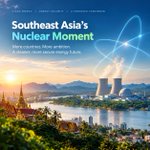
Southeast Asia's nuclear moment has arrived. But who will lead the way?
🇻🇳 Vietnam is moving forward.
🇵🇭 The Philippines is exploring its options.
🇮🇩 Indonesia is advancing its nuclear ambitions.
🇲🇾 Malaysia and 🇹🇭 Thailand are also looking at nuclear power.
With rising electricity demand, energy security concerns and decarbonisation targets, nuclear is firmly back on the ASEAN agenda.
But who will build it? Which technologies will win? And which country will be first?
Is Southeast Asia on the verge of a nuclear breakthrough?
#NuclearEnergy #ASEAN #EnergySecurity
🤖 Made with AI

🌏 𝐒𝐨𝐮𝐭𝐡𝐞𝐚𝐬𝐭 𝐀𝐬𝐢𝐚'𝐬 𝐠𝐞𝐨𝐠𝐫𝐚𝐩𝐡𝐲 𝐝𝐢𝐜𝐭𝐚𝐭𝐞𝐬 𝐢𝐭𝐬 𝐞𝐧𝐞𝐫𝐠𝐲 𝐞𝐜𝐨𝐧𝐨𝐦𝐢𝐜𝐬. 🇮🇩 Indonesia alone has more than 17,000 islands, and much of its industrial growth sits on isolated grids running on imported diesel.
That diesel dependency is the entry point for a business model that has nothing to do with reactor technology. It is a power purchase agreement.
The model: a floating nuclear plant, owned and operated by the vendor. The customer never owns, licenses, fuels or decommissions it, and just pays for delivered electricity. It needs a berth and a contract, not a nuclear regulator and workforce.
It is already commercial. In October 2026, 🇷🇺 Rosatom signed an agreement with PT Pembangkit Listrik Nuklir for two floating units (𝟐𝟎𝟎 𝐌𝐖) to supply northern Halmahera in 🇮🇩 Indonesia, structured business-to-business with no reliance on the state budget.
🇺🇸 The US, 🇰🇷 South Korea and 🇨🇳 China all assume the customer will own and operate a land-based reactor. Only the floating build-own-operate model does not, and today it has one credible supplier.
The adjacent opportunity is in the infrastructure around it: berths, coastal site preparation, grid connection and the industrial supply chains that serve them, whichever reactor design wins.
NBP's Asia Nuclear Business Platform (ANBP) takes place 𝟐𝟒-𝟐𝟔 𝐍𝐨𝐯𝐞𝐦𝐛𝐞𝐫 in Hanoi.
📖 Read the full article: nuclearbusiness-platform.com…
#Nuclear #SoutheastAsia #FloatingNuclear #Indonesia #ANBP2026

Vietnam, the Philippines and Thailand have set nuclear targets that add up to about 24 GW by 2050.
Which programmes are moving, and which are still on paper?
Free 8-page briefing: nuclearbusiness-platform.com…
#ASEAN #NuclearEnergy #ANBP2026

The briefing was prepared ahead of ANBP 2026, 24-26 November at the Pullman Hanoi, hosted by VINATOM. Brochure and registration: nuclearbusiness-platform.com…

Stop reading Southeast Asia's nuclear announcements. Start reading the agreements. 🌏⚛️
There's a reliable test for whether a nuclear market is real or aspirational: ignore the policy statements. Look at the signed agreements, the committed money, and the ground being broken.
Apply that test to Southeast Asia in 2026 and the answer is unambiguous. This region isn't preparing for a nuclear market. It's operating one.
Here's the deal flow 👇
🇻🇳 Vietnam — Intergovernmental construction agreement with Russia for Ninh Thuan 1, signed March 2026. Binding. Site clearance physically underway in Khanh Hoa. Resettlement in progress. Separately: a four-party MOU connecting Korea Eximbank, K-SURE, KEPCO and PetroVietnam for Ninh Thuan 2 financing — a live commercial framework, not a statement of interest
🇵🇭 Philippines — USTDA-funded feasibility study worth $2.7M directing Meralco toward US-designed SMRs. Plus a tripartite MOU: KHNP + KEXIM + Meralco. South Korea connected technology, export financing and the off-taker in a single instrument. That's a complete commercial proposition
🇹🇭 Thailand — KHNP–EGAT MOU signed June 2025 covering SMR technology study, knowledge exchange and HR development. US–Thailand 123 Agreement in force July 2025. Both active
🇲🇾 Malaysia — Strategic Civil Nuclear MOU with the US signed July 2025. The formal precursor to a 123 Agreement
🇮🇩 Indonesia — ThorCon's Site Evaluation Plan approval from BAPETEN, August 2025. First formal regulatory milestone for a non-light-water advanced reactor design anywhere in ASEAN
Now the four gaps that cut across all five markets — none of which require winning a vendor selection 👇
1️⃣ Financing architecture — not one of the five programmes has a fully structured financing solution. The World Bank lifted its nuclear financing ban in June 2025, opening a multilateral channel that didn't exist before
2️⃣ Regulatory capacity — every market is building its licensing framework in parallel with vendor engagement, not before it. Contributing to that process shapes the standards reactors get judged against
3️⃣ Workforce — a licensed operator can't be trained in 18 months. Demand across all five markets is concurrent, not sequential
4️⃣ Data centre power — hyperscale operators need firm low-carbon baseload. Renewables can't reliably deliver it. SMRs as dedicated campus power create private-sector offtake that simplifies financing enormously. Indonesia and Malaysia are the most immediate
On timelines: Vietnam targets COD at Ninh Thuan 1 between 2030–2035. Philippines first power 2035–2038. Thailand SMRs by 2037.
Those aren't finish lines. They're the endpoints of procurement cycles already running. The engineering contracts, component supply agreements, training partnerships and regulatory advisory engagements feeding them are being awarded now — not in 2034.
Every agreement that closes without your firm's involvement is a position someone else is building.
Which of the four gaps is your firm actually positioned to fill? 👇
👉 To know more about Asia, click here: nuclearbusiness-platform.com…
#NuclearEnergy #SoutheastAsia #NuclearPower #CleanEnergy #NetZero #EnergySecurity #NuclearTech #SMRs #Vietnam #Philippines #Thailand #Malaysia #Indonesia #NinhThuan #KHNP #KEXIM #PetroVietnam #Meralco #EGAT #ThorCon #BAPETEN #USTDA #ANBP #NuclearMarket #EnergyTransition #GlobalNuclear #EnergyTwitter #Baseload #Decarbonization #NuclearForClimate #AtomsForPeace #EmergingMarkets #EnergyIndependence

379
Türkiye just became a nuclear nation — and its next 15 GW might be bigger than Akkuyu itself. 🇹🇷⚛️
Akkuyu Unit 1 enters commercial operation in 2026. First unit. First nuclear electricity. The threshold is crossed.
But the real story is what's queued behind it 👇
⚛️ Akkuyu NPP — 4.8 GW. USD 11 billion already deployed into the Turkish economy
⚛️ Sinop NPP — 4.8 GW. Site approved. EIA completed. A US–South Korea trilateral negotiation framework now active
⚛️ Thrace NPP — 5.6 GW. The largest single nuclear investment opportunity in the global pipeline right now
⚛️ SMR programme — 5 GW formally committed.
Rolls-Royce and Westinghouse in active discussions. US EXIM Bank financing confirmed
The target: 20 GW by 2050. Net zero by 2053.
That's a USD 100 billion+ commercial opportunity.
And Türkiye isn't starting from zero on the industrial side:
⚛️ 400+ Turkish companies with nuclear construction experience
⚛️ 49 holding active ASME certifications
⚛️ Independent regulator (NDK) already in place
⚛️ Constitutional investment protections
⚛️ World Bank re-entry into nuclear financing expanding the capital pool
Then there's the demand story nobody's pricing in: data centres, hydrogen production, desalination, industrial co-generation. Nuclear as an industrial heat and power platform, not just a grid asset.
Former Deputy Minister Bayraktar's own estimate: Türkiye needs 16–20 reactors in total, or 12–16 beyond Akkuyu, to reach carbon neutrality.
Sinop, Thrace, and the SMR programme all move against the backdrop of a Türkiye that already operates nuclear power. The credibility premium is real.
Which project closes first — Sinop with the US–Korea framework, or Thrace as the biggest single opportunity in the global pipeline? 👇
👉 To know more about Türkiye, click here: nuclearbusiness-platform.com…
#NuclearEnergy #Türkiye #Turkey #NuclearPower #CleanEnergy #NetZero #EnergySecurity #NuclearTech #SMRs #Akkuyu #Sinop #Thrace #TUNAS #NUTED #NDK #RollsRoyce #Westinghouse #EXIM #TNBP #NuclearMarket #EnergyTransition #GlobalNuclear #EnergyTwitter #Baseload #Decarbonization #NuclearForClimate #AtomsForPeace #NuclearEnergyInnovation #EmergingMarkets #EnergyIndependence #DataCentres

224
India just ended a 60-year nuclear monopoly. The door is open for the first time. 🇮🇳⚛️
The SHANTI Act, passed December 2025, did three things:
1️⃣ Dismantled the state monopoly on nuclear operation
2️⃣ Capped operator liability in line with global standards
3️⃣ Opened private and foreign equity of up to 49% in nuclear projects
For six decades, international stakeholders couldn't engage India's nuclear market on commercially viable terms. That constraint is gone.
The target: 100 GW by 2047.
The near-term milestone: 22,480 MW by 2031–32.
The investment required: over USD 214 billion.
Where it stands today 👇
⚛️ 8.78 GW installed
⚛️ 13.6+ GW in construction and pre-project stages
⚛️ 100 GW target by 2047 — capacity growth India has never attempted before
What's actually open now:
⚛️ Bharat Small Reactor programme — $26 billion, backed by an initial $2.4 billion government outlay. Six industrial giants. 16 sites. A plug-and-play market for international component manufacturers and digital system integrators
⚛️ Precision manufacturing — reactor internals, specialised sensors, advanced cooling systems
⚛️ Hydrogen co-generation, nuclear fuel supply, lifecycle services
⚛️ Customs duties removed on critical nuclear imports until 2035 — directly lowering entry cost
And the buyers aren't just utilities anymore. Private conglomerates in steel, aluminium and data centres are now authorised to fund, build and operate nuclear assets under a new "User" category.
India's own assessment: the most consequential newly opened nuclear market in the world.
The question for international firms is no longer whether to engage. It's how quickly.
Which international vendor moves first into post-SHANTI India — Westinghouse, EDF, or Rosatom?
👉 To know more about India, click here: nuclearbusiness-platform.com…
#NuclearEnergy #India #NuclearPower #CleanEnergy #NetZero #EnergySecurity #NuclearTech #SMRs #SHANTIAct #BharatSmallReactor #BSR #NPCIL #NTPC #TataPower #Adani #Reliance #JSW #Westinghouse #EDF #Rosatom #PFBR #Thorium #NuclearMarket #EnergyTransition #GlobalNuclear #EnergyTwitter #Baseload #Decarbonization #NuclearForClimate #AtomsForPeace #EmergingMarkets #EnergyIndependence

1
4
300
10+ African countries want nuclear within the next decade. $105 billion is on the table. 🌍⚛️
Most people still think of Africa's nuclear story as South Africa and nothing else. That read is two decades out of date.
Here's what's actually happening 👇
7 sub-Saharan African countries are committed to nuclear in their energy mix between 2030 and 2037:
🇬🇭 Ghana
🇺🇬 Uganda
🇳🇬 Nigeria
🇷🇼 Rwanda
🇰🇪 Kenya
🇿🇲 Zambia
(+ others in earlier stages)
Ghana, Nigeria and Uganda have all developed a Nuclear National Position — and they're evaluating both large reactors and SMRs, not defaulting to one.
The numbers behind the pipeline:
⚛️ Up to 15,000 MW of new nuclear capacity by 2035
⚛️ A potential investment market of roughly $105 billion
⚛️ Vendors already circling: Russia, China, the US, France, South Korea — each with a different offer
And the offers are not equivalent:
→ Russia brings Build-Own-Operate financing
→ China brings full IP plus a closed fuel cycle
→ The US brings Section 123 frameworks and EXIM/DFC
→ France brings EPR and institutional partnership
→ Korea brings proven delivery and competitive cost
The countries are not choosing a reactor. They're choosing an ecosystem — financing, fuel, workforce, regulation and geopolitics in one package.
That's why the tier classification matters. Government commitment and timelines vary enormously. Some of these programmes reach financial close. Others stall at the feasibility stage.
For vendors and investors, the diligence question isn't "which African market is biggest?" It's "which one has firm government commitment and a tangible timeline?"
The window to engage early is now — before the partnerships lock.
Which African country moves first after South Africa? 👇
👉 To know more about Africa's nuclear market, click here: nuclearbusiness-platform.com…
#NuclearEnergy #Africa #NuclearPower #CleanEnergy #NetZero #EnergySecurity #NuclearTech #SMRs #Ghana #Nigeria #Uganda #Kenya #Rwanda #Zambia #SouthAfrica #AFNBP #NuclearMarket #EnergyTransition #GlobalNuclear #EnergyTwitter #Baseload #Decarbonization #NuclearForClimate #AtomsForPeace #NuclearEnergyInnovation #EmergingMarkets #EnergyIndependence #Rosatom #CNNC #Westinghouse #EDF #KHNP

140 reactors running. 30–35 under construction. 40–50 more planned. 🌏⚛️
Asia isn't "emerging" in nuclear anymore. It's the epicentre.
Here's the map everyone should be staring at 👇
🇨🇳 China — 53 reactors, 53 GWe operating. 20 more under construction. 5% of electricity, targeting ~70 GW by 2025 and carbon neutral by 2060
🇰🇷 South Korea — 24 reactors, 27% of electricity. Four under construction, six more by 2030. Nuclear share projected at 34.6% by 2036. Carbon neutral by 2050
🇯🇵 Japan — recommitted. Target: 20–22% of the energy mix by 2030. 27 restart applications filed, 17 passed safety checks, only 10 running
🇮🇳 India — 7,380 MW today → 22,480 MW by 2031. Wants nuclear at 9% of electricity by 2047 (from 3.2%). Carbon neutral by 2070
🇵🇰 Pakistan — 3,262 MW installed, ~7.5% of generation. 50% emissions cut targeted by 2030
🇧🇩 Bangladesh — Rooppur coming online. Two VVER-1200s from Russia. Demand growing ~7% per year
Now Southeast Asia, where the targets are stacking up 👇
🇮🇩 Indonesia — 500 MW by 2034. SMR. Net zero 2060
🇵🇭 Philippines — 1,200 MW by 2032 → 2,400 by 2035 → 4,800 by 2050. SMR + large. Net zero 2050
🇻🇳 Vietnam — 4,000 MW by 2035 → 12,000 by 2050. SMR + large. Net zero 2050
🇹🇭 Thailand — 600 MW by 2037. SMR. Net zero 2065
🇲🇾 Malaysia — SMR, targeting 2031. Net zero 2050
And Central Asia is quietly moving:
🇰🇿 Kazakhstan — world's largest uranium producer, now building its first commercial plant. Carbon neutral by 2060
🇺🇿 Uzbekistan — two VVER-1200 units agreed with Russia. INIR Phase 2 underway
The pattern? China and South Korea aren't just building — they're exporting their own indigenous designs. That's the shift nobody priced in a decade ago.
Asia went from buyer to vendor.
Which market surprises everyone next — Indonesia, Kazakhstan, or the Philippines? 👇
👉 To know more about Asia, click here: nuclearbusiness-platform.com…
#NuclearEnergy #Asia #NuclearPower #CleanEnergy #NetZero #EnergySecurity #NuclearTech #SMRs #China #SouthKorea #Japan #India #Pakistan #Bangladesh #Indonesia #Philippines #Vietnam #Thailand #Malaysia #Kazakhstan #Uzbekistan #ANBP #NuclearMarket #EnergyTransition #GlobalNuclear #EnergyTwitter #Baseload #Decarbonization #NuclearForClimate #AtomsForPeace #EmergingMarkets #EnergyIndependence

A nuclear plant that sails to you — built in a shipyard, ready in months, no site infrastructure needed. 🚢⚛️
Most remote communities still burn diesel and coal because they can't afford — or can't site — a conventional reactor.
Floating nuclear power plants break that deadlock.
Here's why this is the most underrated deployment model in nuclear 👇
⚛️ Built in shipyards — factory conditions, serial production, not one-off construction projects
⚛️ Rapidly deployable — tow it to site. Minimal on-site infrastructure required
⚛️ Serves coastal + isolated grids — exactly the markets that conventional reactors can't reach
⚛️ Clean electricity AND heat — not just power, also district heating and desalination
⚛️ Proven and available today — this is not a concept paper
Right now there's no harmonized international framework for licensing a reactor that crosses borders, docks in one jurisdiction, and supplies another. Every deployment is a bespoke negotiation.
That's the real barrier for developing countries and new markets: not cost, not technology — but an untested regulatory path.
The designs already exist:
⚛️ China — ACPR50S (60 MWe offshore), plus ACP100 applications for floating use
⚛️ China — SPIC's OceanStar-V, a barge-mounted CAP200
⚛️ Russia — Akademik Lomonosov already operating in the Arctic
⚛️ Denmark's Seaborg — barge-mounted molten salt, partnered with Samsung Heavy Industries and KHNP for Southeast Asia's archipelagic grids
Southeast Asia is the obvious testing ground. Thousands of islands. Fragmented grids. Diesel dependence. Shipyard capacity already there in Korea.
The gap isn't engineering. It's paperwork.
Which country licenses the first floating reactor in ASEAN — and does it set the precedent for everyone else? 👇
👉 To know more about global nuclear developments, click here: nuclearbusiness-platform.com…
#NuclearEnergy #FloatingNuclear #NuclearPower #CleanEnergy #NetZero #EnergySecurity #NuclearTech #SMRs #MaritimeNuclear #Seaborg #ACPR50S #ACP100 #OceanStarV #AkademikLomonosov #WNA #CORDEL #NuclearMarket #EnergyTransition #GlobalNuclear #EnergyTwitter #Baseload #Decarbonization #NuclearForClimate #AtomsForPeace #NuclearEnergyInnovation #SoutheastAsia #EmergingMarkets #EnergyIndependence #NuclearRegulation #ClimateAction

335
China didn't just learn nuclear from the West. It's now selling it back. 🇨🇳⚛️
The playbook, in order:
1️⃣ Import — France's M310 at Daya Bay, Canada's CANDU at Qinshan, Russia's VVER at Tianwan, Westinghouse's AP1000 at Sanmen and Haiyang
2️⃣ Absorb — Westinghouse agreed to transfer tech over the first four AP1000 units so SNPTC could build the rest alone
3️⃣ Localize — CAP1000 at 80% domestic content. CAP1400 at 90%+ indigenous
4️⃣ Export — Hualong One / HPR1000 becomes the flagship
Now the details that matter 👇
⚛️ Hualong One — 177 fuel assemblies, double containment, 60-year design life, ~90% indigenous components. Fuqing 5&6 and Fangchenggang 3&4 already connected to grid. Under construction in Pakistan
⚛️ CNNC + CGN formed a 50-50 JV — Hualong International Nuclear Power Technology Co — to manage the Hualong brand, IP and assets at home and abroad
⚛️ HPR1000 submitted for European Utility Requirements certification. CGN targeting Central and Eastern Europe, Africa, Southeast Asia
⚛️ Hualong Two announced April 2021 — costs down to CNY 13,000/kW (~$2,000), construction time from 5 years to 4
⚛️ CAP1400 / Guohe One — full Chinese IP above 1350 MWe. Unit 1 commercially operational end-2024. SPIC promoting it for export, with Türkiye and South Africa in discussions
⚛️ HTR-PM at Shidaowan — world's first pebble-bed high-temperature gas-cooled commercial plant, operational December 2023. HTR-PM600 commercialization being pursued; agreements signed in Saudi Arabia and Indonesia
⚛️ ACP100 / Linglong One — 125 MWe SMR with full IP. Cold functional tests completed October 2025, commissioning expected 2026
⚛️ ACP300 / CNP-300 — already built at Chasma in Pakistan
And this isn't a commercial sideline. Exporting nuclear is one of 16 key national science & technology projects, pursued at the highest political level using China's economic and diplomatic weight.
The strategy is backed by a closed fuel cycle — full front-end and back-end capability, not just a reactor catalogue.
So when Western vendors talk about the "China challenge" in Southeast Asia, Africa or Eastern Europe, this is what they mean: a vendor with its own IP, its own supply chain, its own financing, and a state that treats the export as strategic policy.
Not a competitor. A parallel system.
Is the West still ahead on technology — or just on branding? 👇
👉 To know more , click here: nuclearbusiness-platform.com…
#NuclearEnergy #China #NuclearPower #CleanEnergy #NetZero #EnergySecurity #NuclearTech #SMRs #HualongOne #HPR1000 #CAP1400 #ACP100 #LinglongOne #HTRPM #CNNC #CGN #SPIC #Westinghouse #NuclearMarket #EnergyTransition #GlobalNuclear #EnergyTwitter #Baseload #Decarbonization #NuclearForClimate #AtomsForPeace #NuclearEnergyInnovation #NuclearExports #EmergingMarkets #EnergyIndependence

163
China has 65 reactors running. 38 more under construction. Zero shut down. 🇨🇳⚛️
Read that again.
⚛️ 65 operable reactors — 65,085 MWe
⚛️ 38 under construction — 39,755 MWe
⚛️ 0 shut down — 0 MWe
No other country on Earth is building at this scale. Not close.
And the 15th Five-Year Plan (2026–2030), approved March 2026, targets 110 GWe of nuclear capacity by 2030.
Where it stands today: ~62 GWe operating, ~43 GWe under construction at end of 2025. The 14th FYP target was 70 GWe gross — they're sprinting past it.
Why the urgency? In 2024, coal was 59% of generation (6,000 TWh). Nuclear was 4% (451 TWh). The World Bank once put pollution's economic cost at nearly 6% of GDP. Smog in Beijing hit a record 993 µg/m³ in January 2013 — WHO guidelines say 25.
So they declared war on pollution and went all-in on nuclear.
The technology story is the part most people miss 👇
→ AP1000 from Westinghouse — tech transfer over the first four units at Sanmen and Haiyang
→ CAP1000 — localized version, 80% domestic content, demo at Haiyang 3&4
→ CAP1400 / Guohe One — full Chinese IP, >90% indigenous components. Unit 1 hit commercial operation end-2024
→ Hualong One / HPR1000 — the export flagship. Fuqing 5&6 and Fangchenggang 3&4 already grid-connected
→ ACP100 / Linglong One — 125 MWe SMR, cold functional tests done Oct 2025, commissioning expected 2026. Potentially the world's first operating land-based commercial SMR
→ HTR-PM at Shidaowan — world's first pebble-bed high-temperature gas-cooled commercial plant, commercial operation December 2023
→ VVER-1200 from Rosatom at Tianwan 7&8 and Xudapu 3&4
→ CANDU at Qinshan Phase III, now evolving into the Advanced Fuel CANDU Reactor with CNNC
They imported from France, Canada, Russia, and the US — then localized, adapted, and now export.
China signed the Declaration to Triple Nuclear Energy by 2050 in March 2026, joining 37 other nations.
The West's SMR race isn't theoretical anymore. It has a reference plant — and it's in Hainan.
Is China now the world's nuclear technology leader, not just the biggest builder? 👇
👉 To know more, click here: nuclearbusiness-platform.com…
#NuclearEnergy #China #NuclearPower #CleanEnergy #NetZero #EnergySecurity #NuclearTech #SMRs #HualongOne #CAP1400 #ACP100 #LinglongOne #HTRPM #AP1000 #Westinghouse #Rosatom #CNNC #CGN #NuclearMarket #EnergyTransition #GlobalNuclear #EnergyTwitter #Baseload #Decarbonization #NuclearForClimate #AtomsForPeace #NuclearEnergyInnovation #EmergingMarkets #EnergyIndependence #Uranium

3
161