

Hardware that changed everything, then got put in a drawer.
Joined October 2026
- Tweets325
- Following31
- Followers79
- Likes90





Kodachrome, the color film behind decades of family slide shows, was invented by two concert musicians.
Eastman Kodak launched Kodachrome in April 1935 as 16mm home movie film, and 35mm film for color slides followed in 1936. A 1936 ad priced a 100-foot roll at $6.98, with processing included. Kodak kept making it for 74 years before ending production in 2009.
Leopold Mannes was a pianist and Leopold Godowsky Jr. was a violinist, and they started experimenting with color photography as teenagers in 1916. For years they worked in their kitchens and bathrooms in total darkness, and since they couldn't see a clock, they timed each developing step by whistling the last movement of Brahms's First Symphony at two beats per second. Kodak's research director, Kenneth Mees, had Kodak coat test plates for them and in 1930 brought them to its lab in Rochester, New York. Colleagues joked that Kodachrome had been made by God and Man.

1
31
A gadget that made taping TV easy was invented after a scientist's VCR recorded snow instead of a Red Sox game.
VCR Plus+ was a handheld remote from Gemstar, a company in Pasadena, California, that went on sale in 1990 for $59.95. Instead of setting the date, channel, and start and stop times, you typed in a short number printed next to the show in the newspaper TV listings, and it programmed the VCR for you. At the time, 7 in 10 American homes had a VCR, but the company said fewer than half of owners knew how to program one.
In 1988, Henry Yuen, who had a PhD in applied mathematics from Caltech, set his VCR to tape a Boston Red Sox game and found he had recorded only a screen full of snow. He and his colleague Daniel Kwoh came up with the codes, and stores soon had trouble keeping VCR Plus+ in stock. "You can keep the clock on the VCR blinking 12 for as long as you like," Yuen told Newsweek. In 2000, his company bought TV Guide.

1
52
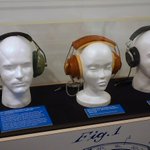
The first hi-fi stereo headphones were built as a gimmick to help sell a record player.
The Koss SP/3 stereophones came out in 1958 from Koss, a small Milwaukee company that had started out renting TV sets to hospital patients. They sold for $24.95, about $240 in today's money. Until then, headphones were made mostly for telephone operators, radio operators and pilots, and they didn't play music in stereo.
John C. Koss and his friend Martin Lange Jr., an engineer, had built a portable stereo record player with a privacy switch and a jack for headphones. To show it off, they made their own pair from two 3-inch speakers in cardboard cups, pads from a flight helmet, and a bent clothes hanger covered in rubber shower hose. At a Wisconsin hi-fi show, visitors kept asking to buy just the headphones, and Koss patiently explained they only came with the record player. Then he gave in, the record player went nowhere, and Koss became a headphone company.

23
One of Apple's early computers could sometimes be fixed by lifting it a couple of inches and dropping it.
The Apple III was Apple's computer for business, designed by engineer Wendell Sander and announced in May 1980 as the successor to the Apple II. It shipped late that year for $4,340 to $7,800, with a built-in floppy drive, a full keyboard with a number pad, and an 80-column screen that could show lowercase letters.
Steve Jobs hated noisy fans, so the Apple III had no fan or air vents and relied on its heavy aluminum case to carry heat away. The machines ran hot, chips worked loose from their sockets, and screens showed garbled text. Early Apple employee Daniel Kottke found that picking his up a couple of inches and slamming it down on the desk brought it back to life. Apple ended up replacing the first 14,000 machines, and the Apple II it was meant to replace stayed on sale until 1993.

For years, hard drives were nicknamed after a rifle.
The IBM 3340 was a disk drive for IBM's smaller mainframe computers, and it began shipping in November 1973. Its disks and read heads were sealed together in a removable cartridge that held 35 or 70 megabytes, and a starter setup cost about $62,500. The heads were so light that they rested on the disk when it stopped and floated about 18 millionths of an inch above it while it spun.
Every IBM project needed a code name. When project manager Ken Haughton came back from vacation, a marketer, Otis Page, had returned from talks with a small computer company with a plan for two spindles holding 30 megabytes each, which the team called a 30-30. To Haughton, a 30-30 meant the famous Winchester rifle, so the project became Winchester. The name stuck to the design itself, and for years "Winchester drive" was the common name for a sealed hard disk, including the ones inside 1980s PCs.

27
George R.R. Martin writes his Game of Thrones novels on word processing software from the 1980s.
WordStar was a word processor for early personal computers, published by MicroPro International and written by programmer Rob Barnaby. It went on sale in June 1979 for $495, plus $40 for the manual. By the fall of 1983 it had sold 650,000 copies, more than twice its nearest rival, and in 1984 MicroPro was the world's largest software company.
MicroPro's founder, Seymour Rubinstein, gave up control of the company after a heart attack in January 1984, and WordStar soon lost its lead to WordPerfect and Microsoft Word. One famous writer never switched. In May 2014, Martin told Conan O'Brien that he writes on an old DOS computer with no internet connection, running WordStar 4.0. "It does everything I want a word processing program to do and it doesn't do anything else," he said, adding that he hates spell-check and programs that capitalize letters for him.

2
39
Two years before the iPhone, Steve Jobs introduced a Motorola phone, then upstaged it on the same stage the same day.
The Motorola ROKR E1, made with Apple, was announced on September 7, 2005, as the first phone that worked with iTunes. Cingular sold it in the US for $250 with a two-year contract. It came with a 512 MB memory card, but its software let it hold only 100 songs at a time.
Jobs unveiled the phone at an Apple event in San Francisco, then used the same event to show off the iPod nano, which held about 1,000 songs. The nano got the attention. A few weeks later, Motorola's CEO, Ed Zander, told a Silicon Valley conference, "Screw the nano. What the hell does the nano do? Who listens to 1,000 songs?" Less than two months after launch, Cingular cut the phone's price to $150, and in 2007 Apple released a phone of its own.

The most famous ringtone of the 1990s was a piece of classical guitar music written in 1902.
The Nokia 2110, from the Finnish company Nokia, came out in January 1994. It weighed 236 grams, could send and receive text messages, and cost £700 in Britain that spring. It was the smallest digital phone on the UK market, and with its updated version it sold about 20 million.
Nokia's first TV ad for mobile phones, in 1992, played Gran Vals, a waltz by the Spanish guitarist Francisco Tárrega. In 1993, Nokia executive Anssi Vanjoki showed the whole piece to communications chief Lauri Kivinen, and the two picked out a short phrase from it. The 2110 shipped it as one of several ringtones, simply named Type 5. Nokia renamed it Nokia Tune in 1998, and by 2014 the company said it was played about 20,000 times a second around the world.

14
The DVD exists as one format because computer companies forced two rival camps to merge their discs.
DVD, short for Digital Versatile Disc, was the size of a CD but held 4.7 GB on one side, about seven times as much, enough for a full movie. Players went on sale in Japan in November 1996 and in the US in March 1997, where the first Toshiba and Panasonic models cost $599 to $750. About 349,000 were sold in the US that first year.
In late 1994 and early 1995, Sony and Philips announced one high-capacity disc, and Toshiba and Time Warner announced a different one. Computer makers wanted a single disc that would also work in PCs, so they formed a group chaired by IBM optical disc expert Alan Bell, which said it would back only one unified format. After six-hour meetings with each camp in Hawaii in September 1995, IBM endorsed a compromise and both sides reluctantly signed on, avoiding a repeat of the VHS and Betamax war. Toshiba's team then flipped through a dictionary to the letter V and picked the word versatile for the new name.

58
In 2000, a rock drummer delivered 13 boxes of paper to a software company, listing more than 335,000 of his own fans.
Napster was a free program that let people search each other's computers for songs and download them. College student Shawn Fanning released it on June 1, 1999, naming it after his high school nickname, a joke about his frizzy hair. At its peak it had about 80 million registered users.
Metallica sued Napster in April 2000 after finding its songs being traded there. On May 3, drummer Lars Ulrich and the band's lawyer, Howard King, brought the boxes to Napster's office in San Mateo, California, listing 335,435 user names accused of sharing Metallica songs over a single weekend. Napster blocked those users, but many fans saw it as the band turning on its own audience. Lawsuits from Metallica, Dr. Dre and the major record labels kept coming, and Napster shut down and went bankrupt by 2002.

38
The chip designs inside most of the world's smartphones trace back to a computer built for a British TV series.
The BBC Micro was made by Acorn Computers of Cambridge, England, to go with a BBC series teaching the public about computers. It launched in December 1981 at £235, or £335 for the Model B with 32 KB of memory, and both prices soon rose to £299 and £399. The BBC planned on about 12,000 sales. More than 1.5 million were sold, and about seven in ten British schools chose it.
In 1981, Acorn cofounder Hermann Hauser promised to show the BBC a machine that existed only as a design. He called engineers Sophie Wilson and Steve Furber and told each of them that the other had already agreed to build it. They worked five days and four nights, and the prototype only started working at about 6 a.m. on the morning of the BBC's visit. Acorn won the contract, and a few years later Wilson and Furber used BBC Micros to design and test a new processor called ARM. ARM designs now run most of the world's phones.

1
71
Toshiba gave up on its high-definition movie disc 46 days after one Hollywood studio picked its rival.
HD DVD was a disc for high-definition movies, created by Toshiba as the successor to the DVD. The first player went on sale in Japan on March 31, 2006, for 110,000 yen, about $934, and US players followed that April at $499 and $799. Each layer of an HD DVD held 15 GB, about three times a DVD, while the rival Blu-ray disc, backed by Sony, held 25 GB.
On January 4, 2008, Warner Bros., the biggest studio in home video, said it would release its high-definition movies only on Blu-ray. Kevin Tsujihara, who ran Warner's home video business, said that on movies sold in both formats, Blu-ray was outselling HD DVD 6 to 4. The HD DVD group canceled its big Las Vegas press event, set for two days later. On February 19, Toshiba's CEO, Atsutoshi Nishida, announced that the company would stop making HD DVD players, saying Warner's decision had a tremendous impact.

1
41
France's first big online chat craze started when a young user figured out a password.
The Minitel was a small terminal with a screen, keyboard and built-in modem that plugged into a phone line. France's state phone service began testing it in 1980, launched it nationwide in 1982 and lent the terminals to households for free, billing time online on the phone bill. By the late 1990s, about 25 million people in France used it, and the network kept running until June 30, 2012.
In Strasbourg, the newspaper Dernières Nouvelles d'Alsace ran an early Minitel service called Gretel, overseen by its head of computing, Michel Landaret. His team had built a hidden tool for sending live help messages to users who got stuck. A young user discovered its password and passed it to friends, and soon people across the city were messaging each other. Instead of shutting it down, Landaret's team opened the tool to everyone, and chat quickly made up about 90% of Gretel's traffic.

1
33
Nikon's worldwide reputation took off after a LIFE magazine photographer saw a close-up of his own face.
Nippon Kogaku, the Tokyo company now called Nikon, sold its first camera, the Nikon I, in March 1948 for 57,690 yen with a 50mm Nikkor lens. It took 40 pictures on a roll of 35mm film, and only about 400 were delivered. At the time, German lenses were considered the best in the world.
In June 1950, photographer Jun Miki took a portrait of LIFE's David Douglas Duncan in Tokyo with a borrowed Nikkor lens, and Duncan was stunned by how sharp the enlargement was. He and Fortune photographer Horace Bristol toured Nippon Kogaku's factory, tested its lenses, and sold most of their German lenses to switch to Nikkors. Soon after, the Korean War began, and Duncan covered it with Nikkor lenses through summer dust and cold so harsh his film snapped. Other war photographers followed, and on December 10, 1950, The New York Times reported on the quality of Japanese cameras and lenses.

1
68
The program that buried VisiCalc was started with money from VisiCalc's own publisher.
Lotus 1-2-3 was a spreadsheet program for the IBM PC from Lotus Development of Cambridge, Massachusetts, released on January 26, 1983, for $495. It combined a spreadsheet, charts and a simple database, which is where the name came from, and it sold 175,000 copies in its first year.
Mitch Kapor had written two charting add-ons for VisiCalc, sold by its publisher Personal Software, and in six months they earned him around half a million dollars in royalties. Worried the company would try to wriggle out of such a costly deal, he sold it the rights for $1.2 million and used the money to start Lotus, hiring programmer Jonathan Sachs to write 1-2-3. Lotus spent $1 million on ads in the first two months of 1983. By early 1984, 1-2-3 was outselling VisiCalc so badly that industry watchers expected VisiCalc to disappear that year.

1
27
The first webcam was pointed at a coffee pot, so computer scientists would stop climbing stairs for nothing.
XCoffee was set up in 1991 at the University of Cambridge's Computer Laboratory in England. A camera clamped to a lab stand sent a 128 by 128 pixel, black-and-white picture of the lab's one shared coffee machine to computers on the network, updating about three times a minute. In November 1993 the picture went onto the World Wide Web, where anyone in the world could check the pot.
Researchers Quentin Stafford-Fraser and Paul Jardetzky built it in a day or so, because colleagues on other floors kept making the trip only to find that the all-night crowd in the Trojan Room had already emptied the pot. Two other lab members, Daniel Gordon and Martyn Johnson, later put it online, and hundreds of thousands of people looked at it. When the lab moved buildings, the camera was switched off on August 22, 2001, and the shutdown made the front pages of The Times and The Washington Post. The Krups coffee maker then sold on eBay for £3,350 and ended up in the offices of the German magazine Der Spiegel.

1
48
Polaroid's founder spent more than a decade developing instant home movies, and a year after they flopped, he stepped down as CEO.
Polavision was an instant movie system that Polaroid released in 1977 for $699. It came with a camera and a viewer that looked like a small TV. You dropped a cartridge into the viewer, and about 90 seconds later it played back two and a half minutes of silent color film.
Edwin Land, who had invented instant photography, unveiled Polavision to about 4,000 shareholders and reporters at Polaroid's annual meeting in April 1977, calling it "living images." But the picture looked murky, the film couldn't be reused or shown on a regular TV, and new videotape recorders could tape an hour or more. In 1979, Polaroid sold off its remaining Polavision equipment at a loss of $68.5 million. Land stepped down as chief executive in 1980.

1
21
The @ in every email address was picked off the keyboard of an office typing machine from the 1960s.
The Teletype Model 33 was a combined keyboard and printer made by Teletype Corporation, introduced in 1963 for about $1,000. It typed only capital letters, printed 10 characters per second on a paper roll and weighed 75 pounds on its stand. More than half a million were built by 1975, and many were used to type commands into computers.
In 1971, Ray Tomlinson, a programmer at the firm BBN in Cambridge, Massachusetts, sent the first email between two computers on ARPANET, the network that grew into the internet. The two computers sat side by side, and he later said there was no way to know what the first message said. He needed a symbol to separate a person's name from the name of their computer, one that wasn't already used for anything else. He looked at his Model 33 keyboard and chose @, because it meant "at."

1
57
A box for surfing the web on a TV nearly cost its inventor everything, then sold to Microsoft for $425 million.
WebTV went on sale on September 18, 1996, as a set-top box made by Sony and Philips that connected a television to the internet over a phone line. It cost $329 to $349, plus $19.95 a month for the service, with a wireless keyboard for about $50 more.
Steve Perlman got the idea after finding a Campbell's soup recipe website and realizing the people who'd want it weren't online. He started WebTV in 1995 with Bruce Leak and Phil Goldman, and when the money ran out, Perlman mortgaged his house and ran up his credit cards to keep it going. Then Sony backed out just before a key investment closed, but the investors went ahead anyway, and Sony later came back. In April 1997, Microsoft bought WebTV, and each founder received $64 million.

49
A radio built for one man's yacht ended up in the hands of servicemen in World War II.
The Zenith Trans-Oceanic was a portable radio that could pick up shortwave stations from other continents as well as ordinary AM broadcasts. The first model went on sale in January 1942 for $75 and ran on household power or batteries. Zenith kept making Trans-Oceanics until 1981.
Zenith's founder, Eugene McDonald, loved sailing and wanted a portable radio that could pull in weather reports, marine signals and stations from overseas, so he had his engineers build one. The first 10,000 had a sailboat on the speaker cloth, but after Pearl Harbor, McDonald swapped it for a bomber. In April 1942, Zenith stopped making the radio to build equipment for the war, after only about 35,000 had been made. Many of them reached servicemen in war zones, and demand stayed high enough that Zenith brought it back after the war.
