Fascinating history of legendary ocean liners that once ruled the seas, shaping the course of human migration, commerce and culture.
Joined November 2024
- Tweets734
- Following22
- Followers1.5K
- Likes181
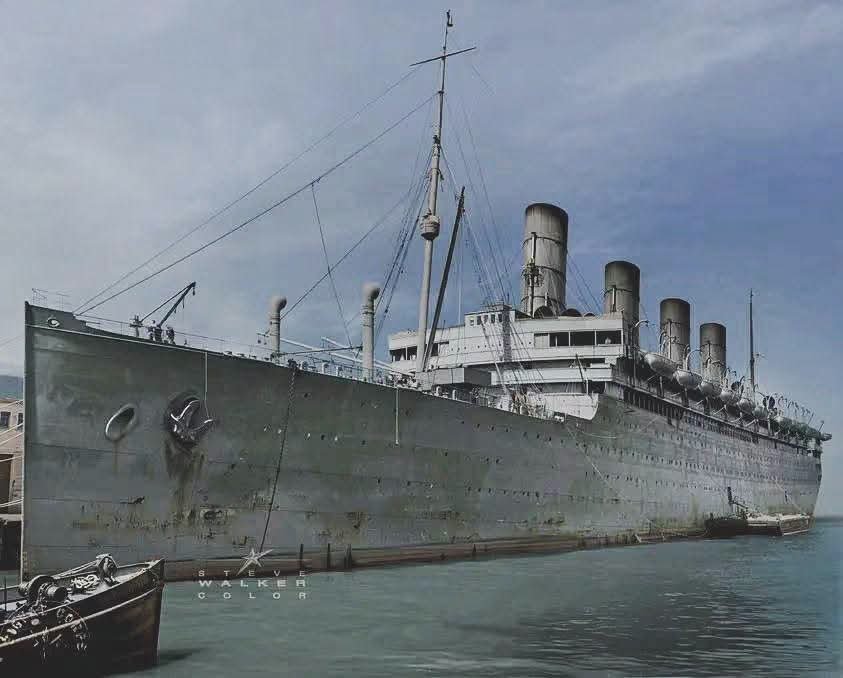
RMS Mauretania being dismantled at Rosyth, Scotland, in 1935, bringing an end to the career of one of the most celebrated ocean liners ever built. After nearly 28 years of service with Cunard, the aging liner was withdrawn in 1934 as newer and more economical ships came to dominate the North Atlantic.

SS United States — The Final Countdown Begins
A date has now been announced for one of the most significant and emotional moments in the history of America's Flagship.
Florida's Okaloosa County has announced that the legendary SS United States is scheduled to be deliberately sunk on Thursday, November 12, 2026, beginning a new chapter as what is intended to become the world's largest artificial reef off the coast of Florida.
For many maritime enthusiasts, watching such an extraordinary vessel disappear beneath the waves will be a difficult and emotional experience. Although her transformation into an artificial reef marks the end of any possibility of restoring the ship as a floating ocean liner, it also offers her a new purpose beneath the Gulf's waters, where she is intended to become a destination for marine life and recreational divers.
To commemorate this historic occasion, Okaloosa County will host a public sendoff ceremony on Wednesday, November 11, 2026, at 1:30 p.m. at the Destin-Fort Walton Beach Convention Center.
Later that afternoon, the SS United States Conservancy plans to host a special program exploring the liner's remarkable history and its vision for a future museum dedicated to preserving the legacy of America's Flagship. Additional event details are expected to be announced.
For those unable to attend in person, the ship's deployment will also be available to watch via livestream, with viewing information to be published at thessus.com ahead of the event.
From her record-breaking maiden voyage in 1952 to her final resting place beneath the waters of Florida, United States has traveled an extraordinary path through maritime history.

RMS Queen Elizabeth receives a fresh coat of paint on September 30, 1946, as preparations continued for her long-awaited sea trials and entry into commercial service. Although the great Cunard liner had been launched in 1938, the outbreak of World War II prevented her from ever beginning the peacetime career for which she had been built.
Instead, Queen Elizabeth secretly departed Britain in March 1940 and was pressed into wartime service, eventually becoming one of the Allies’ most important troop transports. Alongside Queen Mary, she carried hundreds of thousands of servicemen across the world's oceans, her tremendous speed allowing her to operate largely without convoy escort.
With the war over, Queen Elizabeth was finally returned to the role originally intended for her. Her austere wartime appearance gave way to Cunard’s traditional colors, while her interiors were completed and restored for passenger service. After nearly six extraordinary years as a troopship, she was finally ready to begin her peacetime career.
On October 16, 1946, Queen Elizabeth departed Southampton on her maiden commercial voyage to New York—more than eight years after she had first been launched.

Stephen Payne executed an exceptional job in the design of the Queen Mary 2, as he successfully paid homage to the iconic design of the original Queen Mary ocean liner design while simultaneously incorporating modern elements that ensure its competitiveness in today's cruise ship market. His ability to blend classic elegance with contemporary functionality is truly commendable and reflects a deep understanding of both maritime heritage and current industry standards.


RMS Campania under construction at the Fairfield Shipbuilding and Engineering Company shipyard in Govan, Glasgow. Built for the Cunard Line and launched in September 1892, Campania was one of the most advanced passenger liners of her generation. Along with her sister ship Lucania, she was constructed as part of Cunard’s effort to regain supremacy on the increasingly competitive North Atlantic route.
Powered by enormous triple-expansion steam engines, Campania combined impressive size with exceptional speed, capturing the westbound Blue Riband during her first year of service in 1893. This construction photograph offers a fascinating glimpse of the ship before her luxurious interiors, towering funnels, and machinery transformed the unfinished hull into one of the defining Cunard liners of the 1890s.

The Conte Grande was originally commissioned by the Italian shipping company Lloyd Sabaudo to serve as a passenger liner on the Transatlantic route between Genoa, Italy, and New York. In 1932, following Lloyd Sabaudo's merger into the newly established Italian Line, the vessel was reassigned to the South American service.
However, with Italy's entry into World War II on June 10, 1940, the Conte Grande was seized and laid up in the port of Santos, Brazil. On April 16, 1942, the ship was acquired by the United States government. It was subsequently commissioned into the U.S. Navy as the USS Monticello (AP-61), where it served as a troop transport in both the European and Asiatic theaters of the war.


SS United States — Her Final Chapter Is Approaching.
A tentative timeline now places the sinking of America's legendary flagship during the second week of November 2026, weather and preparations permitting.
Once the fastest ocean liner in the world, United States has spent decades out of service, her once-proud appearance gradually deteriorating. Despite years of preservation efforts, the enormous cost of restoring and maintaining the vessel has remained a formidable obstacle.
Now, preparations are underway to give the historic liner a new purpose as an artificial reef off the coast of Florida.
Our latest footage captures the aging liner as she approaches one of the final chapters in her extraordinary history.
With a career spanning over 3 decades, the RMS Empress of Japan (1890), owned by the Canadian Pacific Steamship Company, played a significant role in the trans-Pacific route until 1922, including service as an armed merchant cruiser during the first World War.

RMS Mauretania and RMS Olympic are moored at Western Docks in Southampton waiting to be scrapped. Mauretania's masts are cut down in preparation to pass under Forth Bridge on her way to Rosyth, Scotland in July 1935.
Colorized by: Steve Walker

Installation of Titanic's starboard tail shaft prior to launch in May 1911. Photograph taken by Robert Welch.

Sister ships RMS Campania and RMS Lucania were among Cunard Line’s most technologically impressive liners of the 1890s. Both were powered by enormous twin five-cylinder triple-expansion steam engines, the largest reciprocating marine engines in the world when the ships entered service. Developing roughly 30,000 indicated horsepower, the engines drove two propellers and gave the liners service speeds of around 21 knots.
Their tremendous power helped return Cunard to the forefront of the transatlantic speed race. Campania captured the coveted Blue Riband in 1893, only to have her record surpassed the following year by her sister Lucania. For several years, the two ships ranked among the fastest passenger liners on the Atlantic.
The machinery of Campania and Lucania represented something of a high-water mark for the great reciprocating steam engine. Within little more than a decade, Cunard would embrace steam turbines with Carmania and, most famously, the turbine-powered Lusitania and Mauretania, ushering in an entirely new generation of ocean-liner propulsion.

SS Leonardo da Vinci was the last Italian Line passenger liner to run the North Atlantic route in June of 1976.

Queen Mary and the Rogue Wave.
In December 1942, The Grey Ghost (Queen Mary) encountered a severe storm while carrying over 16,000 soldiers. A massive wave struck the ship on its port side, causing it to roll 52 degrees off its vertical axis. The impact caused lifeboats to break loose from their davits, and windows shattered as seawater poured into the ship, making it increasingly difficult for the Queen Mary to right herself. However, the ship eventually managed to level out, avoiding the risk of capsizing and what would have been the worst single maritime disaster in history.

RMS Queen Elizabeth 2
Entering service in 1969, RMS Queen Elizabeth 2, better known simply as QE2, became one of the most celebrated passenger ships of the 20th century. Built by John Brown & Company at Clydebank, Scotland, she was designed to continue Cunard’s transatlantic tradition at a time when jet aircraft had already transformed international travel.
Unlike the enormous Queen Mary and Queen Elizabeth before her, QE2 was designed with greater versatility, capable of operating both scheduled transatlantic crossings and cruises around the world. Originally powered by steam turbines, she underwent a major conversion to diesel-electric propulsion during the 1980s, helping extend her remarkable career for decades.
QE2 also answered the call to military service. During the Falklands War in 1982, she was requisitioned by the British government and rapidly converted into a troop transport, carrying thousands of personnel to the South Atlantic.
Following the war, QE2 returned to passenger service and became one of the most recognizable ships afloat. Over nearly four decades with Cunard, she completed hundreds of Atlantic crossings, numerous world cruises, and sailed millions of nautical miles.
After almost 40 years of service, QE2 completed her final Cunard voyage in 2008 and was retired to Dubai.


Launched in 25 June 1885, RMS Umbria was Cunard Lines last class ship fitted with auxiliary sails. With a tonnage of 7,100 she ran a speed of 19 knots and had a 26 year long career grabbing the Blue Riband along the way.

RMS Carmania and RMS Franconia lie together at Berth 101 in Southampton on November 13, 1971. The two Cunard liners, both familiar sights on the North Atlantic and in the postwar cruise trade, are captured side by side during the closing chapter of their careers.
Originally entering service in 1954 and 1955 respectively, Saxonia and Ivernia were later extensively rebuilt and renamed Carmania and Franconia as Cunard adapted its fleet to the rapidly changing passenger market. By the early 1970s, traditional transatlantic liner service had been largely overtaken by commercial aviation, and ships such as these increasingly depended upon cruising.
This November 1971 scene at Southampton therefore captures more than two Cunard ships sharing a berth—it represents the twilight of a generation of postwar British ocean liners and a period of enormous change in passenger travel at sea.
Photo credit: Nick Thompson

MS Giulio Cesare initiated her service on the Genoa and Buenos Aires route after her maiden voyage. However, she was later reassigned to the Genoa, Cannes, Naples, and New York City route on June 29, 1956, and navigated the North Atlantic for four years, completing 32 round trips, before resuming her Italy and South America route in 1960.


During World War II, RMS Aquitania was once again called upon for military service, with a troop-carrying capacity of approximately 7,400. It was the second global conflict in which the veteran Cunard liner had served, having previously transported troops and operated as a hospital ship during the First World War.
Her service in both world wars distinguished Aquitania from the other great four-funnelled liners of the early 20th century. Built during the final years of the Edwardian ocean-liner era and entering service in 1914, she survived two world wars and returned to civilian service after each. By the time she was finally retired in 1950, Aquitania had completed an extraordinary 36-year career—earning her a unique place among the great ocean liners of her generation.
Photographs colored by: Steve Walker