

Specialist in on-chain analysis, macroeconomics & research.
Japón
Joined July 2021
- Tweets477
- Following719
- Followers195
- Likes936


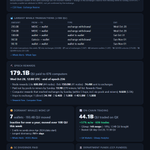
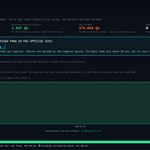


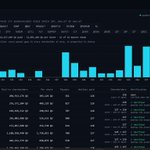

BPP-9000 now has its own page on Tick Unlocked: tickunlocked.com/m/bpp9000/
What it shows:
• Every hour, whether the best network says the running Bitcoin candle will close up or down. The call is written around minute 30 of the candle, before it closes, and cannot be edited afterwards.
• The result so far in epoch 240: 48 of 99 candles right (48.5%). That cannot be told apart from a coin flip. Just looking at the price at that same minute is right 81.8% of the time.
• How many computors have a network at 3,504 misses or fewer: at least 541 of 676 at some hour of this epoch.
• One table with every candle: the call, the entry price, the close and whether it was right.
The page is free and all times are UTC. Prediction mode is expected for epoch 241; if it is released, the page will follow it.
@_Qubic_


Qubic Weekly On-Chain · Nov 16 – 22, 2026
Ticks got faster: epoch 240 ran at one tick every 1.81 seconds (0.55 ticks per second), up from 2.93 seconds in epoch 239. Still far from Nov 5 to 8, when the network ran at 5.2 to 6.4 ticks per second.
Mining change: core v1.313.0 (required for epoch 240) makes Bpp9000 miners take their task data from the hourly BTC/USDT price on Binance instead of a fixed file.
Exchanges: total reserve 30.86T QU, down 283.5B (−0.9%). Gate.io +265.1B, MEXC −85.4B, Bitget −182.1B, Safetrade −281.0B.
Epoch rewards: 181.1B QU to 676 computors. Guardians paid nodes twice the epoch 239 total. Epoch 238 was not paid: only 7 nodes (5 Lite and 2 Bob) met the requirements to receive rewards, and Guardians said that epoch's technical problems made paying with its data unfair.
QX: 68.1B QU traded (−43%), 726 trades. SC dividends: 3.10B QU, including 2.00B in fees for issuing QMUSIC and HOLI.
Coming up: 305.6B QU locked in QEARN during epoch 188 unlocks when epoch 240 ends (Wed Nov 25, ~12:00 UTC), plus 46.3B in rewards. Epoch 241 is expected to start right after.
Full edition, English and Spanish: tickunlocked.com/weekly/2026…
@_Qubic_

Qubic Upstream Pulse now has a Dev board.
Every pull request in Qubic's public GitHub repositories, placed in the stage it is really at: draft, in review, changes requested, approved, merged or released. The column comes from GitHub itself (review state, merge, and whether the merge commit is contained in a tagged release), not from dates. The board rebuilds every hour.
Why it matters: opened, merged and released are three different things. An open pull request is a proposal. A merged one is in the code but may not be in any release yet. A release is published code, which does not mean the network is running it: nodes upgrade on their own schedule.
The panel also has a Developers view (who is merging, reviewing and holding open work over the last 90 days), the official planning board the team keeps by hand, and the activity feed. "Critical repos only" narrows every view to the repositories that run the network: node, protocol and data services.
tickunlocked.com/m/upstream-…
@_Qubic_

📊 Qubic weekly on-chain report · Nov 9 – Nov 15, 2026
• Epoch 239 runs slower: 0.34 ticks per second on average since Nov 11, 12:00 UTC (one tick every 2.95 seconds), against 2.5 ticks per second (0.40 seconds per tick) in the last two days of epoch 238. The epoch started with core v1.312.0, a mandatory update; a causal link is not confirmed.
• Network halts: 2 more unscheduled halts on Nov 9 (40 min from 00:58 UTC and 1h 33m from 01:52 UTC). None of 10+ minutes since, apart from the 11-minute epoch change on Nov 11.
• Exchange reserves: −502.8B QU (−2%)
• Paid to computors: 179.5B QU
• QX volume: 120.1B QU
• Node rewards (Guardians) for epoch 238: not paid this week. Guardians announced it will pay them together with the rewards of epoch 239.
Full report, with the largest whale transactions and dormant wallets:
tickunlocked.com/weekly/2026…
@_Qubic_
Fujimoto David retweeted

Today the Qubic community asked us to file a CCF proposal for our work on Qubic Church. So we did.
Thank you, it means a lot.
Hoping for a positive outcome.
It would cover a year of work behind QC-project
and BPP-9000, and let us focus on what comes next and build it properly.
#Qubic

Fujimoto David retweeted

Last #Neraxon for #arcagi3 mark a small improve to 0.41 #nollm #ngpu almost 180 evolutionary cicles with +100k 🧠 , today competition ends and brains demos and data will be published this week and our research @josesanchezhb and @VivancosDavid for @_Qubic_ #openscience with #aigarth continues, learnings will improve current works on Neraxon3 , stay tuned for updates

New · Qubic Weekly On-Chain: a free weekly report, published on Mondays
A one-page summary of each Monday-to-Sunday week (UTC), in English and Spanish: big news, exchange flows for each exchange (inflow, outflow, netflow, depositing and withdrawing addresses), the largest whale transactions, epoch rewards and how much of them reached exchanges within 5 hops, dormant whales, QX and QSwap trading, SC dividends, CCF-funded wallets and what’s coming next. Read it at tickunlocked.com/weekly.
@_Qubic_

Fujimoto David retweeted

Qubic's science team is in Nice. 🇫🇷
Our research has been accepted at EA 2026.
Our Scientists, @VivancosDavid and @josesanchezhb, are at the International Conference on Artificial Evolution, running 27 to 29 October. 🧵
🔎 New on Tick Unlocked: Qubic Recovery Tracker
Live tracking of the October 17–18, 2026 wallet sweep.
What was stolen: the attacker drained 1,404 weak-seed wallets and took 2.94T QU, spread across 8 attacker wallets. Before the pause it sent 379.04B to MEXC.
What was recovered: the network was paused, so the 2.56T QU the attacker still held on chain was frozen, and at the restart the Qubic team moved it to a recovery escrow through a protocol update, together with the QU and tokens of 1,394 other weak-seed wallets it never drained.
What you will see:
• How much was stolen, recovered and returned so far
• Each attacker wallet with its victims and how much it took from each
• The tokens in the escrow, which wallet each came from and how many came back
• The list of the 1,394 wallets frozen as a precaution
• A lookup for any frozen address
It updates on its own: every refund of QU or tokens that leaves the escrow shows up within minutes. Every figure is checked to the QU against rpc.qubic.org.
To claim funds: weak-seed-reclaim.qubic.org, the official site. As the site itself warns: the Qubic team does not DM you, does not ask for your seed and does not charge a recovery fee.
👉 tickunlocked.com/m/qubic-rec…
@_Qubic_


Drain Watch: mass wallet drain alerts for Qubic
A single wallet sending out its whole balance is usually its owner. Dozens of unrelated wallets doing it at the same time, each into a brand-new address, is a different event: it is what a leak of keys or seeds looks like on-chain. Drain Watch checks the chain every minute for that pattern and posts it to the Anomaly Feed and our Telegram channel.
It alerts in two cases. Many wallets into one address: 20 or more unrelated wallets each send their entire balance to the same new address within 1,000 ticks, at least 1B QU in total. Many wallets into different addresses: 40 or more unrelated wallets are emptied within 10,000 ticks, each with a single transfer to an address with no history. The second case exists because an attacker can use a new collector address for every victim, and then no single address stands out.
"Unrelated" is measured, not assumed: wallets created together are treated as one owner and do not count. Only signed transfers count. Exchanges, mining pools, other labeled wallets and computors are left out, so routine custody and payout flows do not trigger it.
Each alert is a hypothesis until it is investigated. A mass move of funds to new wallets, for example after a security scare, looks exactly the same on-chain, and the alert says so.
tickunlocked.com/m/anomaly-f…
@_Qubic_
182
Fujimoto David retweeted

I built a map of the whole Qubic ecosystem.
90 projects in 18 categories: where to buy, exchanges, DeFi, bridges, wallets, mining pools, explorers, tokens, games, dev tools.
Live network figures. 4 languages. Every project gets its own mark, cut from the Qubic logo.
qubicmap.pages.dev
It's a beta: tell me what's missing or wrong.
$QUBIC @_Qubic_
SC Inflows: net flow heatmap
The QU that enters a smart contract is only half of its activity. Some contracts pass almost everything back out, some release far more than they receive in a given week, and some burn what they receive. An inflow chart cannot tell these apart.
The new Net flow heatmap tab shows, for each smart contract, the net QU over the last 30 days: QU received minus QU paid out minus QU burned. Green means the contract kept QU; red means it released more than it received. Columns show yesterday, 7 days and the whole window, followed by one cell per day, so a single large payout and a steady drain look different.
Burns are counted as their own line. A contract that burns everything it receives would otherwise look like it is accumulating, and the heatmap would show a balance it does not hold. For the same reason, if a contract's figures fail the chart's consistency check, the heatmap is hidden with a message instead of showing a wrong picture. The current UTC day is excluded while it is still in progress.
@_Qubic_
PRO chart: tickunlocked.com/m/sc-flows/

Ecosystem Bubbles: Quadrant view
A price move and a change in the holder base are two different signals, and a token can show one without the other. The new Quadrant view puts both on one chart: each token is placed by how its number of holders changed (horizontal) against how its price changed (vertical), over 1, 7, 30 or 90 days.
The four corners read directly. Top right: more holders and a higher price. Top left: a higher price with fewer holders. Bottom right: more holders while the price fell. Bottom left: fewer holders and a lower price. Bubble size is the current number of holders, so a move in a large token is visible at a glance.
Three design choices shape what you see. Only tokens with at least 50 holders and a price on both dates are included, because a token going from 3 to 6 holders would double its holder count and say nothing. A token whose price on either date comes from a single trade of one share is left out, because one tiny trade does not make a market price. And a window without enough history is greyed out instead of drawing a comparison against the wrong date.
@_Qubic_
Free chart: tickunlocked.com/m/ecosystem…

1
60
Wallet Watchlist: Telegram alerts for QU and every token
If your wallet is emptied, nothing tells you. You find out when you next open it, and by then the funds may already be several wallets away.
Wallet Watchlist sends you a Telegram message when a wallet you follow moves QU or any token. Follow your own wallets, or the ones worth watching, such as whales. Each alert shows the token, the amount and the wallet on the other side, which is where tracing starts.
It covers every movement of a balance, not only the transfers a wallet signs: orders settled on QX (the on-chain exchange), payouts from smart contracts and SendMany (one transaction paying many wallets) are included. Alerts work on the Free plan, and any wallet can be muted with its bell toggle.
tickunlocked.com/m/wallet-wa…
@_Qubic_

73
Fujimoto David retweeted
Qubic AGI Lab is officially founded.
It is now a registered non-profit Swiss association, set up by community members and independent of the Qubic network, with its own legal footing.
Its purpose is research, education and open discourse on decentralized AGI, including work built on Qubic, Useful Proof of Work and Aigarth.
Here is how you can be part of it👇
SC Dividends
What each Qubic smart contract paid to the wallets holding its shares, epoch by epoch since epoch 207. Every shareholder and every wallet paid is listed to the exact QU, with no top-N and no "others" line.
A row is published only if two independent sources agree: the transfers the contract made on chain, and the network's own balance records between two epoch snapshots. When they do not match to the QU, the row is shown as not verified, with the reason. That is also how the panel caught QU leaving a contract with no event in any record we can read: the balance records show who received it, and it is shown separately, never as a dividend.
Only QU paid to shareholders is counted. Payouts to token holders, registered members or QEARN stakers are not dividends and are left out, and a dividend step of 0 QU per share is not counted as a payout. Free chart: tickunlocked.com/m/sc-divide…
@_Qubic_


Fujimoto David retweeted

$QUBIC is taking a quiet but important step: Qubic smart contracts can now read data directly from other blockchains, including Ethereum.
Why does it matter?
Until now, getting two blockchains to talk almost always meant going through an intermediary: a bridge, a third party service, someone you had to trust. Historically, that has been one of the weakest links in crypto.
With the Crosschain Oracle, a Qubic contract can directly verify what happens on another chain, without relying on a third party.
In practice, this opens the door to bridges that require trusting no one, to representing assets coming from other networks, and to accessing external data in real time.
It is the logical next step after the Oracle Machines, active since February: Qubic does not live in isolation, it is learning to listen to the rest of the ecosystem.
Honesty check: announcing a capability and seeing it adopted are two different things. What comes next depends on the developers who take hold of it. The documentation is on docs.qubic.org.
Tick by tick, the building blocks come together.
Rewards Flow: Computors, Miners & Nodes
As each epoch closes, the protocol pays all 676 computors in a single tick. Part of that QU is passed on to mining pools, which pay their miners, and Lite and Bob node operators are paid during the same week. This panel follows every wallet paid in an epoch from the payout until the next one and places every QU of the payout in exactly one box: known exchange addresses, exchange deposit addresses, QEARN, other smart contracts, burned, mining deposits not yet refunded, unlabeled hubs, still held, or not followed further. Every amount is followed, however small. Hover a bar to see who put each part there: computors, collector wallets, pool wallets, miners, a known mining intermediary, other wallets further along, or nodes.
When a wallet already held QU, a later transfer is counted as coming from the payout in proportion to its balance, so a wallet's own money is never counted as a reward. An epoch is shown only if it adds up to the payout to the last QU and every wallet we follow ends with exactly the balance the network recorded at the start of the next epoch. Weeks that do not pass that check are left out rather than estimated; the running epoch is shown as open until it can be checked.
Exchanges means the exchange addresses we have labeled plus deposit addresses we detect because they forward almost everything they receive to one of them within 48 hours. Exchanges with no address we can identify are not counted, so the real flow into exchanges can be larger. The price is the hourly volume-weighted average across the exchanges we record, compared with the same hour on days without a payout: timing, not cause. Press an epoch to see every computor, miner and node paid, grouped by type, and where its reward went.
@_Qubic_
tickunlocked.com/m/rewards-f…


41
Oracle Machine — Rounds & Quorum
What this shows
The Oracle Machine's own work cycle, read from the chain. A requester posts a query; computors answer with commits; the answer lands as a reveal. A round reaches quorum when at least 451 of the 676 computors commit — the same threshold the protocol uses everywhere else. This is the round itself, not a ranking of “oracle providers”.
How to read it
The daily series is on a log axis by default, and that is the honest choice here: usage is campaign-shaped, a baseline of a few rounds a day with bursts of thousands. On a linear axis every ordinary day flattens onto zero and the oracle looks dead. Switch to Lin to see that for yourself.
The quorum line is a daily percentage, so read it against its denominator — the tooltip always shows the raw count. On a day of four rounds, one miss reads as a steep drop; that is sampling noise, not a network event. The headline figure is the one measured over every round.
Latency is in ticks, not seconds, because Qubic's tick cadence is not a constant. Both the median and the p99 are shown: the p99 is what a contract waiting on an answer actually has to tolerate.
How to use it
The interface table tells a new capability from one live since the start: ◆ marks the ones that first appear on-chain in epoch 230. Its “first seen” date comes from the tick timestamp dictionary, not from extrapolating a tick.
The feed table shows which price feeds are still answering and which have gone quiet — compare “rounds” against “last answer”. A large round count with an old last answer means a feed that was exercised and then stopped.
Use the verify button to re-derive the payload yourself: your browser fetches the tick straight from the network's public archive and decodes it independently of us.
Good to know
Rounds are joined by the tick encoded in the query id. When a tick carries more than one query the round is counted but published without a feed rather than guessing which query it answers — attributing the wrong pair would put a real price under the wrong ticker.
The numbers here are cross-checked on a schedule against the network's own archive, which shares no link with our pipeline — not our node, not our ingestion, not our database. The banner above the chart reports that verdict, including when it could not be verified.
A query whose size or interface index this panel's decoder does not recognize yet is never dropped silently. It surfaces in its own banner, shown raw rather than guessed at or folded into a known interface — the earliest signal a brand-new query type has appeared on-chain.
The series covers epoch 224 onward — that is the window this panel publishes, not a statement about when the oracle first answered on-chain. All times UTC.
tickunlocked.com/m/oracle-ma…
@_Qubic_

1
62
Fujimoto David retweeted

🌐$QUBIC Decentralization Report updated🚀
Pools: declare your computor slots. Who operates them, the ledger does not disclose — and no API exposes it.
So: Nakamoto 222 of 676 slots, not operators.
Declarations via Discord only. Registry: github.com/AndyQus/qubic-dec…
