

Sanskrit for seekers of Gita, Vedanta & Scriptures Learn the foundations (without overwhelm) 1.5L+ learners | 60+ countries Begin here ↓
India भारत
Joined June 2014
- Tweets1.4K
- Following2.9K
- Followers8.5K
- Likes3.3K






The opening of Vande Mataram does something unexpectedly simple: it paints.
It doesn't begin with a battle or a throne. It begins with a landscape - four images, laid one after another:
सुजलाम् - rich in water
सुफलाम् - rich in fruit
मलयजशीतलाम् - cooled by the breeze of the Malaya hills
शस्यश्यामलाम् - green with crops
Four brushstrokes of a living land. And only at the end does the line name what all of it has been describing - मातरम्. The Mother.
150 years after Bankim Chandra Chattopadhyay wrote these words in 1875, the opening still unfolds the same way: water, fruit, breeze, green fields - and then, her.
We've stayed with the opening lines here - the landscape at the heart of the song. Not a claim about the whole song, just an invitation to notice something beautiful in words you already know. 🌾
स्वातन्त्र्यदिवसस्य शुभाशयाः - wishing you a thoughtful Independence Day.
Save this, and the next time you hear these lines, you'll see the land inside them.
We teach Sanskrit from scratch to beginners - link in bio if you'd like to begin.
#VandeMataram #Sanskrit #IndependenceDay #BankimChandra #IndianHeritage #LearnSanskrit #OpenPathshala


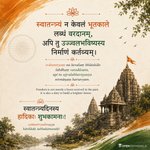
स्वातन्त्र्यदिनस्य हार्दिकाः शुभकामनाः!
svātantryadinasya hārdikāḥ śubhakāmanāḥ!
Freedom is not merely something we inherited.
It is something we are entrusted with.
स्वातन्त्र्यं न केवलं भूतकाले लब्धं वरदानम्, अपि तु उज्ज्वलभविष्यस्य निर्माणं कर्तव्यम्।
svātantryaṃ na kevalaṃ bhūtakāle labdhaṃ varadānam, api tu ujjvalabhaviṣyasya nirmāṇaṃ kartavyam.
Freedom is not merely a boon received in the past; it is also a duty to build a brighter future.
On this Independence Day, may we remember that svātantrya is not only about what was won yesterday, but also about what we choose to build tomorrow.
#IndependenceDay #स्वातन्त्र्यम् #Sanskrit #OpenPathshala #India

You have chanted this since childhood.
Three times, at the close of a śānti pāṭha.
śāntiḥ. śāntiḥ. śāntiḥ.
Most of us assume the repetition is emphasis.
It isn't.
A traditional reading sees three utterances because there are three kinds of suffering to ask peace from.
The Sāṃkhyakārikā begins its philosophical inquiry with duḥkha-traya - threefold suffering.
The Śrīmad Bhāgavatam later calls it tāpa-traya - the three fires - and speaks of the highest truth as that which uproots them.
Ādhyātmika - suffering arising within oneself.
Ādhibhautika - suffering arriving through other beings and the world around us.
Ādhidaivika - suffering arising from forces beyond our control.
So the threefold repetition isn't merely:
“Peace, peace, peace.”
It is a traditional way of asking for peace across the three domains in which suffering reaches us.
Three sufferings.
Three śāntis.
One invocation for each.
Send this to whoever taught you to chant it. 🔖


Everyone remembers that Śiva swallowed the poison.
Almost nobody remembers where it stopped.
The Bhāgavata Purāṇa is unusually precise.
Not the stomach.
Not the heart.
The throat.
The Sanskrit says:
यच्चकार गले नीलं
तच्च साधोर्विभूषणम्
yac cakāra gale nīlaṃ
tac ca sādhor vibhūṣaṇam
The poison marked his throat blue - and that mark became an ornament.
Notice the word:
गले - gale
“on/in the throat.”
And then another text makes the connection explicit.
The Brahmāṇḍa Purāṇa says that Śiva held the poison in his throat and therefore became known as:
नीलकण्ठ - nīlakaṇṭha
the blue-throated one.
So the name isn't merely a poetic title.
It remembers the event.
nīla - blue
kaṇṭha - throat
The story says what happened.
The name remembers where.
Sources: Bhāgavata Purāṇa 8.7.40–44; Brahmāṇḍa Purāṇa, Pūrvabhāga, Anuṣaṅga-pāda 25.45–91.


The one who crossed the ocean first had to cross forgetfulness.
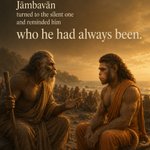
Before the ocean, before Laṅkā, Hanumān sat in silence while the other vānaras measured themselves against the impossible distance. Not because his strength had left him, but because a childhood curse had veiled the memory of it.
Jāmbavān did not give him power. He gave him remembrance.
That is why Sanskrit has a precise word for it:
स्मरण - smaraṇa.
Not learning.
Not acquiring.
The recovery of what was always there.
In Vedāntic thought, this becomes more than Hanumān's story. It becomes a way of understanding the human condition itself: the Self does not become complete - it forgets, and then remembers.
Perhaps that is why Hanumān's leap was never the deepest miracle.
The remembering was.
🔖 Save this for the days you forget what you're capable of.
#Sanskrit #Ramayana #Hanuman #Vedanta #IndianPhilosophy #Smarana #LearnSanskrit #IndianKnowledgeSystem #SanskritQuotes #SanatanDharma #OpenPathshala


The tradition teaches: गु gu = darkness, रु ru = the one who removes it.
From the Advayatāraka Upaniṣad, the guru leads us from ignorance to light.
Sacred. True.
But there's another layer to this word.
The Sanskrit word guru originally means "heavy" or "weighty."
The same ancient Proto-Indo-European ancestor gave rise to Sanskrit guru, Latin gravis ("heavy"), then gravitas, and eventually the English word gravity. They are linguistic cousins.
Sanskrit even has गुरुत्व (gurutva) - "gravity" or "heaviness" - built from the same root as guru itself.
Over 2,000 years before Newton formulated a mathematical law of gravitation, the sage कणाद (Kaṇāda) wrote in the Vaiśeṣika Sūtras (5.1.7):
संयोगाभावे गुरुत्वात् पतनम्
saṃyogābhāve gurutvāt patanam
"In the absence of support, falling results from gurutva (heaviness)."
Kaṇāda identifies gurutva as the cause of falling. Centuries later, Newton would describe that phenomenon mathematically.
Perhaps that's why the metaphor feels so fitting.
A true guru works like gravity - not by force, but by weight.
A guru is the one whose wisdom pulls you toward truth. 🪔
💬 On this Guru Purnima, whose wisdom has had that kind of weight in your life? Name them below.
📤 Share this with someone whose guru changed their life.
Most people think meditation is something you sit down and do.
Sanskrit disagrees.
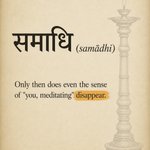
In the Yoga Sūtras, meditation is the last of three stages, not the first. You begin with dhāraṇā - learning to hold your attention on one thing. Only then comes dhyāna, that attention flowing unbroken. Only then, samādhi - the point where even the sense of "you, meditating" disappears.
Patañjali never treated these as three separate techniques. He gave them one name: saṃyama.
There is no version of this where you begin at the end.
Centuries earlier, the Upaniṣads said something almost identical. When the sage Yājñavalkya taught his wife Maitreyī about the Self, he didn't tell her to meditate on it first. He told her to hear about it. Then reflect on it. Only then meditate on it.
Two traditions, centuries apart. Neither one let you skip ahead.
Which means the real question was never "Do you meditate?"
It was always: what have you actually prepared yourself for?
Meditation was never something to do. It was always something to grow into.
Save this. Then ask yourself, honestly - where are you in the sequence?
(धारणा, ध्यान, समाधि: Yoga Sūtra 3.1–3.4. Yājñavalkya and Maitreyī: Bṛhadāraṇyaka Upaniṣad, 2.4.5.)
#sanskrit #meditation #openpathshala #yogasutras #patanjali #vedanta #upanishads #mindfulness


They agreed on the stakes: whoever lost would give up their way of life and become the other’s disciple.
The debate needed a judge fit for both men. So Maṇḍana Miśra proposed the only person impartial and learned enough for the task: his own wife, Ubhayabhāratī, a scholar in her own right.
For seventeen days, the two men debated the nature of the self. On the seventeenth day, Ubhayabhāratī gave her verdict.
Her own husband had lost.
But before Maṇḍana Miśra could accept his fate, Ubhayabhāratī stopped the hall.
“You have defeated only half of him,” she said.
In Sanskrit, a wife may be called अर्धाङ्गिनी (ardhāṅginī) - one’s other half. If she was truly his other half, then defeating him alone had defeated only half the debate.
To finish what he started, Śaṅkara would now have to debate her too.
He agreed. What she asked him next was something a lifelong renunciate had never needed to answer in his life.
For the first time in seventeen days of debate, Śaṅkara paused.
What could make one of India’s greatest philosophers pause?
We’ll tell you what happened next in Part 2.
----------
Tell us your guess in the comments. 👇
----------
(Story per the traditional accounts preserved in the Śaṅkara Digvijaya.)
#Sanskrit #OpenPathshala #AdiShankara #IndianPhilosophy #Vedanta #SanskritStories #IndianKnowledgeSystems


He wrote one of the greatest love epics in Sanskrit. It begins with a mountain.
Imagine looking at the Himalayas and seeing not a mountain range, but a father watching over his daughter.
That is how Kalidasa opens one of Sanskrit's greatest poems. In his hands, Himālaya is no longer stone and snow. He is the father of Pārvatī.
अस्त्युत्तरस्यां दिशि देवतात्मा हिमालयो नाम नगाधिराजः |
asty uttarasyāṃ diśi devatātmā himālayo nāma nagādhirājaḥ |
"In the northern region stands Himālaya, the king of mountains, whose very soul is divine."
(Kumārasambhava 1.1)
He made a cloud into a postman — a lovesick exile asking a passing rain cloud to carry his message across the length of India, spending the entire poem describing the journey.
He made the world remember a woman a king forgot — a curse erases her from his memory; two thousand years later, we're still the ones remembering her.
In 1791, that same story reached a poet in Weimar who had never been within a thousand miles of India. He was so moved that he wrote a verse praising it as the meeting of heaven and earth in a single name. His name was Goethe.
One honest note, briefly: we don't actually know Kalidasa's century, birthplace, or even his real name. "Kalidasa" literally means "servant of Kālī" and may well have been a literary or honorific name rather than the poet's birth name. History lost the man. It couldn't lose the poems.
A mountain imagined as a loving father. A cloud carrying a letter. A woman the world refused to forget. If Sanskrit had a heartbeat, it would sound a little like Kalidasa.
Save this. 🔖 Share it with someone who thinks Sanskrit is only grammar and ritual.
#kalidasa #sanskrit #kumarasambhava #meghaduta #shakuntala #sanskritliterature #indianclassics #openpathshala


Start your Sanskrit learning journey - Get a free eBook - OpenPathshala.com/eBook


Sanskrit has no word for religion.
Not because the concept was hidden. Because the category didn't exist.
धर्म (dharma) comes from √धृ - to hold, to bear, to support. It is the property by which a thing holds its own nature. Fire's dharma is heat. Water's dharma is descent. Remove it and the thing stops being itself.
The Mahābhārata says so in as many words:
धारणाद्धर्ममित्याहुः - it is called dharma because it upholds.
(Śānti Parva 109.11)
Which means every time you read svadharma as "my religion" or even "my duty," you are reading a colonial filing system, not a Sanskrit word.
This is the whole reason we teach the language and not only the translation. A translation gives you someone else's decision about what a word meant. The root gives you the word.
#sanskrit #dharma #bhagavadgita #mahabharata #indianphilosophy #vedanta #sanskritlanguage #openpathshala


You've seen these four words your entire life. On the emblem. On every coin. On courtroom walls.
सत्यमेव जयते - "Truth alone triumphs."
What almost nobody's seen is the rest of the verse it was cut from - from the Mundaka Upanishad, written down more than 2,000 years before it became independent India's national motto in 1950.
The full verse doesn't stop at "truth wins." It says truth is a road - देवयानः, the path of the gods - the same road the sages walked, free of craving, all the way to ultimate reality itself.
सत्यमेव जयते नानृतं सत्येन पन्था विततो देवयानः।
येनाक्रमन्त्यृषयो ह्याप्तकामा यत्र तत् सत्यस्य परमं निधानम्॥
satyameva jayate nānṛtaṃ satyena panthā vitato devayānaḥ | yenākramantyṛṣayo hyāptakāmā yatra tat satyasya paramaṃ nidhānam ||
"Truth alone triumphs, not falsehood. Through truth the path of the gods lies spread out, by which sages who've attained their desires ascend to where that supreme treasure of truth rests."
सत्य की ही विजय होती है, असत्य की नहीं। सत्य के द्वारा ही देवयान मार्ग फैला हुआ है, जिससे इच्छारहित ऋषि सत्य के परम निधान तक पहुँचते हैं।
So the emblem isn't quoting a moral. It's quoting a map.
Save this before you forget it. Send it to your friends so they understand where the line comes from! 🔖


अयं निजः परो वेति गणना लघुचेतसाम् ।
उदारचरितानां तु वसुधैव कुटुम्बकम् ॥
ayaṃ nijaḥ paro veti gaṇanā laghucetasām |
udāracaritānāṃ tu vasudhaiva kuṭumbakam ||
You have seen the last four words of this verse on government emblems, in international speeches, printed on conference banners. Vasudhaiva kuṭumbakam - the whole earth is one family. Almost nobody quotes the first half. And the first half is where the actual force of the verse lives.
अयं निजः परो वेति - "this one is mine, that one is other." This is not a neutral description. It is naming the most ordinary human habit there is: sorting every person we meet into two piles - belongs to me, does not belong to me.
गणना लघुचेतसाम् is the verdict on that habit, and it does not soften anything. Laghu means small, narrow, light. Cetas means the mind, the awareness itself. The verse says plainly: this sorting - mine versus other - is what a narrowed mind does. Not a wrong opinion. A small mind.
उदारचरितानां तु - "but for those of expansive character" - turns the verse toward its actual subject. Udāra means generous, wide, un-narrowed. And carita is important: it means conduct, character built through how a person actually lives and acts - not a birth quality, not an accident of temperament. Something earned.
And only then, in the final line, does the verse arrive at what such a person actually sees:
वसुधैव कुटुम्बकम् - the earth itself, vasudhā, is one household, one kuṭumba. Not a wish. Not a diplomatic nicety. A description of what becomes visible once the small calculation of mine-and-other has been dropped.
This is why quoting only the last four words misses the point of the verse entirely. The line is not a gentle sentiment about global friendship. It is a direct challenge: the size of your family is the size of your mind. Enlarge one, and the other follows.
Save this 🔖 Share it with someone who has only ever heard the second half.
#Sanskrit #LearnSanskrit #VasudhaivaKutumbakam #Hitopadesha #IndianPhilosophy #VedicWisdom #OpenPathshala #SanskritShloka #SanskritLearning #IKS #IndianKnowledge #Unity #SanskritQuote


बुद्धियुक्तो जहातीह उभे सुकृतदुष्कृते ।
तस्माद्योगाय युज्यस्व योगः कर्मसु कौशलम् ॥
buddhiyukto jahātīha ubhe sukṛtaduṣkṛte |
tasmādyogāya yujyasva yogaḥ karmasu kauśalam ||
"One endowed with wisdom abandons both good and bad deeds in this life. Therefore devote yourself to yoga - yoga is skill in action."
- Bhagavad Gītā 2.50
जो बुद्धि से युक्त है वह यहीं पुण्य और पाप दोनों को त्याग देता है। इसलिए योग में लग जाओ - योग ही कर्मों में कुशलता है।
Most people quote "yoga is skill in action" as a nice line about doing your work well. Read slowly, the verse makes a stranger claim.
The first line doesn't say a wise person avoids bad deeds. It says they abandon both - sukṛtaduṣkṛte, good and bad together. That's the line worth sitting with. Krishna isn't describing good moral behaviour. He's describing someone who has stepped outside the entire framework of collecting merit and demerit - not because right and wrong stop mattering, but because a person acting from buddhi, true discernment, no longer acts to earn either.
तस्मात् - "therefore" - is the pivot. Krishna has just dismantled ordinary moral scorekeeping. This word tells you an argument is being built.
The second line answers what the first leaves hanging: if not scorekeeping, then what? Yogāya yujyasva - yoke yourself to yoga. Notice yujyasva and yoga share the same root, √yuj, to join. The line literally says: yoke yourself to yoking. Then comes the Gītā's most compressed definition: kauśalam - skill. Not casual competence, but the precision of handling kuśa grass, sharp enough to cut carelessness.
Together, the verse stops being advice about workplace excellence. It becomes: don't act to accumulate credit, good or bad. Act with such complete precision that scorekeeping itself falls away.
Save this 🔖 Share with someone chasing outcomes over presence.
#BhagavadGita #KarmaYoga #Sanskrit #LearnSanskrit #GitaVerse #IndianPhilosophy #VedicWisdom #OpenPathshala #SanskritShloka #SanskritLearning #Krishna #IKS #Vedanta


