

👉 https://nitter.cf/t.co/NB6BwihCLZ. Changemaker for information systems that integrate local news in business decisions.
Joined July 2012
- Tweets742
- Following379
- Followers460
- Likes2.7K





Kris Boudt retweeted

Chatting about @DataCamp's AI tutor and AI strategy with @ConorBronsdon !

@CornelissenJo: @DataCamp's AI tutor beat its classic courses on willingness to pay, engagement and satisfaction. It also cost 10 to 20x more per hour of learning.
Shipping the better product made the business worse on paper(initially) - here's how they're solving it, and why they think its worthwhile.
DataCamp co-founder and CEO Jonathan Cornelissen and Chief AI Officer Yusuf Saber join @chain_ofthought to walk through how the tutor works and take us through best practices for learning with AI:
- About 30 core teaching behaviors, each checked by tests that run several times over
- Sonnet doing about 70% of the work, with cheaper tiers starting to take more
- Why tool calling is mostly off the table at millisecond latency
- Pre-generating the next response while the learner thinks, and cache hit rates in the mid-90s
- Why open models kept losing on speed, hosting and caching
& more
Chapters:
0:00 Better product, worse economics
0:59 How the tutor helps a struggling learner
7:08 From static courses to AI tutoring
9:25 Multi-agent architecture behind the tutor
13:09 Scaling costs and testing open models
18:30 Economics of cost per learning hour
22:13 What great looks like for DataCamp
25:32 Latency budgets and precomputed lesson plans
33:44 Measuring learning outcomes with Bloom's research
40:11 AI skills gap for early-career workers
43:20 Evals built on tutor behavior expectations
50:10 Closing thoughts on how skills are changing
Brought to you by:
• @coralbricks_ai: lightning fast inference with Deepseek v4.1 Flash - get $10 in credits to try: coralbricks.ai/r/Z6V2RE
• @WalrusProtocol - Walrus Memory gives AI agents portable, verifiable memory that carries context across apps, sessions, and other agents: walrus.xyz/cot
• @inngest - durable execution for agents in production. Failed steps retry; completed steps are saved and skipped: inngest.link/cot-x
• @wisdomai_inc - In their latest benchmark, Claude Code alone topped out at 73% accuracy. WisdomAI closed the gap, with accurate answers 3x faster at about a third of the cost: wisdom.ai/benchmark
Look up the @chain_ofthought podcast on YouTube, Spotify, Apple Podcasts (links below), or wherever you listen. Thanks, Jonathan and Yusuf!

Kris Boudt retweeted

Dit komt eraan: privé-instellingen zullen met nieuwe technieken steeds meer en steeds beter officiële statistieken (hier: inflatie maar denk ook aan bbp) beginnen opmaken/nabootsen als de overheid dat niet goed genoeg doet (bv. niet tijdig genoeg, te veel herzieningen, enz.).

An announcement that is as personal as professional:
18 months ago, we started collecting online prices in real time to track how Liberation Day tariffs were feeding into inflation.
A lot has happened since. The BLS commissioner was fired. The longest government shutdown in US history meant CPI wasn’t published for the first time. And the case for an independent measure of inflation became much stronger.
What started as a tariff inflation tracker has since grown into something much bigger:
The Bloomberg Price Project (BPP), our attempt to build the US CPI from the ground up using alternative data.
Today, BPP covers 87% of the CPI basket, across both goods and services (more new data will be added in coming weeks). Every month, we collect millions of prices from card transactions, e-commerce sites, grocery stores, pharmacies, rental listings, corporate data, Bloomberg Terminal market prices and government records. And more data are coming.
The payoff is detail. Official CPI data let you drill down to categories such as “uncooked beef steaks.” BPP goes much deeper — breaking the CPI basket into almost 700 line items, compared with roughly 200 in the official data.
Brought to you by: myself, Troy Durie, Daniel Ripperger-Suhler, Joshua Danial and Scott Johnson from across Bloomberg Economics.
Explore the Bloomberg Price Project at BECO MODELS BPP <GO>, or download the data at ECAN US BPI <GO>.
I believe the paywall on Bloomberg.com is coming down briefly so you can read this without a subscription (but you should subscribe!)
bloomberg.com/graphics/2026-…
Kris Boudt retweeted

We Must Pace the Frontier: I’ve written a new essay on why the AI industry should slow down, with a three-part plan for doing so.
Anthropic is unilaterally committing to the first of these steps. We’ll provide third-party evaluators with permanent, employee-level access to our systems, so that they can verify adherence to our safety measures, report on incidents, and assess models’ alignment during training.
You can read the full post here: darioamodei.com/post/we-must…

Kris Boudt retweeted

Veruit de interessantste blog rond de recente @DAcemogluMIT hetze.
Economists should be worried about birth rates, by @Noahpinion noahpinion.blog/p/economists…
Kris Boudt retweeted

Executive Board member Piero Cipollone: The digital transformation of money, payments and finance (slides) link.europa.eu/QXW3vm
Kris Boudt retweeted
Peter Rousseeuw schenkt 1 miljoen aan het team achter de ook bij ons gebruikte programmeertaal R. En wie mag daar commentaar bij leveren? Wel, de onnavolgbare @Nabil_Bouamara!
Belgische statisticus schenkt ‘Nobelprijs’ van 1 miljoen aan programmeertaal R tijd.be/politiek-economie/be…

Kris Boudt retweeted

Ik ben net teruggekomen van een reis van 3 weken doorheen China en Taiwan. Wie Taiwan kent, weet dat elke kassabon die je er krijgt automatisch een lottoticket is. En dat zorgt ervoor dat je als overheid je belastinginkomsten kunt verhogen.
Het systeem heet de Uniform Invoice Lottery en bestaat al sinds 1951. De Taiwanese overheid bedacht het als een slimme manier om belastingontduiking te bestrijden.
En het is best geniaal.
Als je de kans groot genoeg maakt om iets te winnen en de hoogste prijs aantrekkelijk is, willen consumenten hun bon bewaren om te controleren of ze iets gewonnen hebben. Dat dwingt verkopers automatisch om officiële kassatickets uit te schrijven. Fiscale controle dus via het eigenbelang van de burger.
Het systeem is ook simpel.
Koop je bijvoorbeeld een koffie van 2 euro? Dan krijg je een bon en je bent klaar. Het is gewoon een kassaticket met een code op. Elke twee maanden maak je dan kans op onderstaande prijzen in Taiwanese dollar.
🥇 Hoofdprijs: NT$10 miljoen (~€280.000)
🥈 Tweede prijs: NT$2 miljoen
🏆 Verschillende andere grote prijzen
🎯 Tot op de laatste 3 cijfers matchen geeft je NT$200 (~€6)
En het is een beetje zoals bij onze Lotto.
Elke twee maanden worden zes reeksen van acht cijfers live op televisie getrokken met draaiende loterijmachines en presentatoren. Oldschool, maar het werkt.
En het resultaat?
In het eerste jaar stegen de belastinginkomsten in Taiwan met 75%. Vandaag zijn er ook digitale e-facturen gekoppeld aan apps, waarbij winnaars automatisch een melding krijgen.
Maar het principe blijft hetzelfde: de bon is het ticket. En dat maakt dat je op een plezante manier zwartwerk tegengaat en je belastinginkomsten kunt verhogen.
Zouden wij ook zoiets moeten doen in België? Ik ben alvast fan.

Kris Boudt retweeted

Zonet kwamen we samen met de Indexcommissie om een inflatiecijfer vast te stellen waar velen reikhalzend naar uitkijken. Het eerste waarin de oorlog in Iran al dan niet merkbaar zou worden. (1/10)
Kris Boudt retweeted

RIP Chris Sims.
I was enormously influenced by Chris. My own, perhaps idiosyncratic take:
His main contribution came at a time when macroeconomists had constructed the first wave of big macroeconometric models. They were constructed piece by piece, a consumption block, an investment block, and so on. Each piece looked reasonable, but when assembled together, the implied macro dynamics were all wrong.
What Chris did was to turn things around, namely argue that one had to start from the actual macro dynamics, the so called VARs, and show how, with minimal identification conditions (leading to "structural" VARs), they could be used to suggest the dynamic effects of various shocks, dynamics that the structural models had to replicate.
To say that his approach was influential would be to understate its influence. Today, a model that did not fit the VAR evidence, would be simply dismissed.
Kris Boudt retweeted

📈Nieuwe publicatie van de economische vooruitzichten 2026-2031 voor België: economie groeit stabiel, maar overheidsfinanciën blijven een aandachtspunt
De voornaamste resultaten:
🔸De Belgische economie zou in 2026 met 1,1% groeien en daarna een iets hoger groeitempo aanhouden.
🔸De koopkracht van de gezinnen zou gemiddeld met 1,1% per jaar toenemen.
🔸De binnenlandse werkgelegenheid zou in totaal met 276 000 personen stijgen.
🔸De inflatie zou dit jaar uitkomen op 1,9%, een tijdelijke opstoot kennen in 2028 en daarna vertragen tot 1,7%.
🔸Het overheidstekort zou in 2026 afnemen, maar daarna weer stijgen tot 6,3% van het bbp in 2031.
🗣️Baudouin Regout, Commissaris bij het Federaal Planbureau: “Onze nieuwste vooruitzichten tonen aan dat het overheidstekort en de overheidsschuld een bijzonder aandachtspunt blijven. Bijkomende ingrepen op korte en lange termijn dringen zich dan ook op om de houdbaarheid van de overheidsfinanciën te verzekeren.”
👉Raadpleeg de volledige publicatie: plan.be/nl/publicaties/econo…
👉Raadpleeg de databank: plan.be/nl/data/economische-…
#economie #begroting #arbeidsmarkt #overheidsfinanciën #overheidstekort #overheidsschuld #inflatie #koopkracht #bbp

Kris Boudt retweeted

FOBO is the new FOMO. 📉 Fear Of Becoming Obsolete is ripping through the software sector. We are moving from "Generative AI" (tools) to "Agentic AI" (replacements). If your SaaS product just digitizes a process, Anthropic’s Opus 4.6 just made you vulnerable. The "moat" is gone.

Kris Boudt retweeted
From the comments: "Bitcoin is often harshly judged. The notion that an asset must have a "fundamental value" is outdated. Economists need to review how they view assets."
How cute ! How dangerous !
On bitcoin being a hedge. I was making the theoretical point that a bubble can be a hedge. But, some of the comments are right. It has been a poor hedge so far (not that gold is a perfect hedge either, but it does better at it)

Always fun to engage with the Bitcoin crowd, getting insights about human nature, credulity, motivated beliefs, and the thinking of Bitcoin investors.
A slightly deeper point. I think Bitcoin is mostly a bubble, with a very small fundamental value (let’s not go there…). Still, it makes sense to hold a bubble if it is a reliable hedge against adverse shocks, the way gold has been for a long time. In the world of multiple equilibria, if others buy an intrinsically valueless asset when times are bad, it makes sense to do the same, and have some in your portfolio.
The issue: This is a very fragile equilibrium. If investors change their mind, then it loses its hedge value, and its price can decrease dramatically. So far, the evidence is that gold seems to be a more reliable hedge than bitcoin.
Kris Boudt retweeted

De #Belgische #economie groeide in het vierde kwartaal van 2025 met 0,2%. Over het hele jaar 2025 nam het #bbp toe met 1,0%. 👉 nbb.be/nl/statistical-update…


Kris Boudt retweeted

Extra belachelijk is natuurlijk dat de heer gewoon bij naam vermeld staat als bestuurder van Showcomm bv (zie Staatsbladmonitor en in verschillende persartikels).
Dit soort websites zijn een pest voor kwaliteitsvolle en correcte journalistiek. Aanpakken die handel.

Laat ons het debat over zweetdieven als redactie24.be en showbizz24.be nu maar eens publiekelijk voeren… #boomerang #censuur hln.be/showbizz/schadeclaim-…
Kris Boudt retweeted
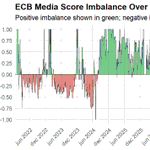
"It started during a mild night in October". Sentiment attention plots to Euroclear show how mild October was in contrast with December. Daily updates via: sentometrics.com/companies/b…

Kris Boudt retweeted

sentometrics.com now lets you look up 700K+ public company reputation pages and share them on social in seconds.

Check out APPELTANS's Reputation in the News on Sentometrics. sentometrics.com/companies/b…
Kris Boudt retweeted
En? Wat vinden jullie van de vernieuwde en verkorte @NBB_BNB_NL Business Echo? Met dank aan de nuttige samenwerking met studenten van @OptimizeRisk!
(Met de Belgische economie gaat het relatief “ça va nog” - dat is economisch jargon. Thanks for asking!)
nbb.be/en/media/23515