

Assistant Professor - decoding the complexity of vascular physiology and blood flow control, one ion channel at a time. @Harraz_Lab @UVMvermont
Burlington, VT
Joined February 2011
- Tweets6.1K
- Following4.7K
- Followers3.4K
- Likes9.9K


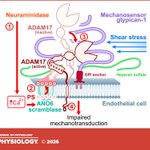


Mechanosensory Physiology:
Lymphatic vessels under pressure
@eLife @Asser_Fawzy @Harraz_Lab
🔗elifesciences.org/articles/1…

Wow!
mechanoLight: 💡A genetically encoded fluorescent biosensor for visualizing 5-HT2AR mechanotransduction in live cells | @PNASNews pnas.org/doi/10.1073/pnas.26…

Osama Harraz retweeted

Neural circuitry mediating hypercapnia-induced microarousal and impaired sleep depth | Science Advances science.org/doi/10.1126/scia…

Osama Harraz retweeted

🦕 Both @miriamcortese and myself had a lot of fun with this. Personally I like the globin hypothesis but I’m biased 🦕
annualreviews.org/content/jo…

Osama Harraz retweeted

@CircRes Oct 23rd Issue is Out! ahajrnls.org/3wPOBJJ
Cover: Activated T cells engage a susceptible endothelial-cell subpopulation through Fas ligand–Fas signaling, inducing endothelial apoptosis & contributing to remodeling of the pulmonary microvascular wall.

Osama Harraz retweeted

Our immune system helps fight cancer. Could it also offer clues about who’s at risk?
Pew-Stewart scholar Alexander Huang studies people with Lynch syndrome, an inherited condition that raises the risk of certain cancers, to find out.
Osama Harraz retweeted

🫀 Our new study in @CircRes uses a “Cell Village” concept with human iPSC-cardiomyocytes to investigate why cardiotoxicity (cancer drug sunitinib) varies between individuals.
@StanfordCVI @StanfordDeptMed @Stanford_ChEMH @GreenstoneBio @StanfordCancer
doi.org/10.1161/CIRCRESAHA.1…

So cool! @AndyShih_Lab!
Axons organize into micro-tracts around the cortical vasculature biorxiv.org/content/10.64898…

🧠Hypertension changes how brain blood vessels sense mechanical forces. Overactive Piezo1 disrupts cerebral blood flow and cognition, while Piezo1 inhibition reverses these deficits in mice. ahajournals.org/doi/10.1161/… @CircRes
🤖 Made with AI


Wow! This is amazing!

We posted a preprint on all-to-all functional mapping of a cortical microcircuit in vivo. biorxiv.org/content/10.64898…
Yitong Qi developed molecular tools, optics, and protocols for massively parallel optogenetic stimulation and voltage imaging during animal behavior.

Wow!

Every cell has an organelle signature — a “fingerprint” created from the shape, size & arrangement of its internal structures. HHMI scientists can now read these signatures across 1000s of cells, revealing how tissues adapt to diet & disease bit.ly/4j6DmoH 📹FelicianoLab


Osama Harraz retweeted

First finalist for the Stephanie Watts Early career award is Dr. Mohammad Saleem @saleemMMH taking about the intersection between lupus and salt sensitive HTN
@hypertension26 @KidneyInCVD @CouncilonHTN

Osama Harraz retweeted

Early start for 🔥 @AHAScience #Hypertension26❗️
Opening with @CouncilonHTN Chair Prof Reckelhoff & Vice Chair Prof Crowley welcoming us & wonderful to have our @American_Heart President Prof @manesh_patelMD 🔦 strength of our @CouncilonHTN @KidneyInCVD leadership & congratulations Program Cttee Chairs @jordy_bc & teams
1/n


Osama Harraz retweeted

It’s out! 🧠🩸Check our new paper in @NatureComms !
💡 We show that #BloodVessels and #BrainBarriers DO NOT suffer equally in #Neurodegenerative #BrainDisorders, but instead break down in different places and in different ways.
🔬 We combined in vivo #fluorescence #TwoPhotonMicroscopy, post-mortem #HumanBrain #Immunohistochemistry, #Electrophysiology and #Proteomics to show, using #HuntingtonsDisease as an example, that #Arterioles are the vessel type most susceptible to disinhibition of #adsorptive-mediated #Transcytosis (#AMT), while the #blood–#CSF barrier (#BCSFB) is more susceptible to #ParacellularLeakage than the capillary #BloodBrainBarrier (#BBB).
❗ Importantly, different vessel types also show different potential for rescue, highlighting that #brain #vascular #barriers should not be considered one homogeneous system.
👉 Read more here: lnkd.in/eCKUw7QU
👏 Thanks to all collaborators from @universitelaval, @neuroscience_dk @UCPH_Research @uni_copenhagen, @UCPH_health, @lunduniversity , @chudequebec , @UofGResearch
🙏 This wouldn't be possible without the help from funding agencies, including @lundbeckfonden, @novonordiskfond, and @DFF_raad.

I have always enjoyed reading work from the Shokat lab! Congratulations!
Congratulations to #HHMIInvestigator Kevan Shokat (@UCSF), awarded @sgpcri's '26 Stephenson Global Prize for his groundbreaking cancer research. By discovering a way to disable the cancer-driving protein KRAS, Shokat launched a new era in cancer treatment: bit.ly/47mCi9b

ALT "Portrait of Kevan Shokat, HHMI Investigator at the University of California, San Francisco, wearing a blue lab coat and smiling in a laboratory setting. Green banner reads 'Stephenson Global Prize.' Text below reads 'Kevan Shokat, HHMI Investigator | University of California, San Francisco.'"
Ion channels rock! ⚡️

This year’s medicine laureate Karl Deisseroth transformed the protein channelrhodopsin into a light-controlled switch for nerve cells.
Deisseroth introduced the gene for channelrhodopsin into nerve cells from rats. By illuminating the cells with blue light, he was able to trigger a nerve signal. He published this breakthrough in 2005. Two years later, he made this light-controlled switch for nerve cells work in the brains of living mice.
#NobelPrize

Osama Harraz retweeted

Why does something taste sweet, bitter, salty, sour or umami?
It feels automatic. You take a bite, and your brain seems to know instantly.
But behind that split-second sensation is a remarkably precise biological system and 2026 Wolf Prize in Medicine Laureate Charles S. Zuker helped reveal how it works.
His research identified the specialized cells and receptors responsible for the basic tastes, and showed how signals from the tongue are carried into distinct pathways in the brain.
In other words, taste isn’t simply about what touches your tongue. It’s about how the nervous system receives that signal, routes it, and ultimately gives it meaning.
Watch the video to see how Zuker’s discoveries helped turn one of our most familiar senses into one of neuroscience’s best-understood systems.
@hhmi_science @Columbia
🤖 Made with AI
Osama Harraz retweeted

Meet Tremella mesenterica (aka "witches' butter"), captured at the cellular level. This fungus's polysaccharides may hold medical potential — research has shown immune-stimulating, anti-inflammatory, & antiallergic effects.
📸: Igor Siwanowicz, HHMI Janelia Research Campus

ALT Tremella mesenterica (aka "witches' butter”), shown here at the cellular level via confocal microscopy. It looks like red and orange droplets.
Osama Harraz retweeted

What gives some colorectal cancer cells the ability to metastasize? In our new paper, we find that tumor-intrinsic ceramide synthesis is a metabolic switch for metastatic initiation. 🧵 Free access: science.org/eprint/UAMCP9BAE…