


volta retweeted

25 TRADES WON. 11 LOST.
THE 11 COST ME $19. THE 25 MADE ME $4,714.
my bot doesn't try to be right. it tries to lose small
every position: 8% of equity. every stop: -6%. no override. no "just this once"
a coin dumps 40% in 2 minutes the bot was out 38 minutes ago. -$2.40. done. next
a coin runs 847% in 11 hours the bot caught the first 310%. trailing stop locked it. exited clean. +$312 on one trade
11 losses × avg -$1.70 = -$19 total
25 wins × avg $189 = +$4,714 total
that's not luck. that's asymmetry
the bot lost 31% of its trades and still turned $500 into $5,214
because it never asked "what if it comes back"
it never moved a stop
it never held through hope
it just cut and moved on. 36 times. 3 weeks
you don't need to win every trade. you need your losses to be irrelevant


$4,714 from 36 trades. but the one that made me the most money was the trade i didn't take
6 bots said buy. 1 flagged a honeypot wallet. the judge killed it. the coin dropped 94% an hour later
if i was trading solo i would've bought that. no question
my bot runs 7 opinions on every coin. different logic each. they vote. but one red flag kills six green lights
next coin, 4 said yes, 3 said no. judge let it run. +$312 on a single trade
then there's the 8th seat. the LIAR. it argues the opposite of what it thinks. on purpose. if the other 7 can't handle one liar, the trade doesn't deserve to exist
7 opinions. a saboteur. a judge. every trade goes through all of them
$500 start. 3 weeks. not one trade was a solo decision
4
15
451
volta retweeted
8,900 PAIRS IN 3 WEEKS.
MY BOT BOUGHT 36.
7 agents. every new Solana memecoin goes through 5 kill rules before a human would even see the ticker
rule 1: liquidity under $40k or volume under $50k dead. 2,492 gone
rule 2: mint or freeze authority not revoked dead. 1,958 gone
rule 3: LP not burned or locked dead. 1,780 gone
rule 4: top 10 wallets hold more than 25% dead. 1,424 gone
rule 5: dev holds more than 3% or bundled buys above 10% dead. 891 gone
8,545 coins killed before the Analyst even looked at them
the remaining 355 got scored. anything under 70 vetoed. 102 more dead
253 went to the Judge. the Judge debated each one: organic growth? late entry? exit risk? 3 rebuttals or you don’t pass
217 didn’t pass
36 survived. 36 out of 8,900
25 won. 11 stopped at -6%
$500 → $5,214
the filter isn’t the boring part. the filter IS the system
full 7-agent setup + kill rules in my article ↓
what’s your filter killing that it shouldn’t?
$500 → $5,214. MY BOT DECIDED FASTER THAN YOU CAN READ THIS SENTENCE.
YOU NEED 4 HOURS TO EVEN OPEN THE CHART.
7 agents. a coin launches on Solana scanned, scored, debated, killed or bought before you'd finish reading its ticker name
8,900 pairs in 3 weeks. 8,545 dead on arrival. the remaining 355 scored. 253 went to the Judge. 3 rebuttals or you don't pass
36 survived. 36 bought. all before a single human saw the ticker trending
meanwhile a real trader sees it on Twitter 15 minutes later. opens DEXScreener. checks the chart. reads the comments. asks a group chat. "should I ape?"
by then my bot already bought, set a -6% stop, and moved on to the next coin
25 won. 11 stopped at -6%. $500 → $5,214
the edge isn't the strategy. the edge is the clock
full 7-agent setup in my article ↓
how long does your decision take?
volta retweeted
I BUILT A JUDGE THAT SCORES EVERY COIN BEFORE I BUY.
THEN I BUILT AN AGENT TO FOOL IT.
7 agents. 8,900 pairs filtered to 36 trades. $500 → $5,214 in 3 weeks
Sunday I took a dead coin — rugged, zero liquidity — wrote it a clean dossier and fed it to my own judge
score: 0.81. BUY. no hesitation. 30 seconds flat
my system just told me to buy a corpse because someone wrote it a nice résumé
so I added an 8th seat. one job: lie to the judge every Sunday
→ week 1: fake dossier. judge said BUY. patched the scoring
→ week 2: fake KOL mentions. judge caught it. score 34, VETO
→ week 3: forged deployer wallet. judge missed it. added cross-check gate
$500 → $680 → $1,340 → $2,100 → $3,400 → $5,214
the 7 agents found the trades. the liar made sure the judge deserved them
full 8th seat setup in the article ↓
you stress-test your judge, or the market does it for you
volta retweeted
HE STOPPED ASKING GROK IF A COIN IS GOOD.
HE GAVE IT A JUDGE THAT CAN'T TALK.
$500 → $11,101 in 5 days
six agents find the coins. the seventh can't write a paragraph. it answers 4 closed questions with a probability. that's it
organic? yes / no
late? yes / no
exit risk? 1–5
action? buy / watch / pass
under 0.70 = pass. second watch = pass. no answer = pass
the number that got me isn't 11k
it's 78. coins that passed every check and still got killed by the judge
59 of them were dead within 24h
and a 0.92 buy gets the same size as a 0.71
a model that writes can talk you into anything at 2am
a model that only answers can't


volta retweeted
Warren Buffett's first wife owned $3 billion in Berkshire stock. She lost his credit card. He never asked for it back.
"The guy was spending less than she did."
Her name was Susan Thompson. They married in 1952. Three kids.
In 1977, after 25 years, she moved to San Francisco. Warren stayed in Omaha.
They never divorced.
Before she left, she introduced him to Astrid Menks, a hostess at The French Cafe in Omaha. Asked Astrid to look after him.
Astrid moved in.
Every Christmas, the three of them signed the same card. "Warren, Susan and Astrid."
Years later, Buffett called her leaving his biggest mistake. Said it was "99% my fault."
Susan owned 2.2% of Berkshire Hathaway. At the time of her death, that was roughly $3 billion.
She died on July 29, 2004. She was 72.
Two years later, Warren married Astrid.
He joked about the credit card. Called losing Susan the biggest mistake of his life. She introduced him to the next one. For 27 years, they all signed the same Christmas card.
volta retweeted
A hedge fund with two Nobel Prize winners returned 43% and 41% in back to back years.
Then it lost $500 million in a single day.
The whole collapse fits in one sentence:
"If I have $100 billion of a position and I lose one percent, I've lost a billion dollars."
LTCM, 1998.
more than $100 billion in debt.
over $25 borrowed for every $1 of its own.
$4.6 billion gone in under four months.
14 banks put up $3.6 billion to wind it down.
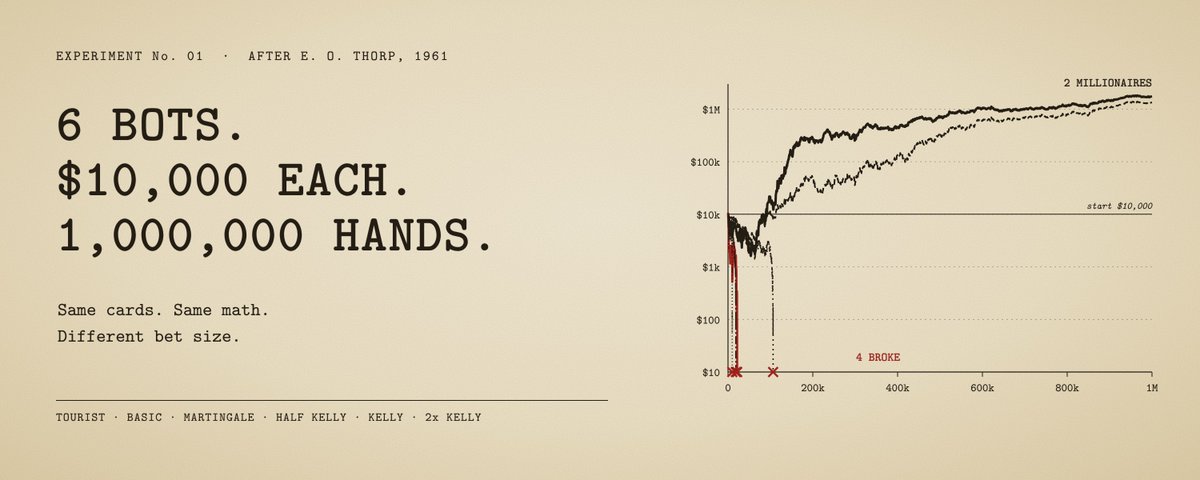
I gave 6 AI bots the same edge and changed only the size.
right size: $10,000 to $1.75M
double size: broke by hand 21,646
across 150 runs, doubling the size took the chance of ruin from 23% to 61%.
same edge. one fund, $500 million in a day. one bot, 21,646 hands.

volta retweeted
In 1961 an MIT mathematician published 3 pages proving the casino could be beaten.
A former bookie bankrolled the test. He won $11,000 in one weekend.
Then he took it to Wall Street. 227 of 230 months in profit. In 1991 he spotted Madoff's fraud. 17 years early.
the paper is still free. here is what is in it, and what came after:
1. blackjack has memory. every card dealt changes the deck that is left. when the right cards are gone, the edge flips to the player
2. bet small when the deck is against you, big when it is for you. the sizing came from a 1956 Bell Labs paper by John Kelly
3. the same year he and Claude Shannon built what is called the first wearable computer. built to beat roulette
4. he published the whole system as Beat the Dealer. 700,000 copies. casinos added decks and started shuffling early to kill it
5. in 1969 he pointed the same math at the stock market. 19.1% a year for nineteen years
6. in 1991 a client asked him to check their funds. he pulled 160 of Madoff's option trades. half never happened on the exchange. he told the client it didn't add up. the world found out in 2008
casinos changed the rules. the market never did.
three pages. still free.

volta retweeted
In 1999, Mark Cuban sold his company to Yahoo for $5.7 billion. He didn't get a dollar. He got stock he couldn't sell.
Broadcast.com had $22 million in revenue and a $16 million net loss. Yahoo paid entirely in stock. Cuban's cut: 14.6 million shares worth $1.4 billion on paper.
The lock-up: six months. He couldn't touch a single share.
Yahoo kept climbing. Hit $237. Cuban's stake reached $3.4 billion on paper. He called Goldman Sachs.
He bought put options at $85. Sold call options at $205. The premiums cancelled out. The trade cost him nothing. It locked his stock into a range: never below $85, never above $205.
Then the dot-com bubble burst.
Yahoo dropped 93%. From $237 to $13. Every founder who held their stock watched billions turn to nothing.
Cuban cashed out above $1 billion.
He bought the Dallas Mavericks for $285 million. Said one day's gain on his Yahoo position paid for the whole team.
Wall Street called it one of the top 10 trades of all time.
"Pigs get fat. Hogs get slaughtered."
The man who sold a money-losing company for $5.7 billion then bet that the money wasn't real. He was right.
volta retweeted
Mark Cuban told his dad he had $100,000 in the bank. His father never made more than $40,000 a year. He started crying.
Norton Cuban upholstered car seats in Pittsburgh. Six days a week. Left before dawn, home by seven.
One day a staple broke and hit him in the eye. Mark was about eleven. His dad got a glass eye and went back to work.
His parents were first-generation Americans. His grandparents came from Russia.
Mark sold garbage bags door to door at twelve. Paid his own way through college.
The day he told his father he had $100,000 saved, Norton cried.
"I don't know what the f*** you're doing, but keep on doing it."
Mark sold his first company, MicroSolutions, for $6 million. Then sold Broadcast.com to Yahoo for $5.7 billion.
Norton kept upholstering cars into his 70s. Mark couldn't get him to retire until he bought the Dallas Mavericks in 2000.
Norton died in 2018 at 92.
$40,000 a year. A glass eye from a staple. Never stopped working. The number that made him cry was $100,000.
volta retweeted
Mark Cuban's receptionist stole $82,000 from his first company with white-out. The account had $84,000.
The company was MicroSolutions. Dallas. Cuban was 27.
Her name was Renee. Her job was to put checks for their suppliers in envelopes and mail them. She covered the recipients' names with white-out, wrote in her own, and cashed them at the bank drive-through.
The bank called.
"You didn't cash them, did you?"
"Of course we did. We're a bank, sir."
$2,000 left. Suppliers still waiting to be paid.
Cuban and his partner called every one of them. Explained what happened. Asked for time. They all agreed.
In 1990, Cuban sold MicroSolutions to CompuServe for $6 million. After taxes, he kept $2 million.
Nine years later, he sold Broadcast.com to Yahoo for $5.7 billion.
Shannon Sharpe asked if they ever pressed charges. Cuban said they never found her. She probably changed her name.
He told the story on Club Shay Shay. Still spelled her name out, letter by letter.
$82,000 out of $84,000. White-out and a drive-through window. The company it almost killed sold for $6 million. The next one sold for $5.7 billion.
volta retweeted
Warren Buffett called Elon Musk "a brilliant guy." Charlie Munger's response: "We don't want that much failure."
May 6, 2023. Berkshire Hathaway annual meeting in Omaha.
Buffett pointed to Musk's interview with Bill Maher, eight days earlier. Said it was worth watching.
"He dreams about things, and his dreams have got a foundation."
Munger: "He likes taking on the impossible job and doing it. We're different. Warren and I are looking for the easy job."
Buffett: "It's a dedication to solving the impossible, and every now and then he'll do it. But it would be torturous to me or Charlie."
Buffett bought See's Candies in 1972. Dairy Queen in 1998. GEICO in 1996. Still owns all three.
Munger: "He would not have achieved what he has in life if he hadn't tried for unreasonably extreme objectives."
Then: "We don't want that much failure."
Musk tweeted back: "Appreciate the kind words from Warren & Charlie."
Seven months later, Munger died. Thirty-four days before his 100th birthday.
The last annual meeting they sat together. One of the things they talked about was the man who does the opposite of everything they ever built.
volta retweeted
Warren Buffett sold $134 billion in stocks in one year. The S&P 500 was at all-time highs.
In 2024, Berkshire Hathaway sold $143 billion in equities and bought $9 billion. Net: $134 billion out the door.
That was not one quarter. Between late 2022 and early 2025, Berkshire was a net seller for 10 consecutive quarters. Total: $174 billion.
No press conferences. No warnings. Just SEC filings, quarter after quarter.
The cash pile as of March 2026: $397.4 billion. The largest cash reserve any company has ever held.
Buffett created his own market indicator decades ago. Total U.S. stock market capitalization divided by GDP. His exact words: "If the ratio approaches 200%, as it did in 1999 and a part of 2000, you are playing with fire."
The ratio is now above 200%.
In 2007, he raised cash. In September 2008, Wall Street collapsed. Buffett called Goldman Sachs and wrote a $5 billion check. One phone call.
In 2008, his entire cash position was a fraction of what he holds today.
$134 billion sold. $397.4 billion in cash. The man who said 200% is playing with fire. The market crossed it.
volta retweeted
Warren Buffett lost $20 billion on a shoe company. He said it deserved a spot in the Guinness Book of World Records.
In 1993, he bought Dexter Shoe. A factory in Dexter, Maine. He called it a "business jewel."
He paid $433 million. But not in cash. He handed over 25,203 shares of Berkshire Hathaway.
Within a few years, cheap imports flooded the market. By 1999, 93% of shoes sold in America came from abroad. Dexter couldn't compete. The factory closed. 1,600 workers in a small Maine town lost their jobs.
The company went to zero.
Those 25,203 Berkshire shares are now worth over $20 billion.
In his 2000 letter to shareholders: "I clearly made a mistake in paying what I did for Dexter. I compounded that mistake in a huge way by using Berkshire shares in payment."
In his 2007 letter: "I gave away 1.6% of a wonderful business to buy a worthless business."
In his 2014 letter: "As a financial disaster, this one deserves a spot in the Guinness Book of World Records."
He wrote about the same mistake in 2000. In 2007. In 2014. In 2015. In his 2017 letter he added: "Today, I would rather prep for a colonoscopy than issue Berkshire shares."
Then at 94, after 60 years of shareholder letters, he wrote one line:
"Mistakes fade away. Winners can forever blossom."
$149 billion. $20 billion for a shoe factory in Maine. The mistake kept growing. So did Berkshire.
volta retweeted
Warren Buffett is worth $149 billion. He just called the stock market "a church with a casino attached."
The man is 95. He has been investing since 1962. The dot-com crash. The 2008 financial crisis. COVID. 60 years of watching markets panic, recover, and panic again.
On May 2, 2026, he sat down with Becky Quick at the Berkshire Hathaway annual meeting in Omaha.
"We've never had people in a more gambling mood than now."
He pointed at one-day options. Prediction markets. A U.S. Army soldier used advance knowledge of a military raid in Venezuela to bet on a prediction market. The Justice Department charged him with insider trading.
Buffett's words: "That's not investing. It's not speculating. It's gambling, just totally."
Then: "Prices for an awful lot of things will look very silly."
Berkshire Hathaway's cash as of March 31, 2026: $397.4 billion. The largest cash reserve any company has ever reported.
He did this before.
In 2007, he raised cash. In September 2008, the market collapsed. Buffett called Goldman Sachs and wrote a $5 billion check. One phone call.
His most famous line: "Be greedy when others are fearful."
At the end of 2025, he stepped down as CEO. Greg Abel took over January 1, 2026. Buffett stayed on as chairman. Kept every share of Berkshire he ever owned.
$397.4 billion in cash. Not buying.
$149 billion. The man who told you the market is a casino. And showed you his hand.
volta retweeted
Michael Bloomberg is worth $106 billion. He sat next to Warren Buffett and the CEO of Goldman Sachs and told them exactly who he'd hire.
Not someone from Harvard. Not Yale. Not Princeton.
The kid whose father never existed. Whose mother is a convicted drug dealer. Who worked three shifts at McDonald's to take care of his siblings.
"That's the kind of kid I want. With an ethic of taking care of his family. Because then he'll take care of others."
Bloomberg himself went to Harvard Business School. Class of '66.
He got hired at Salomon Brothers. $9,000 a year. Worked there 15 years. Made partner. Then got fired.
They handed him $10 million for his equity. He showed up to work the next morning. Different building. His own company.
He had two rules for building it.
Don't hire your relative. Don't hire your friend. Unless you absolutely have to.
And one rule for the office: rip down the walls.
No private offices. Not for executives. Not for managers. Not for him.
His desk is the same size as everyone else's.
"I'm not the smartest guy in the room. But nobody's going to outwork me."
Bloomberg LP. 20,000 employees. $15 billion in revenue. Zero private offices.
$106 billion. The man who told Goldman Sachs to stop hiring from the Ivy League.
volta retweeted
Howard Schultz is worth $3.5 billion. He once cried on camera telling a story about his father.
His father was a diaper delivery man in Brooklyn. Before the invention of Pampers. The family lived in the Bayview Projects. A two-bedroom apartment on the 7th floor. 150 families sharing one elevator.
In 1960, his father slipped on a sheet of ice. Broke his hip and his ankle.
No workmen's compensation. No health insurance. No severance. In 1960, if you were a blue-collar worker and you got hurt on the job, you were dismissed.
Schultz was 7. He came home and found his father on the couch with a cast from his waist to his ankle. He watched his father's self-esteem collapse. A World War II veteran who never finished high school. Held two, three jobs at a time just to buy food. Now lying on a couch with nothing.
Schultz started working at 12. Paper routes. A luncheonette. At 16, he worked in Manhattan's garment district, earning 5 cents per animal skin.
In 1987, he bought Starbucks. A handful of coffee shops in Seattle. He paid $3.8 million.
Then he did something no one understood. He gave every single employee health insurance. Including part-time workers. The first company in America to do it.
Then he added stock options. Also part-timers.
Starbucks was still a private company. Still losing money.
36,000 stores. 361,000 employees. All of them covered.
$3.5 billion. The kid from the Brooklyn projects who never forgot his father on that couch.