

We lead Women's Health research and teaching on Reproductive Medicine & Genetics, Maternal & Fetal Health, Cancer and Global Health @UniofOxford.
Oxford, England
Joined February 2019
- Tweets1.8K
- Following634
- Followers1.9K
- Likes2.2K




How can you tell if a food is ultra-processed? 🔎
In the second video from @SWilliamslab_OX, Oxford researcher, @_heidilong explains how to identify UPFs and share simple ways to reduce how much you eat.
🎥 youtu.be/piRzX09bATQ
#UPFs #OxfordResearch
Nuffield Dept of Women's & Reproductive Health retweeted

🎉What an amazing month of recruitment for the BASE Observational Study! 💙
A fantastic 53 babies recruited in October so far— a huge thank you to all our recruiting sites for their hard work and dedication! 👏
Let’s keep the momentum going! 🚀
@Ox_wrh @NPEU_Oxford @BASEtrial
Ultra-processed foods account for over half of UK adults' calorie intake. But what does the science tell us about their impact on health, including #FemaleFertility?
@SWilliamslab_OX team explores the evidence, uncertainties and unanswered questions.
youtu.be/pF0WkEi4XaM
👀 Keep an eye out for tomorrow's video from @SWilliamslab_OX and @_heidilong, exploring how to identify ultra-processed foods (UPFs) and tell the difference between foods.
#UPFs #OxfordResearch
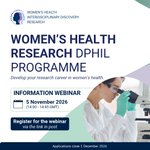
#WomensHealth remains critically under-researched but a new £12m @WellcomeTrust-funded programme will help train healthcare professionals to become the next generation of women’s health research leaders.
bit.ly/4z4OfvX
@UniofOxford @OxfordMedSci @oxford_brookes

At #VESICON2026, Professor Deborah Goberdhan delivered a plenary talk highlighting the role of Rab11a-exosomes and their potential to advance research into diseases such as #Alzheimer's and #cancer.
Read more: wrh.ox.ac.uk/news/exosome-re…
#ExtracellularVesicle

🧬 Considering a #masters in #ClinicalEmbryology or #ReproductiveGenetics?
Join Oxford's virtual open events to explore our MSc programmes, meet our world-leading teaching teams, and ask your questions.
🔗 wrh.ox.ac.uk/news/the-next-g…
@UniofOxford @OxfordMedSci @OxfordGradStudy

Interested in pursuing a career in #ClinicalEmbryology or #ReproductiveGenetics?
Our MSc programmes are taught by world-leading experts, with hands-on training in state-of-the-art facilities.
Register for our open events:
wrh.ox.ac.uk/news/the-next-g…
@UniofOxford @OxfordMedSci
Nuffield Dept of Women's & Reproductive Health retweeted

The @neogastric Trial Results Meeting has now taken place. Read more here bit.ly/4sn7vTD
@NPEU_Oxford @Ox_wrh

❤️ Cardiovascular mortality rates have fallen by 51% across 55 ESC countries since 1990 — but inequalities persist.
New Oxford research reveals important differences in cardiovascular disease between women and men.
#Cardiology #HealthInequalities


🔎 Key findings:
• Men experience more than twice the rate of premature cardiovascular mortality.
• Women face greater inequalities in cardiovascular disease burden between countries.
Read the research story: wrh.ox.ac.uk/news/major-euro…
Published in the European Heart Journal, part of @ESC_Journals
@escardio @UniofOxford @OxfordMedSci @nathalie_conrad
Where can an MSc in Clinical Embryology take you? Hear how the course inspired alumna Emily Robertson to pursue a research career.
#OxfordCareers @UniofOxford @OxfordMedSci
Where can an MSc in Clinical Embryology take you? Hear from alumna Clara Buccianti as she shares her Oxford journey and where it led next.
Follow us for the next video from our #AlumniVideoSeries
#OxfordCareers @UniofOxford @OxfordMedSci @TFP Fertility
Interested in clinical embryology or reproductive medicine?
Meet the course team, ask questions and learn more at our virtual open events on 21 October and 5 November.
wrh.ox.ac.uk/msc-open-events
#mastersatoxford @UniofOxford


Earlier today, we shared new research on Fit4Labour, an Oxford-developed AI tool designed to identify babies at risk earlier in labour. Prof. Antoniya Georgieva explains what sets the approach apart.
@UniofOxford @OxfordMedSci #LabourMonitoring #SaferBirth #MaternityCare

Do you work in a neonatal unit?
Help inform research into respiratory care for babies born at 34–38 weeks.
Our survey takes just 3 minutes. Please take part & share with neonatal colleagues.
🔗 surveys.npeu.ox.ac.uk/respir…
@NPEU_CTU @mbrrace @NPEU_Oxford @Blisscharity @RCPCHtweets

Could new tech help identify babies at risk earlier during labour? Oxford researchers have developed Fit4Labour, a new data-driven tool designed to support more objective, individualised risk assessment.
Learn more: wrh.ox.ac.uk/news/a-novel-di…
@UniofOxford @OxfordMedSci #Maternity
Interested in reproductive genetics? Discover Oxford's MSc in Reproductive Genetics at our virtual open events.
Explore the course, meet the team and ask your questions.
🔗 wrh.ox.ac.uk/msc-open-events
@UniofOxford @OxfordMedSci
#ReproductiveGenetics


Help shape research for premature babies with breathing difficulties. The OPTIMISE trial is looking for parents whose baby was born more than 8 weeks early to join our Parent Advisory Group. No research experience needed.
📧 [email protected]
@NPEU_CTU
