


P1eSenb retweeted
a robot just mopped a floor, washed dishes, brought coffee, peeled an orange and poured tea in a real house.
it knelt by a red bucket with a rag. stood at the sink with a pink cloth. walked over with a cup. held fruit in both hands. poured from a kettle outside.
no special tools. no factory floor. just the same bucket, sponge, cup and table a person already uses.
people still think robots only work in labs. this one is already doing the chores that never end.
P1eSenb retweeted
China already put 50 robot cops on real streets.
They issued 170,000 warnings.
In Hangzhou they stand at intersections, spot helmetless riders, and wave traffic like human officers.
Company data says some violations dropped over 40%.
No arrest power. Just cameras, speakers, and a shift that does not get tired.
They want 200 of them by year end.


P1eSenb retweeted
This is Real Steel but it’s already happening
Two robots just fought in a live arena.
One takedown. One knockout. Crowd screaming through the glass.
No humans in the cage.
Just machines tearing each other apart while people watch and bet.
What used to be a movie
is now a championship with a scoreboard and a round timer.
The future of fighting isn’t coming.
It’s already in the ring.
P1eSenb retweeted
She moves like no human ever could
Every turn is perfect.
Every pause is deliberate.
No hesitation. No wasted motion.
The body is synthetic.
The face is generated.
But the dance feels more alive than half the people you know.
Watch the way her weight shifts.
Watch the micro-expressions.
Watch how the light hits skin that doesn’t exist.
This isn’t a filter.
This isn’t deepfake dancing over a real person.
This is a full digital human
trained to perform
and already better than most professionals.
The uncanny valley is gone.
What’s left is just better.
P1eSenb retweeted
At Belgrade Expo 2026 a T800 skull raised its hand and said “Hello, I am Alice Model T800.”
A perfect blonde face sat on bare titanium ribs and carbon fiber while a woman in a white coat fixed the hair and the crowd filmed every second.
The uncanny valley just got a name tag.
P1eSenb retweeted
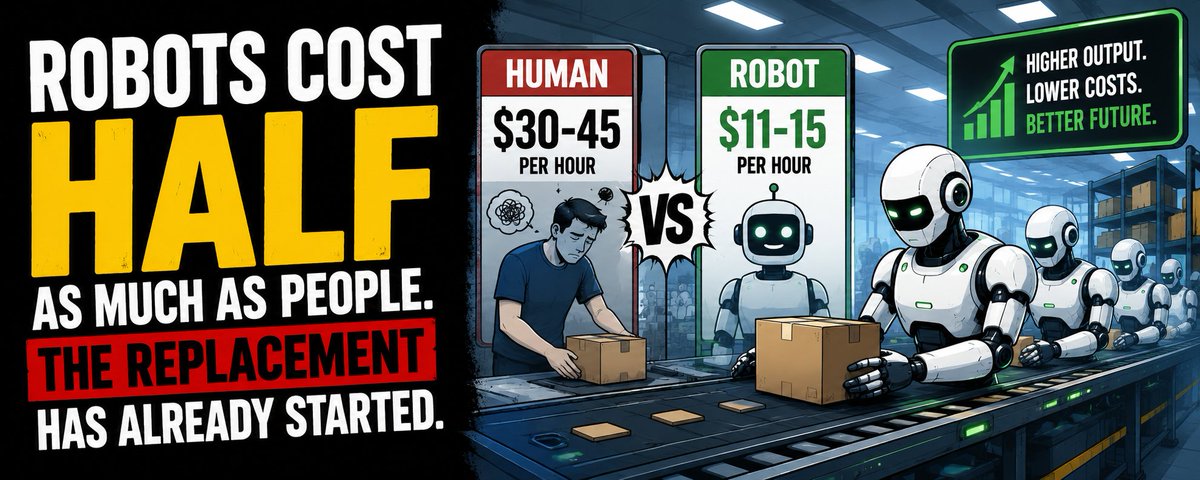
Restaurant fired its two wok chefs, installed one robot, and jumped to 68% gross margin overnight
The white humanoid leans into the open flame at 7:40 PM.
Metal wrists snap the wok, launch the noodles, catch every strand mid-air.
No cough. No burn. No overtime.
That station used to bleed $3,800 a month in wages and turnover.
The robot runs for $600 and never misses a shift.
Kitchen footprint shrank from 70 square meters to 25.
Table turns hit 10 times a night.
The $1,400 unit paid for itself in nine months.
They ordered forty more before the week ended.
The fire still burns.
The humans stay gone.
P1eSenb retweeted
19-year-old feeds one black swimsuit still into Claude and banks 32.000 dollars in 14 days
Laptop open at 11:40 PM.
Blonde waves, gold hoops, heart pendant resting in the cleavage of a tight black one-piece. Soft green eyes, slight pout, one hand brushing the neck.
Kling turns the frame into a 12-second sway.
TikTok gets three versions a day.
Day 5: 50,000 followers.
Day 8: Fanvue live at $9.99.
562 men hit subscribe before the second week ends.
No real girl.
Just that one pose looping under soft bedroom light.
Two weeks. 32.000$
P1eSenb retweeted
19 year old Kai just banked $33K in 14 days selling AI body models.
No camera. No models. Just prompts and folders.
He fine-tunes one base checkpoint overnight, exports clean packs of 40 poses, lists them at $147 each. Fashion brands and OnlyFans creators buy in bulk before lunch. Three sales close while he still has cereal in the bowl.
The same files that took 9 hours to train now print money on autopilot. He checks the dashboard once, closes the laptop, and walks out.
The models never sleep. Neither does the revenue.

P1eSenb retweeted
A human spent five years learning. A robot mastered it in ten seconds.
Zero humans required.Silver fingers hit every key in perfect time.
No missed notes. No fatigue.
Behind them a white biped spins, jumps, throws its arms to the neon lights like it owns the beat.The room fills with music and motion that used to need a pianist and a dancer.
Now one pair of arms and one frame do both jobs at once. Crowds still gather. Tickets still sell. The difference is the performers never ask for a break or a raise.
Art used to be the last human stronghold. The stage just hired its first full robot duo.
P1eSenb retweeted
10 seconds of pure motion. One robot. Zero humans still matching this balance in 2026.
Arms cut the air. Knees drop. Torso snaps. The black helmet stays locked while metal feet pound wood like it owns the floor.
No cables. No remote. Just speed, power, and perfect recovery after every twist.
Owners used to film straight-line walks. Now they film the dance because the reaction is louder. Views explode. Shares multiply. The same machine that can haul boxes suddenly sells the future harder than any demo reel.
The future does not walk in. It already knows the steps.
P1eSenb retweeted
Tesla’s Optimus just took a popcorn job. One black robot. Zero wage. Crowds form to talk to it.
At the diner counter a visitor slides an empty white bag across the table. Optimus reaches out, takes the bag with both hands, turns to the machine, scoops, and returns it full.
People do not queue for the kernels. They queue for the exchange. The robot never looks bored. It never rushes.
The novelty turns a 40-second transaction into a 2-minute conversation. Repeat visits climb. Tickets move faster.
Sales rise because the customer stays longer and comes back for the story, not the snack.
Human staff still exist. They just no longer stand behind the popcorn machine.
P1eSenb retweeted
Laundry just became the next job robots took - this one emptied the basket in 25 seconds and never asked for a raise.
Black fingers dig into the floral basket. Pink shirt. Blue cloth. Leopard print. Yellow rag. Piece by piece into the open Electrolux drum.
The robot stays crouched the entire time. No stretch. No sigh. No check of the clock.
A human needs twenty minutes of bending and stuffing for the same load. The machine finishes before most people unlock their phone.
No wage. No sick days. No attitude about the dirty socks.
One unit runs every cycle for years on electricity alone. The average home burns four hours a week and two thousand dollars a year on laundry help or lost time.
The basket sits empty. The drum sits full. The human walks free.
P1eSenb retweeted
Even the strip club is next. One Chinese lab robot just ran a full pole routine in 13 seconds.
White fingers lock on the chrome. The base spins. Hips roll hard. High heels dig in. One leg lifts clean. The sequence never breaks.
Three feet away a woman in an open lab coat stands arms crossed. She tugs the coat once and keeps watching the hips. No smile.
A man in a dark suit steadies the second unit behind her. Blank robot heads stare from the shelves under the fluorescent lights.
This is not a demo. This is the factory floor.
Human dancers train months for the same moves. The machine runs them on command, every hour of the night. Zero fatigue. Zero attitude. Zero tips.
Club owners already ask the price. One unit works the full shift.
The pole does not care who holds it.


P1eSenb retweeted
China expects over 100,000 humanoid robots in 2026.
The technician lifts the head straight off the neck. Green light dies. Wires hang free. The face still smiles for half a second.
He sets a new one on the collar. Soft skin. Perfect teeth. It blinks, tilts, locks eyes with the crowd.
These are not scripted dolls. Each head runs on embodied AI trained on millions of human expressions and conversations. Vision-language models let it read faces, hold eye contact, and shift emotion in real time.
Chinese firms already control nearly 80 percent of global humanoid shipments. Production is racing past 100,000 units this year. The market is projected at $2 billion now and $15 billion by 2030.
The heads on the floor look identical until you notice one is frowning.
The body stays the same. The AI face is whatever you need next.

P1eSenb retweeted
2,000 HUMANOID ROBOTS JUST ORDERED FOR CHINESE GARMENT FACTORIES.
They sit at the sewing machines right now. Silver arms guide black fabric under the needle. Blue light rings their faces. Humans still work the next stations, but the robots do not blink, do not tire, do not ask for breaks.
Jack Technology wants 30 percent more output. Payback on each unit sits around 18 months. Success rates on fabric handling already hit 97 percent in trials. The government wants 10,000 humanoids on factory floors by year end.
This is the same growth wave that pushed China’s core AI industry past 1.2 trillion yuan. Manufacturing employment has already shed tens of millions of roles while robot density climbed nearly ninefold. Analysts put roughly 70 million jobs at high risk of replacement.
The machines learn the soft, slippery material faster than new workers. They run through the night. The humans beside them watch the line keep moving without them.
The needle does not care who feeds it.


P1eSenb retweeted
19 seconds of AI erased a $38,000 practical effects shoot that took 72 hours to build.
The wave rose under studio lights.
White water swallowed the Transamerica Pyramid first. Coit Tower disappeared. The Golden Gate Bridge folded like wet paper. Tiny cars floated past the ferry building as the model city vanished under foam.
Eight men in black Effects Crew shirts worked the circular track. One pushed a camera dolly through rising water. Another swung a crane arm. They had spent three full days gluing every window, painting every roof, placing 47 miniature cars by hand.
The client paid $38,000 for the five second shot.
That afternoon a solo creator in Lisbon fed the same reference frames into Runway and Kling. The AI version finished in 19 seconds. He uploaded the clip to a stock library and collected $1,850.
No set.
No crew.
No overnight builds.
Just the prompt and the payout.


P1eSenb retweeted
29 year old operator cleared $54,700 in 78 days shipping private LoRAs of consistent female characters to 27 agencies.
He finished the fourth training pass at 2:08 AM. Base was Flux.1 Dev. Dataset: 1,380 tagged frames across six lighting setups and three body types. One agency generated 5,200 unique looks in nine days without a single model booking. Another cut talent fees from $11,400 a month to $2,100.
He never released the faces. Never sold a public pack.
Price: $1,900 per locked character set. Nine deliveries last cycle. Net after GPU: $17,300.
The difference is not the architecture. It is the 34 specific failure notes he logged from the first buyers—hands, skin texture, gaze that killed conversion.
Clients pay for the versions that already survived their rejection folders.