

Next generation #LiteratureReview is here with our #AI-powered #EvidenceSynthesis platform & services, customized to meet your protocol and project needs.
Worldwide
Joined May 2021
- Tweets212
- Following475
- Followers276
- Likes335



Before you start a systematic review, search PROSPERO, OSF Registries, and the published reviews. PubMed indexed 43,908 systematic reviews in 2025, about 120 a day.
#SystematicReview #PROSPERO #EvidenceSynthesis

2
61
The median systematic review in PubMed had three authors in 2000 and six in 2025. The 90th percentile went from six authors to 11.
How many authors did your last review have?
#SystematicReview #ResearchMethods #EvidenceSynthesis

1
24
Scoping reviews were 0.3% of evidence syntheses in PubMed in 2010. In 2025, they were 14%: 7,826 records.
Umbrella reviews, which review other reviews, went from 10 to 751.
#ScopingReview #UmbrellaReview #EvidenceSynthesis

1
24
Systematic reviews in PubMed: 1,413 in 2000, 43,908 in 2025.
Randomized trial reports: 11,160 and 30,852.
Reviews passed trial reports in 2020 and stayed ahead every year since.
#SystematicReview #EvidenceSynthesis #MetaAnalysis

2
42
We published a new article: in 2025, PubMed indexed 43,908 systematic reviews and 30,852 randomized trial reports. Reviews have outnumbered trial reports every year since 2020.

2
30
“…researchers still weren’t using AI in projects.”
Ley Muller, Values-Driven AI: people who know what a classifier is still need help to use one in review software.
#SystematicReview #EvidenceSynthesis #MachineLearning
1
40
The test for a review tool is what it logs.
- Who screened each record.
- Whether screeners were blind to each other.
- Why each exclusion happened.
The same test applies to any tool that offers a systematic review workflow.

1
28
In 1,007 risk of bias ratings of PFAS studies, expert reviewers gave no high-risk rating. An AI gave 36. Its reasons show a pattern: it judged real studies against an ideal design.
#RiskOfBias #PFAS #SystematicReview
1
17
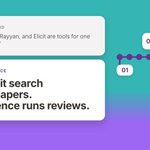
An Elicit search and a Covidence review answer different questions.
Covidence, Rayyan, and Elicit get compared as if they did one kind of work. A Covidence review and a Rayyan review are the same job in two review platforms. An Elicit search runs in an AI discovery assistant, built to find and summarize papers.
- An Elicit search asks what the literature says about a topic.
- A systematic review asks which studies meet criteria fixed in a protocol.
A systematic review also has to show the decision behind every record it rejected, and that requirement decides the class of tool. The Cochrane Handbook makes it mandatory that at least two people decide independently whether each study meets the eligibility criteria. It also requires a selection record good enough to build a flow diagram and a table of excluded studies. A ranked answer from a tool’s own index produces neither record.
The boundary between the classes has started to shift. Elicit now also runs a separate Systematic Review workflow. By its own account it supports PRISMA 2020, dual screening with an exclusion reason for every decision. That puts the workflow in the platform class, next to Covidence and Rayyan.
Discovery assistants still earn a place early in a review. They help scope a question, check whether a review already exists, and find seed papers for the search strategy.

1
35
“Most evidence synthesis projects don’t fail because of bad methodology.”
Eitan Agai, PICO Portal: tool hand-offs can break the audit trail.
#SystematicReview #EvidenceSynthesis #AuditTrail
2
57
Same study, same passages, same instructions, five runs. The AI gave the same risk of bias rating in all five in 62% of cases. A majority vote did not help: 64% against 64.5% for one run.
#RiskOfBias #Reproducibility #SystematicReview
1
17
Feature lists hide the difference between review tools.
We have published the fourth guide in our review series, on Covidence, Rayyan, and Elicit. It covers three classes of tool, eight workflow stages, and when a free tier is enough.

7
To use an AI in risk of bias today: two reviewers rate, the AI rates the same passages, every conflict goes to an adjudicator. Then report the model and the prompt, as PRISMA 2020, item 11, asks.
#RiskOfBias #PRISMA #SystematicReview
1
27
PRISMA 2020, item 11, asks you to report any automation tool in risk of bias assessment. For an LLM, write down:
- the model and its version
- the prompt
- its role: rater, check or adjudicator
Peer reviewers will ask for it.
#PRISMA #RiskOfBias #SystematicReview

1
30
An AI and expert reviewers disagreed on 85 risk of bias ratings. A third expert sided with the reviewers in 47% and with the AI in 31%. In confounding, the AI was right more often.
#RiskOfBias #SystematicReview #AIinResearch
1
23
An AI rated studies stricter than expert reviewers for one main reason: missing details. The experts assumed the method was fine. The AI counted the gap as a possible bias. That explains 40% of the conflicts.
#RiskOfBias #ResearchMethods #SystematicReview
2
24
An AI and two expert reviewers disagreed on 85 risk of bias ratings. A third expert rechecked them. The final rating sided with the reviewers in 47% and with the AI in 31%. In confounding, the AI was right more often: 36% to 29%.
#RiskOfBias #SystematicReview #AIinResearch

1
67
One AI, two risk of bias domains: 90.3% agreement with the experts on conflict of interest, 27.6% on selection bias. Check the AI hardest where the judgment is hardest.
#RiskOfBias #NavigationGuide #SystematicReview
1
25
One set of AI ratings scored 0.199 on Cohen’s kappa and 0.882 on Gwet’s AC2.
Both numbers describe how GPT-5-mini matched expert reviewers on risk of bias in 128 studies.
- Weighted kappa 0.199: poor
- Gwet’s AC2 0.882: almost perfect
- Plain agreement: 64.5%
The cause is the data. 924 of the 1,007 expert ratings were low risk. With one category that large, kappa treats most agreement as chance, and the score falls.
When you read an LLM evaluation, ask for the plain percentage and the share of each rating category.
#RiskOfBias #Statistics #SystematicReview

1
3
30
An AI matched expert reviewers on risk of bias in 64.5% of 1,007 ratings. The experts matched each other in 81.2%. When the AI disagreed, it was almost always stricter.
#RiskOfBias #SystematicReview #AIinResearch
1
51