

Comparative PIE phoneme inventory an IE sound law system digitised. Reading some Hieroglyphic Luwian while introducing improvements on PIE. Tweets @JounaPyysalo
University of Helsinki
Joined December 2012
- Tweets15.4K
- Following3.8K
- Followers7.8K
- Likes6.5K




Pinned Tweet
Hittite Mountain God Statue electrum (a gold-silver alloy): The iconography mixes elements of portrayals of the Storm-Gods, and so one can interpret it also as Tarhunza/Teshub, but the scales making the long kilt definitely point to a Mountain-God:

Proto-Indo-European Lexicon retweeted

Malatya Arslantepe'den (Melid) aslan avı sahnesinin betimlendiği ortostat.
Ankara Anadolu Medeniyetleri Müzesi'nde.
(MÖ 1. bin)

Proto-Indo-European Lexicon retweeted

Twelve thousand years ago, on a limestone ridge in what is now southeastern Türkiye, people hauled stone pillars taller than a house into place and carved wild animals into their surfaces. They had no metal tools and no written language.
turkiyetoday.com/culture/the…

Proto-Indo-European Lexicon retweeted
A piece of Hittite pottery excavated in southern Türkiye depicts two lions and a gazelle or female deer in an arrangement unlike any previously identified on excavated Hittite relief-decorated ceramics.
anatolianarchaeology.net/hit…

Proto-Indo-European Lexicon retweeted

#Natufian 12,000 years old clay figurine depicting a human face 🙂, colored red with #ochre🔴 and with a headdress decoration made of perishable materials🌼🪶from @EynanMallaha
One of the 15 newly discovered #Natufian clay figurines
doi.org/10.1371/journal.pone…

Proto-Indo-European Lexicon retweeted

The Natufian culture of the Levant established some of the world’s first permanent settlements around 15,000 years ago. Archaeologists have found evidence that communities adapted to the desert by feasting on reptiles—especially snakes and lizards.
archaeology.org/issues/novem…

ALT Snake (📸 Ryan van Huyssteen via iNaturalist.org)
Proto-Indo-European Lexicon retweeted

A 3,300-year-old Hittite god in gold.
Standing just 3.8 cm tall, this pendant depicts a deity wearing a horned headdress and holding a weapon.
Discovered in Yozgat, Türkiye, in 1894.
📍 Louvre Museum, Paris | AO 9647

Proto-Indo-European Lexicon retweeted
A royal cuneiform inscription discovered more than a century ago at Karkemish in southeastern Türkiye has been attributed to the wrong king for decades.
anatolianarchaeology.net/los…

Proto-Indo-European Lexicon retweeted

Des figurines en argile de 15 000 ans, révèlent une tradition artistique bien plus ancienne qu’on ne le pensait au Moyen-Orient. Recueillis sur trois sites natoufiens en Israël (Eynan-Mallaha, Hayonim, el-Wad), ces découvertes montrent que les chasseurs-cueilleurs sédentaires utilisaient déjà l’argile à des fins symboliques plusieurs millénaires avant l’apparition de l’agriculture et la poterie.
phys.org/news/2026-11-clay-f…

Proto-Indo-European Lexicon retweeted

🚨 CONFERENCE: Archaeo-Informatics 2026
24-25 November, Istanbul
Co-organised by DAI-Istanbul, METU and BIAA
You can now register for online or in-person participation, or download the programme at biaa.ac.uk/events/conference…

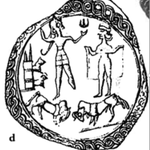
Two Hittite gentlemen wrote their names in BoHa 14.308 (= Bog. V.22) impression more than three millennia ago: Surprisingly the item is a Syrian-styled cylinder seal, not a circle stamp seal...

Proto-Indo-European Lexicon retweeted

Kültepe Tabletlerinde 4.000 Yıllık Bir ‘Bira Evi’ Ortaya Çıktı
arkeofili.com/kultepe-tablet…

Proto-Indo-European Lexicon retweeted
10,000-Year-Old Stone Bowl from Nevalı Çori May Depict Dancing
anatolianarchaeology.net/100…

A seal supporting the idea that the Hittites were also involved in the ‘bull-jumping’, traditionally attributed to the Minoans. Boehmer & Güterbock (BoHa 14.147):

One of the most beautiful Hieroglyphic Luwian seals of all, Ras Šamra (RŠ 17.74): If you can read it, you can read a lot:

Proto-Indo-European Lexicon retweeted
Lost Hittite Royal Archive Reveals 3,400-Year-Old Epidemic, Princess’s Death and Military Crisis
anatolianarchaeology.net/los…

Proto-Indo-European Lexicon retweeted

As part of the ISAC Museum's special exhibition, "Hartapu: The Forgotten King of Anatolia," ISAC Museum Curator and Special Exhibits Coordinator, Kiersten Neumann (@knpazuzu), has curated a case in the ISAC Museum Orientation area in the Mesopotamian Gallery. This case tells the


Proto-Indo-European Lexicon retweeted

Tarihte yazılı ilk kelime "TANRI" :
Göbeklitepe'de CHƆ Sembolü "Tanrı" anlamına gelmektedir,
Luvi Hiyeroglifindeki Tanrı işareti ile aynıdır,
“World’s First Known Written Word at Göbeklitepe on T-Shaped Pillar 18 Means God”
M. Seyfzadeh and R. Schoch, Archaeological Discovery

Proto-Indo-European Lexicon retweeted
New Fragment of One of the World’s Oldest Peace Treaties Found in Hattusa Reveals Ancient Rules for Fugitives
anatolianarchaeology.net/new…

Proto-Indo-European Lexicon retweeted
More than 100 rock carvings of mountain goats, deer and other animals in Türkiye's northeastern Kars province are giving researchers a window into how early communities lived alongside nature.
turkiyetoday.com/culture/anc…

Proto-Indo-European Lexicon retweeted
Three new works by SaraNoa Mark are on exhibition in the ISAC Museum in connection with the special exhibition, "Hartapu: The Forgotten King of Anatolia." Displayed in the Syro-Anatolian Gallery and the Special Exhibit Gallery and curated by Kiersten Neumann, these works reflect


