

Institutional algorithmic trading. CEO @robuxio_com. 20 years across asset classes. Author of The Algorithmic Crypto Playbook.
Joined September 2021
- Tweets9.3K
- Following284
- Followers12.3K
- Likes6.7K





Pinned Tweet
Robuxio Equities is launching:
1/ The key question: how to compound across different market regimes.


QQQ fell 6.5% yesterday. What to expect in the following days:
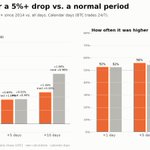
1/ On average, 1, 5 and 10-day returns are positive.

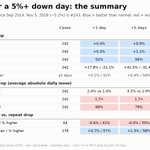
6/ To sum up:
1. The next day is a coin flip. QQQ was higher in 49% of cases, slightly below a normal day.
2. 3-5 days is the horizon with a real edge: median +2.2%, higher 65% of the time.
3. At 10 days the edge is gone. The median is −0.3% and only 49% of cases were higher. The average looks positive only because of a few huge rebounds.
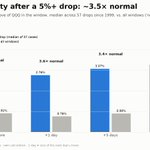
4. Volatility stays about 3.5 times normal for at least two weeks, in nearly every case (98%).
7/ Statistical siginificance
Price action: Not very statistically significant. QQQ was higher 49% of the time after 1 day, 65% after 5 days and 49% after 10 days.
All within what luck alone could produce (p = 0.14 to 0.51), so a crash day doesn't predict direction very well.
Volatility: Highly significant. QQQ kept swinging about 3.5 times more than usual over the next 10 days in up to 98% of cases (p ≈ 0.00000001 or smaller).
This shows the volatility clustering effect well - calm days tend to follow calm days, and volatile days follow volatile days.
Today's price action shows what kind of TradFi perps Binance onboarded this year.
An equally weighted index of all stock perps is down more than the average of all tradable crypto perps (including all the shitcoins!).

There's so much survivorship bias and so many pure lies in the crypto space.
This is the YTD index of crypto funds and CTA programs. Self-reported, so probably on the optimistic side...
Average of 100+ vehicles.

1/ Democrats flipped both chambers last night.
Only the 7th time ever a president's party lost the House and Senate together in a midterm.
Here's what the S&P 500 did after the previous 6:
3/ Best: 1954 (+33% in a year).
Worst: 1946 (roughly flat, post-war inflation).
2006 rose 6.7%, but the market peaked in Oct 2007, right before the financial crisis.
The biggest added value in algo trading is experience.
With AI you can run unlimited automations and thousands of tests.
But more tests only means more chances to find something that worked by accident.
AI won't make most people better researchers.
There aren't many shortcuts to a deep understanding of market mechanics.