

New Number Theory papers from https://nitter.cf/t.co/NKuVGAyUNC: prime numbers, diophantine equations. Thank you to arXiv for use of its open access interoperability.
- Tweets11.7K
- Following2
- Followers279
- Likes2





ALT We obtain improved bounds for bilinear and trilinear forms with Kloosterman fractions, building on the works of Duke-Friedlander-Iwaniec and Bettin-Chandee. Our results use the spectral theory of automorphic forms, and save N¹/¹² A¹/³ over the trivial bound when M = N and A is small. In the exceptional Maass spectrum, we rely on a new large sieve inequality with averaging over the levels, which may be of independent interest. Applications include an asymptotic for the second moment of the zeta function twisted by a Dirichlet polynomial of length T⁰.⁵³² (improving Bettin-Chandee-Radziwill's T⁰.⁵¹⁵ and Dong-Robles-Zeindler's T⁰.⁵¹⁸), as well as an improved level of distribution for unbalanced convolutions (improving results of Fouvry-Radziwill, Wright, and Dong-Robles-Zeindler).

ALT Let α> 0 be irrational. We show that ω(⌊αn²⌋) obeys a Gaussian distribution. That is, for n chosen uniformly at random from {1,…,N}, the random variable (ω(⌊αn²⌋) - loglog N)/√(loglog N) converges in distribution to the standard Gaussian as N tends to infinity. Additionally, we fully describe the distribution of ω(⌊αn²⌋) for a positive rational α.

ALT Let (a,b,c) be a pythagorean triple, i.e., a²+b²=c². Then (c,a) and (c,b) are hypotenuse-leg pairs (hl-pairs), i.e., pairs (c,d) of positive integers such that c²-d² is a non-zero square. An hl-pair (c,d) is called a pythapotent hl-pair of degree h if there is a pythagorean pair (k,l), which is not a multiple of the pythagorean pair (d,√(c²-d²)), such that (cʰk,dʰl) is again an hl-pair. To each hl-pair (c,d) and each h≥ 1 we assign the elliptic curve Γcʰ,dʰ: y²=x³+(c²ʰ-d²ʰ)x²-c²ʰd²ʰx and show that its torsion group is \Bbb Z/2\Bbb Z×ℤ/2ℤ and that (c,d) is a pythapotent hl-pair of degree h if and only if Γcʰ,dʰ has positive rank over ℚ. In this case there are infinitely many such pythagorean pairs (k,l), not multiples of each other. Moreover, every hl-pair is a pythapotent hl-pair of degree 1 and a pythapotent hl-pair of degree 3, and we give sufficient conditions for degree 2. The two cases (c,a) and (c,b), where a=m²-n² and b=2mn, are worked out separately.

ALT We classify the conjugacy classes of isometries in the orthogonal group of regular quadratic modules over Artinian local rings with finite residue fields, provided that the characteristic is odd and coprime to the order of the isometry. (More generally, the same classification holds over Henselian local rings with finite residue fields, such as the ring of p-adic integers.) The main idea is to lift results over finite fields to local rings by using the Henselian property. By applying these results to the residue class rings ℤ/(pˡ), we also obtain a classification of the conjugacy classes of isometries of discriminant forms, under the condition that the order of the discriminant form is odd and coprime to the order of the isometry.

ALT Let N(a) denote the number of occurrences of the integer a>1 in Pascal's triangle, and set ℰ_H={a≥3:N(a)>2H}, A_H(x)=|ℰ_H\cap[1,x]|. For every fixed K≥2 we prove the expansion A₁(x)=\sum_k=2^K(k!x)¹/k+O_K(x¹/(K+1)). Consequently, the Dirichlet series D₁(s)=\sum_{a∈ℰ₁}a^-s extends meromorphically to \Re s>0, with simple poles precisely at s=1/k, k≥2, of residue (k!)¹/k/k. For every H≥2, x≥ 3 and every ε>0, we prove A_H(x)≤ A₂(x)≤exp(2log x/(loglog x)¹/4)\llε xε. Hence D_H(s)=\sum_{a∈ℰ_H}a^-s is holomorphic for \Re s>0 when H≥2, and λ(ℰ₁)=1/2, λ(ℰ_H)=0 (H≥2). Here, for a set S⊆ {mathbbN}, its exponent of convergence is λ(S)=inf{σ>0: \sum_n∈Sn^-σ<∞}. We also determine the logarithmic-order counting law for the classical Lind–Singmaster family of coefficients of multiplicity at least six.

ALT In 1992, Darmon formulated refined conjectures of Birch and Swinnerton-Dyer type for Heegner points, and proved the “order of vanishing” part of his conjectures by a development of Kolyvagin's Euler system arguments. In this paper, for good ordinary primes split in the underlying imaginary quadratic field, we prove the p-part of the “leading coefficient formula” conjectured by Darmon, as well as its derived strengthening by Bertolini-Darmon. Our method, which also offers a novel perspective on earlier results, is based on the formulation and proof of new equivariant anticyclotomic main conjectures, including an equivariant extension of Perrin-Riou's Heegner point main conjecture.

ALT In this paper we develop non-archimedean analogues of the Petersson-Kuznetsov formulas. Specifically, choosing a particular test function on either the geometric or spectral side of the formula, one may express the other side in terms of integral transforms. Such transforms involve representation theoretic Bessel functions attached to irreducible unitary admissible representations of PGL₂(ℚₚ).

ALT Supposing the Lindelöf Hypothesis for the Riemann zeta function we prove that the density hypothesis holds for Res>3/4 for a large class of Dirichlet series. The first result of similar type was reached by Gábor Halász and Paul Turán in 1969.

ALT We give a pairing which describes the first Galois cohomology of a pseudo-reductive group G over a local function field K as the Pontryagin dual of the group \Ext¹(G, \Gm) of translation-invariant line bundles on G. In order to accomplish this, we endow the Picard group of a scheme X over a (Hausdorff) topological field with a topology, and prove that this topology enjoys favorable properties under certain mild conditions on X and on the field.

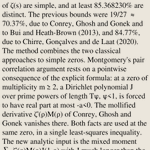
ALT Assuming the Riemann Hypothesis, we show that at least 71.274066% of the nontrivial zeros of ζ(s) are simple, and at least 85.368230% are distinct. The previous bounds were 19/27 ≈ 70.37%, due to Conrey, Ghosh and Gonek and to Bui and Heath-Brown (2013), and 84.77%, due to Chirre, Gonçalves and de Laat (2020). The method combines the two classical approaches to simple zeros. Montgomery's pair correlation argument rests on a pointwise consequence of the explicit formula: at a zero of multiplicity m≥2, a Dirichlet polynomial J over prime powers of length Tψ, ψ<1, is forced to have real part at most -a<0. The mollified derivative ζ'(ρ)M(ρ) of Conrey, Ghosh and Gonek vanishes there. Both facts are used at the same zero, in a single least-squares inequality. The new analytic input is the mixed moment ∑ᵨζ'(ρ)M(ρ)J(1-ρ) with J much longer than the mollifier. We evaluate it under the Riemann Hypothesis alone; the long prime sum stays in the numerator and the mollifier variable is the modulus,

ALT Let A be a non-zero abelian variety defined over a finitely generated field F. A conjecture of Geyer and Jarden [GJ78] asserts that for every σ∈ Gal(Fˢᵉᵖ/F) outside a set of Haar measure zero, there exist infinitely many primes ℓ such that the ℓ-torsion subgroup of A(Fˢᵉᵖ(σ)) is non-zero (or equivalently, the torsion subgroup of A(Fˢᵉᵖ(σ)) is infinite), where Fˢᵉᵖ(σ) denotes the subfield of Fˢᵉᵖ fixed by σ. While this conjecture remains open when Char(F)>0, we establish a new case under the assumptions of End(A)=ℤ and the connectedness of the algebraic monodromy groups attached to A/F.

ALT Siegel theta sums are exponential sums over the integer lattice whose phases are determined by a quadratic form. For a random choice of quadratic form, we prove a limit law for the modulus of the normalised sum as the summation range tends to infinity. The limiting distribution depends on the space from which the quadratic form is sampled. We prove precise heavy-tail asymptotics for random sampling from (a) the full space of quadratic forms and (b) the space of diagonal forms. This study extends classic results by Jurkat and Van Horne for one-variable theta sums and by Götze and Gordin for theta series on Siegel half-spaces. Our approach uses the Shale–Weil representation of the metaplectic group and the ergodic theory of unipotent flows.

ALT We prove a measurable analogue of the Banach–Tarski paradox over locally compact non-Archimedean valued fields. Let K be the completion of a number field at a non-Archimedean place (e.g., K=ℚₚ) and n≥ 2. Then any two bounded Haar measurable subsets of Kⁿ with nonempty interior and equal Haar measure can be cut into finitely many Haar measurable pieces and rearranged into each other by elements of a certain countable group Γ of affine isometries. We also show that the Haar measure is, up to a constant factor, the unique nonzero finitely additive Γ-invariant measure on the bounded Haar measurable subsets of Kⁿ, which solves a p-adic version of the Banach–Ruziewicz problem. Both results follow from the fact that the action of Γ on Kⁿ is expanding, a property closely related to the spectral gap. For n=1 and arbitrary characteristic, we obtain analogous results when the residue field is not prime, using a countable group of isometries that are not necessarily affine.

ALT We study irreducible trinomials over F₂. Using an elliptic curve and reciprocity laws, we prove that, for k ≥ 2, X⁽⁴ᵏ⁺²/3)+X+1 is irreducible if and only if 4ᵏ+3 is prime and 2 is a primitive root modulo that prime. By power substitution and linearization, we also assemble explicit infinite families of irreducible trinomials Xᵐ+Xⁿ+1 in fourteen distinct reduced exponent classes.

ALT We prove that deciding whether a positive integer is abundant is equivalent to complete integer factorization under deterministic polynomial-time Turing reductions. In particular, abundance can be decided in deterministic polynomial time if and only if integers can be factored in deterministic polynomial time. Our reduction uses carefully chosen coprime multipliers to recover exact divisor sums from abundance queries, and then extracts the complete prime factorization of an integer n deterministically from the divisor sums of O(log n) consecutive powers of n. Altogether, factoring n requires O((log n)⁴) adaptive abundance queries, each at an integer of O((log n)⁶) binary digits.

ALT Let n>1 be an integer. We consider complex elliptic curves E admitting a finite subgroup C⊂ E(ℂ) of order n such that E/C is isomorphic to E. % with the additional requirement that the invariant factors of (C) are unequal. We establish class-number counting formulas for the cyclic, noncyclic, and general cases. More precisely, we associate to every negative quadratic-order discriminant D the norm form Q_D(x,y)=x²+ε_Dxy+q_Dy², where ε_D∈{0,1}, q_D=ε_D²-D/4. The invariant factors of the kernel of the corresponding endomorphism are determined by \gcd(x,y). This leads to finite sets of admissible discriminants describing the cyclic, noncyclic, and general cases with unequal invariant factors. Our main result expresses the numbers of isomorphism classes in the three cases as sums of the proper ideal class numbers h(D) over explicitly defined finite sets of admissible discriminants. This provides an arithmetic class-number counting formulation of the CM classification developed in earlier wo

ALT Let k be a CM-field of degree greater than 2, p an odd prime number that splits completely in k, and Σ a p-adic CM-type of k. In this setting, we show the non-triviality of the Σ-ramified Iwasawa module of the maximal multiple mathbbZ_p-extension k̃/k. As a consequence, under a weak form of Greenberg's Generalized Conjecture, we see that the unramified Iwasawa module and the Σ-ramified Iwasawa module of k̃ never coincide. In the case where k is a quartic CM-field, under a certain assumption, we show that the non-coincidence condition is equivalent to Greenberg's Generalized Conjecture. We also study a relation of the non-coincidence condition with Non-freeness Conjecture, which is a conjecture studied in non-abelian Iwasawa theory.

ALT We construct a new family of algebraic varieties over a finite field, realizing the local Langlands and local Jacquet-Langlands correspondences for GLₙ in their compactly supported étale cohomology. The resulting representations have L-parameters which are induced from characters of a partially ramified field extension.

ALT When cubic surfaces in ℙ³ over ℚ are ordered by height, we prove that almost every such surface satisfies the Hasse principle. This extends work of Browning, Le Boudec and Sawin and completes the proof of the conjecture of Poonen and Voloch for Fano hypersurfaces. We also obtain an upper bound for the least height of a rational point on almost all everywhere locally soluble cubic surfaces and we give an upper bound for the number of cubic surfaces with a Brauer–Manin obstruction to the Hasse principle. Finally, once combined with a calculation of Beneish and Keyes about the density of everywhere locally soluble cubic surfaces, this establishes the explicit proportion of cubic surfaces that have a rational point.

ALT We obtain new bounds and asymptotic formulas for the number of solutions to sparse systems of n diagonal congruences modulo an integer q in s variables. In a large range of parameters, our results improve and generalise those of A. A. Karatsuba (1976). In particular, our lower bound on s, which guarantees the solvability of such systems, depends only on n, rather than on specific degrees as in the work of A. A. Karatsuba (1976).