

Online publication: peer-reviewed, open-access, international, no length or figure limits, passionate for palaeo.
Joined March 2012
- Tweets1.2K
- Following144
- Followers3.5K
- Likes58





Pinned Tweet
Palaeontologia Electronica (PE) is a no-cost, #OpenAccess, peer-reviewed #paleontology journal. Here are some fast facts about PE:

A new megaraptorid dinosaur, Rinconraptor pipoae, has just been discovered in Argentine Patagonia! Other fossils in the area suggest the new dinosaur formed part of a local species cluster of megaraptorids.
Full #OpenAccess Paper: doi.org/10.26879/1738

Image: Figure 1 from the paper. Map of the region (Cerro Overo-La Invernada; Bajo de la Carpa Formation) where the studied fossils were found.
Authors: Ariel H. Méndez, Ariana Paulina-Carabajal, Leonardo S. Filippi, Federico A. Gianechini, Javier González-Dionis…
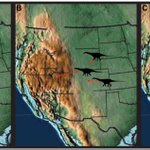
The latest article from our special issue on diplodocoid dinosaurs is out now! A specimen-by-specimen study of diplodocoids from the Morrison Formation (western USA) suggests that their ancestral populations were widespread and that new species formed as populations budded off.

Image: Figure 4 from the paper. Distribution of diplodocoids in the Morrison Formation. (A) basal diplodocoids, (B) apatosaurids, (C) diplodocids.
Authors: Colin Boisvert, Charlie Roger Scherer, Cassius Morrison, Collin Layton, Ezekiel V. O’Callaghan, Steven J.R. Allain, Gunnar T. Bivens, Ray Wilhite, Pedro Salas, John R. Foster, and Brian Curtice
Full #OpenAccess Paper: doi.org/10.26879/1579

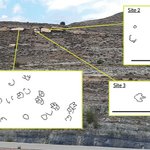
The new dinosaur track site of Las Peñas Amarillas, in La Rioja, Spain preserves an invaluable record of their behavior. A new study describes the tracks, reconstructs their environmental context, and interprets the behavior.
Full #OpenAccess Paper: doi.org/10.26879/1612

Image: Figure 1 from the paper. View of the Las Peñas Amarillas site and illustration of its trackways.
Authors: Javier Rubio-Nieto, Jesús Reolid, Félix Pérez-Lorente, and Angélica Torices
Temporary link pending doi update: palaeo-electronica.org/conte…

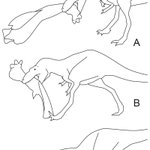
Around 80 million years ago in Texas, a tyrannosaur stripped the flesh from the bones of a large hadrosaur. An analysis of the marks left behind on the bones allows a hypothetical reconstruction of its feeding behaviour.
Full #OpenAccess Paper: doi.org/10.26879/1657

Water voles (Arvicola) have four species in Europe and northern Asia. Evidence from their tooth anatomy shows how these species diversified from an archaic Arvicola ancestor through repeated dispersions into western Europe.
Full #OpenAccess Paper: doi.org/10.26879/1683

Jacinto Román, Mikel Arlegi, Andion Arteaga-Brieba, Zoltán Barkaszi, Jessica Cohen, Alban Defleur, Mónica Fernández-García, Damien Flas, Karl Frafjord, Monika Vlasta Knul, Arturo de Lombera-Hermida, Ahmad Mahmoudi, Boyan Milchev, Adam Nadachowski, Piroska Pazonyi… (continued)
Omiodon cabassi is a fish from the Eocene epoch with a controversial identification. From marine deposits of northern Italy, it was assigned to the Characiformes, a predominantly freshwater group, in the 1800s. A new study reassigns it to Aulopiformes – a group of marine fishes!

Authors: Pietro Calzoni, Jacopo Amalfitano, Eliana Fornaciari, Luca Giusberti, and Giorgio Carnevale
Image: Figure 1 from the paper. Original illustration of Omiodon cabassii holotype (above) and photograph (below).
Full #OpenAccess Paper: doi.org/10.26879/1710

Central Europe and western Asia were inundated by a shallow sea during the Miocene epoch which teemed with marine life, including seals. A new study examines seal limb bones found in western Ukraine and compares them to diverse Miocene seals from the seaway!

Authors: Pavlo Otriazhyi, Dmitry V. Ivanoff, Leonid Gorobets, and Pavel Gol’din
Image: Figure 1 from the paper: Miocene seal limb bones; view direction indicated.
Full #OpenAccess Paper: doi.org/10.26879/1707

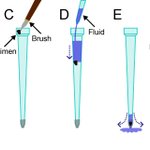
Palaeontologists make fossils accessible by creating digital models. But this can be extremely difficult for microfossils, which are as common and impactful as they are tiny. A new study reviews commonly used techniques for imaging microfossils and proposes new methods.

Image: Figure 1 from the paper: method mounting specimens with a pipette tip.
Authors: Petra Tonarová, Petra Procházková, Marek Zemek, Martina Nohejlová, Ondřej Švagera, Olle Hints, Michal Kubajko, Tomáš Zikmund, and Jozef Kaiser
Full #OpenAccess Paper: doi.org/10.26879/1659
