

Let's Go Explore some Exoplanets!
The Laniakea Supercluster
Joined August 2014
- Tweets37.4K
- Following5K
- Followers2.2K
- Likes32.7K






Willie Aaron Lewis retweeted

A purported leaked NASA video captures a strange object or being of enormous proportions moving across the lunar surface. The strange object appears to walk by taking giant leaps, the shadow it casts helps to distinguish it better.
Willie Aaron Lewis retweeted

Every second, you move about 230 kilometers through the galaxy. And you never feel it. We picture the solar system like a clock: planets circling a Sun that stays put. But the Sun does not stay put. It is racing around the center of the Milky Way at about 230 km/s (828,000 km/h)
Willie Aaron Lewis retweeted

Nuestro satélite natural y las maravillosas Pléyades. 🤩🌌

Aquesta nit, la Lluna visitarà les Set Germanes 🌙
La nit del 27 al 28 d’octubre ens regalarà una bonica trobada aparent entre la Lluna i un dels cúmuls estel·lars més coneguts del firmament: les Plèiades, també anomenades les Set Germanes.
📷 Cayetana Saiz @apod

Willie Aaron Lewis retweeted

Today (28 October 2026) on Astrobiology.com
Astrobiologist Dale Andersen’s Antarctic Field Report: 28 October 2026: Shoveling Snow In Antarctica
astrobiology.com/2026/10/28/… #astrobiology
Offworld Agriculture
astrobiology.com/2026/10/28/…
Mesoscale Modelling Of Titan's Shangri-La region: The Impact Of Surface Properties On Winds
astrobiology.com/2026/10/28/…
Spectroscopic Survey of Small Solar System Bodies with Ariel
astrobiology.com/2026/10/28/…
A Covariance-Aware Framework for Spatially Resolved Exoplanet Biosignature Inference with the Solar Gravitational Lens
astrobiology.com/2026/10/28/…
DragonflyPol: Wide-Field Optical Linear Polarimetry with the Dragonfly Telephoto Array (Instrument Description and Commissioning)
astrobiology.com/2026/10/28/…
The Physical And Chemical Structure Of Titan's Upper Atmosphere: Energy Balance, Photochemistry And Jeans Escape
astrobiology.com/2026/10/28/…
A New Database To Track Origins Of Water From Space
astrobiology.com/2026/10/28/…
Webb Space Telescope Used To Compare Interstellar Comet 3I/ATLAS With Icy Bodies In Our Solar System
astrobiology.com/2026/10/28/…
#astrobiology #interstellar #astrochemistry #comet #remotesensing #biosignatures #atmosphere #astrochemistry #exoplanet


Willie Aaron Lewis retweeted

One of the biggest mysteries of the Wow! Signal is its exact location, with two possible positions in the sky. Our #AreciboWow team has solved this mystery using three independent methods. We’ll present our findings in 2027.
We know! 😉

Willie Aaron Lewis retweeted

#PPOD: The First Look at Venus
On October 22, 1975, the Soviet Union's Venera 9 spacecraft made history by transmitting the first photograph from another planet's surface. Landing on Venus at about 32° south latitude, the spacecraft survived for 53 minutes in crushing atmospheric pressure and temperatures hot enough to melt lead.
The black-and-white panorama reveals a rocky landscape dominated by angular, partially weathered stones roughly 30–40 centimeters across, many partly buried in soil. The bright white shape at the bottom is part of the lander, while the scene's curved appearance results from the camera's imaging system. Although Venera 9 returned only this single view, it gave humanity its first direct glimpse of Venus's surface, transforming a world hidden beneath thick clouds into a place we could finally see.
Credit: Soviet Academy of Sciences
#otd #planetaryscience

ALT Rocky, boulder-strewn Venusian surface photographed by Soviet Venera‑9 lander in high-contrast black-and-white; caption reads "VENERA‑9 22.10.1975 — processed 28.2.1976."
Willie Aaron Lewis retweeted

Eight Expedition 75 crew members gather inside the International Space Station’s Destiny laboratory module for a daily planning conference at the end of their shift.
📸 NASA


Willie Aaron Lewis retweeted
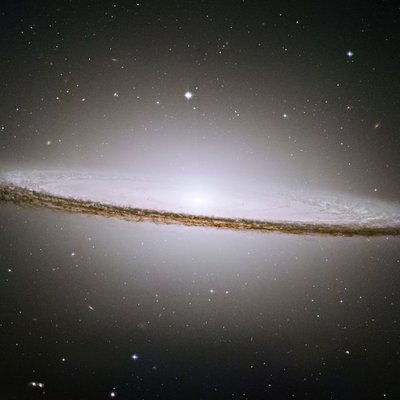
The Trifid Nebula (M20) is a rare fusion of phenomena: newborn stars in a loose cluster, ionized gas glowing red, blue starlight scattered by dust, and dark filaments dividing the scene.
(Credit: RubinObs/NOIRLab/SLAC/NSF/DOE/AURA)

Willie Aaron Lewis retweeted
🌕 Could the Moon be a billion-year archive of ancient alien technology?
Unlike Earth, the Moon has no atmosphere, oceans, or plate tectonics to continually erase its geological history. That makes lunar regolith a promising place to search for microscopic technosignatures that may have traveled across interstellar space.
On #SETILive, SETI Institute Affiliate Scientist Lewis Pinault explains why the Moon could preserve evidence of technological civilizations from billions of years ago.
🔬 Watch the full conversation with host Simon Steel: youtube.com/live/dBAUleB7SJs
Willie Aaron Lewis retweeted

IC410 - The Tadpoles Nebula!
The Tadpoles Nebula, also known as IC410, is a captivating dusty emission nebula situated in the constellation of Auriga, approximately 12,000 light-years away from Earth.
I took this image in late December, my longest integration time yet! 19hrs

Willie Aaron Lewis retweeted
I imaged The Great Orion Nebula for the 1st time in 15yrs!! More details on my website blog! (In Profile) Hope you enjoy this one, it was a challenge!!
#Astrophotography #Space #Nebula #Stellarvue #Orion #RASC
