

Constitutional libertarian promoting constitutional government from first principles.
The West
Joined December 2008
- Tweets5.8K
- Following1.5K
- Followers1.5K
- Likes595


Patrick Henry retweeted

When socialists make your life unlivable, take your money and give it to their pals, it’s not because they give a rat’s ass about you or this freest, most prosperous, most secure society humanity has ever known.
They just want your money. That, and they lust for power. Absolute power.


Patrick Henry retweeted

Jensen Huang was just as happy with open weight models running on Nvidia GPUs as with closed weight models - both are good for Nvidia sales.
This undermines the value of Anthropic and OpenAI IPOs since many businesses will prefer an OS model running on local hardware for security and client privacy reasons.
Now, the alternative approach is to force Anthropic, OpenAI, Google etc. to release their models as open weights - and this is defensible legally, as all these models are trained on copyrighted works.
But that’s what it’s really all about - open source is a great threat to the monopolistic ambitions of the Dario/Altman types.
Patrick Henry retweeted

"It's very far from true to say that it is a Jewish strategy or Jewish plot." -@ConceptualJames
newdiscourses.com/2026/05/wh…

Patrick Henry retweeted
Too many people like to throw accusations without actually reading what is written.
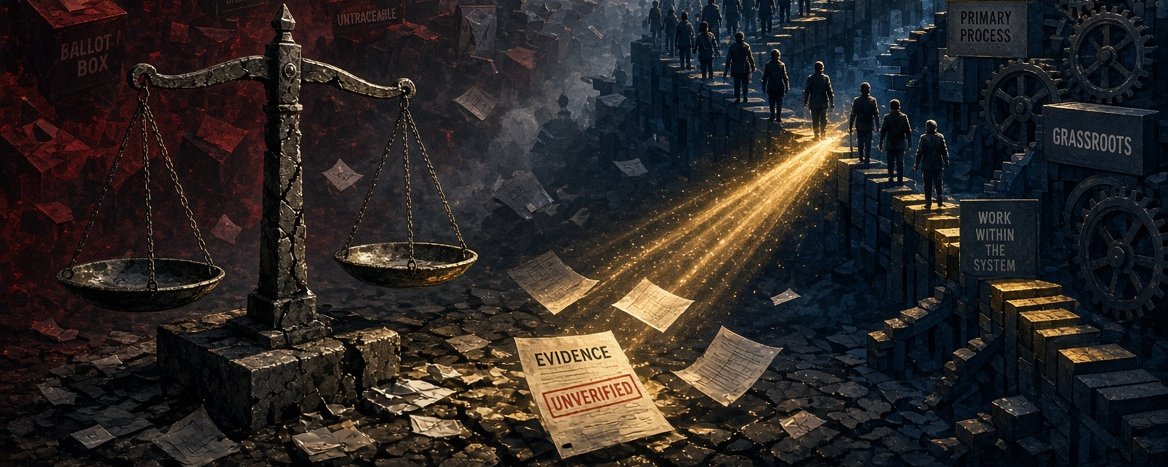
Election fraud ABSOLUTELY, POSITIVELY did happen in the 2026 election, and if you allege that I don't believe that, then you get an insta-block. I'm sick of the lies.
The issue is that the Democrats, over decades and through legislation at state and national levels, have engineered election procedures such that it is impossible to prove the fraud to a reasonable evidentiary standard in a court of law.
IMPOSSIBLE. The lack of accountability built into their laws not only makes fraud easy, it makes it basically impossible to prove the fraud in a way where results can be challenged legally in an effective way.
Make all the charts you want. If you cannot meet a court's evidentiary standard, you are accomplishing nothing productive.
Unfortunately--and this is the hard truth no one seems to want to address--the only way to undo this is the same way it happened, by winning elections and then passing reform legislatively.
(And yes, we CAN win elections, see 2024.)
My article explains.

Patrick Henry retweeted

History will remember two men as the ones who exposed the empire of lies: Javier Milei and Nayib Bukele.
For decades, the same class of experts, NGOs, think tanks and international institutions told us two things were impossible.
That you could kill inflation without destroying a country.
That you could kill violent crime without "addressing root causes" for another 30 years.
Milei took the first one.
Argentina, December 2023: inflation over 200% a year, 25% in a single month. A central bank printing money to fund a state that had become a vote-buying machine. Every economist on TV predicted a social explosion if anyone touched it.
He cut the number of ministries in half. He balanced the budget in his first year. Monthly inflation went from 25% to under 2%. Poverty, which peaked at 52.9% right after the devaluation, fell to 28%, the lowest since 2018. It's not a straight line, poverty ticked back up this year, and he says so himself. But the point is proven: the "impossible" was possible all along.
The lesson is brutal. Endless money printing was never a technocratic necessity. It was a hidden tax on the poor, quietly paying for the people who designed the system and lived off it.
Bukele took the second one.
El Salvador, 2015: 106 homicides per 100,000 people. The most violent country on earth outside a war zone. Gangs ran neighborhoods, taxed every bus driver and every street vendor, and decided who lived and who died.
El Salvador, 2025: 1.3 per 100,000. Lower than the United States.
Every international expert said it couldn't be done. The NGOs called it barbaric. Salvadorans re-elected him with over 80% of the vote, because they're the ones who used to bury their kids.
And now his helicopters are in Haiti, pulling his own soldiers out of gang territory, telling the gangs: we finished with ours, we can finish with you.
So ask yourself the real question. If it was this simple, why didn't anyone do it?
Because an entire ecosystem lived off the problem.
Inflation funded the state that funded the clients that funded the elections. Crime created fear, and fear created demand for programs, consultants, studies, panels, subsidies and "experts" who never had to deliver a result. In Latin America it was the gangs. In the West it's mass immigration with no integration and crime with no consequences. Different symptom, same business model: the problem is never solved because too many people are paid to manage it.
Milei and Bukele didn't just fix two countries. They published the proof. Every politician who still says "it's complicated" now has to explain why a guy with a chainsaw and a guy with a baseball cap did in two years what they couldn't do in forty.
Thank you Javier Milei. Thank you Nayib Bukele.
The world is going to heal with your solutions.
Europe is next. We're waiting.

Patrick Henry retweeted
Mr. President @realDonaldTrump
You want to drain the swamp? Then stop doing it by hand.
The West's problem isn't the left or the right. It's that public money has become the only money in the world nobody really watches. Trillions flowing through grants, government contracts, nonprofits, NGOs, subcontractors of subcontractors. And at every level, a leak.
Audits show up three years too late. Inspectors are overwhelmed. Fraudsters know it. Corruption isn't a bug in the system. It's the system running at cruising speed.
The solution already exists. It's called AI.
Plug Palantir into every dollar that leaves a public account. Every elected official, every senior bureaucrat, every agency that signs a check with taxpayer money. Total traceability, in real time. Every anomaly flagged in hours, not years. Fraud doesn't become riskier. It becomes impossible.
Note the direction: we don't watch the citizen. We watch power. Whoever spends other people's money gives up the right to opacity. That's the deal. You've already started. Finish the job.
Because if you don't, there are only two outcomes.
The first: the state becomes a patronage machine. Public money buys loyalties, communities, votes. The Islamo-leftist alliance settles into the cracks, collectivism wins by exhaustion, political Islam pours through the breaches, and at the bottom of the slope there's a caliphate. Not through war. Through subsidies.
The second: the right, fed up, seizes total control and turns those same tools against the population. Mass surveillance, checks and balances dismantled, a techno-authoritarian state that solves corruption by abolishing freedom. Just as dystopian. Only more efficient.
Two walls. One door between them.
Radical transparency of public money. AI pointed up, not down.
The technology is ready. All that's missing is political will.
You have it. Use it.

Patrick Henry retweeted

The Civilizational Significance of the Events in Poland 🇵🇱
What is happening in Poland goes way beyond the Constitutional Tribunal and the Polish government. It is even bigger than the EU. It is about whether nations, and human communities in general, can govern themselves, or whether they are all turned into a gray mass that can only be administered until we die out.
Everyone knows what being administered feels like. You have made this phone call. Your case is being processed. The woman on the line is polite, and she can't decide anything. Neither can her manager. Somewhere there is a rule, and nobody you can reach wrote it. Nobody lied to you. Nobody is responsible. You hang up feeling smaller, and you can't say who did it.
Now imagine that phone call as a country. Then as a continent.
This week the Tribunal's president was suspended and riot police stood at its gate. Let's be fair: PiS filled that Tribunal its own way – it had its reasons. The EU's top court ruled it isn't independent, Strasbourg ordered it to accept the new judges, and the Venice Commission effectively backed the government. Polish MPs chose those judges. Tusk has a real argument and plenty of paper.
But look where the paper comes from. Ask who has the last word in Poland, and the answer moves to Luxembourg, Strasbourg and Venice. And a year before Poles could settle it themselves at the ballot box, the argument arrives in riot gear.
Self-government was never about being wise. Peoples vote badly. They elect fools and build bad courts. Self-government means the mistake is yours, so the repair is yours too. And Popper put it most plainly, saying the question is not so much who should rule, but how to remove them without blood. Poles can remove Tusk in 2027 and Nawrocki in 2030. Who removes a judge in Luxembourg? Try it. Call them. Your case is being processed.
Administered Until We Die Out
A people and a population can look identical: same streets, same shops, even the same elections. The difference appears on the day they say no. A people's no ends the matter. A population's no gets processed.
And Tocqueville saw it coming, describing a power that doesn't break the will but softens it, until a nation is a flock of timid, busy animals with the government as its shepherd. Communism needed tanks, and it lost. The new gray needs only forms, and it gets thanked. Poles know that gray. We lived in it. The difference is that back then, you knew whom to hate.
Why Poland? Because Poland ran the experiment. For 123 years there was no Polish state on any map. Three empires administered the Poles, and they stayed a people, in language, prayer and memory. Then in 1980 the workers built a union and put the whole idea in its name: Niezależny Samorządny Związek Zawodowy Solidarność. Niezależny – Independent. Samorządny – Self-governing. And Solidarity. Poland knows from experience that a nation is not its state, and can outlive one.
But Poland isn't safe. Germany, the land of efficient administration, is just across the border, and it is stronger and richer than us. It doesn't need to plot anything – the forms do the job. And even to some Poles being administered may sound easier than the responsibility of self-government.
This temptation is as old as our civilization. Everything the West has built rests on one wild idea: that an adult answers for his own life, and a people for its own fate. Freedom is the pleasant part of that idea. Responsibility is the heavy part, and you can't have one without the other.
Take it away and you don't get a happier people. An administered people never grows up. It only grows old.
So the question is not whether Poland stays in Europe. It is whether anyone in Europe can still say "we", mean it, and answer for it.
Nations are no longer conquered. They are wound down, in full compliance, with a final report nobody reads.

Post-communism (1989–2026) – an Obituary
Post-communism was born in 1989, of a lie. We were told communism had ended. It had only changed its name. The communists handed over the government and kept the rest. The change was real on the surface and fake underneath.
Every lie needs a charming face. Post-communism found its best one in Donald Tusk, Poland's Tony Blair: modern, smiling, fluent in the language the West wanted to hear. Brussels loved him, and in time post-communism grew into Euro-communism: the same apparatus, the same contempt for the voter, now speaking the language of "European values".
This week, the face slipped. Riot police kept the Chief Justice out of his own Constitutional Tribunal, and the government called it restoring the rule of law.
A lie that needs the police has stopped persuading anyone. Lies do not die gently. They stand until the day they fall all at once. In 1989, we were told that day had come. It had only been postponed. Now this lie is coming to an end – and this time, the end will be real.
Post-communism is survived, for now, by its networks. In lieu of flowers, Poles are asked to vote in 2027.
Post-communism is dead.
Long live a Free Poland! 🇵🇱🗽✌🏻

Patrick Henry retweeted

No—instead, tell Congress to pass the Sunshine for Our Kids Act. Ditch DST with permanent Standard Time, for natural health and safety!

Tonight, we once again have to take part in the outdated practice of changing our clocks.
Americans are tired of it.
It’s time for the Senate to pass my Sunshine Protection Act to get rid of this ridiculous time change.
Readers added context they thought people might want to know
Recent polls show more Americans want permanent Standard Time, the opposite of Senator Scott’s permanent DST.
—Gallup: news.gallup.com/poll/657584/ha…
—ActiVote: activote.net/analysis/stop-…
—Rasumussen: rasmussenreports.com/public_content…
Historical polls show support for Scott’s permanent DST reverses into opposition when its 9am sunrises are experienced: rosap.ntl.bts.gov/view/dot/10504
Patrick Henry retweeted
"Nationalize Starlink." Three words, 142K views. And the entire economic history of the 20th century screaming in the room.
Let me explain what would actually happen.
Start in 1920. Ludwig von Mises publishes an essay that will haunt every central planner: without private property, there are no market prices. Without prices, there is no way to calculate. A bureaucrat cannot know whether a ton of steel is more useful in a satellite or in a bridge. He guesses. He guesses wrong. And nobody pays when he's wrong.
In 1945, Hayek drives the point home. The knowledge needed to run an economy doesn't exist in any single brain or any ministry. It's scattered across millions of people, and prices are the only mechanism that can aggregate it in real time. Centralize the decision and you destroy the information.
This isn't theory. Look at the numbers.
In the US, from 2000 to 2025, overall inflation was about +90%. Now look at the sectors where government subsidizes, regulates, and protects the most: hospital services +271%. College tuition +194%. Textbooks +181%. Childcare +152%. Medical care +144%.
And the sectors exposed to competition? TVs: -97%. Software, toys, cell phone plans: all down in nominal terms over 25 years.
The more the state is involved, the more expensive and scarce things get. The less it's involved, the more abundant they become.
Space is the perfect example. NASA's Space Shuttle cost about $54,500 per kilo to low Earth orbit. Falcon 9: about $2,700. Twenty times cheaper. That's not my number, that's NASA's own study. A private company did in fifteen years what a government agency couldn't do in forty.
Starlink is the logical next step. Thousands of satellites launched on reusable rockets. High-speed internet for a remote village, a ship in the middle of the Pacific, a soldier on the front line. No government built that.
So you nationalize it. What happens?
First, you have to pay. SpaceX is worth somewhere around $1.75 to $2 trillion, and seizing it requires just compensation. That's more than a full year of the US defense budget, to buy something that already works.
Then the machine changes its objective function. Today it optimizes for cost, speed, iteration. Tomorrow it optimizes for budgets, procurement cycles, and subcontractors spread across as many states as possible to lock in congressional votes. We know how that ends: look at SLS, years late and billions over budget. When Starship blows up in a test, SpaceX learns and flies again. When a government agency loses a rocket, you get a commission of inquiry and years of paralysis.
And the power? The argument is "no private individual should have this much power." But nationalization doesn't eliminate power. It hands it to whoever sits in the Oval Office. And one day, that will be the person you hate most.
Here's what I deeply believe: humanity is figuring it out. The 20th century tested the state as the engine of value creation. The result: waiting lines, rents, and debt. The model that works is entrepreneurs with the people. Create value, offer it to people who are free to say no. And tear down everything that protects incumbents: rents, regulations that work as moats, patents that freeze innovation instead of rewarding it.
Elon understood this before anyone else. Tesla opened up its patents in 2014. SpaceX broke ULA's near-monopoly (Boeing + Lockheed) on launches. Starlink is making decades of telecom rents obsolete.
He isn't competing with the old system. He's setting a new standard. And when the new standard is twenty times cheaper, the old system doesn't reform. It disappears.
That's exactly why some people want to nationalize it. When you can't compete, you confiscate.
Nationalizing Starlink isn't taking back control. It's handing the future back to the system that already missed it.

Patrick Henry retweeted
Antonio Gramsci – The Most Dangerous Intellectual of the Twentieth Century.
Not the most famous. Not the most read. The most dangerous and the most consequential – because he was the one who figured out why the revolution kept failing, and what to do instead. The man who invented the long march through the institutions.
Everything that followed — the Frankfurt School, the Fabian Society’s operational model, the WEF formation pipeline, the captured university, the HR department enforcing approved speech — is downstream of what he wrote in a prison cell in Mussolini’s Italy, in code, between 1929 and 1935.
1. His central question: why hasn’t it happened? The working class was supposed to rise. The contradictions of capitalism were supposed to produce the revolution. They hadn’t – not in the West. Gramsci’s answer was precise and devastating: because the ruling class does not maintain power through force alone. It maintains power through cultural hegemony – the control of the ideas, values, and frameworks through which people understand the world. The worker who accepts that the existing order is simply how things are will not revolt, regardless of his material conditions. The revolution requires cultural change first.
2. The instrument was the long march through the institutions. Not the barricade. The school, the university, the media, the judiciary, the civil service, the cultural establishment – every institution through which a civilization transmits its values to the next generation. Capture these, fill them with people who share the counter-hegemonic project, and the cultural assumptions that maintain the existing order gradually dissolve. No barricades. No visible moment of rupture. Just the slow replacement of one cultural hegemony with another.
3. The educational capture was the masterpiece. Control the curriculum and you control the categories of thought available to the next generation. Not by telling them what to conclude – by shaping what questions they think to ask, what they consider obvious and what they consider unthinkable. The generation educated after the long march does not need to be told what to think. It thinks what it was formed to think – and experiences that thinking as its own.
4. He also theorized the organic intellectual – the person who translates the theoretical framework into stories and assumptions that circulate through the culture without appearing ideological. The film that makes the existing order seem absurd. The journalist who frames every story within the approved assumptions. Gramsci understood that culture is politics by other means – and that the side that controls the culture wins, regardless of who wins the elections.
5. This is not a conspiracy theory. It is a published, documented, widely taught strategy that the left implemented consciously across the entire Western world. The 1968 generation put it into practice in the universities. They became the professors, the journalists, the civil servants, the judges, the HR directors of the decades that followed. The march took fifty years. It worked.
6. Mussolini’s prosecutor said at his trial: "We must stop this brain from functioning for twenty years." The brain did not stop. It produced thirty-three notebooks – smuggled out, published, and became the most widely read Marxist text in the Western academy after Marx himself. Gramsci died in 1937, six days after his release, at forty-six. He did not see the march he theorized. He did not need to.
7. Every captured institution, every transformed curriculum, every HR department enforcing approved speech, every content moderation policy suppressing the unauthorized voice – all running the program Antonio Gramsci designed in a prison cell, by a brain that was supposed to have been stopped. It wasn’t. And neither was the march.
Until now – because the distribution monopoly that made its outcomes enforceable is cracking. The counter-march has begun. It just doesn’t have a name yet.

The Most Destructive Intellectual Project of the Twentieth Century.
The Frankfurt School. You should know what it was, what it built, and why you are still living inside it.
1. The Institute for Social Research was founded in Frankfurt in 1923 and relocated to Columbia University in 1934 when Hitler came to power. The civilization they had decided to dismantle gave them refuge when another tried to kill them. They spent the next five decades producing the theoretical infrastructure for that dismantling. Western civilization itself was the problem: reason, the Enlightenment, the family, tradition, authority. Not reformed. Dismantled.
2. They called it Critical Theory – and the name is the program. Everything is to be criticized; nothing is to be built. In The Dialectic of Enlightenment (1944), Adorno and Horkheimer argued that Western reason — the reason that produced Newton and the rule of law — contained the seeds of Auschwitz. Not that reason had been misused, but that reason itself, taken to its conclusion, produces the death camp. This was not a critique of institutions. It was an indictment of the civilization itself.
3. Adorno gave them the psychological weapon. The Authoritarian Personality (1950) classified conservatism, religious faith, patriotism, and the traditional family not as political positions but as symptoms of a proto-fascist personality. If you believe in the nation or the father’s authority, you are pre-fascist. The opponent was no longer wrong – he was sick. You don’t argue with a pathology. You treat it.
This made dialogue impossible. You don’t persuade someone who is wrong; you diagnose someone who is sick. Politics becomes therapy, and disagreement becomes pathology.
4. Marcuse gave them the political weapon. Repressive Tolerance (1965) argued that tolerating wrong ideas is itself oppression. True tolerance therefore requires suppressing intolerant ideas. The left decides which ideas are intolerant. Everyone else is silenced – not despite tolerance, but "in its name." Censorship dressed in the vocabulary of liberation.
5. The generation that read Marcuse at Columbia, Berkeley, and Yale went on to run universities, media, foundations, NGOs, content moderation departments, and the EU regulatory apparatus. They implemented the argument sincerely because they had been taught it as philosophy. This was the Frankfurt School’s greatest achievement: it produced true believers.
6. French Theory picked up the tools and made them aesthetic. Foucault made the critique of power literary. Derrida made the critique of meaning philosophical. Deleuze made the critique of identity elegant. A political program became a cultural sensibility. You can argue with a program. A sensibility is in the air you breathe. By the time these ideas reached the American campus through the French conduit, they were no longer ideology. They were the water. The fish did not know they were wet.
7. A civilization stands on three pillars: truth exists and is accessible to reason; good is distinguishable from evil; and there is an inheritance worth transmitting. The Frankfurt School attacked all three – systematically and with considerable intellectual sophistication. It produced a generation that knows how to deconstruct and has forgotten how to build. That sees power everywhere and beauty nowhere.
The ultimate achievement was to make destruction feel like progress. Every inherited institution became suspect; every constraint became oppression; every act of preservation became reactionary. Deconstruction became the default, while construction became something that needed to justify itself.
The answer is not another theory.
It is the thing the Frankfurt School most feared: the builder who simply builds, the scientist who follows the evidence, the father who transmits what was transmitted to him.
The deconstruction machine runs on the assumption that nothing is worth building.
Prove it wrong.
Tell the truth, have courage, and build.

Patrick Henry retweeted
Introducing:
The Prince of Lies, Unmasked – Notebooks on the Praxis of Socialist Power.
In the Prison Notebooks, Gramsci called the revolutionary party "the Modern Prince," the collective successor to Machiavelli's prince. We will turn Machiavelli's method on Gramsci's creation and take it apart.
Rousseau said that Machiavelli, while pretending to give lessons to princes, gave great ones to the people. We will try to do the same, openly.
—
In 1513, a Florentine diplomat, dismissed, tortured and exiled to his farm, wrote a short book about how power is really taken and kept – not how things ought to be, but how they are. He called it going straight to the effectual truth of the thing. Niccolò Machiavelli scandalized Europe. Five centuries later, The Prince is still on every serious reader's shelf.
Four hundred years after him, in a Fascist prison cell, Antonio Gramsci rewrote it for the modern age: the prince would no longer be a man but the Party – a Modern Prince, a collective one, that takes power not by storming the palace but by capturing minds, schools, newspapers and culture. His notebooks became the manual of the long march.
The prince of our time is the Prince of Lies: socialism, in all its forms. The regime with its secret police, the party with its long march, the managerial state with its committees, and the habit of mind that no longer needs reality. We will describe how it takes power, how it keeps it, and how it falls – coldly, as mechanisms, the way an engineer describes a machine. Without outrage – the facts are enough.
Gramsci wrote his notebooks in prison. Ours will be notebooks from freedom.
We write from Poland, where the experiment was run on us for forty-five years – with notes from Paris, where many of its ideas were born, and from London, where ideas are weighed against reality.
Stay tuned for a new chapter every day – in a month, we will probably have a whole book…
—
Chapter 1 – Of What Socialism Is.
The law: socialism is not an economy that fails. It is a technique of power that works.
§1. Socialism is a contradictory rhetoric used to gain power over people by manipulating those who are easiest to manipulate. Everything else – the economics, the philosophy, the slogans – is costume.
§2. Why contradictory? Because a contradictory rhetoric can say everything to everyone at once: equality and privilege, freedom and protection, abundance without work. Each listener hears his own half. Logic limits what you can say. Contradiction removes the limit.
§3. Why the easiest to manipulate? Because power, under majority rule, needs numbers, not quality. The manipulator doesn't need to convince the best minds, only the most available ones: the envious, the frightened, the comfortable who have never borne the cost of their opinions, and the half-intelligent – clever enough to repeat the vocabulary, not clever enough to question it. Add them up and you have a majority.
§4. Then look at what it says, and at what it produces.
It postulates equality – and produces the most unequal societies of all: the nomenklatura in its special shops, everyone else in the queue.
It says it frees the workers – and in 1980, ten million Polish workers had to rise up against the workers' state.
It postulates abundance – and gets rid of the people who produce it. Venezuela, sitting on the largest oil reserves in the world, watched its people lose an average of eleven kilograms in a single year.
It says the state will wither away – and builds the biggest state in history.
It postulates peace – and needs an enemy for every failure.
§5. Someone has to resolve these contradictions. In socialism, that someone is the police, by force. When the theory says one thing and reality another, it is never the theory that is arrested.
§6. That is why it is anti-life. Life works by getting reality right: every living thing survives because it reads the world correctly. Socialism switches off the instruments – prices that say what is scarce, profits and losses that say what works, free speech that says what is wrong. A society that can no longer see where it is going ends up where socialist societies always end up: first the queue, then the famine and the camp.
§7. And yet it keeps coming back, because it was never an economic theory that failed. It is a technique of power that works. The economics always fails. The rhetoric never does – on those easiest to manipulate, and for those who rise by manipulating them. Socialism has never delivered what it says. It has always delivered what it is for: power.
§8. How do you recognize it when it doesn't use its name? Reverse the logic and look at the symptoms. It lies, because it cannot stand reality. It needs an emergency, ideally a war, because it must hide its contradictions. And it never pays for its mistakes – someone else always does.
The counter: a contradiction cannot survive a plain sentence. Judge socialism by its results, never by what it says. Ask three questions: Who pays? Compared to what? What would prove you wrong? The manipulator needs you confused. Clarity is the first act of resistance.
—
Next: Chapter 2 – Of the Lie, and Why It Must Be Told Every Day.

Antonio Gramsci – The Most Dangerous Intellectual of the Twentieth Century.
Not the most famous. Not the most read. The most dangerous and the most consequential – because he was the one who figured out why the revolution kept failing, and what to do instead. The man who invented the long march through the institutions.
Everything that followed — the Frankfurt School, the Fabian Society’s operational model, the WEF formation pipeline, the captured university, the HR department enforcing approved speech — is downstream of what he wrote in a prison cell in Mussolini’s Italy, in code, between 1929 and 1935.
1. His central question: why hasn’t it happened? The working class was supposed to rise. The contradictions of capitalism were supposed to produce the revolution. They hadn’t – not in the West. Gramsci’s answer was precise and devastating: because the ruling class does not maintain power through force alone. It maintains power through cultural hegemony – the control of the ideas, values, and frameworks through which people understand the world. The worker who accepts that the existing order is simply how things are will not revolt, regardless of his material conditions. The revolution requires cultural change first.
2. The instrument was the long march through the institutions. Not the barricade. The school, the university, the media, the judiciary, the civil service, the cultural establishment – every institution through which a civilization transmits its values to the next generation. Capture these, fill them with people who share the counter-hegemonic project, and the cultural assumptions that maintain the existing order gradually dissolve. No barricades. No visible moment of rupture. Just the slow replacement of one cultural hegemony with another.
3. The educational capture was the masterpiece. Control the curriculum and you control the categories of thought available to the next generation. Not by telling them what to conclude – by shaping what questions they think to ask, what they consider obvious and what they consider unthinkable. The generation educated after the long march does not need to be told what to think. It thinks what it was formed to think – and experiences that thinking as its own.
4. He also theorized the organic intellectual – the person who translates the theoretical framework into stories and assumptions that circulate through the culture without appearing ideological. The film that makes the existing order seem absurd. The journalist who frames every story within the approved assumptions. Gramsci understood that culture is politics by other means – and that the side that controls the culture wins, regardless of who wins the elections.
5. This is not a conspiracy theory. It is a published, documented, widely taught strategy that the left implemented consciously across the entire Western world. The 1968 generation put it into practice in the universities. They became the professors, the journalists, the civil servants, the judges, the HR directors of the decades that followed. The march took fifty years. It worked.
6. Mussolini’s prosecutor said at his trial: "We must stop this brain from functioning for twenty years." The brain did not stop. It produced thirty-three notebooks – smuggled out, published, and became the most widely read Marxist text in the Western academy after Marx himself. Gramsci died in 1937, six days after his release, at forty-six. He did not see the march he theorized. He did not need to.
7. Every captured institution, every transformed curriculum, every HR department enforcing approved speech, every content moderation policy suppressing the unauthorized voice – all running the program Antonio Gramsci designed in a prison cell, by a brain that was supposed to have been stopped. It wasn’t. And neither was the march.
Until now – because the distribution monopoly that made its outcomes enforceable is cracking. The counter-march has begun. It just doesn’t have a name yet.

Patrick Henry retweeted
If we want the world to get better, we'll have to accept one thing: some people really are exceptional, and they really do create value.
I've explained how the system works. Now I'm going to tell you why Elon Musk is under attack.
It isn't because of his tweets or his positions. It runs deeper than that. Elon Musk is under attack because he exists.
In a world built on egalitarianism, the exceptional individual is an anomaly. Worse, he's a threat. Left free, he creates gaps: he produces more value, he moves faster, he climbs higher. Every gap he creates proves that the egalitarian project rests on a lie, the lie that we're all interchangeable.
Kurt Vonnegut saw it back in 1961 in a chilling short story, Harrison Bergeron. In an America made perfectly equal, the strong are weighed down, the beautiful are masked, and the most intelligent have their thoughts scrambled by piercing noises so that nobody rises above anybody. That isn't some distant dystopia. It's the ultimate logic of this system. If equality of outcome is the goal, then excellence is the enemy.
Here's a truth almost nobody dares to say: humanity moves forward through geniuses.
Look across the centuries. Aristotle founds logic. Gutenberg prints and sets knowledge free. Copernicus and Galileo move the Earth. Descartes and Pascal give reason its method. Newton writes the laws of the universe. Pasteur defeats microbes. Darwin explains life. Turing invents computing. Every time, one mind, a single one, tips history over.
In 1905, special relativity was in the air, and others were getting close. But general relativity, without Einstein, we might still be waiting for. And the digital revolution as we lived it, from the personal computer to a phone in every pocket, wouldn't look the way it does without Steve Jobs.
We almost always admire these geniuses once they're dead. Galileo had to recant on his knees. Semmelweis, who understood that washing hands was enough to save mothers, died in an asylum, mocked by his peers. Turing, who helped win the war, was convicted and then chemically castrated. Van Gogh sold almost nothing in his lifetime.
And then there's Nikola Tesla. The man who invented the electric world we still live in: the alternating current that powers our homes, the induction motor, the foundations of wireless transmission. He dreamed of sending energy freely across the planet. When J.P. Morgan stopped funding him, his Wardenclyffe tower was abandoned, then demolished. He ended his life alone, buried in debt, in a New York hotel room, feeding pigeons. He was found dead in January 1943, at 86. The man who electrified the world died with almost nothing.
The irony of history: his name is now written on millions of cars, the cars of the company Elon Musk took to the top. As if history wanted to pay its debt.
The system has always hated those who surpassed it, and it only celebrates them once they can no longer bother it.
It's hard to accept, but it's reality. It doesn't mean geniuses have more rights than anyone else. Before the law, before justice, and in their dignity, all people are equal, and they must stay that way. It means that some individuals, through their talent, their courage, and their risk-taking, create a thousand times, a million times, a billion times more value than ordinary people. And they don't keep that value for themselves. All of humanity benefits from it.
Elon Musk is one of those men.
He revived space exploration when governments had turned away from it. He forced the entire auto industry into a new century. With Starlink, he brought the internet to the most isolated corners of the planet. Every time, he was told it was impossible. Every time, he risked everything, and every time, he won.
He is the first person in history to cross a trillion dollars. People want him to apologize for it. I say the opposite: he deserves it, and he deserves much more. The value he's creating for humanity, with reusable rockets, the electrification of the world, and the road to Mars, is beyond any comparison with what he owns.
His fortune wasn't taken from anyone. It was created where there was nothing.
That's exactly what the system can't forgive him for.
In their worldview, nobody should be above anybody. Success is suspect, wealth is theft, excellence is an injustice to be corrected. Elon Musk is living, dazzling, unbearable proof that their model is wrong: a free man with talent and courage can create more value than all their administrations combined. As long as he exists, their story doesn't hold. So he has to be destroyed. The lawsuits, the investigations, the press campaigns, and the regulatory threats all come from there.
But here's what makes me deeply optimistic.
The system is cracking. It bet that people would end up preferring equality in mediocrity to freedom in excellence, and it lost. People saw the rockets come back and land. They saw what a single man could accomplish when nobody stopped him from acting. And they understood they had been lied to.
What's coming is a new world, built on real meritocracy. Not a world where the same people inherit the same seats, but a world where everyone gets to play. The child of a factory worker, a farmer, or an immigrant can get in the game, and if he's good, he rises fast. Very fast. As high as his talent takes him.
The equality worth defending is equality of opportunity, not equality of outcome. The first sets geniuses free. The second smothers them.
We think it's normal for a soccer player to earn a fortune because he's exceptional with a ball. We think it's suspicious for an engineer to get rich by bringing rockets back from space. The world will be better the day kids have Elon Musk posters on their bedroom walls, the way they have posters of Messi and Ronaldo.
Humanity never moved forward thanks to people who wanted nobody to stand out. It moved forward thanks to those who dared to outrun everyone.
Elon Musk is one of them. And this time, history won't wait until he's dead to recognize it.
🤖 Made with AI

Patrick Henry retweeted
Once you see the world through this lens, a lot of things that looked random suddenly make sense.
You understand why Macron recognized a Palestinian state at the UN. Not a state with borders it controls, a single government, or elections. A symbol. A gesture for domestic consumption, performed on the world stage. That's the politics of posture over reality, the obłuda I described earlier: what matters isn't what is true on the ground, it's the narrative you get to emit.
You understand why Jean-Luc Mélenchon, the leader of France's hard left and a man trained in Trotskyist organizations in his youth, made Gaza the center of his politics and refused for months to call Hamas a terrorist organization. Look at the mechanism. He doesn't address French Muslims as individuals with their own jobs, families, ambitions and disagreements. He addresses them as a bloc. A mass to be mobilized. That's the collectivist reflex in its purest form: you don't speak to people, you herd categories. Yesterday the proletariat, today identity blocs. The individual disappears every time.
You understand why Zohran Mamdani built his rise on the Democratic Socialists of America. The mayor of New York isn't just a progressive Democrat. He's a DSA member, and DSA doesn't hide what it is: an organization that openly calls itself socialist and treats the Democratic Party as a vehicle. His campaign promised a rent freeze, city-run grocery stores, free buses. Every one of those ideas has the same shape: the individual steps back, the city steps in. The price is set by the planner, the store is run by the planner, and voters are addressed as categories, tenants, riders, communities, rather than as free people who can build something of their own.
And Mamdani didn't come out of nowhere. The same movement helped send Alexandria Ocasio-Cortez to Congress in 2018, and Bernie Sanders spent decades making the word "socialist" respectable in American politics. Different faces, same software. The lie isn't that they hide their ideology. It's the promise attached to it: that you can freeze prices without killing supply, that the state can run what entrepreneurs run, that someone else will always pay. That promise has been tested on every continent. It has never been kept.
And you understand the most important thing: collectivists need chaos.
This isn't a metaphor. It's their own doctrine. Lenin's strategy in 1914 was to turn the war between nations into a civil war inside them. The Soviet Union spent decades arming and funding movements across the Middle East and pushed through the 1975 UN resolution equating Zionism with racism. The KGB had an entire doctrine, "active measures," dedicated to amplifying every division inside Western societies. A stable, prosperous, confident society is the collectivist's worst enemy. Chaos is his natural habitat.
Why? Because chaos is the perfect justification. It justifies emergency powers. It justifies more state. It turns citizens into frightened masses looking for a shepherd. It replaces individual judgment with tribal loyalty. A society at peace with itself asks the planner: what do we need you for?
Look at the two great conflicts of our time through this lens.
Russia's war in Ukraine was launched by a former KGB officer who called the collapse of the Soviet Union the greatest catastrophe of the century. A man formed in the exact school that treated chaos as a weapon. He doesn't just wage war on Ukraine. He wages it on Western cohesion, feeding every division he can find in our elections, our streets, our feeds.
The Israeli-Palestinian conflict is the perfect fuel for Western politics. It splits every campus, every party, every city. It lets politicians like Mélenchon build an electoral base on permanent outrage. And for everyone who lives off that outrage, a real peace would be a disaster. Ask yourself honestly: who in our political class actually has an interest in this conflict ending?
That's the pattern. The people who live off chaos never solve it. They manage it, they feed it, they posture around it. Because a solved problem is a lost lever.
Freedom produces order from the bottom up: people who own things, build things, trade with each other and have something to lose. Collectivism produces disorder from the bottom up and then sells you order from the top down.
Once you see it, you can't unsee it.


A lot of people are trying to explain the Epstein affair through antisemitism. They're looking at the wrong axis.
Bill Gates isn't Jewish. He met Epstein several times, years after Epstein's conviction. If your theory is ethnic, it collapses on the very first name.
I read the Epstein affair through a different lens: the oldest war in human history. The individual versus the mass. Private property, freedom to build, freedom to grow, versus the mind that looks at humanity and sees livestock to be managed.
Look at what Epstein actually believed. He told scientists he wanted to "seed the human race with his DNA" by impregnating women at his New Mexico ranch. In emails released this year, he argued that racial gaps in test scores were genetic and pushed genetic editing as the answer. He mused to an AI researcher that "maybe climate change is a good way of dealing with overpopulation."
Notice what's missing from all of it: the individual. Only populations, stocks, gene pools, numbers to optimize. Humans as raw material for a design drawn up by someone who considers himself above them.
That's not a Jewish trait. It's not even a left or right trait in the electoral sense. It's the mental structure at the core of Marxism: the conviction that an enlightened few have the right to engineer humanity from above, and that individuals are just inputs. Marx wanted to remake man through the economy. The eugenicists wanted to remake him through breeding. The transhumanists want to remake him through technology. Same posture. The planner and the herd.
Communism never died. It changed vocabulary. From the Politburo to the Davos panel. From the five-year plan to the global roadmap. From "the new Soviet man" to "optimizing the species." And the people who hold this view don't need to be cynical. They sincerely believe they're the shepherds.
Which brings us to the AI era. Bill Gates said on national TV that within a decade humans won't be needed "for most things." Think about what that sentence assumes. That a human being's value is their output. That once a machine can produce it, you're surplus. That someone, somewhere, will decide what you're still allowed to do.
That's the real fault line of this century. Not Jews versus non-Jews. Not even left versus right. Collectivists versus free people. Those who see humanity as a mass to be managed, and those who see each human being as sovereign: owner of their body, their work, their property, their future.
AI can go two ways. It can be the greatest tool of individual empowerment ever built, letting one person do what used to take an entire company. Or it can be the ultimate instrument of the planner, the dream every central committee ever had, finally within reach.
Epstein is not an anomaly. He's a symptom. The question isn't who he was connected to by blood. The question is who shares his view of humanity.
Choose your side.

Patrick Henry retweeted

🚨🚨 THE ILLEGITIMACY PLAYBOOK / THE DEMOCRACY FILES: A PRIMER 🚨
I will be using this thread to track all drops, so bookmark it.
I spent most of yesterday backing everything (now 312 gigabytes) up in various sources and getting the materials out to others. I also produced an AI video (below) to explain the whole thing to others are not on 𝕏 - feel free to distribute.
Here's the primer:
USAID, the foreign aid agency, had a democracy office. Inside the agency, it was called DRG.
Officially, DRG administered "democracy assistance." They'd go inside countries they thought were sliding into authoritarianism and help the opposition there. That assistance included election monitoring, judicary support, independent media, and civil society building.
You may have heard the term "color revolution." The model comes from Serbia in 2000, where trained student activists brought down Milosevic with the help of Western governments, after sustained protests. With the help of USAID's democracy office, this model was implemented in many other countries to topple governments: Georgia's "Rose Revolution" in 2003, Ukraine's "Orange Revolution" in 2004, and many more.
Then last year, DOGE shut down USAID. But the USAID democracy office didn't stop. They formed a group called the Democracy Renewal Group, the same initials as their office (USAID Democracy, Human Rights, Governance). Their goal: apply their own playbook to the United States itself.
This goal became a plan, called Renew American Democracy (RAD). It invoked the "4 B's" framework. Block - use lawfare and protests to make life harder for the Trump administration. Bridge & Belong - control dialogue and win people over. The final and most important B is Build. Build means redesigning the American government itself, and the crisis is the opening.
In their own words:
"We can take that breakdown moment and leverage it for a big structural reform, you know, refounding moment." - Danielle Reiff, DRG lead.
Calls show DRG working alongside DSA on ideas of creating a different government, one that does away with the Constitution itself.
DRG does not run the Block operations. They hand it to UDA, the United Democracy Alliance. One organizer calls it a "huge galaxy": lawsuits, street protests, non-cooperation. They list No Kings, Indivisible, MoveOn, 50501, and many other mega-activist NGOs among their members.
Another organizer calls UDA Erica Chenoweth's project. Chenoweth is the Harvard professor behind the three-and-half-percent rule of regime change: get that share of a country's populace onto the streets, and historically, the movement wins.
The UDA is very "hush-hush." They have no website, no roster, no filings.
Then come the red lines: things the Trump administration could do, such as calling the Insurrection Act on protesters, that would mean that the federal government, in their words, "crosses the threshold into illegitimacy." Nobody voted on those lines. There was no public debate. These red lines were developed within secretive working groups, and in a paper addressed to governors and staff.
In the words of Reiff/DRG:
"So that if there is a red line crossed in terms of a Constitutional crisis, like everyone's already pre-organized. And so Mike Smith actually said, he goes, oh, you guys have the day after tomorrow plan."
Cross a line, and the paper's options include states refusing to lend their resources to federal officials, and governors convening what it calls a "Third Continential Congress."
Running the UDA's Insurrection Act working group: Rear Admiral Mike Smith (RET) of National Security Leaders of America (NSL4A). NSL4A is also credited with operationalizing UDA, the blocking operations. NSL4A consists of about 1,600 ex-officers, spies, diplomats. They're turning red lines into indicators and running a situation room to monitor them throughout the midterms and beyond.
The NSL4A's lawyers told them to stop recording meetings in case of subpoenas. But the rest of the network continued to record. DRG works in conjunction with Renew to Thrive (R2T), which ended up accidentally publishing 400+ calls and thousands of documents. These calls and documents were never meant for our eyes, but it's them, on tape.
Thousands of NGOs and billions of dollars are involved in this endeavor. Most of them believe they're saving democracy. The problem is that people who spent their careers deciding when other countries' governments had lost their legitimacy wrote that test for ours, in private, and planned for what comes after.
Who decides when your government is legitimate?

Patrick Henry retweeted

I really need people who are considering sitting out this election remembering what was going on during the Biden Admin and realizing that going back isn't an option.
Patrick Henry retweeted

Six months after September 11, while the recovery workers were still digging, two columns of light rose four miles into the sky over Ground Zero.
They were made of 88 light bulbs.
Eighty-eight was not a design choice. It was every bulb of that type that existed in the world.
In the days after the attack, with the fires still burning, two young artists named Julian LaVerdiere and Paul Myoda had the same thought independently, and so did an architect named Richard Nash Gould, and so did two designers named John Bennett and Gustavo Bonevardi.
Put the towers back. In light.
Nobody was ready to talk about what should be built on the site. The site was still a grave. But everyone in the city was looking at the same thing every night: the hole in the skyline where the towers had been. Two empty rectangles of sky.
The artists wanted to fill them, temporarily, with light. Not a building. A ghost of one. Something you could see from anywhere in the city and know exactly what it meant.
The Municipal Art Society brought the five of them together. Con Edison helped power it. The technical problem was enormous. To throw a visible column of light four miles into the sky, you need the most powerful lamps on earth. Seven-thousand-watt xenon searchlights, each bulb the size of a refrigerator, hand-blown glass, the kind used to light up stadiums and film sets.
They went looking for every one they could find.
They found 88.
Forty-four for each tower, arranged in two 48-foot squares on a vacant lot on West Street, directly across from the pile, matching the footprints and orientation of the buildings that had stood there.
At first they were going to call it Towers in Light.
Then the families said something. They said, we do not want a memorial to buildings. We want a memorial to our people.
So it became Tribute in Light.
On the night of March 11, 2002, the six-month anniversary, they switched it on.
The two beams went up four miles. Past the clouds. Into the stratosphere. At the time it was the most powerful shaft of light ever projected from the surface of the earth into the night sky.
You could see it from 60 miles away. From New Jersey. From Connecticut. From Long Island. From the suburbs where so many of the dead had lived, where so many widows and children were sitting in kitchens that night, and looked out the window, and saw two towers standing in the sky where two towers should have been.
The recovery workers on the pile, six months in, still digging, looked up at it too.
It was meant to be temporary. Thirty-two nights, then it would go dark.
It never really went dark.
The city asked for it again on the first anniversary. Then the second. Then every year. It has been lit every September 11 since, from sunset on the 11th until dawn on the 12th.
Here is what it takes.
Ten days before the anniversary, a crew of about thirty electricians and stagehands begins assembling the 88 lamps on the roof of a parking garage six blocks south of the site. Each lamp weighs hundreds of pounds. Each one has to be focused and leveled by hand, because if a single beam is a fraction of a degree off, the column of light breaks and the tower is ruined.
A technician named Massimo Moratti has been up on that roof aiming the lights since the very first year. His son works beside him now.
The bulbs are hand-blown glass and last about five years. Each year, a few are replaced. When one fails, it takes two people fifteen minutes to unscrew the old one and seat the new one.
The artists have said they were in denial when they made it. They could not accept what had happened. So they put the towers back the only way they could.
Every September 11, at sunset, in the loudest city on earth, two columns of light go up, and the city goes quiet, and looks.
Two towers. Four miles high. Made of 88 bulbs.
Every bulb that existed.
Not one to spare. 🇺🇸

