

🤖🕹💻🎮Articles/tutorials on AVR,#MSP430,#DIY,#Electronics,#Arduino,#RaspberryPi,#Robotics,#IoT,#Python3,#Java Website: https://nitter.cf/t.co/029T4a8vd4
Bengaluru (Bangalore) India
Joined July 2021
- Tweets5K
- Following4.6K
- Followers3.2K
- Likes5.9K





Pinned Tweet
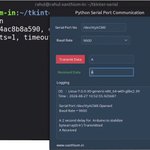
Check out this #Python #Tkinter Serial Communication Program designed to talk to an #Arduino or Microcontroller like #RP2040,ATmega8535
👇👇Links to Tutorials Below,👇👇
youtube.com/watch?v=iKMPLOqG…

3
183
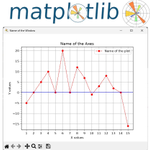
Animating Multiple Matplotlib Subplots inside a Single Window using FuncAnimation() class & Python
youtube.com/watch?v=KOe_P13k…
66
How to Create and Animate Multiple Matplotlib Plots in Single Window using FuncAnimation()
rahulsreedharan.medium.com/h…
@matplotlib

53

Animating Multiple Subplots in Real Time Inside a Single Matplotlib Window (Figure) Using FuncAnimation() Class & Python Tutorial
instructables.com/Animating-…
@instructables @matplotlib

1
66
PerenialDeveloper retweeted

FreeBSD has its own answer to Linux's RCU. Apple's XNU adopted it too. And until now it was documented mostly in code comments.
Loïc Grégoire decided to write it up: GUS, FreeBSD's safe memory reclamation scheme, which he calls "RCU's cool cousin".
Every kernel with lock-free data structures hits the same question: when is it safe to free memory that another CPU may still be reading? Most of us only know the Linux answer. Seeing a second design, one that another OS chose to adopt, is a good way to understand the trade-offs behind both.
I also like this kind of work: taking a mechanism that only lives in source comments and turning it into something people can read. That's how knowledge stops depending on a handful of maintainers.
osnews.com/story/146443/free…
PerenialDeveloper retweeted
A WiFi NAS for 3.5" floppies, built to pull photos off old Sony Mavica camera disks. An RP2354A runs a Greaseweazle port, an ESP32-S3 decodes FAT12 and serves the files at floppy.local, and the whole thing runs on a LiPo. Open hardware, public domain.
What I like is the split. The RP2354A owns the drive's 26-pin interface and the flux timing. The ESP32-S3 owns WiFi, the web page and the microSD copy. A custom SPI link joins them, with the frame layout in a shared header that both firmwares use. The Greaseweazle flux engine was reworked so PIO programs and DMA replace the STM32 timers of the original. Nice!
The README is a model too: schematic, Gerbers, STLs, a bring-up self-test firmware, host tests that need no board, and a Quirks section. Example: the BQ25180 charger's default 1000 mA over-current limit trips when the drive spins up on battery, so the ESP32 firmware sets the limits at every boot. The author also flags that a read plus WiFi at full power gets close to the 1500 mA limit, and asks builders to report resets.
A small touch: photos are deduplicated by SHA-256, because the camera restarts at MVC-00001 after a disk is erased.
Credit to Keir Fraser's Greaseweazle for the foundation.
github.com/bigcrimping/flopp…

PerenialDeveloper retweeted

Wow, they found the cockpit voice recorder of the Learjet 60 that crashed in Miami.

NTSB investigators have recovered the cockpit voice recorder (CVR) of the Learjet 60 that crashed on Nov. 1 near Greenacres, Florida. The CVR was located at the site of initial impact. The CVR is being evaluated in the NTSB Vehicle Recorders Laboratory in Washington, D.C. The excavation work at the impact site has been completed.

ALT CVR from the Learjet 60.

ALT CVR from the Learjet 60 at the NTSB Vehicle Recorders Laboratory in Washington, D.C.

ALT CVR from the Learjet 60 at the NTSB Vehicle Recorders Laboratory in Washington, D.C.

ALT CVR from the Learjet 60 at the NTSB Vehicle Recorders Laboratory in Washington, D.C.

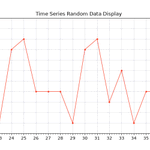
A Beginner’s Guide to Real-Time Data Plotting in Python using Matplotlib FuncAnimation() Class
Link Below
youtube.com/watch?v=CZHtWocv…

Matplotlib Real time Plot Animation Tutorial using FuncAnimation() and Python for Beginners
youtube.com/watch?v=CZHtWocv…
#matplotlib #Python
4
196
PerenialDeveloper retweeted

> be Sam Zeloof
> decide that making computer chips shouldn't require a billion-dollar factory
> turn your parents' garage into a semiconductor laboratory
> start making individual transistors while still in high school
> then attempt something almost nobody has done at home
> manufacture an actual integrated circuit from scratch
> in 2018, build the Z1 with six transistors
> not buy a chip, not assemble a kit
> actually manufacture the silicon chip yourself
> use chemicals, furnaces, microscopes, and ultraviolet light
> build your own machine to print microscopic patterns onto silicon
> because commercial photolithography machines can cost millions
> finish the entire first chip using 66 steps
> then go back and make something 200 times more complex
> build the Z2 with 1,200 transistors
> use salvaged equipment and machines he repairs himself
> even buy a broken electron microscope for $1,000
> a machine that originally cost $250,000
> design chips, fabricate them, and test whether the transistors actually work
> all from a garage in New Jersey
> for perspective, Intel's first commercial microprocessor had 2,300 transistors
> Sam is using technology inspired by the semiconductor industry of the 1970s
> his chips aren't competing with modern processors
> he's proving that making silicon isn't exclusively a billion-dollar industry's privilege
> imagine what happens when more people can build their own chips

PerenialDeveloper retweeted

Coratia has bagged ₹18 cr to support the ₹66 cr Indian Navy iDEX contract & fuel deep-tech R&D. Its flagship ROV JalaSimha is at TRL-9, deployed with Tata Steel & SAIL, and built for silt-heavy, low-visibility, high-current Indian waters. Also just licensed NIOT’s AUPD tech via NRDC, adding serious deep-sea monitoring capabilities down to 2,000m.


Meet Debendra Pradhan and Biswajit Swain, the Odisha-based innovators behind Coratia Technologies!
NIT Rourkela alumni, the duo founded this deep-tech startup to develop indigenous underwater robotic systems for defence and marine applications.
The startup has secured a Rs 66 crore Indian Navy deal for indigenous underwater robotic systems.
Now, NRDC has transferred ocean-profiling technology developed by NIOT, Chennai, to Coratia Technologies.
The technology measures ocean temperature, salinity and depth up to 2,000 metres, transmitting real-time data via satellite.
From defence robotics to ocean research, Odisha’s homegrown talent is building advanced technologies for India!
Debendra Pradhan (Founder & CEO)
Biswajit Swain (Founder & CTO)


PerenialDeveloper retweeted

The Rhind Mathematical Papyrus is the oldest manuscript written in algebra and trigonometry, dating back to 3,550 years ago.
It shows that the Egyptians used first-order equations, geometric series and a second-order algebraic equation, related to the Pythagorean theorem a² + b² = c²
It also describes how to obtain an approximation of π accurate to within less than 1% and one of the earliest attempts at squaring the circle.


PerenialDeveloper retweeted

An upgraded Donnager-class ship from The Expanse.
#space #art by BLTheArmyGuy
reddit.com/r/TheExpanse/comm…


PerenialDeveloper retweeted

eye candy glass interposer from eindhoven university of technology, BGA at the bottom and MPO at the top


