

Established in 1914 and housed in @UPCollegeofLaw, the Philippine Law Journal (PLJ) is the oldest English-language law journal in Asia, now in its 100th volume.
Malcolm Hall, UP Diliman
Joined September 2023
- Tweets167
- Following1
- Followers181
- Likes1


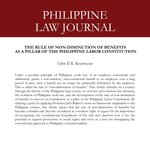
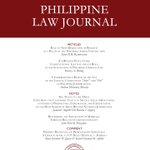


Pinned Tweet
CALL FOR PAPERS: VOLUME 100
The Philippine Law Journal (PLJ) is the flagship peer-reviewed, student-edited law review of the University of the Philippines College of Law and the preeminent legal periodical on Philippine law.
#100PhilLJ


CALL FOR PAPERS: VOLUME 100
Volume 100 of the Philippine Law Journal (PLJ) is accepting submissions of scholarly works, e.g., legal articles, book reviews, student notes, and comments on recent jurisprudence and legislation, for Issues 3 and 4 of Volume 100.
#100PhilLJ


51
VOLUME 99, ISSUE 3 RELEASE
The third issue of the 99th Volume of the Philippine Law Journal is now accessible on the PLJ Website at philippinelawjournal.org/vol…. Issue 3 contains three peer-reviewed Articles, two Notes, and one Comment.

1
62
John Paul Punzalan’s Note utilizes the doctrine of relative constitutionality to challenge the definition of marriage in Articles 1 and 2(1) of the Family Code and develops a framework to challenge such gendered definition through the equal protection clause.

1
19

CALL FOR PAPERS: VOLUME 100
PLJ AMENDED POLICY ON USE OF AI AND AI TOOLS
Volume 100 of the Philippine Law Journal (PLJ) is still accepting submissions of scholarly works for Issues 2 to 4 of Volume 100.
#100PhilLJ


IN RETROSPECT:
PRIVATIZATION OF OPERATIONS: ENFORCING ACCOUNTABILITY ACROSS CRITICAL INDUSTRIES
Read the full In Retrospect here: philippinelawjournal.org/for…

34
CALL FOR PAPERS: VOLUME 100
ISSUE 4 THEME ANNOUNCEMENT
Volume 100 of the PLJ is still accepting submissions of scholarly works, e.g., legal articles, book reviews, student notes, and comments on recent jurisprudence and legislation, for Issues 1 to 4 of Volume 100.
#100PhilLJ


Further, the advent of Artificial Intelligence (AI) looms large as a potential opportunity or threat to how laws are examined and how justice is administered. An evaluation of the digitalization of law would present a rich discussion on its role in a paperless age.
1
32
For inquiries, you may contact Mr. Benedict Gabriel Casino (Chair) at [email protected] or visit philippinelawjournal.org.

16
You may include a brief preemption memo (without any identifying information) in .doc or .docx format to aid the Board in evaluating your submission. Further, all submitted works must adhere to the Journal's policy on use of artificial intelligence (AI).
1
10
For inquiries, you may contact Mr. Benedict Gabriel Casino (Chair) at [email protected] or visit philippinelawjournal.org.
9
VOLUME 99, ISSUE 2 RELEASE
The second issue of the 99th Volume of the Philippine Law Journal is now accessible on the PLJ Website at philippinelawjournal.org/vol…. Issue 2 contains two peer-reviewed Articles and three Notes.

Andrew Holandez-Mencias’ Note uses textual analysis and postcolonial constitutionalism in the context of Rappler v. SEC to argue that the 1987 Constitution’s 100% Filipino-owned equity restriction on mass media should prevail over the right to freedom of speech.

1
15
