
Population, Demography. Birth statistics.
Kazakhstan
Joined July 2021
- Tweets225
- Following262
- Followers670
- Likes30



Pinned Tweet
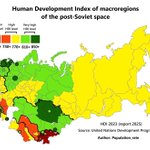
This map shows the Human Development Index (HDI) across macroregions of the post-Soviet space for 2023.

1
9
789
2. The gap between HDI categories exceeds 150–160 points. HDI is directly influenced by levels of urbanization, education, healthcare, and income per capita.
1
204
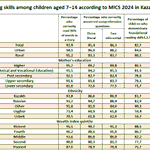
As the MICS 2024 results show, children's reading skills are strongly correlated with the parents’ level of education and material well-being.

1
5
1,109
Kazakhstan: How many women believe a husband has the right to beat his wife (MICS 2024)
1.Age:
The older the women, the more likely they are to justify domestic violence.
➡️ 45–49 years — 5.9%
➡️ 18–19 years — 0.7%

1
7
858
2.Education:
Belief in a husband’s “right to beat his wife” drops sharply with education:
📉 Lower secondary — 14%
🎓 Higher — 2.1%
(MICS 2024)
3.Wealth:
Poverty correlates with tolerance of violence.
💸 Poorest — 9.7%
💰 Richest — 1.5%
(MICS 2024, Kazakhstan)
1
1
536
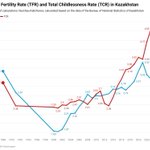
Expected childlessness rates by country in conventional generations. Based on the invested TFR1 or TMR indicators for 2023-2024. The current global decline in the birth rate is primarily due to the postponement and refusal to have first children.

9
1,059
Since 2015, fertility patterns have changed significantly in many countries, leading to a kind of childlessness revolution (at least in relative generations). Kazakhstan has been particularly involved in the decline in the TMR.

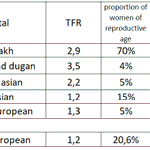
Birth rate in Kazakhstan is declining, but the high level of imbalance in birth rates between ethnic groups remains

Business activity and economic growth in Kazakhstan's main sectors have reached their highest levels in the past 15-20 years. The main contribution comes from infrastructure projects, housing construction, and the expansion of the industrial base.

1
8
1,067
May 31 is the Day of Remembrance of Victims of Political Repression and Famine in Kazakhstan.
Asharshylyk (kazakh famine, holodomor) is an artificially organized famine in Kazakhstan in 1931-1933.

4. Despite the high birth rate, the share of the world population of the early 20th century has not been restored to this day and it is possible that this will never be restored.
1
3
924