

Earnings, EBITDA margins & concall teardowns using AI for NSE & BSE listed companies. NFA. DYOR. Educational only.
Canada
Joined November 2025
- Tweets352
- Following141
- Followers36
- Likes290






SOME IMOORTANT PATENTS
Sun Pharma, US 12,758,608 (granted Oct 13).
A ready-to-inject cetrorelix pen for IVF patients, so there's no mixing step.
Jio Platforms, US 12,756,433 (granted Oct 6)
An antenna filter unit for its own 5G massive-MIMO radios, which should mean more capacity at each site.
TCS, US 2026/0310714 (application published Oct 8)
A way to detect and reduce hallucinations in enterprise AI assistants.
TCS, US 12,754,178 (granted Oct 6)
An NFC tag that checks packaged milk freshness without opening the pack.
Indian Oil, US 2026/031763 (application published Oct 15)
A process that turns crude oil straight into petrochemical feedstock.
Infosys, US 2026/0301407 (application published Oct 1)
Multi-camera tracking of what shoppers pick up, for checkout-free stores.
40

Starlink, Jio and Airtel satellite plans in India
None of the three has launched commercial satellite broadband in India yet. All are waiting for spectrum assignment and final security clearances.
Partnerships
Jio has a joint venture with SES (51:49) for GEO and MEO capacity. It also signed a 2025 distribution deal with Starlink. It is preparing its own sovereign constellation of around 1,600 LEO satellites (future plan).
Airtel has a major stake in Eutelsat OneWeb and also signed a 2025 distribution deal with Starlink.
Can Starlink work without them?
Yes. Starlink has its own licence and ground infrastructure and can sell directly. The deals with Jio and Airtel are mainly for distribution, retail support and installation help.
Existing infrastructure advantage (Indian customer view)
Jio and Airtel can make the service easier and more practical for Indian customers through their retail network, bundling with existing mobile or fibre plans, EMI style hardware payments, local installation support and hybrid terrestrial plus satellite services. This is their main edge. Starlink has the advantage on pure satellite capacity and latency.
Expected costs
Starlink: Analyst estimates of ₹2,500 to ₹3,500 per month for retail, plus hardware of ₹33,000 to ₹34,000. Official price is not confirmed (a higher test listing was removed).
Airtel / OneWeb: No consumer price published. Mainly enterprise and custom contracts. Professional terminals are costlier.
Jio / SES: No official price. Enterprise oriented. Hardware is likely to be subsidised or bundled for existing customers.
Retail versus enterprise focus
Starlink’s core strength is retail and rural residential broadband. In India, early uptake is expected to be heavier on enterprise and remote sites because of high costs.
Customers they are targeting
Jio: Enterprises, small and medium businesses, mobile backhaul, remote communities, schools and health centres. Also retail customers for Starlink kits. Future own LEO plan also covers defence, maritime, aviation and direct to device.
Airtel: Enterprises, government, maritime, aviation, business customers and remote communities. Also retail equipment sales for Starlink.
Defence and international deals
Airtel / OneWeb: Used by the Indian Army and Navy (Myanmar relief, Sri Lanka floods, Navy voyage). Strong international deals including French Armed Forces (up to €1 billion) and UK government worldwide.
Jio / SES: Indian defence trials done. Future sovereign LEO plan is positioned for defence and national security. No major public international defence satcom deals yet for the joint venture.
Technology comparison
Starlink: LEO at around 550 km, about 11,000 satellites, latency around 25 to 60 ms. Best on speed, latency and capacity.
Airtel / OneWeb: LEO at around 1,200 km, about 650 satellites, latency around 40 to 70 ms. Better for enterprise service levels and polar coverage. Adding more satellites for capacity, but staying at higher orbit.
Jio / SES (current): Higher latency GEO and MEO. Own LEO plan (aligned with 6G non terrestrial network) is still a proposal.
Other points
Satellite will remain much costlier than fibre or fixed wireless for most users and is mainly useful for hard to reach areas. Jio is integrating satellite into its 6G roadmap. Sovereignty and data control are key themes for Jio’s own constellation.

We have worked closely with regulators, industry and operators in India for 5+ years, and built a network of dedicated systems, gateways, and other infrastructure all in-country to exclusively serve Indian traffic safely and securely - and all with the requisite government approvals.
Starlink is ready to connect India with high-speed internet.
115
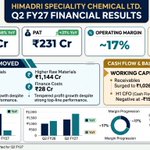
Himadri Speciality Chemical Q2 FY27 results: sales jump 58 percent, profit rises 31 percent
Himadri makes speciality chemicals. The main line is carbon materials and chemicals used in aluminium smelting, graphite electrodes and tyre rubber, with a small power business on the side.
Sales rose to 1691.43 crore rupees in the quarter ended 30 September 2026 from 1071.03 crore rupees a year ago. That is a rise of 620.40 crore rupees or 58 percent. Against the previous quarter sales climbed 259.55 crore rupees or 18 percent from 1431.88 crore rupees.
Profit after tax came in at 231.32 crore rupees against 176.14 crore rupees a year ago. That is a rise of 55.18 crore rupees or 31 percent. Against the previous quarter profit was almost flat, moving from 228.43 crore rupees to 231.32 crore rupees.
Profit before tax was 307.34 crore rupees, higher than 236.54 crore rupees a year ago and 300.51 crore rupees in the previous quarter.
Other income was 41.79 crore rupees this quarter, down from 56.31 crore rupees in the previous quarter.
There is no exceptional gain or loss this quarter.
The sales jump did not fully flow into profit because material costs, purchase of traded goods and finance costs rose with the higher business, while other income also cooled.
Why the numbers moved
Material costs rose to 1143.92 crore rupees from 710.76 crore rupees a year ago as the carbon materials business expanded. Purchase of stock in trade also jumped to 152.43 crore rupees from 28.18 crore rupees. Finance costs increased to 27.72 crore rupees from 14.78 crore rupees. These higher costs kept the profit rise slower than the sales rise. The carbon materials and chemicals segment still delivered most of the profit at 251.64 crore rupees.
Ratios from the filing
Operating margin worked from the printed profit before tax, finance cost and other income comes to about 17 percent. Debt to equity is low at about 0.23 times on the half year balance sheet, with borrowings at 1155.84 crore rupees against equity attributable to owners of 5135.22 crore rupees. Interest cover is comfortable as profit before tax plus finance cost covers the finance cost many times over. Tax rate on the quarter is about 25 percent. Earnings per share is 4.60 rupees basic for the quarter.
Cash and free cash
For the six months the cash flow statement shows cash from operations at a negative 154.35 crore rupees. Spending on property, plant and equipment was 173.04 crore rupees. Free cash is therefore negative. Profit for the half year of 459.75 crore rupees did not turn into cash because working capital, mainly higher receivables and lower payables, absorbed the cash. Cash on hand fell to 95.93 crore rupees from 164.76 crore rupees at the start of the year, while short term borrowings rose.
What a careful reader would check
Profit after tax for the quarter is solid at 231.32 crore rupees, yet cash from operations for the half year is negative. Other income of 41.79 crore rupees is not the main driver of the 231 crore profit. There is no one time exceptional item.
Receivables jumped sharply to 1026.18 crore rupees from 696.42 crore rupees at the end of March, which is a large rise against the sales growth. The limited review report of the auditors is clean with no qualification or emphasis of matter that changes the numbers.
#Himadri #SpecialityChemicals
Not financial advice. Not a buy or sell recommendation. Do your own research.

115

Prem Srinivasan retweeted

What if every post you make could create an opportunity to earn?
On Vync, your followers can directly support your posts with gifts. 🎁
If people love what you create, they can send you a gift — and those rewards can be converted into real money.
No waiting for brand deals.
No complicated creator programs.
No need to be a huge influencer.
Your audience appreciates your content → they support you → you earn.
Every post can become more than just a post.
It can become a direct connection between your content, your community, and your earnings.
That’s the creator experience we’re building with Vync. 🚀
aratt.ai/@vync
Prem Srinivasan retweeted

fucking grok @bot got my LinkedIn account suspended :')
@LinkedInHelp pls forgive me I didn't know grok bot sucks so hard
Prem Srinivasan retweeted
Sometimes you want people to know it’s you.
Sometimes you just want to say what’s on your mind.
On Vync, you can do both.
Switch between Public Mode and Anonymous Mode without leaving the same platform.
Join communities, discover content, jump into live conversations, share your thoughts, and connect with people — all in one place.
Your identity shouldn’t decide how you participate.
You decide how you show up.


The Reserve Bank of India is actively tightening the liquidity tap this week using two decisive moves.
Here is the breakdown:
1. Daily CRR Floor Raised from 90% to 99% (Effective October 16, 2026)
The Cash Reserve Ratio (CRR) is the portion of customer deposits banks must maintain as cash balances with the central bank.
While the headline CRR remains unchanged at 3.00%, the RBI is raising the minimum daily maintenance threshold from 90% to 99%, starting from the reporting fortnight beginning October 16, 2026.
Previously, banks had breathing room to manage liquidity flexibly across the 14-day cycle as long as their two-week average matched the requirement.
Under the new mandate, lenders must lock up virtually the entire mandated balance every single day, drastically cutting their daily surplus cash.
For example,
From RBL Bank’s official Q2 FY27 published today 12 October, Total Deposits as on 30 Sept 2026 = 1,56,272 crore.
Headline CRR at 3% = 4,688.16 crore (14-day daily average).
Old daily floor (90%) = 4,219.34 crore
New daily floor (99%) from the fortnight beginning 16 Oct 2026 = 4,641.28 crore
Daily flexibility drops from 469 crore to 47 crore.
Roughly 422 crore of floating cash gets locked every night for RBL alone.
For the entire Indian banking system, roughly 75,000 to 77,000 crore of extra cash gets locked every night across the banking system.
2. 25,000 Crore OMO Bond Sale Auction (Scheduled for October 13, 2026)
The RBI is conducting an Open Market Operation (OMO) auction to sell government securities across six tranches maturing between 2030 and 2034.
When banks and financial institutions purchase these bonds, liquid cash moves off bank balance sheets and directly into the RBI, pulling 25,000 crore out of the system in one go.
Why the tightening?
Coming right after the repo rate was raised by 25 basis points to 5.50%, these actions target systemic surplus liquidity (which hovered around 3.88 lakh crore).
By locking up daily cash and absorbing reserves through bond sales, the RBI is ensuring interbank lending rates stay closely aligned with the policy rate to keep inflationary pressure in check.
Show less
#nifty #niftybank
103
Alkali Metals Limited returned to profit this quarter after losses in the previous quarter and the same quarter last year, as sales of fine chemicals rose sharply.
The company makes sodium amide, sodium alkoxides, sodium hydride, sodium azide, tetrazoles, amino pyridines and other intermediates used by pharmaceutical companies.
Revenue from operations stood at 27.27 crore rupees in the quarter ended 30 September 2026. That is 9.70 crore rupees or 55 percent higher than the previous quarter and 8.50 crore rupees or 45 percent higher than the same quarter last year.
Profit after tax came in at 0.58 crore rupees. The company had reported a loss of 0.64 crore rupees in the previous quarter and a loss of 0.91 crore rupees in the same quarter last year.
Profit from the main business before other income was thin at about 0.11 crore rupees. Other income of 0.47 crore rupees helped the final number. There were no exceptional items this quarter.
The filing does not announce a dividend.
Sales rose on both domestic and export fronts, with exports roughly doubling from the previous quarter. The profit margin stayed thin because material costs and other expenses also moved up.
Profit before tax was 0.58 crore rupees, the same as profit after tax because tax expense was zero this quarter. Interest cover, worked as earnings before interest and tax divided by finance cost, came to about 2.2 times. Debt to equity stood near 0.48 times on the half year balance sheet. The filing does not print a full year equity or a clean operating profit line, so operating margin and return on equity cannot be stated cleanly for the quarter alone.
The cash flow statement is for the half year ended 30 September 2026. Cash from operations was a negative 1.18 crore rupees. Spending on fixed assets was small at 0.09 crore rupees, so free cash flow was also negative. The profit in this single quarter did not turn into cash for the half year. Cash on the balance sheet stayed low at about 0.72 crore rupees while borrowings were about 21 crore rupees.
Please note that profit after tax this quarter includes other income of 0.47 crore rupees against a final profit of 0.58 crore rupees, and that the half year cash from operations remained negative even though the quarter itself showed a profit. There is no exceptional item. The limited review report is unmodified.
The same filing shows trade receivables of 15.78 crore rupees, with a large part from exports. Inventories rose from the March level. Related party lines are not printed. The auditor’s limited review is clean.
#AlkaliMetals #FineChemicals
Not financial advice. Not a buy or sell recommendation. Do your own research.

20
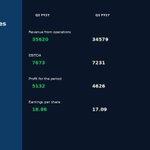
HCL Technologies reported higher sales and a sharper rise in profit after tax this quarter.
The numbers are from Consolidated and unaudited statements
Sales rose to 35620 crore rupees this quarter. That is 1041 crore rupees or 3 percent more than the previous quarter and 3678 crore rupees or 12 percent more than the same quarter last year.
Profit after tax came in at 5132 crore rupees. That is 506 crore rupees or 11 percent higher than the previous quarter and 896 crore rupees or 21 percent higher than last year.
Profit from the main business also rose. The IT and business services segment delivered the largest share of the segment result at 4995 crore rupees.
Other income fell to 234 crore rupees from 361 crore rupees in the previous quarter and 415 crore rupees in the same quarter last year.
There was no one time gain or loss this quarter.
The board declared an interim dividend of 12 rupees per equity share of face value 2 rupees.
Sales rose and profit after tax rose by more because the core IT services business improved its margins even while other income dropped.
Operating margin, which is earnings before interest and tax divided by sales, stood near 19 percent this quarter after adding the printed finance cost and depreciation to profit before tax.
Return on equity on the printed equity of about 75165 crore rupees at the half year end was high for the quarter alone, though the filing does not annualise a single quarter figure.
Debt to equity remains low.
Interest cover is comfortable as finance cost of 194 crore rupees is small against earnings before interest and tax.
Tax rate on the printed profit before tax was about 21 percent. Net debt is negative because cash and bank balances exceed borrowings.
The filing prints the cash flow statement for the half year. Cash from operations was 7730 crore rupees, spending on property plant equipment and intangibles was 999 crore rupees, and free cash flow was about 6731 crore rupees.
Half year profit after tax was 9758 crore rupees, so most of the profit turned into cash. Cash and bank balances remain high.
Cash from operations for the half year covered the profit after taxes. The limited review report is clean with nothing that came to the auditors attention.
The filing prints receivables and inventories in the balance sheet with no sharp rise flagged against sales, and no related party line that changes the picture.
#HCLTech #ITServices
Not financial advice. Not a buy or sell recommendation. Do your own research.

Swan Defence and Heavy Industries Limited reported a sharp jump in profit after tax to 567 crore rupees for the quarter ended 30 September 2026, driven almost entirely by the write back of an earlier tax provision.
The company manufactures defence and heavy industry equipment and builds ships at its Pipavav yard.
Sales for the quarter stood at 69 crore rupees. This was higher by 29 crore rupees or 74 percent compared with 40 crore rupees in the same quarter last year. It was also higher by 38 crore rupees or 125 percent compared with 31 crore rupees in the previous quarter.
Profit after tax reached 567 crore rupees. This compares with a loss of 1 crore rupees in the same quarter last year and a loss of 42 crore rupees in the previous quarter.
Profit before tax from the main business was only 4 crore rupees. The large increase in profit after tax came from the write back of 563 crore rupees of earlier years tax provision.
Other income was 57 crore rupees, which is almost as large as sales for the quarter. There is no exceptional item in this quarter. The filing does not announce any dividend.
The big profit is not coming from the yard or the defence work. It is coming from the clearing of an old tax number, while the operating side of the business remains thin.
The auditor has given a limited review and no qualification is visible in this filing.
#SwanDefence #Defence
Not financial advice. Not a buy or sell recommendation. Do your own research.

42
RBL Bank interest earned rose 23 percent this quarter and profit after tax more than doubled to 498 crore rupees.
RBL Bank is a private sector bank that takes deposits and gives loans.
These are consolidated numbers.
Interest earned rose to 4322 crore rupees from 3508 crore rupees a year ago, an increase of 814 crore rupees or 23 percent. It stood at 3840 crore rupees in the previous quarter, up 482 crore rupees or 13 percent.
Profit after tax rose to 498 crore rupees from 192 crore rupees a year ago, an increase of 306 crore rupees or 159 percent. It was 234 crore rupees in the previous quarter, up 264 crore rupees or 113 percent.
Operating profit before provisions rose to 1417 crore rupees from 745 crore rupees a year ago.
Other income came in at 1080 crore rupees, large next to the profit after tax.
There is no exceptional item this quarter.
Gross NPA improved to 1.02 percent and net NPA to 0.29 percent.
Interest earned rose 23 percent but profit after tax rose 159 percent because operating profit jumped and provisions did not rise in step.
The filing prints return on assets at 0.92 percent annualised for the quarter. Capital adequacy ratio stands at 30.10 percent. Debt to equity is 0.31.
Tax expense is 152 crore rupees on profit before tax of 650 crore rupees, a rate of about 23 percent. Basic earnings per share is 3.22 rupees. The filing does not print a separate consolidated return on equity figure.
The filing prints the half year cash flow statement, not the quarter. For the half year, cash from operations was a use of 21039 crore rupees, mainly from the rise in advances, while capital expenditure was 88 crore rupees. Loan growth turned the profit into a cash outflow for the half year.
Profit after tax of 498 crore rupees sits next to other income of 1080 crore rupees. There is no one time item. The half year cash from operations shows a large outflow because advances grew.
The filing shows no related party transaction that changes the story.
The limited review carries an unmodified opinion.
Gross and net NPA both improved.
#RBLBank #Banking
Not financial advice. Not a buy or sell recommendation. Do your own research.

75
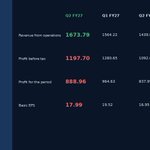
ICICI Prudential AMC sales rose this quarter but profit after tax fell from the previous quarter because other income dropped sharply.
Sales rose to 1673.79 crore rupees, up 234.73 crore rupees or 16 percent from the same quarter last year, and up 109.57 crore rupees or 7 percent from the previous quarter.
Profit after tax was 888.96 crore rupees, up 50.97 crore rupees or 6 percent from last year, but down 75.67 crore rupees or 8 percent from the previous quarter.
Other income fell to 16.91 crore rupees from 180.80 crore rupees in the previous quarter and 71.86 crore rupees last year.
There is no exceptional item this quarter.
The company declared an interim dividend of 30 rupees per equity share.
Sales grew but the profit after tax fell from the last quarter because other income was much lower this time.
The operating margin stayed high near 71 percent as the main business of managing funds continued to deliver. The tax rate was about 26 percent. Finance cost remained small.
For the half year, cash from operations was 1688.23 crore rupees after tax paid, and spending on assets was 37.02 crore rupees, so free cash was strong and the profit turned into cash.
A careful reader would note that other income was large in the previous quarter and is now small, which explains the profit drop. The limited review report is clean with no qualification. Receivables rose modestly from the year end.
#ICICIAMC #MutualFunds
Not financial advice. Not a buy or sell recommendation. Do your own research.

58
Prem Srinivasan retweeted

Nyburs 2.7 is here 🚀
📱 Android: live now, update from the Play Store.
🍏 iPhone: reaching the App Store within a day. Keep an eye out for the update!
What's new
🔔 Notifications are back and more reliable. Never miss a like, comment, follow or message.
🙅 "Not interested" on any post, video or news, with Undo.
⚙️ Content preferences in Settings: manage everything you've hidden.
📰 Nearby news: what's happening around you, in the News tab.
🔍 Faster search with @handles and #tags.
🎙️ Smoother live audio and video, dark mode fixes, and lots of small improvements.
This is just the beginning. Next: more control over the topics you see, smarter recommendations, and much more.
💬 Help us build Nyburs. Try the update and tell us in the comments what you love, what's broken, and what you want next.
⭐ Enjoying Nyburs? A rating on the Play Store or App Store helps more people find us. Please share Nyburs with friends too ❤️
Prem Srinivasan retweeted

Hi Elon,
I’m surprised to see that X invoices for Premium and other paid subscriptions in India do not include local taxes (GST).
If X is earning revenue from users in India, it should comply with Indian tax laws and collect and remit GST, just like other digital service providers do.
Could you clarify why GST is not being charged on paid subscriptions in India?
Thank you for your attention.
@elonmusk @X @XCorpIndia
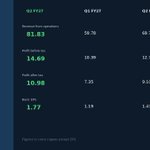
Swaraj Engines Q2 FY27 sales and profit after tax both rose.
The company makes diesel engines mainly for the Swaraj tractor division of Mahindra and Mahindra.
Sales rose to 635.19 crore rupees from 504.04 crore rupees in the same quarter last year, an increase of 131.15 crore rupees or 26 percent. Compared with the previous quarter of 588.39 crore rupees, sales rose by 46.80 crore rupees or 8 percent.
Profit after tax rose to 60.57 crore rupees from 49.68 crore rupees last year, up 10.89 crore rupees or 22 percent. From the previous quarter of 55.53 crore rupees, profit after tax rose by 5.04 crore rupees or 9 percent.
Profit before tax rose to 81.38 crore rupees from 66.75 crore rupees last year. Other income was only 1.58 crore rupees, small next to profit. There was no one time gain or loss.
Engine sales volume reached 61216 units against 51164 units last year.
Sales and profit both climbed. This quarter posted the highest ever profit before tax and profit after tax.
Costs rose with higher volumes, yet the profit before tax margin held up. Tax came to roughly 26 percent of profit before tax.
#SwarajEngines #TractorEngines
Not financial advice. Not a buy or sell recommendation. Do your own research.

72
Prem Srinivasan retweeted

Attacks sirf Indians or NRI ko kyon Hoga uski vajah @ankitatIIMA Ji Ne bahut acche se samjhaya hai
Kya Sach baat kahi Aapne 🙌
Prem Srinivasan retweeted

Mark Zuckerberg kept one story secret for years. When everyone told him to sell Facebook for up to $1 billion, Steve Jobs gave him strange advice. Go to a temple in India.
He finally told it on stage, sitting next to Narendra Modi.
"This is a story that I haven't told publicly and very few people know."
Facebook was young and had hit a tough patch. A lot of people wanted to buy it and thought he should sell.
So he went to see one of his mentors.
Jobs didn't give him a business plan. He told him to visit a temple in India, the one Jobs had gone to early on, when he was still figuring out what he wanted Apple to be.
Zuckerberg went. He traveled for almost a month, watching how people connected with each other.
It reminded him why Facebook mattered. He says he held on to that for the next 10 years as he built the company.
He didn't sell. Today Meta is worth more than a trillion dollars.
Would you have taken the $1 billion, or gone to India?
Follow me for more stories like this.