

The leading journal to provide reviews, surveys, and tutorials on technical developments in electronics, electrical engineering, and computer science.
Joined October 2017
- Tweets3.3K
- Following282
- Followers2.4K
- Likes96




Looking for a quick way to catch up on @ProceedingsIEEE's May 2026 issue? From the challenges facing #neuromorphic object detection and 4D imaging #radar to #hydrogen's role in #EnergyResilience, “Scanning the Issue” brings the research into focus: bit.ly/ProceedingsIEEE-May26…

Don't forget our next free @ProceedingsIEEE #webinar will address how #MIMO #transceivers unite sensing and communication. Join us for an insightful discussion about interference, near-field sensing, and more at 4pm ET on 4 Nov 2026. Register at: bit.ly/ProceedingsIEEE-ISACW… #ISAC

What if #wireless networks could communicate and sense their surroundings using the same resources? This #PIEEEKnowledgeInFocus paper explores multiple-access strategies to boost efficiency and curb interference in integrated sensing and communications: bit.ly/ProceedingsIEEE-KIF_I…

What do #neuromorphic vision, 4D imaging #radar, and #hydrogen-powered #EnergyResilience have in common? They're opening new possibilities for how we sense, understand, and respond to the world around us. Explore @ProceedingsIEEE's May 2026 issue now: bit.ly/ProceedingsIEEE-May20…

Thank you to everyone who attended yesterday's "Field-Programmable Gate Arrays and the #IEEE Milestone" #webinar.
If you missed the presentation, video excerpts are now are available on-demand at @ProceedingsIEEE's #YouTube channel. Tune in at: bit.ly/ProceedingsIEEE-FPGAW… #FPGA

On-demand excerpts and the full replay from today's "Field-Programmable Gate Arrays and the #IEEE Milestone" #webinar will be available soon. Our thanks again to @ASU's Aman Arora, @UofT's Vaughn Betz, #UWaterloo's Andrew Boutros, and @IEEEorg's Michael Geselowitz. #FPGAWebinar


And here's a final summary of the key takeaways from today's @ProceedingsIEEE "Field-Programmable Gate Arrays and the #IEEE Milestone" #webinar. Our thanks to our expert speakers for a great presentation, and to everyone who attended. #FPGA #FPGAWebinar

Here's a look at how you can achieve the best of both worlds when you have a #FPGA fabric alongside a vector processor, courtesy of @ASU's Aman Arora. #FPGAWebinar

Next, the data movement must also be hardened. @ASU's Aman Arora has examples showing two different routed for accomplishing this goal. #FPGA #FPGAWebinar

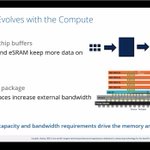
So, how are FPGAs handling these demands? It starts with hardening arithmetic #DeepLearning needs, including adding very narrow multipliers and reduction in the DSP slice. #FPGA #FPGAWebinar

Our next speaker is @ASU's Aman Arora, who shares how and why #FPGA architecture follows its workloads. He also notes that #DeepLearning is accelerating specialization, and explains what #DL is demanding of chips. #FPGAWebinar


The third design style introduced by #UWaterloo's Andrew Boutros is #FPGA-specific accelerators. For binarized NN, the impression is that efficiency is improved, there are still some drawbacks. #FPGAWebinar


#UWaterloo's Andrew Boutros also has a great look at generating custom CNN hardware, and how performance is impacted. #FPGA #FPGAWebinar


The second designs style #UWaterloo's Andrew Boutros points to custom model-specific hardware. He notes that FPGA's spatial nature enable greater customization and better efficiency. #FPGA #FPGAWebinar

What are some of the applicable design styles? #UWaterloo's Andrew Boutros is walking us through a number of them, beginning with overlay architectures, including this example, Microsoft's Brainwave overlay. #FPGA #FPGAWebinar


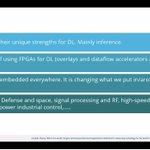
We're now hearing from #UWaterloo's Andrew Boutros, who is giving us a look at which #DeepLearning use cases are best suited for FPGAs. He also calls diverse I/Os "an underrated superpower". #FPGA #FPGAWebinar

What of low power requirements? Here's how #SpatialComputing and data flows play into things. #FPGA #FPGAWebinar

How do you optimize for low #latency? With a well thought out on-chip memory organization design, says @UofT's Vaughn Betz. #FPGA #FPGAWebinar

When we talk about FPGAs and these requirements, what do we mean exactly? @UofT's Vaughn Betz has a good summary of each, including how programmable I/Os, massive parallelism, and low latency and power enable you to choose your precisions. #FPGA #FPGAWebinar


What's needed for #DeepLearning applications? Flexibility, low-latency, and low power are all top priorities, according to @UofT's Vaughn Betz. #FPGA #FPGAWebinar
