

PSQ is a journal that covers public service issues in academic libraries. Published by @tandfonline | Editorial Board: https://nitter.cf/t.co/sv9gxWB7Zd
- Tweets210
- Following127
- Followers57
- Likes442
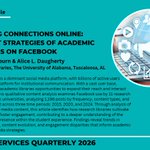


ALT Building connections online: Content strategies of academic libraries on Facebook Emily J. Wilburn & Alice L. Daugherty University Libraries, The University of Alabama, Tuscaloosa, AL Facebook remains a dominant social media platform, with billions of active users making it a key platform for institutional communication. With a vast user base, Facebook offers academic libraries opportunities to expand their reach and interact with students. This qualitative content analysis examines Facebook use by 11 research libraries at public universities, analyzing 1,196 posts by frequency, content types, and user engagement across three time periods: 2015, 2020, and 2024. Through analysis of library-led social media content, this article identifies how research libraries cultivate community and foster engagement, contributing to a deeper understanding of the library’s digital presence within the student experience. Findings reveal trends in posting patterns, content evolution, and engagement dis

ALT CALL FOR EDITOR: Best of the Literature Column Please send letters of interest and questions to Public Services Quarterly editor-in-chief Kim Mitchell ([email protected]).

ALT Engagement within academic libraries can take on various forms. Delineating the differences between engagement and outreach provides academic librarians a pathway to increase external collaborations and institutional impact. Understanding new and emerging academic librarian roles creates the foundation for institutional impact and job satisfaction. Student success is another product of effective engagement; understanding how students engage with campus activities can provide another avenue for collaboration. Successful engagement is also demonstrated in assessing student research confidence and abilities, managing faculty expectations for incoming student research abilities, and making significant changes in existing one-shot instruction sessions. Evidence synthesis research can provide another avenue for academic librarian engagement with faculty and researchers. The articles reviewed here explore various facets and trends in academic librarianship and opportunities for engagement.

ALT public services Quarterly tandfonline.com/toc/wpsq20/current NEW ISSUE RELEASED! Volume 22, issue 3 JULY - SEptember 2026

ALT Spilling the Tea on Librarians Spill the Tea: How to start a podcast COLUMN: MARKETING Mary Elizabeth Schiavone & Tristan MK Draper Library & Information Technology Services, Beloit College, Beloit, WI Outreach, marketing, and professional development can feel out of reach, especially at small institutions. Learn how the producers of the podcast Librarians Spill the Tea launched the project, how it informed their library outreach, and how they learned from their mistakes. This article explores the nuts and bolts of starting a podcast, developing branding, and creating sustainable workflows that can still make an impact. public services Quarterly 2026

ALT COLUMN: TECHNOLOGY Eva Spin & Tyler Lutz University of Chicago Library, MI Binding energy: Books by UChicago physics faculty Binding Energy is an experiment in collaborative, book-based historiography. A team of students, faculty, and staff ventured to open a rather particular window into the life of the University of Chicago’s physics department: a comprehensive accounting of the books published by faculty members across the full span of the department’s existence. This paper details how the team produced a bibliography and created a web exhibit designed to highlight a broadly representative selection of published works. This paper concludes by offering some thoughts about how our process could be built upon and adapted to other contexts. Public Services Quarterly 2026

ALT Research Article Feeding minds: The impact of academic library food access on student engagement and success María Evelia Emerson University Library, University of Illinois Urbana-Champaign, Urbana, IL A large academic library investigated the impact of food availability, access, and policy on student use of library spaces and services and support for academic work. Survey results reveal student strategies for accessing food, use of existing food support services, and perceptions of the impacts of library support for food access. Findings reveal positive perceptions of library support for food access on student academic success and use of library spaces. Results also articulate opportunities for academic libraries to connect with student needs for food information and develop programs to support food security. Public Services Quarterly 2026

ALT Research Article Incorporating fidget tools in library instruction: A case study Alexander Deeke University Library, University of Illinois Urbana-Champaign, Urbana, IL This paper reports the results of a case study where fidget tools were offered to undergraduate students in the context of one-shot library instruction. The literature suggests students, particularly neurodivergent students, perceive a positive influence from fidget tools on their learning and attention. An instruction librarian provided and tracked fidget tool usage in seven one-shot library instruction sessions taught in an introductory composition course. Fidget tool usage and results from a survey indicate that most undergraduate students will take a fidget tool when offered and perceive a positive influence from fidget tools on their perceptions of inclusion, learning, and attention. Public Services Quarterly 2026

ALT COLUMN: BEST OF THE LITERATURE Recruitment and retention in academic libraries: New perspectives Brad Vogus, ASU Library, Arizona State University, Tempe, AZ The challenge of recruiting and retaining academic librarians is not new. Library administrators often struggle to produce a large pool of applicants from diverse backgrounds for open positions, while candidates are frequently frustrated with limited communication and the slow, complex nature of the hiring process. Although some aspects of recruitment and retention are difficult to control, others are within institutional reach. Flexible work arrangements, transparent tenure and promotion policies, equitable treatment, and support for work–life balance are priorities for many librarians. The articles reviewed here explore the issues librarians identify as most significant.

ALT COLUMN: INTERNET RESOURCES AI LITERACY RESOURCES Annis Lee Adams University Libraries, California State University - East Bay, Hayward, CA We know students are using generative AI to brainstorm research topics, to develop research questions, and to find sources for research projects in addition to using AI for writing papers and creating presentations. We also know that, at this time, AI tools have limited ability to find high-quality, relevant sources; frequently hallucinate citations that do not exist; and provide no grounding or context for why they present sources or where they found them. Teaching students and our academic colleagues AI literacy is imperative. AI literacy includes discussing the strengths and limits of generative AI tools by explaining how they operate, how they may be biased, and how they are different from traditional search engines, such as Google and library databases. Furthermore, AI literacy includes guiding students to create productive, iterative prompts

ALT COLUMN: ECHNOLOGY Brooke Gross University Libraries, Western Kentucky University, Bowling Green, KY AI literacy long term: Conversations and implications While there is a great deal of research and discussion on the efficacy, pitfalls, and various uses of artificial intelligence in academic settings, it seems there is very little emphasis on the long-term consequences of delegating thought-based tasks or how information professionals in particular can engage in meaningful and productive conversations surrounding these risks. This article will examine the potential impacts of increased reliance on artificial intelligence and identify ways in which libraries can lead AI literacy initiatives from a place of neutrality, utilizing existing information literacy and critical thinking expertise. public services Quarterly 2026

ALT Simple and sustainable: Maintaining the Merry-Go-Round of exhibitions at The Grolier Club Shira Belén Buchsbaum In September 2026, The Grolier Club will open our 1,000th and 1,001st exhibitions since our founding in January 1884. These two exhibitions reflect some of the foundational aspects of The Grolier Club’s exhibition’s program: observing, narrating, and interpreting the history of book making; celebrating practitioners and innovators; and expanding notions on what constitutes the art and history of the book. The oldest and largest bibliophilic membership society in the United States, the Grolier Club is proud that over 142 seasons and three buildings in Manhattan, we have always hosted exhibitions of books and prints open to the public free of charge. This paper reflects on that rich history, our ever-evolving approach, and how we continue to develop exhibitions that further our mission “to celebrate the art and history of the book.”

ALT COLUMN: MARKETING Beyond the building: Leveraging a library renovation to tell a broader story Kristen Shuyler Libraries, James Madison University, Harrisonburg, VA A library renovation presents a unique communication challenge, requiring a thoughtful strategy that minimizes disruption while building anticipation. When James Madison University (JMU) decided to renovate and expand its flagship library, the JMU Libraries’ Communications & Outreach team pivoted from routine promotional efforts to a streamlined communication model designed to handle significantly increased, narrative-driven messaging related to the renovation. This article outlines the renovation project’s communication plan, describes our streamlining efforts, and highlights unexpected opportunities that emerged along the way—allowing us to share the library’s story in new ways and with broader audiences. public services Quarterly 2026


ALT COLUMN: SPECIAL LIBRARIES, SPECIAL CHALLENGES A perfect storm: Navigating a temporary move, major renovation, and a pandemic Michael Lear & Sarah Greene Department of Education, Bureau of State Library of Pennsylvania, Office of Commonwealth Libraries, PA Providing service from a temporary location for over four years during a major building renovation, compounded by the COVID-19 pandemic, posed unique challenges for the State Library of Pennsylvania. Challenges included providing service in a limited, temporary space, staff scattered among seven different spaces in three buildings, and limited access to the majority of collections. COLUMN: SPECIAL LIBRARIES, SPECIAL CHALLENGES public services Quarterly 2026

ALT Addressing student confidence levels in using library resources through flipped classroom instruction Margaret Bates University Libraries, University of Alabama, Tuscaloosa, AL Library instruction positively impacts library anxiety and students’ reluctance to use library resources. The flipped classroom instruction model is a useful tool for librarians faced with a class with no focusing component. This article presents the findings of a flipped classroom designed to help students improve confidence in accessing the physical library space and navigating both physical and electronic library resources. The framework discussed takes place in an entry-level class without an assignment to focus library instruction. Findings from a pre- and post-test analysis show a promising increase in student confidence levels following library instruction through this model. Public Services Quarterly 2026

ALT Public Services Quarterly tandfonline.com/toc/wpsq20/current NEW ISSUE RELEASED! Volume 22, Issue 1 January - March 2026


ALT Dispatches from the 2025 Library Marketing and Communications Conference COLUMN: MARKETING John M. Jackson, Loyola Marymount University, Los Angeles, CA The Library Marketing and Communications Conference is an annual gathering of outreach librarians and library marketing professionals. For academic library employees, attending the conference provides insights into marketing strategies that can be deployed to foster student engagement, connect with faculty, and effectively tell the story of the library to campus stakeholders. This year’s conference hosted several presentations by academic library representatives, including presentations on building communications toolkits, creating opportunities to foster student engagement, hosting contests that promote a campus reading culture, and strategically developing programming themes.

ALT Megaphone calling for editors