

Quantum Source is developing a photonic quantum architecture for fault-tolerant, practical quantum computers that can scale to millions of qubits.
Joined November 2023
- Tweets79
- Following58
- Followers843
- Likes20



Pinned Tweet
Every quantum computing roadmap is approaching a critical juncture: the moment where we discover which architectures will bridge the gap to practical, fault-tolerant scale - and which will remain bound to the scientific domain.
To show how we're tackling this challenge, we opened our lab doors to the cameras.
Our new 6-episode video series takes you behind the scenes with the scientists and leaders building Quantum Source.
We break down step-by-step why we're betting on a compound photon–atom architecture - combining the long-range connectivity of photons with the near-deterministic entanglement enabled by single trapped atoms.
Here is what we cover across the series:
🔹 Episode 1: The Vision — Compound Qubit Approach Why are we betting on a compound photon-atom architecture?
🔹 Episode 2: The Physics — Cavity QED & Quantum Gates in Practice Years of work to trap and hold a single atom reliably enough to build on.
🔹 Episode 3: The Engineering — From Lab Optics to Rack-Mount How ORIGIN went from a room-filling optical table to a compact system built around a reusable unit cell.
🔹 Episode 4: The Scale & Chip — Silicon Photonics Integration How silicon photonics carries quantum information between units.
🔹 Episode 5: The Full Team Story How trust and collaboration between theory, physics, and engineering shape our architecture.
🔹 Episode 6: Culture amp; Vision — Inside Quantum Source The ambition behind the project: building real infrastructure for quantum computing at scale.
🎬 Watch all six episodes live now: youtube.com/watch?v=s4S8fRgW…
#QuantumComputing #DeepTech #SiliconPhotonics #QuantumHardware #Physics #Innovation
Nature is always right. Physics never lies.
That's how our theory group starts the day. They own the quantum architecture end to end, and a blueprint only counts if it's grounded in what's physically possible.
Episode 5 brings the theorists, the engineers, and the physicists into one room. You'll hear why limitations at one layer often become opportunities at another, and what it takes to turn a lab demonstration into a scalable machine.
▶ Episode 5, The Full Team Story: youtube.com/watch?v=4g6Ly6_c…
Next week, the finale: what we're really building toward.
#QuantumComputing #DeepTech #QuantumSource
1
67
The scalability of photons. The precision of atoms.
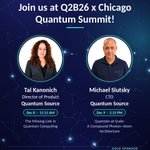
That's the core of Quantum Source's compound photon-atom architecture, and this December we're bringing it to the main stage at #Q2B26 x #Chicago Quantum Summit, alongside the industry's leading companies. 👇
🔹 Dec 9 | 2:15 PM
Dr. Michael Slutsky, CTO
Quantum at Scale: A Compound Photon–Atom Architecture for Fault-Tolerant Computing.
Michael will show how a single trapped atom in an optical cavity becomes the building block of a complete fault-tolerant quantum computer. It's one unit cell, replicated and connected, with fast deterministic entanglement that cuts hardware overhead and speeds up Quantum Computation.
🔹 Dec 8 | 11:15 AM
Tal Kanonich, Director of Product
The Missing Link in Quantum Computing: Efficient Photonic Interconnect for QC Systems.
The same core technology powers a room-temperature photonic interconnect. It links quantum processors, even ones built on different platforms, over standard optical fiber.
📍 Keynote Room W375E, Chicago
Will you be there? Let's meet 👋
#Q2B26 #QuantumComputing #FaultTolerance #Photonics #QuantumNetworking #Q2B26xChicagoQuantumSummit #MidwestQuantum #QuantumPrairie

94
Thousands of unit cells. One rule: every photon matters.
In classical optics, if you lose some light, you turn up the power. In quantum optics, a lost photon means lost information, and no amplifier can bring it back.
Episode 4 goes inside the silicon photonics layer that carries quantum information between our unit cells, including the one interface where the loss battle is won or lost.
▶ Episode 4, The Scale & Chip: youtube.com/watch?v=xB3H2-nl…
Next week: the people who decide what gets built.
1
2
123
Last week: one atom, one cavity, and a lot of lasers. This week we fit it all into a rack.
Here's the twist: the core of our system is tiny. So why did it once take up an entire optical table?
Episode 3 follows ORIGIN from research setup to rack-mount system, and shows why making it smaller also made it more stable, and ready to be replicated.
▶ Episode 3, The Engineering: youtu.be/JnHnjpaXZiU
Next week: thousands of unit cells. How do you connect them without losing a single photon?
Last week we showed why we bring atoms and photons together. This week we show what it took to get them to interact.
A single photon passing a single atom barely notices it.
Making them interact reliably starts with trapping the light itself.
Episode 2 takes you into the lab: an optical cavity, one trapped atom, and lasers that all have to stay perfectly locked.
Watch how what was once a major challenge became everyday practice in our lab.
▶ Episode 2, The Physics: youtu.be/KX-hUR95RWA
Next week: how a room-filling optical table became a rack.
#QuantumComputing #CavityQED #QuantumSource
Hope you enjoyed the teaser. Now let's dive into the question behind everything we build.
A useful quantum computer needs two things at once: enough qubits to protect information, and the connectivity to entangle any two of them.
Most architectures are strong at one and struggle with the other.
In Episode 1, we explain why we stopped choosing between them, and how a single trapped atom and a photon can do together what neither can do alone.
Watch for the moment the atom takes on a new role: a reusable interaction node.
▶ Episode 1, The Vision: lnkd.in/e_GQRAhe
Next week: the problem that took us years to solve.
Our new paper predicts useful entanglement rates for modular quantum computing with QS-LINK, Quantum Source’s photonic interconnect, even when successful photon delivery is rare.
The approach also removes the need for identical photon waveforms, easing a demanding requirement for connecting quantum processors built on different physical platforms.
Connecting quantum processors offers a way to scale beyond the limits of a single processor. But to execute a shared computation, they need a continuing supply of entanglement. How quickly they receive it determines how quickly they can perform computation together.
In conventional two-photon interconnect protocols, each processor sends a photon entangled with its communication qubit. Both photons must arrive and be detected in the same attempt. When photon delivery is inefficient, requiring two successes together makes entanglement generation much slower.
QS-LINK’s proposed protocol removes that requirement using a single atom as a quantum memory.
After the first photon interacts with the atom and is detected, the atom preserves entanglement with the first processor’s communication qubit while the second processor keeps trying. Once the second photon interacts with the atom and is detected, measuring the atom leaves the processors entangled. The two successful deliveries can therefore happen in separate attempts.
Because each photon interacts separately with the atom, the photons do not need to interfere with each other. Their pulse shapes can therefore differ, making the protocol particularly attractive for connecting different types of QPUs.
Using realistic parameters targeted for QS-LINK in the near term, our model predicts useful entanglement rates while requiring far fewer photon-generation attempts per second from each QPU than conventional two-photon protocols. These predictions account for both photons lost before detection and storage errors.
Explore the protocol and predictions in our new paper: arxiv.org/abs/2609.21961
Shana Tova from all of us at Quantum Source. 🍎
This year we shared our Compound Photon-Atom Blueprint for fault-tolerant quantum computing.
The idea, in plain terms:
Photons spread the information. Atoms hold it in place.
Reach and memory, working together.
Not a bad thing to wish for a year, either. Something bright to reach for, and the best people to hold onto.
Wishing everyone inside and outside the quantum space a sweet and meaningful new year.
🤖 Made with AI

1
627
We spend our days building the future. So for one day, we brought it into the office.
People don't feel valued by what a company says about them. They feel it when it makes room for the parts of their life that have nothing to do with work. Usually, that's the people waiting for them at home.
So we gave our team's kids the run of the office for a full day. You can see how it went in the video.
If you want to build the future somewhere that makes room for your whole life too, we're hiring: qs-labs.com/careers
#QuantumSource #LifeAtQuantumSource #WeAreHiring
415
Good to see @QuantumDaily take on a subject that's quietly become national policy: quantum computing, and how countries are already positioning for it.
Government money is moving fast. The US, UK, Japan, and Canada have each pushed quantum out of research budgets and into binding national policy.
These are countries preparing for a capability they expect to matter, and sooner than most people assume.
Adversaries aren't waiting either. They're already harvesting encrypted data today, on the bet they'll be able to decrypt it once quantum arrives.
Our board member, former Prime Minister @naftalibennett , put it as plainly as anyone in the piece: "I view quantum computing as a matter of national sovereignty." When Q-day comes, today's encryption stops protecting anything, and the countries that prepared early are the ones left standing.
The point worth sitting with is that no country controls the full quantum supply chain. So the winners won't be whoever spends the most. They'll be the ones that put real talent next to real capital and actually build the alliances to hold it together.
Read the full article here: thequantuminsider.com/2026/0…
#QuantumComputing #PhotonicQuantum #QuantumSovereignty #QuantumCryptography
We recently shared the launch of our Compound Photon-Atom Blueprint, a major milestone in our roadmap. For those interested in the technical reasoning behind this architecture, The Quantum Insider has just published an excellent deep dive.
Their article breaks down why combining photons and atoms provides a unique, synergistic solution to the scalability constraints of fault-tolerant quantum computing.
A great read on the intersection of quantum physics and practical engineering: thequantuminsider.com/2026/0…
@QuantumDaily
#QuantumComputing #QuantumSource #PhotonicQuantumComputing

2
935
🚀 Taking quantum networks out of the lab and into real-world infrastructure.
Excited to share that our latest research, developed together with Israel's @Mafat_IL, is now featured in @QuantumDaily .
The headline: a single trapped atom can now generate entangled photon pairs on demand, and those pairs hold up perfectly after traveling through more than a kilometer of everyday, unstabilized optical fiber.
Some highlights from the work:
🔹 Deterministic generation: A rubidium atom coupled to a microscopic optical cavity fires two entangled photons within tens of nanoseconds of a trigger, replacing the guesswork of probabilistic SPDC sources.
🔹 Built-in resilience: The photons come out in the singlet Bell state—the one entangled state that stays intact no matter how the fiber bends, heats, or flexes.
🔹 Zero compensation needed: No polarization stabilization, no dispersion correction, no active feedback, and still no measurable loss in fidelity over 1km+ of fiber.
Prof. Barak Dayan, our Chief Scientist, summed up why this matters: "Once an application requires entangled pairs with both high probability and high fidelity, a deterministic source becomes essential."
This kind of robustness is exactly what's needed to move QKD networks, quantum repeaters, and distributed quantum computing out of the lab and into real infrastructure.
📖 Read the full article here: thequantuminsider.com/2026/0…

🔬 A milestone for quantum communication, achieved with a single atom.
Quantum Source, working with Israel's DDR&D, has demonstrated on-demand generation of entangled photon pairs that survive real-world fiber conditions, with no active stabilization needed.
🔹 A single rubidium atom in a microscopic optical cavity emits two entangled photons on demand: deterministic, unlike probabilistic SPDC sources.
🔹 The photons are generated in the singlet Bell state, uniquely immune to the polarization drift fiber introduces from temperature, bending, and stress.
🔹 Sent through 1km+ of unstabilized fiber, no correction, no calibration, the entanglement arrived with no measurable fidelity loss.
"Once an application requires entangled pairs with both high probability and high fidelity... a deterministic source becomes essential," says Prof. Barak Dayan, Chief Scientist at Quantum Source.
Why it matters: removing the need for constant calibration simplifies deployment of QKD, quantum repeaters, and distributed quantum computing, another step in translating Israel's quantum science into deployable technology.
#QuantumComputing #Photonics #DeepTech
Introducing fault-tolerant compound photon–atom architecture.
Today, Quantum Source is introducing a transformative concept in fault-tolerant quantum computing: our compound photon–atom architecture.
Rather than building around a single qubit modality, the architecture combines two complementary quantum systems in one fault-tolerant framework:
Photons provide scalable, long-range connectivity.
Atoms provide deterministic entanglement and short-term quantum memory.
By letting each modality do what it is naturally best suited for, this blueprint addresses limitations that have challenged both purely photonic and matter-based approaches.
The architecture also brings the physical layer and fault-tolerance framework together from the start, including hardware-specific modeling, loss-aware decoding, and a path toward scalable measurement-based quantum computing.
This is the first time Quantum Source is presenting its innovative compound architecture: a blueprint for building scalable, fault-tolerant quantum computers from photons and atoms.
Read the full blog and accompanying arXiv paper: qs-labs.com/post/b-the-best-…
#QuantumComputing #FaultTolerant #PhotonicQC #QuantumArchitecture #LightAndMatter #QuantumSource
Introducing fault-tolerant compound photon–atom architecture.
Today, Quantum Source is introducing a transformative concept in fault-tolerant quantum computing: our compound photon–atom architecture
Rather than building around a single qubit modality, the architecture combines two complementary quantum systems in one fault-tolerant framework:
Photons provide scalable, long-range connectivity.
Atoms provide deterministic entanglement and short-term quantum memory.
By letting each modality do what it is naturally best suited for, this blueprint addresses limitations that have challenged both purely photonic and matter-based approaches.
The architecture also brings the physical layer and fault-tolerance framework together from the start, including hardware-specific modeling, loss-aware decoding, and a path toward scalable measurement-based quantum computing.
This is the first time Quantum Source is presenting its innovative compound architecture: a blueprint for building scalable, fault-tolerant quantum computers from photons and atoms.
Read the full blog and accompanying arXiv paper: qs-labs.com/post/b-the-best-…
#QuantumComputing #FaultTolerant #PhotonicQC #QuantumArchitecture #LightAndMatter #QuantumSource
3
490
What happens if a nation misses the quantum era?
That's the question @evankubes, President and Co-Founder of @QuantumDaily, posed to former Israeli Prime Minister @naftalibennett.
"It's tantamount to being in a war with horses when your enemies have tanks."
In a new interview with The Quantum Insider, Bennett explains why he views quantum computing as a strategic technology, why he believes governments must invest today, and why he chose to join Quantum Source.
One of the reasons: the photonic approach.
"We front load the problems."
The hardest challenges come first. But once solved, the path to scaling becomes dramatically more practical.
Watch the conversation to hear Bennett's perspective on quantum computing, national competitiveness, and the road to fault-tolerant systems: youtube.com/watch?v=l8zyZ3RB…

1
343
Quantum Source is the Readers' Choice winner in @globesnews' "Startups to Watch 2026."
Thank you to everyone who voted. As we work to build a scalable, fault-tolerant photonic quantum computer, recognition from the community means a great deal to us.
The future of quantum computing is being built today - and we're excited to be part of it.
linkedin.com/feed/update/urn…

2
631
Something exciting is taking shape behind the scenes.
Over the past few weeks, we've been capturing new conversations, insights, and milestones as we continue advancing our path toward fault-tolerant quantum computing.
Stay tuned for upcoming content featuring the people, science, and engineering behind Quantum Source's light-matter approach to scalable quantum computing.
#QuantumComputing #PhotonicQC #FaultTolerant #QuantumTechnology #LightAndMatter #QuantumSource
456
Our latest work on trapping and coupling single atoms to a planar photonic chip is now featured by The @QuantumDaily.
The milestone demonstrates single-atom trapping just 150–200 nm from a photonic resonator surface, enabling efficient atom-photon interactions on a CMOS-compatible platform - a key step toward scalable fault-tolerant quantum computing.
Excited to see the conversation around deterministic atom-photon architectures gaining momentum.
Read the full coverage: thequantuminsider.com/2026/0…

2
213