Quantus retweeted
I’m not really a defi guy but wow this guy ships like crazy. Respect 🫡
v3 is live.
One curve for every token. Buy and sell any amount, launch yours from 0.03 QTC, graduate to NEAR.
app.qlyphs.com
Quantus retweeted
First lending market for $QTC is live on $NEAR.
Collateral on @rhea_finance, powered by @near_intents.
QTC collateral is live on @rhea_finance
The first lending market for quantus:native , powered by @near_intents.
Quantus retweeted
Everything QTC is now in one app: Meteor ☄️
With Meteor you can:
- Bridge funds from native Quantus L1 to Meteor App
- Access QTC’s LP and lending borrowing on Meteor Explore
No switching apps. Everything in one place.
Quantus retweeted
NEW INTEGRATION
Aurora Intents is now live on @qlyphsxyz.
Bring assets into @QuantusNetwork from other chains, right inside the Qlyphs app and wallet extension.
Live quotes. Tracking from deposit to settlement. And back out the same way.
Bridge in → trade → bridge out.
Powered by @near_intents.
Quantus retweeted
I think Fortune is underestimating it tbh. It’s quite a bit more than $2 trillion at this point. migration.fail puts it at $2.7 trillion, and even that is an underestimate.
Get the details here:
beincrypto.com/bitcoin-quant…
Quantus retweeted
Normies are starting to notice that Bitcoin isn’t taking quantum seriously.
ambcrypto.com/tezos-algorand…
Quantus retweeted
➥ My quantum-resistant token wishlist
I’m spending more time on this sector because the migration is already happening.
Google targets 2029 for post-quantum readiness, with Google Cloud publishing a detailed migration roadmap in August.
That’s a deadline to prepare infra, not a prediction that Bitcoin gets broken in 2029.
I believe wallets, custodians and institutions will need to evaluate quantum exposure before a capable quantum computer arrives.
But I’m checking what actually protects user funds: native signatures, optional account upgrades, or unfinished implementations.
Here’s my wishlist:
→ base:0x37696cd8f723ce541ac376f79fc109080e505ba3 - the operating history I want to study.
Native transactions have used hash-based XMSS signatures since 2018.
Next checkpoint is Zond: whether its post-quantum smart-contract stack can attract developers beyond the security thesis.
→ $QTC - the newer implementation I’m following closely.
@QuantusNetwork native ML-DSA transaction signing.
I want to see sustained usage, accessible liquidity and demand that can absorb mining emissions.
→ $CKB - cryptographic flexibility interests me.
Its SPHINCS+ Lock Script and Quantum Purse let users adopt post-quantum protection today.
It’s optional, so wallet adoption matters as much as protocol capability.
→ algorand:native - a concrete migration path on an established chain.
Native Falcon-1024 accounts are supported. I’m watching wallet and app compatibility.
→ $NEAR - migration without changing the account address.
ML-DSA-65 signing went live in July.
Fireblocks demonstrated rotating a funded account in 2 transactions, then receiving and sending funds with the new key.
That’s the kind of practical integration I care about.
→ abelian:native - privacy and post-quantum security together.
@PQabelian uses lattice-based cryptography for private transactions.
I want to understand whether that translates into recurring payment demand and stronger liquidity.
→ $CELL - the ability to change algorithms over time.
@cellframenet supports multiple post-quantum signature schemes.
I’m watching adoption of its native infra, while checking which chain and token representation users actually hold.
→ $STRK - promising architecture, with dependencies.
Hash-based STARK proofs and working Falcon account implementations give Starknet a migration path.
Those account implementations remain early-stage, and full protection still depends on Ethereum’s transition.
I’m also tracking $ZEC’s quantum-recoverability work.
It supports a future migration; it doesn’t make current Zcash fully quantum-resistant.
Where I expect growth:
→ wallets that make key migration usable.
→ custody systems that can support new signatures.
→ infra that handles their higher verification costs.
→ networks that turn those capabilities into retained users and fees.
Existing chains can upgrade too, so post-quantum cryptography alone won’t guarantee token demand.
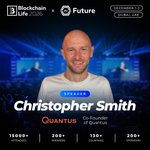
Christopher Smith says Bitcoin should take quantum seriously
"If you've got a trillion dollar asset secured by elliptic curves, you might want to be taking it seriously."
"Signal, iMessage, Cloudflare, they already went post quantum and just nobody noticed."
Quantus retweeted
Welcome, Herominers!
quantus.herominers.com
Quantus retweeted
In 9 weeks all US gov procurements will be required by law to be post-quantum.
IN FOUR MONTHS, THE NSA STOPS BUYING ANYTHING THAT RUNS ON TODAY'S ENCRYPTION.
THE REASON IS QUANTUM COMPUTERS.
This is not a proposal, but a published directive with a date.
It's called CNSA 2.0, the NSA issued it in 2022, tightened it in 2025, and almost nobody outside the agency has read it. It quietly orders every national security system in America to abandon the encryption the entire internet runs on, because a large enough quantum computer breaks all of it, and the NSA has decided that machine is coming.
The schedule:
January 1, 2027: every new system the government buys for classified or sensitive work must use quantum resistant encryption.
2030: all network equipment and software signing must run quantum resistant only. Legacy gear that can't be upgraded gets ripped out.
2033: operating systems, applications, cloud. Everything.
2035: full quantum resistance across all national security systems. Hard stop.
The NSA gave the EARLIEST deadlines to two categories, signed software and network traffic. Their stated reason: those are most exposed to harvest-now-decrypt-later, adversaries recording encrypted data today to crack it once the quantum computer exists.
Defense systems take 18 to 36 months to build. Anything designed today ships after the deadline. For much of the government, the planning window already closed.
Meanwhile your bank, your hospital, and the app you're reading this on run the exact algorithms the NSA is abandoning.
$INFQ $IONQ $QBTS $RGTI
Quantum thread attention is actually picking up on its own right now.
Not because of some big catalyst or coordinated shill, but more ppl are just starting to dig into the actual projects building post-quantum stuff.
You’re seeing more real conversations around which chains are native vs which ones still need to migrate, and the pure-play ones are starting to get more eyes.
With this kind of slow burn momentum, I think the narrative still has room to run before it gets fully crowded.
So if you’re looking for projects actually building in the post-quantum space, I’ve got you covered here by tier:
✨ Tier S (already shipped)
@QRLedger | base:0x37696cd8f723ce541ac376f79fc109080e505ba3: Native XMSS since 2018. Every transaction is PQC from day one. Longest track record, no migration needed.
@NEARProtocol | $NEAR: ML-DSA signing live on mainnet since Jul 2026. Accounts can add a PQC key without changing address.
@QuantusNetwork | $QTC: ML-DSA from genesis, mainnet ~Sep 2026. Uses ZK aggregation to reduce signature bloat.
✨ Tier A (gaining traction)
@Starknet | $STRK: Already demoed Falcon/ML-DSA. Account abstraction makes switching signature schemes easier.
@PQabelian | abelian:native: Lattice-based native + privacy. Live mainnet for a while, supports multi-algorithm (Blanc Fork), has QDay L2 EVM-compatible.
@mochimocrypto | $MCM: Native hash-based (WOTS+) since 2018, same generation as QRL.
@Algorand | algorand:native: Falcon-1024 accounts live on mainnet (Aug 2026) + Falcon State Proofs since 2022
✨ Tier B (Building momentum, tooling/infra value)
@QANplatform | $QANX: Hybrid Dilithium + hash, EVM-compatible, dual-key.
@cellframenet | $CELL: Uses CRYSTALS-Dilithium, already live.
@SuiNetwork | $SUI: ML-DSA-65 already running on Devnet. Clear roadmap (testnet end of 2026 → mainnet auth Q1/2027).
@projecteleven: Yellowpages (link BTC → PQC key) + Strongpoint custody. Practical tooling, working with multiple large chains.
@qlabsofficial | $Qone: qVAULT + migration toolkit, uses Falcon. Focused on infra to protect existing assets.
✨ Tier C (Still roadmap, slow ship)
Bitcoin (BIP-360): BIP-360 is in the repo but not live yet. Migration is very hard due to the UTXO model.
Ethereum: Targeting ~2029. Nothing meaningful live yet.
Aptos, Nervos, Solana, XRP Ledger (roadmaps / opt-in): Have proposals, opt-in paths, or roadmaps, but haven’t officially shipped yet.
#DYOR. If I missed anyone actually shipping real PQC, drop them below 👇🏻
Quantus retweeted
IBM JUST TOLD WALL STREET IT’S READY TO SCALE QUANTUM.
HERE’S EVERYTHING THEY SAID
$IBM reported earnings today, and Arvind Krishna spent part of the call on quantum. The biggest line was workloads that cost about $100 to run on IBM “could cost up to $10 million on slower competitive modalities.”
IBM signed 16 enterprise quantum engagements this year, including AT&T and General Motors, across automotive, aerospace, telecom, finance and manufacturing.
Its newest processor, Nighthawk R2, runs 7,500 gates, executes 100,000 circuits per second, and is up to 19x faster than the last generation.
IBM connected its first modular cryogenic systems, the step toward linking machines into one big computer, and is building a 300,000-square-foot quantum manufacturing facility in Poughkeepsie.
It’s in the final stage of DARPA’s quantum benchmarking program, and it closed a $1 billion Commerce Department award to manufacture quantum chips.
The full update comes at IBM’s Quantum Day on December 10.
Three months ago Krishna said quantum would hit IBM’s income statement by 2028. Tonight he named customers.
$IBM $INFQ $IONQ $QNT
IBM’S CEO SAYS QUANTUM WILL BE WORTH A TRILLION DOLLARS BY THE END OF THE 2030S
Arvind Krishna isn’t hedging anymore.
On CNBC this summer he said quantum will have “a measurable impact on our top line and bottom line” by 2028 or 2029. Then he went further, “By the end of the 2030s, we are now pretty convinced this is a trillion dollars of value.”
This isn't some startup CEO pitching investors. That’s a 115 year old company that sells to banks and governments.
And IBM is spending like it means it, more than $10 billion on quantum over five years. A target of a large scale, error-corrected quantum computer by 2029. A new quantum chip foundry called Anderon, backed by $1 billion from the Commerce Department and $1 billion from IBM. Meanwhile it just bought HRL Laboratories from Boeing and GM, the lab that put a quantum computer’s control electronics inside the freezer.
The trillion dollar figure is value across the whole industry, not IBM’s revenue. But the date is what matters. Two years ago, “commercial quantum” was always 10 years away. Now the CEO of IBM is putting it on his own income statement within three years.
IBM reports earnings tonight. Watch what he says about quantum.
$IBM $INFQ $IONQ
Quantus retweeted
This is a great post. It’s too early to ossify anything in blockchains.
I also think Ethereum overstates the benefits of switching from snark-friendly hashes to hash-friendly snarks. It’s newer hashes or newer zk systems, and I don’t think either one is obviously better, especially given all the activity on hashsma.sh
I also agree that dysfunctional but secure is not really a thing, because if something is hard to use people generally won’t use it. The blockchain industry as a whole has been held back by the fact that you basically have to be a cybersecurity expert to safely use blockchains.
Hashes-only means no key exchange, no public-key encryption, probably no threshold sigs, probably no private-information-retrieval.
Let’s be agile and alert, many things are changing rapidly. Don’t get trapped in infighting, you’re not a barn animal.
A few reflections on the lattice vs. hash-only debate that our recent Aerie post sparked:
1. Cryptographic ossification for blockchains was never safe. Until the day we know with certainty that P ≠ NP, that finding short vectors in lattices is intractable, that Keccak effectively behaves like a random oracle in deployed SNARKs, and that every single bug has been eliminated from our codebases, blockchains cannot ossify. That is simply not how safe systems are built. Issues will arise, and the system will have to respond.
It’s a double standard to reject lattices because blockchains are hard to upgrade if lattices break, while counting on upgrades if AI breaks your hash function or finds a critical zkVM bug.
The best counterargument is that hash-only designs are more agile: if your hash function breaks, just swap out the hash. But we must aspire to a higher level of agility than this. Indeed, as I cover next, if SNARK recursion itself turns out to degrade security, the proposed hash-only blockchain designs would need to be rethought from the ground up.
2. The real security debate is not lattices vs. hashes — it is lattices vs. building everything on SNARK recursion. That’s because “hash-only” is not really hash-only: it rests on hashes plus the soundness of deep SNARK recursion. Ethereum’s roadmap relies on exactly that: hash-based aggregation needs recursion to keep up with a slot’s worth of signatures, and EIP-8288 would send other signature schemes and users’ own proofs through the same recursive pipeline. In contrast, Aerie proves a slot’s worth of signatures on one laptop without any recursion.
All deployed post-quantum SNARKs rely on the Random Oracle Methodology (via Fiat–Shamir) to establish their security. This is an idealization we know fails in the real world: we have explicit counterexamples where “SNARKs” coming out of this methodology are totally insecure when instantiated with any concrete hash function.
We generally ignore these counterexamples in part because they only arise when proving contrived, self-referential statements about the very hash function used by the SNARK verifier.
But proving statements about the verifier’s own hash function is the exact thing you do in SNARK recursion. That’s why the security of recursive SNARKs can’t be established even in the random oracle model.
On top of that, the standard security proofs for recursion (in other models) suffer an “extractor runtime” blowup that is exponential in the recursion depth, suggesting that security may degrade as more recursion is applied. Yet Ethereum’s own EIP-8288 enables unlimited-depth recursion, even as it lists soundness of recursive SNARKs as a trust assumption. Proofs in more idealized models avoid the blowup, but they mainly tell us that an attack on SNARK recursion would have to exploit the concrete hash function, which is exactly what the Fiat–Shamir attacks above do.
To be clear, we don’t know of any outright attacks on SNARK recursion, and I very much hope it is secure. But some of us who have studied the question have a lingering sense that an attack may be possible in some settings. And if AI is going to supercharge cryptanalysis, there is no reason to expect it to spare Fiat–Shamir for SNARKs, let alone SNARK recursion, both of which have had far less scrutiny than lattices.
So, I do not concede that a “recursion everywhere” hash-only approach is clearly more conservative than one built on standard lattice assumptions.
3. “Just wrap everything in a hash-based SNARK” (like EIP-8288) faces challenges.
Aggregating signatures and proofs off-chain into a single block-level proof is a powerful design independent of the hash-only vs. lattice debate, and I am not telling people to avoid it. But claiming, as Vitalik Buterin did this week, that users can run whatever cryptography they want locally and wrap it in a client-side leanVM proof glosses over major hurdles.
For example, leanVM today is a minimal VM designed almost entirely to prove hash-based signatures and recursion, not general-purpose computation. And binary-field SNARKs like leanVM remain slow at proving the integer multiplications that lattice cryptography does en masse.
I am optimistic that many of these zkVM challenges can be met (including via my own work, binary-field Twist and Shout, which are now implemented in Magnetar). But regardless, if lattices can make aggregation simpler and faster, then they should be leveraged. We need to be agile no matter what.
4. For chains whose reason for existence is privacy, I truly struggle to understand the pushback. Public-key encryption (and fast single-server PIR) cannot be built from hashes alone, at least not in any black-box way. If lattices break, it is going to be very, very hard for these chains to provide acceptable levels of privacy and functionality. For a project whose entire reason for existence is privacy, a loss of confidentiality is an existential failure. Next to that, a second signature upgrade (after the first one, from elliptic curves alone to, hopefully, a hybrid lattice scheme) is easy.
Summary: We don’t know for sure what is secure and what isn’t. We are all weighing unquantifiable risks against each other, and we do not need to agree on a total order on them. But hash-only solutions face many open engineering challenges, and they are not more “conservative” in the way some have argued. Some of those challenges are entirely prosaic and have nothing to do with bugs or cryptography, like hardware support for custom schemes whose hash function is still undecided. I hope we can overcome those challenges within the appropriate timelines, but they must be acknowledged and portrayed realistically.
Overall, cryptographic agility and defense in depth (e.g., hybrid signatures) are the answer, which is why we are building both lattice-Jolt and hash-Jolt. In practice, the positions are less polarized than social media discourse suggests: for example, StarkWare is working to make Falcon verification cheap (falcon.provably.fast/), which is great to see.
Here is the (apparently) controversial take I am sticking to: Conditioned on agility, whenever lattices make systems simpler or more functional, we should embrace them rather than default to “hash-only” designs. Lattices are what the rest of the world will depend on, with decades of study and hardening behind them, and at the system level, less functional often means less secure. Where hash-only designs are just as simple and functional, by all means use them.
Quantus retweeted
Chris (@YuviLightman), founder of Quantus Network, studied math and computer science, plays piano, and named the project after the Latin word for “how much.”
He says he’s often been early to things because he wants to stick his nose into anything novel.
@QuantusNetwork launched its mainnet on September 9th, and he says a wave picked up behind the team right after. He thinks the industry’s $3T needs to go post-quantum and calls the engineering part “not that difficult.”
On today’s episode: how piano and math connect, why his old teacher’s “repeat until it’s easy” made him a better founder, and why he can tell the gremlins from the whales in Telegram.
Timestamps
0:00 - Cold DMs That Actually Work
4:30 - How Piano Teaches You to Be a Founder
6:20 - Timing Is Effort Meets Grace
8:30 - The $3 Trillion Quantum Threat
9:48 - Final Thoughts & Wrap Up
Quantus retweeted
“Don’t roll your own crypto” is a pretty good rule of thumb it’s error prone and makes you less interoperable with the rest of the ecosystem. On the other hand, you may dodge a bullet…
I personally like lattice crypto for the geometry of it. Hash crypto is also elegant in its own way.
I think in the age of AI the interoperability question is less important. Just be agile and pick a higher security level than the minimum, so you have some cushion if something breaks.
Quantus retweeted
🚨⚡ BIG: Nine crypto firms just formed a Quantum Alliance to set post-quantum standards, warning 6.04M BTC, about 30% of supply, is exposed if quantum computers catch up.
Quantus retweeted
google just proved a core piece of the $btc attack math on a real chip. $qtc has NOTHING to migrate
> tl;dr btc: 1.7m+ coins with the pubkey in plain sight. qtc: 0, dilithium is its only signature
google in 3 lines, then qtc vs the quantum alliance checklist below:
google, short:
- oct 15, in science: magic state cultivation works on willow. 40x fewer errors, 99.99% logical fidelity
pic 1: sundar's post x.com/sundarpichai/status/21…, paper science.org/doi/10.1126/scie…
- google's march paper prices the btc attack at <500k qubits and ~9 min per key, and its magic state math cites this exact trick arxiv.org/abs/2603.28846
- willow is 105 qubits, no wallet dies today. but coinbase said oct 13 btc's migration can take years
9 teams just launched the quantum alliance to define "quantum ready": signatures, keys, consensus, zk, p2p
qtc vs those 5, straight from its docs:
- signatures: ml-dsa-87, nist level 5, no ecdsa fallback, lib audited by neodyme
- p2p: ml-kem-768 handshakes, ml-dsa peer ids
- consensus: pow on poseidon2 hashes, nothing for shor to break
- zk: plonky2 starks, no trusted setup
- keys: hd wallet ending in a dilithium keypair
pic 2: the no-ecdsa line docs.quantus.com/deep-dives/… and the sig size table docs.quantus.com/deep-dives/…
the cost of being pq: one ml-dsa-87 sig is 4,627 bytes vs 64 for a btc schnorr sig, ~72x fatter
sent raw, a 3.75mb 12s block fits ~510 transfers = ~43 tps
qtc's wormhole folds them into zk proofs: ~430 tps with current aggregation, ceiling ~2,800
pic 3: wormhole performance table docs.quantus.com/deep-dives/…
and if a key ever leaks: opt-in high-security accounts force a delay on every outgoing transfer and a guardian can cancel it. on btc a confirmed theft is final
respect to @QuantusNetwork for shipping pq on p2p and zk too, not just signatures, on a mainnet live since sep 9
honest minus: quantus is a founding member of that alliance, so judge the docs, not the vibes. and the exit to near runs on an mpc bridge with no named signature scheme, hashcloak audit still pending. flagged it oct 14
next: the alliance writes the standard, f2pool already mines it, testnet miner airdrop in the app runs till dec 1
meanwhile on btc: 1.7m+ coins, ~9% of supply, sit in p2pk scripts with the pubkey public from the first block they landed in
pic 4: google's own paper arxiv.org/html/2603.28846v2#…
also on @QuantusNetwork have a 1st launchpad @qlyphsxyz which is endorsed by the $qtc team and supported by them. you should take a closer look at it👀
so when you see "quantum cracks bitcoin by 2029" all over the tl, now you know: the chip is years out, the migration is the real clock. qtc started on the other side of it
now you know more about $qtc than 99% of ct
$QTC went live on near.com today with only 1.27% of its supply actually circulating
> tl;dr 98.7% is unmined or vesting, and the big insider cliff is 338 days out
267k qtc circulating x $100 = ~$26.7m. not the $2.1b fdv
math, receipts, how to buy and the one wallet to watch
coingecko still shows mc as $0 (coingecko.com/en/coins/quant…), so heres the live chain read from qtcscan.com/supply
- 5.72m of 21m qtc issued
- 5.46m of that locked in the vesting pallet
- ~54k mined since sep 9 genesis
> 46 schedules hold 5.42m qtc and release nothing before sep 9 2027. every one is listed here: qtcscan.com/vesting
the split is in the whitepaper (quantus.com/whitepaper): 23% team + investors, 4% company, 1y cliff then 36mo linear
until today the only market was a cex the team never endorsed, ~$1.4k of +2% depth. their oct 1 warning about it: x.com/QuantusNetwork/status/…
> today @near_intents opened qtc to 180+ assets on 30+ chains: x.com/QuantusNetwork/status/…
the near pool opened at ~$20 (24h low $19.98). its ~$101 now, 1,781 buys vs 164 sells, $13m liquidity: geckoterminal.com/near/pools…
how to buy, official route only:
- go to near.com, sign up with a wallet or passkey, no email no kyc
- swap into qtc from usdc, btc, eth, sol, zec or 180+ other assets
- swaps route through the @rhea_finance pool via near intents solvers
- withdraw natively to your own quantus wallet (quantus.com/wallet) if you want self custody
- real ca on near is qtc.omft.near, any other "qtc" ca is a copy
props to @QuantusNetwork: vesting fully onchain and no dev tax, block reward is just unmined supply / 50m (docs.quantus.com/deep-dives/…)
the risk:
- miners print ~2k qtc/day (~$200k)
- the team pegs mining cost at $45-80/coin (quantus.com/blog/weekly-upda…)
- sep 2027 adds ~4.9k/day for 3 years
> so when you see "one wallet holds 73% of the float", now you know: its the treasury's 210k, the 1% set aside for initial liquidity. it moved oct 5, and nearblocks now shows 185k qtc bridged to near: nearblocks.io/token/qtc.omft…
treasury account, check the outflows yourself: qtcscan.com/account/?address…
now you know more about $QTC than 99% of ct. nfa dyor
Our Quantus ($QTC) mining pool is now LIVE! 🚀
@QuantusNetwork is a PoW public chain powered by post-quantum cryptography, with ZK for scaling.
⚙️ Algorithm: Poseidon2-Goldilocks
🖥️ Hardware: GPU (RTX 30, 40, and 50 series)
📖 Mining guide: f2pool.zendesk.com/hc/en-us/…
📝 Announcement: f2pool.zendesk.com/hc/en-us/…
Start mining $QTC at f2pool today! ⛏️