

Curator - archaeologist and numismatist Town Museum Bečej, Serbia
Joined March 2020
- Tweets256
- Following96
- Followers1K
- Likes1.6K




Raško Ramadanski retweeted
An illustration of the only known Serbian medieval grosso that includes the title DVX (dodge/prince) in the otherwise common inscription SSTEFAN STEFAN. Some authors speculate that this coin was issued by Serbian grand prince and later king Stephen the First-Crowned (1196-1227).


The lead seal of Peter, "caretaker and ruler" of Serbia. This 10th century seal was once suspended on a charter issued by this early medieval ruler. Incidentally, this is also the earliest preserved sigillographic source referring to Serbia. Image after: Leu Numismatik.


The Serbian medieval church and necropolis at Dići near Ljig, Western Serbia. The church was built in the 14th century and is sorrounded by more than a hundred graves, covered by characteristic stone slabs.

The overgrown circular base of one of the stone towers at Castra Herculis, an ancient Roman fortress near Čortanovci, Serbia. This was the stronghold of the IV Herculia Legion, safeguarding the confluence of the Danube and Tisa rivers.

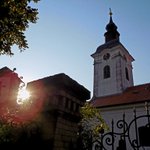
The Serbian Orthodox monastery of Mesić near Vršac, Serbia. Built by Jovan Branković, the last ruler of the Branković dynasty, the original church is in the Moravian style, a distinct Serbian medieval school of art, while the antechamber and baroque bell tower were added later.

Raško Ramadanski retweeted

Два километра даље, у Раковцу, налазе се остаци рефугијума Домбо. Постоји теорија да се на тој локацији налазила романичка црква Св. Стефана коју је подигао бан Белош Вукановић у 12. веку. Ову област византијски извори називају Петрик, и данас у близини постоји место Каменица.


The ruins of the medieval church in Klisa, Stari Ledinci, on the northern slopes of Fruška Gora in Srem, Serbia. Even though the site is a sacred place for local Serbs, who inhabit the area since the Middle Ages, little is known about this church.

Examples of Serbian heritage in the very north of our country in Martonoš. The old baroque church and adjacent cantor's cottage, sadly in poor condition, an 18th century tombstone and the oldest tree in the area, likely regarded once as a "zapis" or sacred place for local Serbs.


The Serbian Orthodox monastery of Šišatovac, nestled in the hillsides of Fruška Gora in Srem, Serbia. The monastery was founded in the 16th century by Stefan Štiljanović, the last traditional Serbian despot of the Middle Ages.

The 18th century crown of St. Stefan Štiljanović, the last Serbian despot of the 16th century and saint of the Serbian Orthodox Church. This artifact was added to his relics at least two centuries after his passing. Image: Muzej Srpske pravoslavne crkve.

An ''in situ'' metal seal matrix discovered during my excavations of the Bečej Fortress at the Tisa river in Serbia. This 16th century seal has a monogram and a star and crescent motive. It was worn and used by a local Serbian (Rascian) authority.


The contemporary reconstruction of a late 14th century sword from the area of modern Bečej, Serbia. The faceted sword pommel proved crucial in our effort to make a worthy replica for the Archaeological Department of the Town Museum in Bečej.

The facial reconstruction of a woman from a 10th century grave discovered in modern Bačko Petrovo Selo, Serbia. This is one of the highlights of my 2023 exhibition, focused on the Early Middle Ages and the arrival of the Hungarians to Europe.


A gilded belt fitting from an early medieval grave in the Church of the Holy Apostles Peter and Paul in Serbia. The artifact can be dated to the 9th century and likely belonged to a member of the aristocracy involved in the building of the old church.
