

Race Reflections is a U.K. based social enterprise tackling inequality, injustice & oppression — join us in our quest to make society fairer & safer for all.
England, United Kingdom
Joined November 2020
- Tweets2.3K
- Following18
- Followers3.1K
- Likes768





Race Reflections retweeted
Good morning!
This morning I want to return to the body.
I suggested yesterday that embodiment required attention — I invited you in the same way I invited the students to reflect on the dizziness, disorientation, and vertigo I experienced following the supervisor’s words.
These physical responses are entirely consistent with the kind of enactment of racialised power I experienced.
This enactment was bound to space; it was spatial violence. I was displaced from space: from a room I had legitimately occupied as a clinician; thus from my role and professional identity; I was displaced from the safety of the analytic frame; and I was displaced from my capacity to think.
Epistemically, I was rendered homeless — remember when I say the capacity to know is dependent on the capacity to have a home…? If only momentarily, I lost that capacity because I lost that home.
A further reminder that racism often attacks the racialised subject’s capacity to think. So, for a few seconds I lost my bearings physically and epistemically.
So we can see that my body reacting with dizziness — almost as though the rug was pulled from under my feet — is entirely consistent with the symbolic and literal actions in the hospital.
I was destabilised in space, and I felt destabilised. Even if one argues, I responded with this vertigo and dizziness because I was having an acute stress response and became autonomically activated, there is a wide repertoire of bodily responses that can be triggered under stress or under duress.
Stress is involved but alone is not precise enough as an explanatory frame. It does not account for why my body responded in the specific way that it did. We can be more attuned to the links between the body’s responses and the form of violence, it is subjected to.
Again we are only formulating, not trying to make truth claims, only exploring these relationships.
I would say the attack on my capacity to think, the symbolic blow to my head we could say, is something also reflected in students’ comments.
Many noted the irrationality of the senior analyst’s actions, with a student stating it was as though ‘he was possessed by some kind of colonial archetype’ — a very vivid imagery, particularly useful if we return to scripts, repetitions, and equivalence.
So we could say, analytically, at least two things. In the moment that I was experiencing the dizziness and vertigo, I was not formulating in my head that I had been displaced from space, that there were strong colonial echoes, or that I recognised that script as heavily loaded historically and ancestrally.
I was simply attempting to keep grasp of was happening. But my body, we could say, recognised the spatial violence and responded in a spatialised manner — pointing to the specific disturbance. Therefore, the possibility that my body registered the violence before it could be fully symbolised, is viable.
If like Bion we speak of containment as the transformation of inarticulate or pre-verbal emotional experience into thought and meaning, containment was triply disrupted: first, by the senior analyst - who could be said to represent authority, if not a parental figure - then by my quasi-maternal figure, the supervisor, who also did not provide containment; and then by peers and colleagues in the broader profession who simply refused to allow any kind of meaningful racialised meaning-making, so that was left to contain the experience without support.
So we could say the supervisory then structural refusal to contain repeats the initial displacement.
Finally, my body responding as though I had been hit at the back of the head makes the violence of mundane racialised exchanges hard to ignore. It makes it impossible to deny in good faith that such racialised enactments have significant implications for our health, I add here the connection between hypertension and race discrimination. Core symptoms of hypertension are dizziness and head spinning…
Thoughts welcome

I did not put emphasis on this, but may I also invite you to consider the embodied response to the supervisor’s actions, some have called collusion?
Yesterday I did ask the students to reflect on this and return to the body. I felt disoriented, dizzy, vertigo… for a minute or so seconds. I’ll leave this here for you to consider.
I may share how we collectively formulated.
Race Reflections retweeted
My good people
Second Open Day — Foundation course in Group Analysis and racial trauma.
November 30th 16h00 to 18h00
A gentle reminder that we still have places to grab onto the certificate in working with racial trauma using the foundation of Group Analysis. Half the places have gone and we are now outside the early bird period but you can still join!
Race Reflections’ members, remember that your fees is fixed at £1250 — instead of the now £1800 for non-members (+ vat) — but I have more good news and I will be emailing you directly before going public.
And because I have received a couple of queries about Afroanalytics… yes, we cover the fundamentals as part of the programme as critique/alternative to understanding group forces, inheritance and transmission without Eurocentric sanitation.
So yes, excited people say they want to learn more.
Join us at the end of the month.
racereflections.co.uk/events…
Good morning!
This morning I want to return to the body.
I suggested yesterday that embodiment required attention — I invited you in the same way I invited the students to reflect on the dizziness, disorientation, and vertigo I experienced following the supervisor’s words.
These physical responses are entirely consistent with the kind of enactment of racialised power I experienced.
This enactment was bound to space; it was spatial violence. I was displaced from space: from a room I had legitimately occupied as a clinician; thus from my role and professional identity; I was displaced from the safety of the analytic frame; and I was displaced from my capacity to think.
Epistemically, I was rendered homeless — remember when I say the capacity to know is dependent on the capacity to have a home…? If only momentarily, I lost that capacity because I lost that home.
A further reminder that racism often attacks the racialised subject’s capacity to think. So, for a few seconds I lost my bearings physically and epistemically.
So we can see that my body reacting with dizziness — almost as though the rug was pulled from under my feet — is entirely consistent with the symbolic and literal actions in the hospital.
I was destabilised in space, and I felt destabilised. Even if one argues, I responded with this vertigo and dizziness because I was having an acute stress response and became autonomically activated, there is a wide repertoire of bodily responses that can be triggered under stress or under duress.
Stress is involved but alone is not precise enough as an explanatory frame. It does not account for why my body responded in the specific way that it did. We can be more attuned to the links between the body’s responses and the form of violence, it is subjected to.
Again we are only formulating, not trying to make truth claims, only exploring these relationships.
I would say the attack on my capacity to think, the symbolic blow to my head we could say, is something also reflected in students’ comments.
Many noted the irrationality of the senior analyst’s actions, with a student stating it was as though ‘he was possessed by some kind of colonial archetype’ — a very vivid imagery, particularly useful if we return to scripts, repetitions, and equivalence.
So we could say, analytically, at least two things. In the moment that I was experiencing the dizziness and vertigo, I was not formulating in my head that I had been displaced from space, that there were strong colonial echoes, or that I recognised that script as heavily loaded historically and ancestrally.
I was simply attempting to keep grasp of was happening. But my body, we could say, recognised the spatial violence and responded in a spatialised manner — pointing to the specific disturbance. Therefore, the possibility that my body registered the violence before it could be fully symbolised, is viable.
If like Bion we speak of containment as the transformation of inarticulate or pre-verbal emotional experience into thought and meaning, containment was triply disrupted: first, by the senior analyst - who could be said to represent authority, if not a parental figure - then by my quasi-maternal figure, the supervisor, who also did not provide containment; and then by peers and colleagues in the broader profession who simply refused to allow any kind of meaningful racialised meaning-making, so that was left to contain the experience without support.
So we could say the supervisory then structural refusal to contain repeats the initial displacement.
Finally, my body responding as though I had been hit at the back of the head makes the violence of mundane racialised exchanges hard to ignore. It makes it impossible to deny in good faith that such racialised enactments have significant implications for our health, I add here the connection between hypertension and race discrimination. Core symptoms of hypertension are dizziness and head spinning…
Thoughts welcome
I did not put emphasis on this, but may I also invite you to consider the embodied response to the supervisor’s actions, some have called collusion?
Yesterday I did ask the students to reflect on this and return to the body. I felt disoriented, dizzy, vertigo… for a minute or so seconds. I’ll leave this here for you to consider.
I may share how we collectively formulated.
Reflections on analytic defenses…
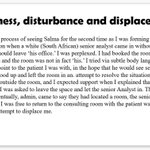
I want to share a few reflections based on the vignette I shared yesterday, which we discussed as part of our seminar on dynamic administration.
I think it’s very easy to get comfortable when we’re speaking to people who get it — people invested in equality, justice, and liberation. We can forget that this understanding is not the norm — particularly within professional fields, and within the psychotherapy and psychology world at large.
So I wanted to share some reflections on discussing that vignette with analysts more broadly, and the kinds of defensive responses I have encountered.
The most common reaction is to see the intrusion into the space simply as a concrete boundary violation; one that has nothing to do with race, or gender — and to refuse to make/attack those links (see Bion).
This is striking, isn’t it? Because the bread and butter of group and analytic practitioners is precisely to think deeply about the matrix — to consider what *communication* may be unfolding at personal, dynamic, and institutional levels.
It is fascinating that people trained to think deeply about the unconscious, to attune to its communications and its enactments, both relationally and within groups would refuse to consider, if only hypothetically, that there might be something significant here when it comes to the repetition of particular racialised histories.
On this point — and as we discussed yesterday — there is a tendency, when thinking about repetition compulsion, to look at an individual’s history and ask whether they might have invited violations due to unresolved trauma.
Following that line of thought, people may zero in on my history of displacement. And of course I have such a history: I have a history of migration, I am the child of migrants, descended from people carrying ancestrally inherited histories of displacement. That is absolutely part of the formulation. But stopping there is part of how dysfunction and disturbance get located in those with less social power — and how our understanding of social reality becomes skewed.
This white man also has a history of migration. As a white South African in Britain — that history of displacement, and indeed of *displacing*, is not distant from him either.
This takes us to the repetition of the broader history of colonialism — the ways Black and Brown bodies have been positioned in space, how whiteness has been made to feel at home and prioritised, and the violence of white expectations of comfort, priority, and entitlement.
These are scripts, narratives, and discourses are echoed and repeated in that interaction too.
So I find myself genuinely flabbergasted that so many colleagues have resisted engaging with these reflections, insisting instead on reading the situation through racially and power-neutral lenses: “It’s all because he was senior,” “I am white, I’ve also had a similar experience,” “How do you know race was at play?” — Not only refusing to consider the unconscious and symbolic communication, but discarding the very concepts group analysis puts at our disposal that speak directly to such processes.
I’m thinking especially of Hopper’s concept of equivalence; the idea that groups and social structures can and do repeat historical trauma. Isn’t colonialism a profound historical trauma? — asking rhetorically, for a friend.
I’m sharing this because our conversation yesterday felt clear and easy — I was speaking with students who already grasp these ideas if only viscerally, and there was no resistance, even among those racialised as white.
But we must remember: most people do resist. My invitation to you is this: before reaching for the impulse to find an individualised explanation for what happened — pause. Consider the symbolic. Consider the unconscious. Consider group forces. Consider history. Consider what is discomforting, that is where the deeper understanding lies.
racereflections.co.uk/workin…
My good people,
This evening we’re running the November seminar on the certificate in working with racial trauma using the foundation of Group Analysis all discussions/reflections and formulations will centre on the vignette/experience below.
What do you make of it? True story.
The topic is dynamic administration — basically what in Group Analysis refers to the actions/inactions taken by the conductor to manage/protect the group’s structural integrity.
Why does it matter? We’ll consider. But we never address a topic in isolation thus, we’ll also revisit displacement, scapegoating and to disturbance of course which I hope will help us understand what may be at stake in terms of group functioning.
I shall lead the seminar this month.
My central premise is that dynamic administration from a liberatory/decolonial perspective carries ethical, relational and political responsibility to see power, and disrupt coloniality in the formation/‘management’ of the group.
It involves protecting the therapeutic frame while remaining alert to the ways institutional racism and historical trauma can enter and shape the group.
Interested?
A reminder that you can still apply for the certificate, to start in February 2027. Places are being allocated.
We’ll hold a open day at the end of the months more info here; racereflections.co.uk/workin…

A few words on the decolonial group on racial trauma
Yesterday’s decolonial group on racial trauma went ahead, slightly off schedule. We welcomed some new voices and people into the space, following the open invitation that I’ve made.
Today, I want to share some of the themes that transpired yesterday, and in particular the idea that so many people shared about confrontation, the real confrontation, the facing of racism and anti-Blackness in today’s world.
What does it mean for us as parents to see our children experience some of the struggles that we went through and thought, or hoped, were done and dusted?
At the same time, what does it mean for our children to support us through experiences of discrimination, of institutional violence, experiences that they may have had before, or are likely to encounter in the future?
And so I wanted to speak again to that circularity issue of racial trauma within the family, and the intergenerational component of racial traumatization, particularly in the context of witnessing for parents and children’s suffering.
One thing that we discussed was the reality that children sometimes will not speak to their parents about the experiences of racism that they have, because they want to protect their parents. Certainly, I remember doing that as a child, at times.
But there is also the reality that parents want to protect their children from racism, and sometimes they keep things quiet for that purpose so they may not name the racism they themselves experience. Sometimes they may inadvertently minimize or silence.
And even though the impulse to preserve the child’s innocence is understandable, it can cause more damage in the long term when the child is not prepared, when the child is not offered the space to process and the words to speak to what they are encountering.
And so yesterday, we dwelt on this issue within the family, and it was quite moving,
if I’m honest, because you see people who are pioneers, people who are established in their fields, in their scholarship, in their anti-racism and justice work, and they come to the humbling realization that actually, there is no escaping this stuff, even at home.
And so it was a session where we were connected to grief and to loss then someone asked about pain…What do we do with the pain? It has crystallising effect.
And I want to say that there were people from different countries so this question of how we manage the pain of racial injustice, of violence or othering echoed across continent, across diasporas. It is something that I want to leave you with. And it remains unresolved, of course.
Of course, we can look after ourselves, we can practise self-care, we can resist alongside the pain.
And I’m always conflicted, because I do think that there is sometimes some artificiality or pressure in trying to remain “positive” in the face of injustice, brutality and violence that can be unrelenting.
But I am always conflicted about that, about whether I am imposing a superficial positivity when perhaps the mood or state is one of grief and mourning and pain which should be honoured.
Thank you to those who always bless me with their experience, with their thoughts, with their understanding, and also with their vulnerability. I take those offerings very seriously and receive them with gratitude. They continue to make me think and grow as well.
So today the reflective direction was more intimate, more personal in some sense, more affectively engaged. And this is part of the dance when engaging with racial trauma, the movement between the personal and the professional, or the sociopolitical, and the psychic, the individual, and the Group.
We still welcome members so feel free to reach out if you are interested.
racereflections.co.uk/new-re…
My good people,
A few more words on the Afroanalytics methodology
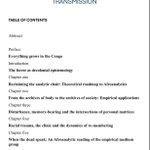
I need to return to writing for the last push very soon. I tried hard not to edit, to give my head a break, but in reality the brain is always working on your research when you do research.
This is part of my methodology.
Note that since giving myself a break I further wrote about intuition, on inheritance, on marking criteria, on decolonisation and racial trauma, on Fanon ect…even when I was not actively writing for my thesis. This in the past 2-3 weeks.
Most of this will end up in the thesis or help refine it, so pay attention.
You give your brain a problem and all resources converge to solve or consider it even when you do not actively or consciously seek to.
This can get sidelined as distraction, but the Afroanalytic methodology makes space for these spontaneous digressions and associations. It takes them very seriously indeed.
It was in fact when I started to really pay attention and note what came to me, what lingered in my mind, what got activated in and the sensations and embodiment of these mind and body creations that Afroanalytics really started to come into being as research methodology.
The recurring and initially distressing images of the impenetrable forest, of floating bodies, certain memories like the pit-bull incident, my trip to Elmina, my son writing Sadness: the poem about war and the death of his grandfather.
These were spontaneously generated, often felt viscerally and before I started to collect data, even before I started the PhD.
This is why I ask us to rethink the temporality of knowledge and ‘white time’ when it comes to research.
These momories, evocations, associations and embodied reactions continued have shaped the study’s processes and findings. They have been treated as data. Not as extraneous information to bracket out as we have been taught under Eurocentric empiricism.
If we do not pay attention, we lose fundamental opportunities to understand non-linearly and non-rationally the phenomenon under investigation.
That takes us to the question in my preface: when did I know what I came to understand as knowledge?
It seems simple enough, right but I say it provides a radical opening and reorientation of how we may understand knowledge thus data in the context of research including
1) that some research knowledge does not require exposure to empirical data as we understand it at least
2) that the direction of empirical endeavours may be partly shaped by this pre-verbal, embodied, intuitive material
3) that there is no accident in the research process whether we consider associations, evocations, recollections or who and what the researcher will eventually encounters as data —understood in the traditional sense including participants' stories.
These ideas which are central to the Afroanalytic methodology push really hard against formations of research as discovery arguably a colonialist perspective, and sets the scene for understanding research as reclamation, the perspective of the colonised. A perspective which finds ontological and epistemic foundation, once more in African metaphysics
I use the expression mind or body creation often but I really do not like the idea of creation which is too cognitive, too agentic and too individualistic, but I cannot find better terms, you have to remember English is not my first language and sometimes I do struggle to find the language, but this is not only a linguistic problem of course. It is also an epistemic one, often I am timited to dominant terms because alternative do not exist conceptually, both issues are at play.
I remember one thing, to help people understand how it felt behind the wheel when I was driving without understanding rationally how to drive, it felt as though I was following the rhythm, in flow…and coordinating with this flow, this is how it felt. Like I could anticipate change in gear/movement based on the patterns of a tempo.
It is vague that is all I can say to describe the experience.
A little bit more about intuition via autoethnography
I want to share is that my experience of learning to drive speaks to some of the dilemmas and dynamics that I am grappling with in relation to intuition, which I discuss in my thesis and which is also a foundational tenet of African philosophy and cosmology.
I have shared this story before, but I want to share it again in a new light, because when I first told it, I wasn’t as academically invested in these questions as I am today, having since developed Afro-analytics.
When I first started learning to drive, things were going well. This was in England, perhaps 15 or 20 years ago.
I had a very experienced driving instructor, and I must have had perhaps five sessions with him. After just two or three sessions, he let me onto the road.
It hadn’t taken him very long to explain the gear changes to me, as he thought I was going to learn by doing. I didn’t quite understand what he was explaining, but somehow I was able to drive straight away and change gears.
I could feel my feet going through the motions, making the necessary movements, but I wasn’t really using my head. I wasn’t consciously concentrating on what I was doing.
Things were going so well after a single session, in fact, that the driving instructor told me he was extremely surprised at how quickly I had mastered changing gears, particularly given that it was the first time I had been behind the wheel of a car.
I knew nothing about cars, nothing about gears, and certainly nothing about how to drive a car safely. Never been interested.
He was congratulating me and was very enthusiastic. He said it was probably the first time he had seen someone master the process so quickly in my particular circumstances.
And so I became puzzled.
I was puzzled to the point where, when I got home, I became a little scared. I was thinking: I have absolutely no idea what it is that I’m doing, yet I’m driving. I’m driving without thinking, as though I were operating a piece of machinery that I had operated for years.
For reasons that I cannot quite fully explain, I was fearful that, without understanding what I was doing, I might not be able to replicate it. So I became increasingly scared and anxious.
I didn’t know how I had acquired this ability so quickly. I couldn’t explain the movements I was making. There seemed to be absolutely no conscious mind-body connection in what I was doing.
It was almost as though I was simply flowing.
Of course, at the time, I wasn’t nearly as attuned to questions of epistemology, intuition and intuitive knowing as I am today.
I simply thought: here I am, apparently able to perform something that this man is telling me I’m doing extremely, extremely well, and yet I don’t know what the hell I’m doing!
It almost felt as though I was making random decisions. But, of course, they couldn’t have been random, since what I was doing required highly coordinated action, anticipation and decision. Otherwise, I wouldn’t have been able to remain on the road and drive the car well and safely.
So I went home and started thinking about it. And I still couldn’t explain to myself how I was doing it.
I then said to myself: Okay, at the next session, I’m really going to pay attention. I’m going to concentrate on precisely what I’m doing.
And so, at the next session, I got into the car and started driving very mindfully.
I paid attention to the movements of my hands. I paid attention to my feet. I tried to coordinate everything consciously, to operate the car rationally, deliberately, which is how I imagined most people would learn to operate a car.
Everything fell apart.
I couldn’t keep the car straight on the road. I became completely uncoordinated. Not only could I still not explain what I was doing, but now I could no longer drive either.
It became so dangerous that the instructor grew worried for my safety and that of others 1/2
I had apparently been operating the car through a different learning pathway, and when I tried to replace that pathway with a consciously rational one, everything collapsed.
I went home, and after another session I think, whatever I had been able to do during those first two or three sessions seemed to have disappeared completely.
The instructor kept telling me, “You were doing it! What is happening? Why can’t you just do it again?”
I couldn’t.
Eventually, the driving instructor recommended that I not go back behind the wheel.
And that, my friends, is the story of my attempt to learn to drive all those years ago.
But I am sharing it because I think it tells us something important about different ways of knowing, learning and doing.
There is a lot at stake. Firstly something here about allowing space within our systems and structures, particularly within our educational systems, for people who have different styles of learning and ways of processing, which once more challenge linear, rational or conscious boundaries.
And I use conscious here with a high level of caution, because I do think that intuition is a fundamental analytic problem, certainly in the way that we have come to think about the unconscious.
When I mastered gear changes instantly, we cannot simply speak about memory, because this was not a task I had previously mastered.
Nor can we simply speak about mirroring or imitation of something I had previously observed. I had never been particularly interested in cars, and I had certainly never paid much attention to what people were doing when they drove, I was not interested, once more.
We cannot easily say that my unconscious was in operation when I grasped driving, because what anxiety would it have been trying to keep at bay? What would have been the psychic pay off? And, more importantly, how would the unconscious, understood in this way, explain apparent procedural knowledge?
And yet I was clearly mastering something through what seemed to be a different process, a different system of learning.
So I am going to ask you to think.
What interests me is that this knowing appeared to function remarkably well until I attempted to bring it under conscious, rational control.
The moment I tried to understand and reproduce the process through deliberate thought and action, the ability fell apart.
This is where the experience connects, for me, with the dilemmas of intuition and with questions I have explored in developing Afroanalytics.
What forms of knowing are we failing to recognise because they do not conform to our dominant models of conscious, rational cognition?
And what happens when we insist or internalise that people must be able to explain, in a particular way, how they know what they know or how they do what they do?
That is all I will say for now. Thoughts welcome.
Race Reflections retweeted
My good people,
The Black Leader Power Matrix™
I have spend much time thinking about scholarly things, thesis things, metaphysics and all the rest, as I walk these last few steps to the finish line but I do not forget we exist within material and structural realities.
I want to remind you that we are here still in the real world, still operating in the clinical space, and still supporting the workplace.
To that end, I want to introduce to you to The Black Leader Power Matrix™
A programme designed to address some of racially specific experiences and challenges Black leaders navigate and the racialised structural dynamics that shape their workplace experiences and influence:
- Does your leadership programme addresses widespread resistance to Black authority/expertise and associated sabotage or envy?
- Does it recognise the ways group processes such as horizontal violence can lead to Black (and Brown) employees marginalising and being hostile to leaders who look like them?
- Does it speak to the impact of code switching and assimilation pressures on Black health and wellbeing?
- Does it make visible intergenerational stories around wealth, power & associated conflicts around community loyalty/ betrayal?
These are just a few of the issues a targeted Black Leadership Programme needs to delve into but which are still not mainstream and yet can influence career trajectories and workplace engagement.
Drawing on the RACE Matrix™, the Black Leadership Programme equips participants with greater clarity, confidence and practical strategies to lead effectively while Black within complex organisational systems.
Ultimately, the programme aims to support Black leaders in strengthening their leadership, expanding their influence and safeguarding their wellbeing, while creating the conditions for sustainable professional growth.
We’ll be planning an open day later in the week.
You can already read more about the programme here;
racereflections.co.uk/the-bl…
