

Climate and clean energy investor. Author of 5 books. Energy & Environment co-chair @SingularityU. Trying to build a better world.
Seattle
Joined May 2007
- Tweets71.3K
- Following10.2K
- Followers63.3K
- Likes212K




Pinned Tweet
Despite this election, I remain an optimist about America and the world. Humanity will continue to produce new ideas and new innovations to improve our lives. Good people will continue to come together to improve the world. And the political tide will turn. We'll make it so.
Yes, AI models will improve AI algorithms, and compute efficiency will create larger models that learn more efficiently.
In each domain you're mostly still limited by training data quality (signal/noise), ability to create accurate evals and RL environments, and cost/speed of getting more data & evals.

If you have a narrow superintelligence which can fully automate groundbreaking ml/ai research, then in a few months can't you radically improve learning efficiency in terms of both training data points and observations in deployment, then bootstrap to general ASI from there?
2
8
1,028
All super-intelligence we know of is narrow super-intelligence. Discourse went off the rails when people made the mistake of assuming that super-intelligence was inherently as broad as artificial general intelligence. Not at all supported.

Ramez Naam retweeted

Lovely @tylercowen piece on the ways Al can increase our individual and collective economic well-being in ways that GDP alone doesn't fully capture. humanistreview.ai/issue-2/co…


Biology is not simple. The odds that an AI could devise such a pathogen purely by thinking about it are very very low. AI biologists will need experimentation in cells, in mice, and probably human 'clinical' trials to know if their supervirus works.

" If you have an AI that produces bioweapons that could kill most humans in the world, then it's playing at the level of the superpowers in terms of mutually assured destruction.
If you think 'we'll just destroy the server farms, if it becomes known that the AIs are misbehaving.'
Are you willing to destroy the server farms, when the AI has demonstrated it has the capability to kill the overwhelming majority of the citizens of your country and every other country?
That might give a lot of pause, to a human response."
Ramez Naam retweeted

"men and women are politically and morally equal even though on average men are taller" has had the greatest run in human history as a worldview. I do not think "no, men are not taller" is gonna succeed at displacing it


If so, this is a bummer. We have plenty of mundane ways to improve AI instruction-following that can be iterated on inside the labs. Philanthropist have the chance to fund the wilder ideas and catalyze larger jumps into the future.

Great take from @stuartbuck1 in 2020 that happens to explain why "AI Safety" funders don't fund the most ambitious Alignment research:
"With traditional grantmaking, you can be much more certain that every single grant will increase your reputation and psychological satisfaction. That’s more of a reward than enduring failure after failure.
Indeed, I suspect that many philanthropists who start out sincerely intending to do high-risk, high-reward grantmaking instead gravitate to safer projects over time."

1
822
Ramez Naam retweeted

Epoch is just constantly out here doing God’s work

We are publishing 4 new benchmark reviews: 1 benchmark is Verified, 3 are Flawed. Another 4 benchmarks lacked sufficient information to assign a verdict.
🟩 Verified: the benchmark can broadly be interpreted as described by the developer, and any errors don’t substantially affect results. We publish a full review, including weaknesses and limitations.
🟥 Flawed: the benchmark has one or more substantive flaws users need to know about to interpret results, most often >20% of tasks with accuracy-impacting errors. We publish a limited write-up of the flaws.
⬛ Not Enough Info: we couldn’t access enough to assign a verdict. Developers get a week to respond before we apply this label.
Details from Verified and Flawed reviews are below, along with a link to our full rubric.

Ramez Naam retweeted

About those “data centers can lower electrical rates” notion:
Here is Alabama Power stating it will reduce rates by $160 million, and “the principal driver for this rate reduction is an increase in large load data centers revenue in cost year 2027”

Ramez Naam retweeted

🎯 I think people underestimate posturing when dealing with trends, investments, news cycles like this as well. When you talk to many practitioners in the space and within the companies, grid-connected is still the strong preference. BTM is serving more as a bridge. Islanded power will be more of a rarity. News cycle last few years would’ve convinced you otherwise.

There’s a growing amount of excitement and trepidation around off-grid data centers.
I’m not convinced many will actually go fully off-grid -- probably as a bridge in most cases. But it’s surfacing a more interesting tension about how we build the system.
As @ceboudreau detailed, that tension played out on stage at CERAWeek between Fermi and Google.
Fermi is leaning into the “power island” model that pairs data centers with dedicated generation, starting with gas and potentially nuclear. The idea is to move faster, avoid interconnection bottlenecks, and not push costs onto the broader system.
Google pushed back on that framing. Their view is that once you start building isolated systems, you end up overbuilding for reliability and tie up more capital into assets that run a fraction of the time. And none of that investment actually improves the grid. There’s also a concern that it could lead to higher system costs over time if those resources aren’t shared.
We will clearly see some version of both of these approaches, but I agree more with Google's @AmandaCorio on this one: “We are focusing too narrowly on this moment and the bottlenecks, and not thinking collectively as a system in 10 years."


Ramez Naam retweeted

AI and Energy: Is Power the Limit on Intelligence?
Now a familiar face at PB summits, we were excited to welcome back @ramez to kick off the Type II Summit with another one of his superb slide decks
Timestamps:
0:00 - AI's exponential energy demand
2:11 - In AI: Time is money
4:19 - Speed to power is the problem
7:48 - Can we get more out of the grid, faster?
10:22 - China: does faster power buildout win the AI race?
11:18 - AI power demand: where's the limit?
16:08 - Five ultimate ways to power AI
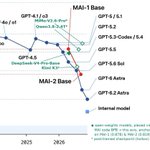
Very true that model size, training corpus size, and training compute would help us make more sense of this.
I'm also puzzled at the omission of RL. OpenAI has twice as many people working on post training than pre. And RL may now consume more compute, as well.

The longer I look at this plot the more useless it becomes without knowing the actual model sizes and how much compute went into them.
I don't think you need some magic RSI like research acceleration for this.
My shizo theory to explain this is the following:
- OpenAI starts focusing on coding in mid 2025 (Codex release in April and first Codex models).
- GB200/300 NVL 72 starts coming online in mid to late 2025 allowing for bigger models.
- By late 2025 - early 2026 the Codex loop is amasssing a shit ton of high quality coding data and later they go all in on coding in March 2026
and surprise surprise with their bigger models and higher quality coding data their loss on CODING starts plummeting
If cyber attackers are lagging in their adoption of new tools (which seems to be the case) then now is the perfect time to use AI to secure the world, getting defense ahead of offense.

Here's a post on what Congress / the White House should do to proactively head off a huge rise in cyber damages due to AI; this is a summary of the congressional briefing I gave on the hill yesterday with @ReadyStateLabs and Senator Chuck Schumer's office.
joshuasaxe181906.substack.co…

The AI cyber apocalypse just isn't here. Once again, tech diffusion and adoption lag far behind tech capabilities. (This time, a positive.)

This is not very vibe compliant, but we have a new post out today looking at what data on *impacts* of cyber attacks tells us about whether the cyber-pocalypse is here.
TLDR: not yet?
May just be lagging data, or slow adoption of AI tools by cyber attackers. But another possibility is that a significant factor here is that attackers' incentives matter at least as much as their technical capabilities, and their incentives (to avoid retaliation/prison/etc) have not changed all that much.
If so, one implication is that attribution matters a lot in this new era - does AI make anonymity easier, and if so can we do anything about that?
Some data below; more charts and more recommendations in the full piece.
cset.georgetown.edu/article/…


3
16
1,237
Ramez Naam retweeted

Article discussing our research showing that many common beliefs about LLMs are outdated.


An analysis finds that many undesirable LLM behaviours dissipate after about 16 months
go.nature.com/4zGDVuo

Ramez Naam retweeted

NYT reporting on the situation inside SpaceXAI. It's possible that Elon may deny this report has any truth to it, as he sometimes does.

Ramez Naam retweeted

This is not very vibe compliant, but we have a new post out today looking at what data on *impacts* of cyber attacks tells us about whether the cyber-pocalypse is here.
TLDR: not yet?
May just be lagging data, or slow adoption of AI tools by cyber attackers. But another possibility is that a significant factor here is that attackers' incentives matter at least as much as their technical capabilities, and their incentives (to avoid retaliation/prison/etc) have not changed all that much.
If so, one implication is that attribution matters a lot in this new era - does AI make anonymity easier, and if so can we do anything about that?
Some data below; more charts and more recommendations in the full piece.
cset.georgetown.edu/article/…
We project selfish drives onto AIs (dominance, power, control, survival, propogation) because the minds we've met until now were shaped Darwinian evolution. AIs are not.
Because of the above, our instinct any time we encounter intelligence is to see those surival & propogation vibes. This is below the level of rational thought. It's 'theory of mind' in neuroscientist speak. It happens fast, without conscious or rational thought.
It's the short-cutted, highly-biased 'Type 1' thinking Daniel Kahneman wrote about.
And it rests on empirical observations and real-world forces (Darwinian Evolution) that shaped us, shaped the other members of our species, and shaped all animal life we encounter.
Instrumental convergence (the theory that AIs will ultimately seek power as a way to accomplish other goals) is much more of a theory than an observation, resting ont he intuition pumps of a species (us) that's never met an intelligence shaped by something other than evolution.


