

Climate and clean energy investor. Author of 5 books. Energy & Environment co-chair @SingularityU. Trying to build a better world.
Seattle
Joined May 2007
- Tweets71.3K
- Following10.2K
- Followers63.3K
- Likes212K




Ramez Naam retweeted

Lovely @tylercowen piece on the ways Al can increase our individual and collective economic well-being in ways that GDP alone doesn't fully capture. humanistreview.ai/issue-2/co…


Ramez Naam retweeted

"men and women are politically and morally equal even though on average men are taller" has had the greatest run in human history as a worldview. I do not think "no, men are not taller" is gonna succeed at displacing it


Ramez Naam retweeted

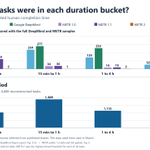
Epoch is just constantly out here doing God’s work

We are publishing 4 new benchmark reviews: 1 benchmark is Verified, 3 are Flawed. Another 4 benchmarks lacked sufficient information to assign a verdict.
🟩 Verified: the benchmark can broadly be interpreted as described by the developer, and any errors don’t substantially affect results. We publish a full review, including weaknesses and limitations.
🟥 Flawed: the benchmark has one or more substantive flaws users need to know about to interpret results, most often >20% of tasks with accuracy-impacting errors. We publish a limited write-up of the flaws.
⬛ Not Enough Info: we couldn’t access enough to assign a verdict. Developers get a week to respond before we apply this label.
Details from Verified and Flawed reviews are below, along with a link to our full rubric.

Ramez Naam retweeted

About those “data centers can lower electrical rates” notion:
Here is Alabama Power stating it will reduce rates by $160 million, and “the principal driver for this rate reduction is an increase in large load data centers revenue in cost year 2027”

Ramez Naam retweeted

🎯 I think people underestimate posturing when dealing with trends, investments, news cycles like this as well. When you talk to many practitioners in the space and within the companies, grid-connected is still the strong preference. BTM is serving more as a bridge. Islanded power will be more of a rarity. News cycle last few years would’ve convinced you otherwise.

There’s a growing amount of excitement and trepidation around off-grid data centers.
I’m not convinced many will actually go fully off-grid -- probably as a bridge in most cases. But it’s surfacing a more interesting tension about how we build the system.
As @ceboudreau detailed, that tension played out on stage at CERAWeek between Fermi and Google.
Fermi is leaning into the “power island” model that pairs data centers with dedicated generation, starting with gas and potentially nuclear. The idea is to move faster, avoid interconnection bottlenecks, and not push costs onto the broader system.
Google pushed back on that framing. Their view is that once you start building isolated systems, you end up overbuilding for reliability and tie up more capital into assets that run a fraction of the time. And none of that investment actually improves the grid. There’s also a concern that it could lead to higher system costs over time if those resources aren’t shared.
We will clearly see some version of both of these approaches, but I agree more with Google's @AmandaCorio on this one: “We are focusing too narrowly on this moment and the bottlenecks, and not thinking collectively as a system in 10 years."


Ramez Naam retweeted

AI and Energy: Is Power the Limit on Intelligence?
Now a familiar face at PB summits, we were excited to welcome back @ramez to kick off the Type II Summit with another one of his superb slide decks
Timestamps:
0:00 - AI's exponential energy demand
2:11 - In AI: Time is money
4:19 - Speed to power is the problem
7:48 - Can we get more out of the grid, faster?
10:22 - China: does faster power buildout win the AI race?
11:18 - AI power demand: where's the limit?
16:08 - Five ultimate ways to power AI
Ramez Naam retweeted

Article discussing our research showing that many common beliefs about LLMs are outdated.


An analysis finds that many undesirable LLM behaviours dissipate after about 16 months
go.nature.com/4zGDVuo

Ramez Naam retweeted

NYT reporting on the situation inside SpaceXAI. It's possible that Elon may deny this report has any truth to it, as he sometimes does.

Ramez Naam retweeted

This is not very vibe compliant, but we have a new post out today looking at what data on *impacts* of cyber attacks tells us about whether the cyber-pocalypse is here.
TLDR: not yet?
May just be lagging data, or slow adoption of AI tools by cyber attackers. But another possibility is that a significant factor here is that attackers' incentives matter at least as much as their technical capabilities, and their incentives (to avoid retaliation/prison/etc) have not changed all that much.
If so, one implication is that attribution matters a lot in this new era - does AI make anonymity easier, and if so can we do anything about that?
Some data below; more charts and more recommendations in the full piece.
cset.georgetown.edu/article/…


Ramez Naam retweeted

In 2021, the IEA projected the world would add about 14 GW of battery storage a year this decade. In 2025, it added 115 GW.

Ramez Naam retweeted

Frontier models can now propose technical social science research designs that experts grade more highly than the world's top political economist's---that's the finding from our new Free Systems eval, SnyderBench, in which we have PhD experts blind grade research proposals from AI models compared to papers written by Harvard political economist Jim Snyder (which the experts have not previously read).
At the same time, we see no evidence that models can develop research ideas that experts rate as better overall contributions. They're getting better and better at the technical part of research, but not necessarily at the more subjective part.
This could be because human experts possess "judgment" that the models do not.
It could also be that research "contribution" is so subjective that it doesn't actually point at any meaningful goal---consistent with this possibility, we find that our human experts don't agree with one another when rating project ideas for the strength of their contribution, with agreement rates barely higher than random chance. Perhaps social science research is what @alexolegimas might call a "relational good": something people value in part because it's produced by a human. We're not sure.
This past January, I released the results of a pilot in which I had Claude Code replicate and extend a past empirical paper on vote-by-mail. 10 months later, it's stunning the amount of progress that's been made. It's no longer interesting to ask whether AI can collect data and run analyses automagically---we take that for granted---instead, the question is how much of the entire research loop AI can complete. Our tentative answer: AI can handle the technical aspects of empirical political economy research from end to end, devising the design and executing it, but for now, we still need humans to drive the agenda.
This is joint work with @AndyCWMyers, and is of course dedicated to my PhD advisor Jim Snyder, who remains the world's great empirical political economist, AI or no AI.
Lots more in the full piece here:
freesystems.substack.com/p/b…

Ramez Naam retweeted

I have one request for Anthropic and Levent:
would it be possible to put a fully cleaned up end to end trace of human <> agent communication to solve the millennium prize.
I think it should go down into a history book. And it will improve understanding of how to use models. People will believe in miracles and push harder.
Ramez Naam retweeted

The rise of lab-grown diamonds has transformed the market. As with most manufactured products, prices have steadily declined as production has scaled and technology has improved…

Ramez Naam retweeted

BTM gas for DCs has been the kick in the pants the grid needed for a decade.
Actually having to compete to capture AI growth has finally created urgency to fixing the grid’s problems.
Suddenly, interconnection flexibility and permitting and transmission buildout and aggregated BYOC and nuclear and GETs are all being seriously progressed by the various electricity institutions.
If BTM didn’t exist there’d just be endless low-urgency meetings and the AI load would go to another country.
Those who eagerly hope to ban BTM prejudicially (as opposed to applying a general principle like increasing air standards across the board) may find doing so actually hurts their cause because then utilities and ISOs and regulators can go back to their natural state of kicking back and seeing how things go.
Ramez Naam retweeted
Anthropic, you’ll also provide the same information about your models, right?

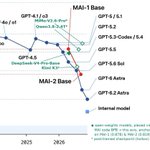
We decided to provide more transparency into pretraining progress at OpenAI for the sake of moving toward shared safety bars. In “Perplexity and Intelligence” I argue for common limits based on perplexity and other measurements, with progress beyond them gated on our ability to understand AI behavior.
openai.com/index/perplexity-…

Ramez Naam retweeted

Another major step forward for transparency at OpenAI and a sign of how high the stakes are around highly capable models and RSI. Really heartened that the company took the costly step of releasing this data and hope that more disclosures will follow suit
We decided to provide more transparency into pretraining progress at OpenAI for the sake of moving toward shared safety bars. In “Perplexity and Intelligence” I argue for common limits based on perplexity and other measurements, with progress beyond them gated on our ability to understand AI behavior.
openai.com/index/perplexity-…

Ramez Naam retweeted

THERE IS NO WALL
@merettm published internal loss numbers: log-perplexity 0.99 (GPT-3.5) → 0.91 (GPT-4) → ~0.76 now.
It states that breakthroughs emerged below 0.8, an AI-research "avalanche" could hit in 2027, and labs should agree on shared limits.
For a long time now, pre-training information was not shared with the public.
Thank you so much for publishing this super valuable data point @OpenAI @sama

Ramez Naam retweeted
Acceleration of pretraining progress is arguably the highest risk in the short term of AI capability growth exceeding our ability to monitor or control it.
Disclosing this information might have competitive disadvantages, but the benefit of transparency is far more important.
We decided to provide more transparency into pretraining progress at OpenAI for the sake of moving toward shared safety bars. In “Perplexity and Intelligence” I argue for common limits based on perplexity and other measurements, with progress beyond them gated on our ability to understand AI behavior.
openai.com/index/perplexity-…