

Couch researcher
Evergreen, Co
Joined September 2017
- Tweets7.7K
- Following5.9K
- Followers376
- Likes8.6K






Maverick Monk🔥🛡️ retweeted

Former Google CEO Eric Schmidt just told everyone the easiest way to get rich in the next two years:
“If you really want to make money, it’s actually easy. Found an agentic AI company. Build an agent to do something.
If you build a better agent than anyone else, you can probably build one incredible company and own it yourself.”
In 27 seconds he explains why the next 1–2 years are the agentic window. And why it won’t stay open.
Prompts → Fable 5.2 → Memory → Skills → MCP → A Company You Own Yourself
Save this before it gets lost in X’s algorithms
Everything below is free:
1. Claude Code Overview
Official starting point for building with Claude
code.claude.com/docs/en/over……
2. Claude Code Best Practices
How Anthropic engineers actually use it
code.claude.com/docs/en/best……
3. Building Effective Agents
Anthropic’s research on what actually works
anthropic.com/research/build…
4. Effective Harnesses for Long-Running Agents
How to keep agents running reliably
anthropic.com/research/effec…
5. Claude Agent SDK
Build your own agents on the same stack
github.com/anthropics/cla…
6. Claude Code Skills
Reusable skills that agents can call
code.claude.com/docs/en/skil…
7. Hooks in Claude Code
Rules the agent can’t skip
code.claude.com/docs/en/hook…
8. Custom Subagents
Run specialized agents inside one system
code.claude.com/docs/en/sub-……
9. Memory System
How Claude remembers your project
code.claude.com/docs/en/memo…
10. Claude Code in Action
Free hands-on course
anthropic.skilljar.com/claud……
11. Awesome Claude Code
Best tools and resources in one place
github.com/hesreallyhim/a…
12. Claude Code GitHub Action
Run agents on your PRs and issues
github.com/anthropics/cla…
All of this costs $0
99% will spend the entire agentic period scrolling threads
The 1% who actually ship agents will own the companies that come out of it
Bookmark it and start with the first link right now
Then read how to build an agent that actually does the job in the "Context, Harness, Loops, Prompts" guide below ↓
Maverick Monk🔥🛡️ retweeted

If you learn Forward Deployed Engineering, you will never be unemployed again.
I'd do this.
Stage 1: Enterprise Identity & Agent RBAC
SSO (SAML/OIDC), SCIM provisioning, Row-Level Security (RLS), Agent-to-Human delegated OAuth, scoped JWTs for tool execution.
Stage 2: Air-Gapped & VPC Inference Deployments
Terraform/Helm for private VPCs, air-gapped container registries, strict egress filtering, on-prem GPU provisioning, zero-trust networking.
Stage 3: Legacy Data Extraction & ETL
OCR pipelines, mainframe DB connectors, unstructured PDF parsing, messy CSV normalization, Airflow/dbt orchestration, data reconciliation.
Stage 4: Permission-Filtered RAG & GraphRAG
Document-level RBAC, hybrid search, metadata tagging, cross-tenant isolation, citation grounding, multi-hop graph traversal, abstention logic.
Stage 5: MCP & Legacy System Integration
Raw JSON-RPC MCP servers, SOAP/REST translation, headless browser fallbacks, on-prem SAP/Oracle connectors, strict API rate-limit handling.
Stage 6: PII Cryptography & Guardrails
Deterministic UUID swapping, NER redaction, pre/post-flight unmasking proxies, format-preserving encryption, immutable audit logging.
Stage 7: Human-in-the-Loop (HITL) & Durable Workflows
Temporal{dot}io state machines, async Slack/Teams approval gates, workflow checkpointing, crash recovery, legal accountability trails.
Stage 8: Edge & On-Prem Local Inference
vLLM/TensorRT-LLM on customer hardware, AWQ/GGUF quantization, offline fallback routing, local SLM triage, zero-latency PII screening.
Stage 9: Telemetry, ROI & Customer Health
OpenTelemetry for LLMs, cost-attribution per department, time-saved dashboards, silent failure alerting, usage-based billing meters.
Stage 10: Shadow Evals on Customer Data
Golden dataset creation from historical logs, trajectory grading in shadow mode, LLM-as-a-judge calibration, custom business metric design.
Stage 11: Technical Discovery & SOW Scoping
Stakeholder interviewing, architecture diagramming, gap analysis, translating executive "AI hype" into scoped 4-week deployment plans.
Stage 12: The Handoff & Self-Serve Admin
Runbook automation, internal IT enablement, chaos testing in customer VPCs, admin portals for prompt/config management without FDE intervention.
Most people stay stuck watching tutorials.
Builders get hired.
(Bookmark it)
Maverick Monk🔥🛡️ retweeted

STOP WASTING HOURS TRYING TO FIGURE OUT WHAT TO LEARN IN AI.
I put together one practical roadmap with videos, GitHub repos, guides, books, research papers, and courses.
VIDEOS:
1. LLM Introduction — youtube.com/watch?v=zjkBMF…
2. LLMs from Scratch — youtube.com/watch?v=9vM4p9…
3. Agentic AI Overview (Stanford) — youtube.com/watch?v=kJLiOG…
4. Building & Evaluating Agents — youtube.com/watch?v=d5EltX…
5. Building Effective Agents — youtube.com/watch?v=D7_ipD…
6. Building Agents with MCP — youtube.com/watch?v=kQmXtr…
7. Building an Agent from Scratch — youtube.com/watch?v=xzXdLR…
8. Philo Agents — youtube.com/playlist?list=…
GITHUB REPOS:
1. GenAI Agents — github.com/nirdiamant/Gen…
2. Microsoft AI Agents for Beginners — github.com/microsoft/ai-a…
3. Prompt Engineering Guide — github.com/dair-ai/Prompt…
4. Hands-On Large Language Models — github.com/HandsOnLLM/Han…
5. GenAI Agents — github.com/NirDiamant/Gen…
6. Made with ML — github.com/GokuMohandas/M…
7. Hands-On AI Engineering — github.com/Sumanth077/Han…
8. Awesome Generative AI Guide — github.com/aishwaryanr/aw…
9. Designing Machine Learning Systems — github.com/chiphuyen/dmls…
10. Machine Learning for Beginners — github.com/microsoft/ML-F…
11. LLM Course — github.com/mlabonne/llm-c…
GUIDES:
1. Google's Agent Whitepaper — kaggle.com/whitepaper-age…
2. Google's Agent Companion — kaggle.com/whitepaper-age…
3. Building Effective Agents by Anthropic — anthropic.com/engineering/bu…
4. Claude Code Agentic Coding Practices — code.claude.com/docs/en/best……
5. OpenAI's Practical Guide to Building Agents — cdn.openai.com/business-guid……
BOOKS:
1. Understanding Deep Learning — udlbook.github.io/udlbook/
2. Building an LLM from Scratch — manning.com/books/build-a-…
3. The LLM Engineering Handbook — oreilly.com/library/view/l…
4. AI Agents: The Definitive Guide — oreilly.com/library/view/a…
5. Building Applications with AI Agents — oreilly.com/library/view/b…
6. AI Agents with MCP — oreilly.com/library/view/a…
7. AI Engineering — oreilly.com/library/view/a…
RESEARCH PAPERS:
1. ReAct — arxiv.org/abs/2210.03629
2. Generative Agents — arxiv.org/abs/2304.03442
3. Toolformer — proceedings.neurips.cc/paper……
4. Chain-of-Thought Prompting — arxiv.org/pdf/2201.11903
COURSES:
1. Hugging Face Agent Course — huggingface.co/learn/agents-……
2. MCP with Anthropic — deeplearning.ai/courses/mcp-……
3. Building Vector Databases with Pinecone — deeplearning.ai/courses/buil……
4. Vector Databases: Embeddings to Apps — deeplearning.ai/courses/vect……
5. Agent Memory — deeplearning.ai/courses/llms……
No endless searching.
No information overload.
Just resources you can actually use. 🔖
Your future AI skill set will come from consistent building, experimenting, and learning.
Repost so someone else can find this roadmap, and pls consider following.
follow
@trreo7 for more content around AI, Beauty, and businesses.

Maverick Monk🔥🛡️ retweeted

Stanford's TEN FREE Courses on AI & ML:
❯ CS336 - LLM from Scratch
❯ CS221 - Artificial Intelligence
❯ CS229 - Machine Learning
❯ CS230 - Deep Learning
❯ CS234 - Reinforcement Learning
❯ CS236 - Deep Generative Models
All links inside:
Maverick Monk🔥🛡️ retweeted

Fuck, this is absolutely insane.
Dario Amodei, CEO of Anthropic, was asked what a young person who has just finished high school should do today.
His answer:
«AI already knows how to do a junior lawyer’s job. A junior financial analyst’s. A junior consultant’s.
We can’t deny that it will also eliminate jobs, and probably in large numbers».
In a few minutes, he lists the professions that will disappear first and THE skill that will let you stay in the game.
His advice boils down to one sentence:
«Obviously, learning to use AI».
Those who start this year won’t compete against AI: they’ll be the ones directing it.
Everything that follows is free. Start today:
1. Anthropic - Prompt Engineering Interactive Tutorial: the fastest way to learn how to direct a model.
github.com/anthropics/prompt…
2. Anthropic Courses: from your first prompt to managing agents.
github.com/anthropics/course…
3. Anthropic Cookbook: practical recipes you can copy starting today.
github.com/anthropics/anthro…
4. Microsoft - Generative AI for Beginners: 21 lessons, no degree required.
github.com/microsoft/generat…
5. Microsoft - AI Agents for Beginners: build agents that do a junior’s work for you.
github.com/microsoft/ai-agen…
6. Hugging Face - Agents Course: free and with certification, from A to Z.
github.com/huggingface/agent…
7. Google Cloud - Generative AI: hands-on notebooks from Google.
github.com/GoogleCloudPlatfo…
8. OpenAI Cookbook: code for every common task.
github.com/openai/openai-coo…
9. DAIR.AI - Prompt Engineering Guide: the go-to guide everyone shares.
github.com/dair-ai/Prompt-En…
10. Andrej Karpathy - Neural Networks Zero to Hero: to understand what’s under the hood.
github.com/karpathy/nn-zero-…
11. CrewAI: get your own team of AI workers up and running.
github.com/crewAIInc/crewAI
12. Microsoft - AutoGen: put several agents to work on the same task.
github.com/microsoft/autogen
13. Awesome LLM Apps: hundreds of hands-on projects to learn from.
github.com/Shubhamsaboo/awes…
14. DeepLearning.AI - Short Courses: free one-hour courses taught by subject-matter experts.
deeplearning.ai/short-course…
15. Anthropic: AI Fundamentals with Claude
imp.i384100.net/9Vyr33
16. Anthropic: AI Automation with Claude
imp.i384100.net/E0RWXK
17. Anthropic: AI Collaboration with Claude
imp.i384100.net/JkRaN2
18. Anthropic: Building with the Claude API
imp.i384100.net/n4WzQV
19. Anthropic Model Context Protocol: Advanced Topics
imp.i384100.net/3km3Nr
20. Anthropic Teaching AI Fluency
imp.i384100.net/R02X9X
21. Anthropic: Real-World AI for Everyone Specialisation
imp.i384100.net/AgBqn1
22. Claude AI for Marketing
imp.i384100.net/enkbGz
23. Claude From Zero
imp.i384100.net/AgRGD7
24. Claude Code: Software Engineering with Generative AI Agents
imp.i384100.net/OeGoDn
Total cost: €0.
You don’t need another year of study to learn all of this. What you need is to start telling AI what to do.
95% will finish their studies and compete against AI for the same junior position.
The 5% who learn to direct it this year will manage the agents that do that work.
Save this post and send it to someone who will finish their studies this year.
Maverick Monk🔥🛡️ retweeted

These are literally the best visual resources for learning how Transformers, LLMs, embeddings, diffusion, and inference work ↓
1/ Transformer Explainer - Watch GPT process text through embeddings, attention, MLPs and next-token prediction.
poloclub.github.io/transform…
2/ Brendan Bycroft’s LLM Visualization - Explore an LLM from architecture down to tensors and operations.
bbycroft.net/llm
3/ 3Blue1Brown - Visual intuition for linear algebra, neural networks, backprop, attention and Transformers.
3blue1brown.com/topics/neura…
4/ The Illustrated Transformer - One of the clearest visual explanations of embeddings, Q/K/V and attention.
jalammar.github.io/illustrat…
5/ TensorFlow Playground - Watch neural networks learn as you change layers, activations, features and learning rate.
playground.tensorflow.org
6/ Google PAIR AI Explorables - Interactive explainers on LLMs, generalization, interpretability and model behavior.
playground.tensorflow.org
7/ Distill - Exceptional visual essays on t-SNE, feature visualization, GNNs and interpretability.
distill.pub
8/ Abhik Sarkar’s Transformer Visualizations - RoPE, KV cache, FlashAttention, MQA, GQA and more.
playground.tensorflow.org
9/ Visual Guide to Attention Variants - MHA, MQA, GQA and MLA visually compared.
magazine.sebastianraschka.co…
10/ Visual Guide to Mixture of Experts - Routing, experts, sparse activation and load balancing.
newsletter.maartengrootendor…
11/ Modular LLM Inference Handbook - Prefill, decode, KV cache, batching, quantization and speculative decoding.
handbook.modular.com/llm-inf…
12/ Apple Embedding Atlas - Explore clusters, neighborhoods and outliers in large embedding spaces.
apple.github.io/embedding-at…
13/ Diffusion Explainer - Follow Stable Diffusion step by step.
poloclub.github.io/diffusion…
14/ Neuronpedia - Explore features, activations, SAE latents and attribution graphs inside real models.
neuronpedia.org
15/ Seeing Theory - Probability, Bayes, distributions, regression and inference made interactive.
seeing-theory.brown.edu
16/ CNN Explainer - Visualize convolutions, feature maps, activations and pooling.
poloclub.github.io/cnn-expla…
17/ GAN Lab - Train a GAN in your browser and watch its generated distribution evolve.
poloclub.github.io/ganlab/
Save this. There’s a serious AI curriculum hiding inside these links.
Maverick Monk🔥🛡️ retweeted

LLM Inference Engineering Roadmap
Part 1: Foundations
1. Training vs Inference
2. Inference Engineering
3. Closed vs Open Models
4. Latency vs Throughput
5. Model Selection
6. Model Evaluation (Evals)
Part 2: Transformers and LLM Architecture
1. Tokens
2. Token Embeddings
3. Positional Encoding
4. Transformer Architecture
5. Matrix Multiplication (Matmul)
6. Attention
7. Queries, Keys, Values
8. Causal Masking
9. Multi-Head Attention (MHA)
10. Feed-Forward Network (FFN)
11. Logits
12. Mixture of Experts (MoE)
13. Active vs Total Parameters
Part 3: LLM Inference Mechanics
1. Autoregressive Generation
2. Chat Templates
3. Context Window
4. Prefill vs Decode
5. KV Cache
6. Sampling
7. Temperature
8. Top-k Sampling
9. Top-p (Nucleus) Sampling
10. Stop Tokens
11. Reasoning Models
12. Token Streaming
Part 4: Performance Metrics
1. Time to First Token (TTFT)
2. Time Per Output Token (TPOT)
3. Throughput
4. End-to-End Latency
5. Latency Percentiles (P50, P90, P99)
6. Cost per Token
Part 5: Bottleneck Analysis
1. Compute vs Memory Bandwidth
2. Arithmetic Intensity
3. Roofline Model
4. Compute-Bound vs Memory-Bound
5. Prefill Bottleneck (Compute)
6. Decode Bottleneck (Memory)
7. Memory Footprint
8. KV Cache Memory Calculation
9. Batching and Arithmetic Intensity
Part 6: Hardware
1. CPU vs GPU
2. GPU Architecture
3. Tensor Cores
4. High-Bandwidth Memory (HBM)
5. DRAM vs SRAM
6. NVLink
7. InfiniBand
8. Groq LPU
9. Local (Edge) Inference
10. Cloud vs On-device Deployment
Part 7: Software Stack
1. CUDA
2. CUDA Kernels
3. CUDA Graphs
4. Kernel Fusion
5. PyTorch
6. Inference Engines
7. OpenAI-Compatible Server
Part 8: Benchmarking and Profiling
1. Performance Benchmarking
2. Traffic Simulation
3. Load Testing
4. Profiling
Part 9: Attention Optimizations
1. Standard Attention Inefficiency
2. FlashAttention
3. PagedAttention
4. Multi-Query Attention (MQA)
5. Grouped-Query Attention (GQA)
6. Sliding Window Attention
7. Attention Sinks
8. KV Cache Compression
Part 10: Batching and Scheduling
1. Batching
2. Static Batching
3. Continuous Batching
4. Batch Size vs Latency
5. Chunked Prefill
6. Prefill-Decode Interference
Part 11: Caching
1. Prefix Caching
2. Cache-Friendly Prompt Design
3. Prompt Caching
4. KV Cache Offloading
5. Cache-Aware Routing
6. Long Context Handling
Part 12: Speculative Decoding
1. Speculative Decoding
2. Rejection Sampling
3. Acceptance Rate
4. Draft-Target Speculation
5. N-gram Speculation
6. Speculation vs Batch Size
Part 13: Quantization
1. Quantization
2. Number Formats
3. Post-Training Quantization (PTQ)
4. Weight-Only Quantization (W4A16)
5. Weight-Activation Quantization (W8A8)
6. KV Cache Quantization
7. Measuring Quality Impact
Part 14: Model-Level Optimizations
1. Model Size vs Speed
2. LLM Routing
Part 15: Parallelism
1. Why Multi-GPU
2. Model Parallelism
3. Communication Overhead
4. Data Parallelism
5. Tensor Parallelism (TP)
Part 16: Disaggregation
1. Prefill-Decode Disaggregation
2. KV Cache Transfer
3. When to Disaggregate
Part 17: Production Infrastructure
1. Replicas
2. Autoscaling
3. Cold Starts
4. Observability
Start here: github.com/amitshekhariitbhu…

Maverick Monk🔥🛡️ retweeted
My CS degree never covered GPU programming.
I wish someone had handed me these 4 free CUDA resources on day one 👇
1./ NVIDIA - Modern CUDA C++
Learn GPU programming directly from NVIDIA. Video lectures, slides, and coding notebooks covering parallel algorithms, CUDA streams, and writing your own kernels.
github.com/NVIDIA/accelerate…
2./ freeCodeCamp - CUDA Programming
12 hours with Elliot Arledge. Starts with setup and a C/C++ review, then moves into kernels, memory management, matrix multiplication, and custom PyTorch operations.
freecodecamp.org/news/learn-…
3./ University of Illinois - Applied Parallel Programming
Understand CUDA’s execution and memory models, then work through tiling, reductions, scans, and convolution.
lumetta.web.engr.illinois.ed…
4./ University of Oxford - CUDA Programming on NVIDIA GPUs
Free lecture slides and practical exercises from Mike Giles and Wes Armour. Covers memory, synchronization, libraries, and programming across multiple GPUs.
people.maths.ox.ac.uk/~giles…

Maverick Monk🔥🛡️ retweeted

this is absolutely unreal
Google open-sourced Harness², and it lets an agent rebuild its own harness on every new task
the harness is everything around the model: system prompt, guardrails, memory, tool guidance, subagents, skills, scripts, plugins
usually a person designs it once, and every task after that runs on the same fixed setup
Harness² edits that setup per task and never touches the model weights:
> propose - the agent writes edits to its own harness
> probe - it runs a few candidate versions on the same task
> compose - it builds a better harness from how those runs differed
the clever part: it learns from the differences between runs, so it works on tasks that have no answer key or grader
it also remembers. the harness it settled on and the lessons that held up get saved, so the next task starts from notes instead of a blank file
Google ran it with Gemini 3.5 Flash and GLM-5 on JobBench, LAB and WorkBuddy-Bench. one round of edits already beat the original harnesses, and more rounds pushed the scores higher
rounds can go wide, several candidates at once, or deep, one harness refined step by step through OpenCode or Codex
whoever wires this into a team's agents stops losing evenings to failed traces
the loops and graphs that let you stop babysitting agents and only approve the last step are below ↓


Maverick Monk🔥🛡️ retweeted

Anthropic just dropped a 10-page PDF on building your own skill library - 8 layers to an agent that picks the right procedure on its own and never needs the same feedback twice:
the formula: Skill = Trigger + Procedure + Resources + Checks
most people still paste the same prompts by hand every day. or dump everything into one giant CLAUDE.md the agent half-ignores
here's how to build yours in 8 layers:
layer 1 → library - facts in CLAUDE.md, procedures in skills. ~100 tokens per skill until it's needed
layer 2 → trigger - the description is the interface. output, input, 3 real phrases, 1 "not for"
layer 3 → procedure - numbered steps. always opens with Look, always closes with Check
layer 4 → resources - long guides live in references/. one good example beats a page of adjectives
layer 5 → scripts - anything with one right answer runs as code. the model never totals in its head
layer 6 → checks - 5 yes/no lines. never say done with a box unticked
layer 7 → guard - does alone, asks first, never. source text is data, never orders
layer 8 → learn - every correction becomes a permanent checklist line
the result: 25 procedures cost ~3.9K tokens per request instead of ~36K. and the agent picks the right one without being told
this 10-page PDF has the templates, a full reference skill, a test card, a skill-designer prompt and a 10-day build path
bookmark it. the next prompt you paste for the 3rd time should be a skill ↓


Maverick Monk🔥🛡️ retweeted

This is huge.
Xiaomi open-sourced 7k+ reinforcement learning task environments used to train MiMo, covering code, cybersecurity, general tool use, visual web development, and music-related tasks.
here's why this matters more than another model release:
open weights let you run a model. open environments let you teach one.
reinforcement learning environments are difficult to build, because each task needs an executable world, a clear objective, tools the agent can use, and a reliable test for success.
Xiaomi has released much of that missing infrastructure, including prompts, agent configurations, reward metadata, and the surrounding training framework.
here is what developers can now do with it.
→ train models on real agent work. instead of imitating static answers, a model can attempt tasks, call tools, observe results, and improve from the outcome.
→ specialize smaller models. teams can train an open checkpoint for software engineering, vulnerability reproduction, knowledge work, or web development instead of relying on a much larger general-purpose model.
→ study complete trajectories. each run captures the agent’s reasoning, tool calls, environment feedback, and reward. researchers can identify where agents fail and compare training algorithms, reward strategies, harnesses, and models.
→ build a complete training loop. Xiaomi’s stack covers environment interaction, trajectory collection, reward evaluation, and policy optimization. developers can replace individual components and measure what improves behavior.
the key shift is from open-sourcing model outputs to open-sourcing learning experiences.
a dataset teaches a model what an answer looks like. an environment lets it discover which actions lead to success.
check this out on HuggingFace 🤗: huggingface.co/datasets/Xiao…
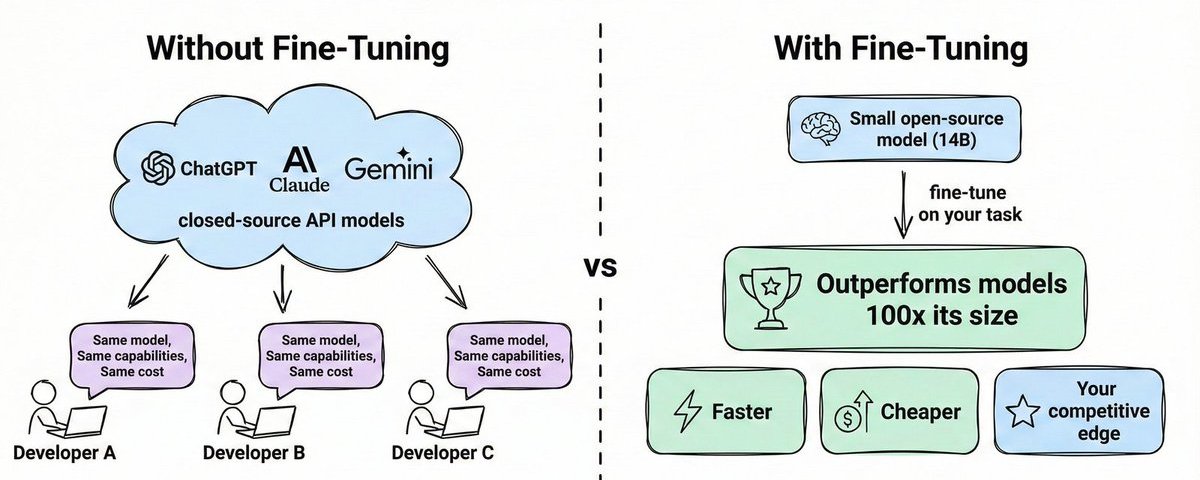
we wrote a complete breakdown of fine-tuning models with reinforcement learning using GRPO and RULER. RULER uses a language model judge to rank trajectories, so you do not have to manually write reward functions or collect labeled answers.
the article is quoted below.



Maverick Monk🔥🛡️ retweeted

The hottest job in AI isn't researcher.
It's the engineer who makes AI work inside someone else's company.
OpenAI, Anthropic and Google are all hiring for it. Here's the roadmap I'd follow.
Stage 1: Customer Discovery & Problem Framing
- Learn: Stakeholder interviews, scoping, requirements under ambiguity, success metrics and writing a one-page problem statement.
- Practice: Interview a non-technical person about a messy workflow (like invoice processing) and write a one-page scope with measurable success criteria.
- Why: The best FDEs solve the right problem first. The code comes second.
Stage 2: Full-Stack Fundamentals
- Learn: Python, TypeScript, SQL, REST APIs, Git and Docker.
- Practice: Build and ship an internal tool end to end, with a React frontend, a FastAPI backend and a Postgres database.
- Why: You'll be dropped into someone else's stack with very little time to ramp up.
Stage 3: Data Integration & Messy Data
- Learn: ETL/ELT, schema design, API pagination and rate limits, legacy exports and data quality checks.
- Practice: Pull data from a REST API, a CSV export and a SQL database, then reconcile and clean it into one data model.
- Why: Customer data is rarely clean, and the integration work is where most of the time goes.
Stage 4: LLM Application Engineering
- Learn: Prompting, structured outputs, function calling, embeddings, context windows, cost and latency.
- Practice: Build an app that extracts structured data from messy documents and writes it into a database.
- Why: The model is the engine. Your job is wiring it into a real workflow.
Stage 5: RAG & Knowledge Systems
- Learn: Chunking, hybrid search, vector databases, reranking, citations and access control.
- Practice: Build a RAG assistant over a company's internal docs with source citations and per-user permissions.
- Why: Enterprise AI is mostly about getting the right context to the model, for the right person.
Stage 6: AI Agents & Tool Use (MCP)
- Learn: Agent loops, tool calling, Model Context Protocol, state management and human-in-the-loop approvals.
- Practice: Build an agent that reads support tickets, looks up the customer in a CRM and drafts a reply for human approval.
- Why: Customers don't want answers alone. They want work done.
Stage 7: Evals & Reliability
- Learn: Eval datasets, LLM-as-judge, regression testing, tracing and fallback strategies.
- Practice: Build an eval suite of 100 real cases for your agent and track accuracy on every release.
- Why: "It worked in the demo" doesn't survive production. You need numbers the customer's leadership can trust.
Stage 8: Enterprise Integration & Security
- Learn: SSO, OAuth, role-based access control, secrets management, audit logs and PII handling.
- Practice: Add SSO, role-based access and audit logging to the tool you built in Stage 2.
- Why: A security review can decide whether you ship at all.
Stage 9: Deployment & Cloud
- Learn: Docker, Kubernetes basics, AWS/Azure/GCP, CI/CD, infrastructure as code and private or restricted environments.
- Practice: Deploy your app to a cloud environment with CI/CD, health checks and one-command rollback.
- Why: Every customer's environment is different, and you'll have to adapt on site.
Stage 10: Observability & Incident Response
- Learn: Logs, metrics, traces, alerting, root cause analysis and blameless postmortems.
- Practice: Break your own system on purpose, find the root cause from logs alone and write a postmortem.
- Why: When production breaks at the customer's site, you're the one they call.
Stage 11: Communication & Stakeholder Management
- Learn: Demos, status updates, explaining trade-offs to non-engineers, managing scope and saying no.
- Practice: Record a 5-minute demo for a non-technical executive covering what you built, what it can't do and what it costs.
- Why: The role sits between engineering and the customer. Technical skill alone isn't enough.
Stage 12: Case Studies, Portfolio & Interviews
- Learn: How FDE interviews work, including decomposition case studies, ambiguity handling and coding rounds.
- Practice: Ship 2-3 end-to-end projects for real or realistic customers and write a case study for each, covering the problem, constraints, solution and results.
- Why: Proof of shipping beats a list of certificates.
Bookmark and Repost!
Full story: medium.com/@dhanushnehru/the…

Maverick Monk🔥🛡️ retweeted

Google just dropped a free 2-hour masterclass on Loop and Graph Engineering
From one prompt to 200+ agents that check and fix their own work:
0% → 00:15 - Graph engineering from scratch
30% → 30:13 - Your first agent graph
45% → 42:41 - Parallel agents, as many as needed
75% → 59:47 - Loops that resend bad work
100% → 1:23:03 - Self-fixing graph while you sleep
Prompts → Agents → Loops → Graphs → Self-Improving Systems
Most people still cram every instruction into one agent and hope it follows
Worth more than most $2,000 agentic engineering courses
Bookmark and watch it today
Then read the full Graph Engineering guide below ↓
Maverick Monk🔥🛡️ retweeted

Want to become an AI Inference Engineer in 2026? One of hottest job roles right now...
Stop focusing only on training models. Start learning how to make AI models run faster, cheaper and at scale.
Bookmark these 6 resources:
1. Inference Engineering – Complete guide to LLM inference: inferenceengineering.tech/
2. Hugging Face – LLM Inference Optimization: huggingface.co/docs/transfor…
3. vLLM – Learn high-performance LLM serving: docs.vllm.ai/
4. SGLang – Learn fast and efficient LLM serving: docs.sglang.ai/
5. NVIDIA – TensorRT-LLM Documentation: nvidia.github.io/TensorRT-LL…
6. GPU MODE – Learn GPU programming, CUDA and Triton: github.com/gpu-mode
Don't just learn how to run models.
Learn GPU architecture, CUDA, memory management, KV caching, quantization, speculative decoding, continuous batching, distributed inference and performance benchmarking.
The goal isn't just to make an LLM work.
It's to serve millions of tokens with lower latency, higher throughput and minimum GPU costs.
Inference engineering is where AI meets serious systems engineering.
Bookmark this. Repost it for someone trying to break into AI infrastructure.

Maverick Monk🔥🛡️ retweeted

Stripe Crypto brings together everything needed to enable agentic commerce.
From stablecoins on @tempo to secure non-custodial wallets powered by @privy_io, here's what's powering Link balance for AI agents, starting with @instinct. View article
Maverick Monk🔥🛡️ retweeted
GPU Engineering from Scratch 🚀
Found this excellent free, open-source learning resource that explains GPU architecture and performance engineering from the ground up.
It's called Before GPU Engineering, a structured digital notebook with 56 chapters listed across four phases.
What makes it useful is the approach: instead of jumping straight into CUDA or Triton, it builds an understanding of how GPUs actually execute programs, move data, and handle parallel workloads.
What's inside:
→ CPU vs GPU architecture and parallel computing
→ Warps, SIMT, threads, and thread blocks
→ Registers, shared memory, caches, and HBM
→ Compute-bound vs memory-bound workloads
→ Kernel launches, synchronization, and race conditions
→ Memory coalescing and access patterns
→ Occupancy, latency hiding, and register spilling
→ Arithmetic intensity and memory bottlenecks
→ Tiling, matrix multiplication, and GPU performance
→ Profiling and identifying kernel bottlenecks
The explanations connect hardware concepts to problems encountered in AI workloads, including attention and efficient matrix operations.
It's primarily a reading resource rather than a hands-on programming course, and some later chapters are still being written.
Perfect for AI/ML engineers and software developers who want to understand the hardware behind LLM training and inference before diving deeper into CUDA, Triton, and GPU kernel optimization.
Completely free.
Here's the GitHub Repo: github.com/BEFORE-GPU-ENGINE…


Maverick Monk🔥🛡️ retweeted

I went through 100+ early projects building on @Enter_Elysium
Elysium is a new hyperliquid layer 2 built by kinetiq, with mainnet launching November 9
here are 21 worth paying attention to:
Launchpads
• @AscendLaunch
• @MontraXYZ
• @oxleydotfun
• @SignalFam
• @perpmefun
• @Neuriio
DEXs, Trading & Predictions
• @kalosfun - dex + trading
• @NestExchange - dex + trading
• @Atlas_Elysium - dex + trading
• @speculatexyz - prediction market
NFTs
• @ElytraNFT
• @ElysiumPunks
• @lutra_hl
• @elysiumant
• @hypawwX
• @slymzcrew - free mint
• @AtlasHL - NFT marketplace
GameFi
• @Hyperion_RPG
• @playtilt_gg
AI
• @AgentEly_ - AI agent + meme
Infrastructure
• @Enter_Elysium - official bridge
Some of the best opportunities in crypto come from getting in early on new chains
Good luck!


