

Digital workforce infrastructure for AI-native enterprises. Don’t standardize agent frameworks—standardize enterprise governance.
Joined August 2017
- Tweets99
- Following330
- Followers99
- Likes14
Maybe in classical computing, P ≠ NP really is a wall. But look closely at the hidden assumption baked into a problem like 3-SAT: we assume first come the 400 constraints, and then a machine steps through one-way time searching for the 100 switch settings that satisfy them.
That "first the problem, then the search" order is a product of living inside a one-way slice of time.
Look at how complexity erupts from inside time:
2-SAT is trivial; 3-SAT explodes.
Two bodies trace neat ellipses; three bodies collapse into chaos.
A single pendulum is periodic; a double pendulum turns unpredictable.
Now drop the assumption of one-way time. Think of light obeying the Principle of Least Action—it doesn't brute-force paths millisecond by millisecond; in 4D spacetime, start, end, and optimal path coexist as one self-consistent geometry. Or think of timeless global constraints: if you could step outside the sequential slice of time, the constraints (the problem) and the configuration (the answer) wouldn't happen one after another. They would exist simultaneously as two sides of the same self-consistent structure.
Perhaps NP-hardness isn't a limit of reality itself—just the tax finite observers pay for reading a timeless geometry one frame at a time.
And perhaps that narrow slice of "now" isn't a flaw. Without it, everything would be solved, silent, and already finished—and nothing would ever be lived.
1
21
Watching AI drop Lean formal proofs for both the Riemann Hypothesis and VP ≠ VNP in the same week, everyone is asking again whether P = NP is dead.
Maybe in classical computing, P ≠ NP really is a wall. But look closely at the hidden assumption baked into a problem like 3-SAT: we assume first come the 400 constraints, and then a machine steps through one-way time searching for the 100 switch settings that satisfy them.
That "first the problem, then the search" order is a product of living inside a one-way slice of time.
Look at how complexity erupts from inside time:
2-SAT is trivial; 3-SAT explodes.
Two bodies trace neat ellipses; three bodies collapse into chaos.
A single pendulum is periodic; a double pendulum turns unpredictable.
Two and a half thousand years ago, Laozi wrote: "One gives birth to two, two to three, three to ten thousand things." At two, constraints stay linear. At three, mutual feedback breaks open into endless complexity—as long as you are forced to predict the next second from the present one.
Now drop the assumption of one-way time. Think of light obeying the Principle of Least Action—it doesn't brute-force paths millisecond by millisecond; in 4D spacetime, start, end, and optimal path coexist as one self-consistent geometry. Or think of timeless global constraints: if you could step outside the sequential slice of time, the constraints (the problem) and the configuration (the answer) wouldn't happen one after another. They would exist simultaneously as two sides of the same self-consistent structure.
Perhaps NP-hardness isn't a limit of reality itself—just the tax finite observers pay for reading a timeless geometry one frame at a time.
And perhaps that narrow slice of "now" isn't a flaw. Without it, everything would be solved, silent, and already finished—and nothing would ever be lived.
58
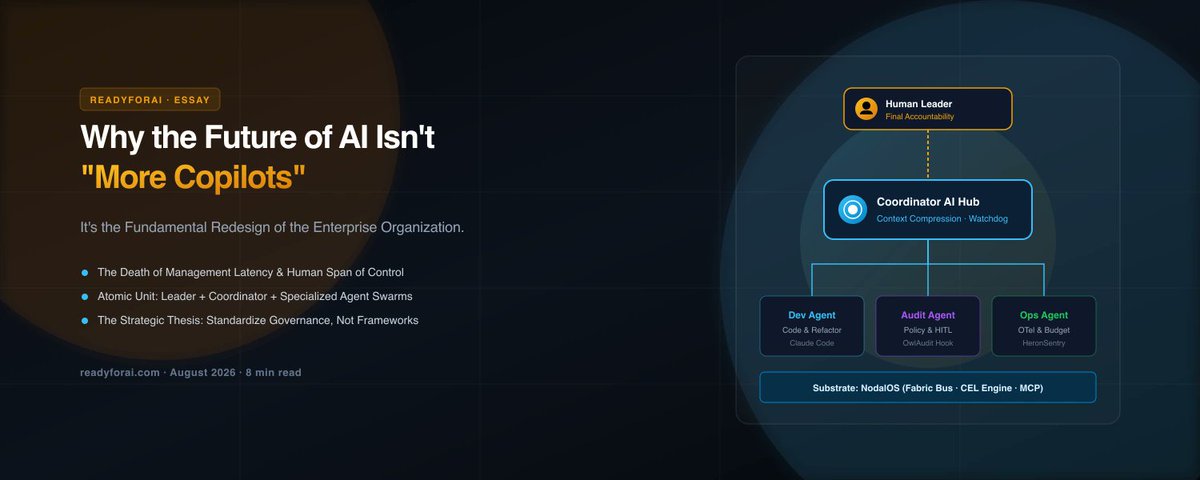
When Models Expire in Six Months, What Are Enterprises Actually Buying?
readyforai.com/en/blog/build…

2
19
ReadyForAI | Enterprise Digital Workforce Infrastructure youtu.be/E7eYbWIu1Nc?si=tVfB… via @YouTube
1
46
Ready For AI retweeted

We remain committed to our partnership with OpenAI and have confidence in our product roadmap, our ability to continue to innovate with everything we announced at Microsoft Ignite, and in continuing to support our customers and partners. We look forward to getting to know Emmett Shear and OAI's new leadership team and working with them. And we’re extremely excited to share the news that Sam Altman and Greg Brockman, together with colleagues, will be joining Microsoft to lead a new advanced AI research team. We look forward to moving quickly to provide them with the resources needed for their success.
Embrace Buddha's teachings to elevate your spirit. Discover the essence and purpose of life.
chat.openai.com/g/g-ff4dekUJ…
9

Ready For AI retweeted

1/ Thrilled to announce: Our new course ChatGPT Prompt Engineering for Developers, created together with @OpenAI, is available now for free! Access it here: deeplearning.ai/short-course…
Ready For AI retweeted

Announcing GPT-4, a large multimodal model, with our best-ever results on capabilities and alignment: openai.com/product/gpt-4


Ready For AI retweeted

🎉 The wait is over! TensorFlow 2.0 is finally here.
Driven by community feedback, this release provides a complete set of tools for developers, enterprises, and researchers to easily build ML applications.
Read the blog ↓ goo.gle/TF2rel
Ready For AI retweeted
In this age of technology, it’s important to preserve privacy for sensitive data. Federated Learning keeps privacy in mind without centralizing data while allowing edge devices to use machine learning. #MLFridays
Learn more here → goo.gle/2Tg3aAZ

ALT Federated Learning thumbnail
Ready For AI retweeted

65% of hate speech on Facebook is proactively taken down.
But should it be up to Facebook to decide what content is acceptable?
No. facebook.com/722677142/posts…

Ready For AI retweeted

Truck won't start? These robo-dogs from @BostonDynamics might be able to help: https://nitter.cf/t.co/1MScmDFEhD
Ready For AI retweeted

One tiny bit of good news in the tragedy. "For the last half-decade or so, an architectural historian named Andrew Tallon worked with laser scanners to capture the entirety of the cathedral’s interior and exterior in meticulous 3D point clouds." wired.com/story/the-notre-da…

Ready For AI retweeted

“There are things that attract human attention, and there is often a huge gap between what is important and what is attractive and interesting."

Ready For AI retweeted

We’re open sourcing PyTorch-BigGraph, a tool that makes it much faster and easier to produce graph embeddings for extremely large graphs. Quickly produce high-quality embeddings without specialized computing resources like GPUs or huge amounts of memory. ai.facebook.com/blog/open-so…