Find your echo chamber & raid theirs | 🇮🇱 & 🇮🇷 FOREVER
Greater Israel Project
Joined January 2024
- Tweets5.7K
- Following1.8K
- Followers2.4K
- Likes3.5K





Pinned Tweet
We have a big announcement to share today.
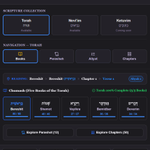
TorahCloud.org is officially live
Including faithful (to original text) renditions of the Chumashim (Five Books of Moses)
Bereshit (Genesis)
Shemot (Exodus)
Vayikra (Leviticus)
Bamidbar (Numbers)
Devarim (Deuteronomy)
And what is a Chumash without the complete commentaries in English? You get both English and Hebrew, side by side, so you can read the full text without losing your place.
To get here, we restored, translated, and verified 15,101 commentary passages across 162 chapters, checking every passage in full against the original vocalized Hebrew and Aramaic text so nothing was summarized or cut short.
Full English commentaries for the Chumash now include seven foundational Mefarshim (classical commentators):
Onkelos
Rashi
Rashbam
Ibn Ezra
Nachmanides (Ramban)
Baal HaTurim
Sforno
Every chapter also includes footnotes, direct Sefaria source links, a built-in glossary and sources index, full-book search, and offline access so you can study anywhere.
And if you thought we were done... we already have the rest of the Tenakh (Hebrew Bible) live, with all of Nevi'im (Prophets) and Ketuvim (Writings) available alongside Rashi. Full English restorations for more commentaries on Nevi'im and Ketuvim are on the way next.
Check it out at torahcloud.org and let us know what you think.
Video demos w/ voiceovers below 👇

Rhythm בעל רית׳ם retweeted
We have a big announcement to share today.
TorahCloud.org is officially live
Including faithful (to original text) renditions of the Chumashim (Five Books of Moses)
Bereshit (Genesis)
Shemot (Exodus)
Vayikra (Leviticus)
Bamidbar (Numbers)
Devarim (Deuteronomy)
And what is a Chumash without the complete commentaries in English? You get both English and Hebrew, side by side, so you can read the full text without losing your place.
To get here, we restored, translated, and verified 15,101 commentary passages across 162 chapters, checking every passage in full against the original vocalized Hebrew and Aramaic text so nothing was summarized or cut short.
Full English commentaries for the Chumash now include seven foundational Mefarshim (classical commentators):
Onkelos
Rashi
Rashbam
Ibn Ezra
Nachmanides (Ramban)
Baal HaTurim
Sforno
Every chapter also includes footnotes, direct Sefaria source links, a built-in glossary and sources index, full-book search, and offline access so you can study anywhere.
And if you thought we were done... we already have the rest of the Tenakh (Hebrew Bible) live, with all of Nevi'im (Prophets) and Ketuvim (Writings) available alongside Rashi. Full English restorations for more commentaries on Nevi'im and Ketuvim are on the way next.
Check it out at torahcloud.org and let us know what you think.
Video demos w/ voiceovers below 👇


No, you don't. Fuck off.

Dear non-Muslims,
Please understand that Muslims have the right to practise Islam without being mocked.
We have the right to pray.
We have the right to wear our hijabs.
We have the right to avoid alcohol and pork.
We have the right to raise our children according to our faith.
You don't have to practise Islam to respect Muslims who do.
Religious freedom should apply to everyone.
🤣🤣🤣

Palestinian Tik Tok is now claiming that Israel is dropping snakes on Gaza.
Over 200,000 likes.
Genuinely the most low-IQ movement in history.
Readers added context they thought people might want to know
The video is from Pakistani account @Saba5670 captioned that Allah is powerful over everything, with no reference to Israel, Gaza or Palestine. It is a known AI-generated fake unrelated to any real event.
x.com/Saba5670/statu…
cyberpeace.org/resources/blog…
Silly sand creatures gonna get sandy. Couldn't handle me in argument so blocked. Another sandy boy bites teh dust.
Good luck, - @_MohammedShak, no amount of therapy can fix the damage of inbreeding.

4
96
The whole Tanakh is now on TorahCloud. Every book. Every chapter - all available our our new domain, torahcloud.org
I’ve also been polishing the web and mobile interfaces to make studying easier, whether you’re at your desk or reading on your phone.
And we’re adding more commentaries right now, with Hebrew source texts and English translations to help you dig deeper.
The goal has always been free, accessible Torah study, even if you don’t have advanced Hebrew.
Come explore, test it on your devices, and tell me what works, what breaks, and what you’d love to see next.
torahcloud.org


Introducing TorahCloud
Bringing Traditional Torah Study Into the Modern Age
-
I've been developing TorahCloud, a free, expanding Torah study platform intended to make the Chumash and its classical commentators (Mefarshim) more accessible to English-speaking readers without sacrificing the richness, depth, or integrity of the original Hebrew sources.
The premise is straightforward: Traditional Torah scholarship should not be difficult to access simply because of linguistic barriers, outdated interfaces, or cumbersome navigation.
The objective isn't to replace traditional seforim or established methods of learning. It's to make their contents more accessible through modern technology while preserving their substance.
What TorahCloud Offers
1. The Chumash — Hebrew, English & Transliteration
The original Hebrew text with niqqud, English translations, and optional transliteration, presented in customizable reading layouts.
Readers can study the original text alongside its translation or configure the experience according to their Hebrew proficiency.
2. Seven Classical Mefarshim — Accessible in English
One of the project's central objectives is bringing the classical commentators together in a single, verse-by-verse study environment:
Rashi
Ramban (Nachmanides)
Ibn Ezra
Sforno
Baal HaTurim
Rashbam
Onkelos
Their traditional Hebrew or Aramaic material is presented alongside English translations where available, making it easier to explore competing interpretations, examine traditional explanations, and engage directly with the Jewish scholarly tradition.
3. Traditional Torah Navigation
TorahCloud supports navigation by Chumash → Parashah → Aliyah → Chapter → Verse.
Traditional Shabbat reading divisions are identified through bilingual labels and Yad (Torah pointer) markers, including aliyot that cross modern chapter boundaries.
Readers can follow the weekly Torah portion or navigate directly to a particular passage.
4. Modern Accessibility & Study Tools
The platform incorporates features intended to improve both everyday reading and more serious study:
Four reading themes, including paper, dark, and true OLED.
Adjustable typography, including accessible English fonts and Hebrew font options.
Customizable bilingual reading layouts.
Search across available biblical text and commentaries.
Bookmarks and reading-position tracking.
Built-in glossary and source index.
Offline reading through Progressive Web App functionality.
These features are intended to make extended study practical across desktop computers, tablets, and mobile devices.
The Larger Objective
TorahCloud is not intended to be merely another digital Chumash.
My broader ambition is to develop an expanding, accessible library of traditional Jewish scholarship in which original texts, classical interpretations, English translations, and source references can be studied together.
The scholarly material is developed through a separate production process, with source-preservation and completeness checks. I'm also interested in introducing independent scholarly review to strengthen textual accuracy and accountability as the project grows.
The application remains a work in progress. Additional chapters and material are being incorporated progressively, and I expect both the interface and the scholarly verification process to evolve.
I'd Like Your Thoughts
I'm particularly interested in hearing from Torah scholars, rabbis, educators, Hebrew students, and anyone who regularly studies Chumash with Mefarshim.
What would make this platform more useful to you? What functionality is missing? Are there aspects of traditional Torah study that a modern digital interface frequently overlooks?
I'm interested in substantive criticism as much as encouragement.
Explore TorahCloud here:
torahcloud.pages.dev/


Rhythm בעל רית׳ם retweeted

College student:
“Jews are refugees. They have no right to self-determination. Israel has no sovereignty.”
The response that shut the room down:
“Millions of Jews left Auschwitz with nowhere to go.
Not one country on Earth took them in.
A million and a half Jews fought in World War II…
and still couldn’t bomb the tracks to the gas chambers.
Because they had no army.
No country.
No power.
The day Jews could finally defend themselves…
is the day Jews stopped dying.”
Hamas has said it out loud for two years:
They will keep going until every last Jew is dead.
You’re telling Israelis to dismantle their self-defense “for peace.”
Hamas is telling them: “Do it and we’ll slaughter you.”
And somehow… Hamas is winning the argument inside your head.
Go learn the actual history.
Then come back and talk. 🇮🇱


Finished all of Nevi’im for TorahCloud: Translation, chapter pages, and publication to the live app.
Seeing the Prophets come together book by book has been incredible.
The Ketuvim (writings) coming next, expect it by end of week ❤️
Introducing TorahCloud
Bringing Traditional Torah Study Into the Modern Age
-
I've been developing TorahCloud, a free, expanding Torah study platform intended to make the Chumash and its classical commentators (Mefarshim) more accessible to English-speaking readers without sacrificing the richness, depth, or integrity of the original Hebrew sources.
The premise is straightforward: Traditional Torah scholarship should not be difficult to access simply because of linguistic barriers, outdated interfaces, or cumbersome navigation.
The objective isn't to replace traditional seforim or established methods of learning. It's to make their contents more accessible through modern technology while preserving their substance.
What TorahCloud Offers
1. The Chumash — Hebrew, English & Transliteration
The original Hebrew text with niqqud, English translations, and optional transliteration, presented in customizable reading layouts.
Readers can study the original text alongside its translation or configure the experience according to their Hebrew proficiency.
2. Seven Classical Mefarshim — Accessible in English
One of the project's central objectives is bringing the classical commentators together in a single, verse-by-verse study environment:
Rashi
Ramban (Nachmanides)
Ibn Ezra
Sforno
Baal HaTurim
Rashbam
Onkelos
Their traditional Hebrew or Aramaic material is presented alongside English translations where available, making it easier to explore competing interpretations, examine traditional explanations, and engage directly with the Jewish scholarly tradition.
3. Traditional Torah Navigation
TorahCloud supports navigation by Chumash → Parashah → Aliyah → Chapter → Verse.
Traditional Shabbat reading divisions are identified through bilingual labels and Yad (Torah pointer) markers, including aliyot that cross modern chapter boundaries.
Readers can follow the weekly Torah portion or navigate directly to a particular passage.
4. Modern Accessibility & Study Tools
The platform incorporates features intended to improve both everyday reading and more serious study:
Four reading themes, including paper, dark, and true OLED.
Adjustable typography, including accessible English fonts and Hebrew font options.
Customizable bilingual reading layouts.
Search across available biblical text and commentaries.
Bookmarks and reading-position tracking.
Built-in glossary and source index.
Offline reading through Progressive Web App functionality.
These features are intended to make extended study practical across desktop computers, tablets, and mobile devices.
The Larger Objective
TorahCloud is not intended to be merely another digital Chumash.
My broader ambition is to develop an expanding, accessible library of traditional Jewish scholarship in which original texts, classical interpretations, English translations, and source references can be studied together.
The scholarly material is developed through a separate production process, with source-preservation and completeness checks. I'm also interested in introducing independent scholarly review to strengthen textual accuracy and accountability as the project grows.
The application remains a work in progress. Additional chapters and material are being incorporated progressively, and I expect both the interface and the scholarly verification process to evolve.
I'd Like Your Thoughts
I'm particularly interested in hearing from Torah scholars, rabbis, educators, Hebrew students, and anyone who regularly studies Chumash with Mefarshim.
What would make this platform more useful to you? What functionality is missing? Are there aspects of traditional Torah study that a modern digital interface frequently overlooks?
I'm interested in substantive criticism as much as encouragement.
Explore TorahCloud here:
torahcloud.pages.dev/

Rhythm בעל רית׳ם retweeted
A major milestone for TorahCloud!
We've completed all five books of Moshe — the entire Chumash — bringing together Hebrew, English translations, transliterations, and classical Mefarshim in a modern, accessible study platform.
We're now turning our attention to Nevi'im (the Prophets) as we continue building toward the complete Tanakh.
The goal remains the same: make the depth and richness of traditional Jewish scholarship accessible to everyone, without losing sight of the original sources.
Explore TorahCloud: torahcloud.pages.dev/

Introducing TorahCloud
Bringing Traditional Torah Study Into the Modern Age
-
I've been developing TorahCloud, a free, expanding Torah study platform intended to make the Chumash and its classical commentators (Mefarshim) more accessible to English-speaking readers without sacrificing the richness, depth, or integrity of the original Hebrew sources.
The premise is straightforward: Traditional Torah scholarship should not be difficult to access simply because of linguistic barriers, outdated interfaces, or cumbersome navigation.
The objective isn't to replace traditional seforim or established methods of learning. It's to make their contents more accessible through modern technology while preserving their substance.
What TorahCloud Offers
1. The Chumash — Hebrew, English & Transliteration
The original Hebrew text with niqqud, English translations, and optional transliteration, presented in customizable reading layouts.
Readers can study the original text alongside its translation or configure the experience according to their Hebrew proficiency.
2. Seven Classical Mefarshim — Accessible in English
One of the project's central objectives is bringing the classical commentators together in a single, verse-by-verse study environment:
Rashi
Ramban (Nachmanides)
Ibn Ezra
Sforno
Baal HaTurim
Rashbam
Onkelos
Their traditional Hebrew or Aramaic material is presented alongside English translations where available, making it easier to explore competing interpretations, examine traditional explanations, and engage directly with the Jewish scholarly tradition.
3. Traditional Torah Navigation
TorahCloud supports navigation by Chumash → Parashah → Aliyah → Chapter → Verse.
Traditional Shabbat reading divisions are identified through bilingual labels and Yad (Torah pointer) markers, including aliyot that cross modern chapter boundaries.
Readers can follow the weekly Torah portion or navigate directly to a particular passage.
4. Modern Accessibility & Study Tools
The platform incorporates features intended to improve both everyday reading and more serious study:
Four reading themes, including paper, dark, and true OLED.
Adjustable typography, including accessible English fonts and Hebrew font options.
Customizable bilingual reading layouts.
Search across available biblical text and commentaries.
Bookmarks and reading-position tracking.
Built-in glossary and source index.
Offline reading through Progressive Web App functionality.
These features are intended to make extended study practical across desktop computers, tablets, and mobile devices.
The Larger Objective
TorahCloud is not intended to be merely another digital Chumash.
My broader ambition is to develop an expanding, accessible library of traditional Jewish scholarship in which original texts, classical interpretations, English translations, and source references can be studied together.
The scholarly material is developed through a separate production process, with source-preservation and completeness checks. I'm also interested in introducing independent scholarly review to strengthen textual accuracy and accountability as the project grows.
The application remains a work in progress. Additional chapters and material are being incorporated progressively, and I expect both the interface and the scholarly verification process to evolve.
I'd Like Your Thoughts
I'm particularly interested in hearing from Torah scholars, rabbis, educators, Hebrew students, and anyone who regularly studies Chumash with Mefarshim.
What would make this platform more useful to you? What functionality is missing? Are there aspects of traditional Torah study that a modern digital interface frequently overlooks?
I'm interested in substantive criticism as much as encouragement.
Explore TorahCloud here:
torahcloud.pages.dev/
A major milestone for TorahCloud!
We've completed all five books of Moshe — the entire Chumash — bringing together Hebrew, English translations, transliterations, and classical Mefarshim in a modern, accessible study platform.
We're now turning our attention to Nevi'im (the Prophets) as we continue building toward the complete Tanakh.
The goal remains the same: make the depth and richness of traditional Jewish scholarship accessible to everyone, without losing sight of the original sources.
Explore TorahCloud: torahcloud.pages.dev/
Introducing TorahCloud
Bringing Traditional Torah Study Into the Modern Age
-
I've been developing TorahCloud, a free, expanding Torah study platform intended to make the Chumash and its classical commentators (Mefarshim) more accessible to English-speaking readers without sacrificing the richness, depth, or integrity of the original Hebrew sources.
The premise is straightforward: Traditional Torah scholarship should not be difficult to access simply because of linguistic barriers, outdated interfaces, or cumbersome navigation.
The objective isn't to replace traditional seforim or established methods of learning. It's to make their contents more accessible through modern technology while preserving their substance.
What TorahCloud Offers
1. The Chumash — Hebrew, English & Transliteration
The original Hebrew text with niqqud, English translations, and optional transliteration, presented in customizable reading layouts.
Readers can study the original text alongside its translation or configure the experience according to their Hebrew proficiency.
2. Seven Classical Mefarshim — Accessible in English
One of the project's central objectives is bringing the classical commentators together in a single, verse-by-verse study environment:
Rashi
Ramban (Nachmanides)
Ibn Ezra
Sforno
Baal HaTurim
Rashbam
Onkelos
Their traditional Hebrew or Aramaic material is presented alongside English translations where available, making it easier to explore competing interpretations, examine traditional explanations, and engage directly with the Jewish scholarly tradition.
3. Traditional Torah Navigation
TorahCloud supports navigation by Chumash → Parashah → Aliyah → Chapter → Verse.
Traditional Shabbat reading divisions are identified through bilingual labels and Yad (Torah pointer) markers, including aliyot that cross modern chapter boundaries.
Readers can follow the weekly Torah portion or navigate directly to a particular passage.
4. Modern Accessibility & Study Tools
The platform incorporates features intended to improve both everyday reading and more serious study:
Four reading themes, including paper, dark, and true OLED.
Adjustable typography, including accessible English fonts and Hebrew font options.
Customizable bilingual reading layouts.
Search across available biblical text and commentaries.
Bookmarks and reading-position tracking.
Built-in glossary and source index.
Offline reading through Progressive Web App functionality.
These features are intended to make extended study practical across desktop computers, tablets, and mobile devices.
The Larger Objective
TorahCloud is not intended to be merely another digital Chumash.
My broader ambition is to develop an expanding, accessible library of traditional Jewish scholarship in which original texts, classical interpretations, English translations, and source references can be studied together.
The scholarly material is developed through a separate production process, with source-preservation and completeness checks. I'm also interested in introducing independent scholarly review to strengthen textual accuracy and accountability as the project grows.
The application remains a work in progress. Additional chapters and material are being incorporated progressively, and I expect both the interface and the scholarly verification process to evolve.
I'd Like Your Thoughts
I'm particularly interested in hearing from Torah scholars, rabbis, educators, Hebrew students, and anyone who regularly studies Chumash with Mefarshim.
What would make this platform more useful to you? What functionality is missing? Are there aspects of traditional Torah study that a modern digital interface frequently overlooks?
I'm interested in substantive criticism as much as encouragement.
Explore TorahCloud here:
torahcloud.pages.dev/