




Robyer | Ω retweeted

Want to be ahead of 99% of the crypto space when it comes to understanding the quantum threat?
Our new Quantum Threat 101 Masterclass breaks down the fundamentals: quantum computing (without a physics degree), why today's blockchains are vulnerable, and what it means for the future of digital asset security.
Watch it here 👇
youtu.be/aaH84AE0kbU

Robyer | Ω retweeted
Binance Hacked: The Biggest Crypto Heist in History? | Crypto Roadmaps, Quantum, & Coffee
We're going Live today at Noon ET (16:00 UTC).
Join us for the latest Official QRL Show Live as we dive into the Binance Hack (as it unfolds), the evolving cryptographic landscape, AI vs Cryptography, and what it all means for the future of digital asset security.
Joining @Strike_Attack & Ryan for the discussion is post-quantum cryptography expert, Dr. Joseph Kearney (@Joseph_Kearney).
🗓️ October 30th | Noon ET (16:00 UTC)
📍 QRL YouTube & X Livestream
Join us 👇
youtube.com/live/vBvL7Gd9Yyc…

Robyer | Ω retweeted

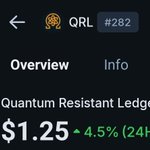
$QRL's price is rising. But what does quantum computing have to do with it?
The story behind Quantum Resistant Ledger, in under two minutes.
Robyer | Ω retweeted
To: @Support @Safety @singhai @benjitaylor
Please Assist.
FYI: @dexscreener @base
The base:0x37696cd8f723ce541ac376f79fc109080e505ba3 Cashtag on X points to a token that is not QRL.
The Quantum Resistant Ledger is an independent, post-quantum secure Layer-1 blockchain, live since 2018. QRL is not a token on Base, Ethereum, Solana, or any other chain.
Right now, tapping the QRL Cashtag on X shows the chart for an unaffiliated Base ERC-20, created April 3, 2026, that copies our name and ticker:
0x37696cd8f723ce541ac376f79fc109080e505ba3
This token has no connection to QRL. It already has 92 holders and roughly $6,000 in buyer ETH in its trading pool, people who may believe they bought QRL. Please don't buy it, and don't rely on the QRL Cashtag for price info until this is fixed.
What we've done so far:
- Reported to X Support on Oct 6, followed up Oct 15
- Contacted the Cashtag data partners
- Posted a public warning on Oct 12
What we're asking X:
Map the QRL Cashtag to the native QRL asset, or show it as ambiguous with no default contract
Stop defaulting to any Base contract that uses our name. Dozens of clones exist, so removing one won't solve it.
For those copied FYI:
- Cashtag partners: Please help route this to the team that owns asset mapping
- DEX Screener & Base: Please flag this contract as impersonating QRL
We're glad to provide any verification needed. Proof of the real QRL in the reply below 👇
📢 QRL community, we need your help:
🔁 Repost this so it reaches the right people at X
💬 Reply below if the QRL Cashtag has misled you or someone you know
🚩 Report the token anywhere you see it promoted as QRL
The more visibility this gets, the faster it gets fixed.
Thank you.

Robyer | Ω retweeted
If you've already put in the work building blockchain projects with Solidity...you shouldn't have to start from scratch to prepare for a post-quantum future.
Bring what you've built to QRL 👇
theqrl.org

Robyer | Ω retweeted

ZEC's Sprout freeze should raise some serious questions.
If Zcash can't migrate all its legacy funds before deprecating a transaction format, how smoothly will it handle a full PQC migration?
Meanwhile...QRL was built for the quantum threat from day one.
cryptoslate.com/zcashs-plann…

Robyer | Ω retweeted

Five reasons to take a closer look at Quantum Resistant Ledger $QRL:
🔬 Google Quantum AI researchers name QRL among post-quantum blockchains.
quantumai.google/static/site…
🇪🇺 A Europol report describes QRL’s quantum-resistant design and XMSS signatures. See PDF page 101.
europol.europa.eu/cms/sites/…
🛰️ A Lockheed Martin patent describes a secure communications system using a QRL blockchain.
patents.google.com/patent/US…
🔍 Trail of Bits published an independent security assessment of QRL’s go-qrllib cryptographic library.
trailofbits.com/library/the-…
🛡️ Halborn audited QRL’s qrypto.js signature implementations: 13 informational findings, all resolved, with none rated low, medium, high or critical.
halborn.com/audits/qrl-quant…
Research references, a patent and scoped security audits each tell a different part of the story. They do not imply investment endorsements or confirmed commercial adoption.
Explore the original sources and judge for yourself.
@QRLedger #QRL #QuantumSafe #PostQuantum

Robyer | Ω retweeted

OGAudit Web3 Research: @QRLedger base:0x37696cd8f723ce541ac376f79fc109080e505ba3 - Post-Quantum Layer 1 & Cryptographic Security Infrastructure.
Quantum Resistant Ledger (QRL) operates as an enterprise grade, post-quantum secure Layer 1 blockchain specifically engineered to protect digital assets and smart contract logic from future decryption attacks enabled by Quantum Computing (Shor's and Grover's algorithms):
- Rejecting vulnerable Elliptic Curve Cryptography (ECDSA), QRL natively implements the eXtended Merkle Signature Scheme (XMSS—RFC 8391), an audited, forward secure, hash based signature mechanism that guarantees post quantum immunity without requiring trusted setups.
- Expanding from its legacy Cryptonight PoW chain toward a PoS architecture, QRL 2.0 (currently live on public testnets) integrates the Quantum Resistant Virtual Machine (ZVM/QRVM) and Hyperion smart contract execution layer, supporting both XMSS and lattice based ML-DSA (Dilithium) signature schemes for unlimited, EVM compatible dApp execution.
- Beyond base layer asset transfers, QRL's protocol suite powers secure offchain messaging, ephemeral keys and post quantum digital identity verification pipelines natively built into its native node client ecosystem. With the QRL token functioning as the native transaction fee currency on the mainnet, the block reward distributed to PoW miners (transitioning to PoS validator staking rewards in QRL 2.0) and the underlying asset securing network consensus.
Is this an indispensable security primitive insulating decentralized finance from quantum decryption timelines or do address state management trade offs and developer adoption barriers cap short term token velocity?
Category: Proof of Work / Quantum-Resistant
Coin Name: base:0x37696cd8f723ce541ac376f79fc109080e505ba3
Market Cap: $97.07M
OG Score: 34
OG Score Rank: #160/952


Robyer | Ω retweeted
Solidity developers: the blockchains you've spent years building on are vulnerable to the quantum threat.
The good news is that your next project doesn't have to be.
QRL 2.0 brings smart contracts to a blockchain built with post-quantum security in mind since Day 1.
Explore and start building 👇
qrlecosystem.com/getting-sta…


Robyer | Ω retweeted
10 years ago today, on 16 October 2016, QRL began with a single GitHub commit.
At the time, few in the industry took the quantum threat seriously. Fast forward to today and it's an industry-wide priority.
What started as an early vision has grown into a global community building for what's next.
The next decade starts now. Be part of it.
Robyer | Ω retweeted

Quantum Ledger Funds Manchester Cryptographers to Build Quantum-Proof Signatures
Quantum Resistant Ledger is funding researchers at the University of Manchester to address a critical vulnerability in current digital security protocols.
#nationalcybersecuritycentre

Robyer | Ω retweeted
Building a post-quantum future takes more than new standards.
QRL is proud to support three cryptographers at the University of Manchester (@OfficialUoM) advancing post-quantum signatures and the cryptographic infrastructure needed for the next generation of blockchains.
Read the announcement here 👇
theqrl.org/press/qrl-backs-u…

Robyer | Ω retweeted
Join our Reddit AMA with Joseph Kearney.
Questions are open until October 15 at 18:00 UTC.
Cryptographers, AI researchers and skeptics are welcome.
reddit.com/r/QRL/comments/1x…

Robyer | Ω retweeted
Enigma was unbreakable.
Until a machine broke it.
Bitcoin has a machine coming for it too.
Robyer | Ω retweeted
I believe QRL deserves more attention. So I'm giving away 100 QRL.
Follow + repost to enter. One entry per person. No purchase needed.
Draw: Oct 25, 2026. Winner announced publicly and contacted by DM. By reposting, you agree to be tagged if you win.

Robyer | Ω retweeted

Vitalik is now trying to convince everyone that lattices are bad because he is bag-holding too much hash-based crypto research can't back out. The case against lattices is the GNFS story, a.k.a. a hunch about "structure," and a multiplier pulled out of thin air. None of it has ever held up in the last few decades.
The factoring analogy is wrong. The number field sieve didn't come from generic cleverness. It came from very specific arithmetic -> smooth numbers, factor bases, relations stitched together by linear algebra into a congruence of squares. If you claim lattices have a GNFS hiding in the closet, you have to name what plays that role. "Structure" names nothing. The sieve was finished by 1993, and RSA sizes have barely moved in the thirty years since, so the lesson of factoring is that the skeletons ran out. Even the formula in the post is wrong. GNFS is exp(O(n^(1/3) (log n)^(2/3))), and if you're going to size parameters by analogy, you could at least get the analogy's complexity right.
Lattices had their sieve era decades ago. LLL in 1982, BKZ, pruned enumeration, sieving at 2^0.415n in 2008 and 2^0.292n in 2016. Every one of those was priced into parameters the moment it appeared. ML-KEM and ML-DSA are sized against exactly these attacks with a cost model that hands the attacker free memory and drops polynomial factors. The post talks as if nobody has ever seriously looked at lattices. Forty years of the best people in the field moved is the constant in the exponent.
The post also skips the one thing lattices have that GGEV and Peikert proved: breaking random LWE or SSIS instances at the right parameters solves approximate shortest-vector problems on every lattice of that dimension. A "skeleton" for plain LWE wouldn't be some clever trick for one family. It's a theorem for one of the most attacked problems in computer science. SHA-256 has no theorem like that. Its security is that nobody has broken it yet, which is exactly the standard the post refuses
to extend to lattices.
If you actually want to worry about structure in lattices, then look at the algebra of rings and ideal lattices. Cramer, Ducas, Peikert, and Regev (2016) and Cramer, Ducas, and Wesolowski (2017) gave quantum attacks on Ideal-SVP in cyclotomic fields. Albrecht, Bai, Ducas, and Kirchretched NTRU. Those results killed real schemes, and none of them touch ML-KEM or ML-DSA, which are module schemes with small moduli. Ducas, Plançon, and Wesolowski showed the quantum ideal attack does worse than plain BKZ at every dimension, applied the structure, measured how far the attacks reach, standardized outside their range, kept FrodoKEM with no ring at all, and added HQC in 2025 so KEMs don't rest on lattices alone. Vitalik is either unaware of this or hash-crypto bagholding is causing citation amnesia.
Then there's the claim that hashes are "intended" to have no structure, as if intent were a security proof. Differential cryptanalysis destroyed both MD5 and SHA-1 by attacking their round functions, with no help from P = NP. Of every family he lists, hashes are the only one whose deployed primitives have actually been broken. And the hash-only roadmap he's defending runs on Poseidon and Poseidon2, low-degree polynomial maps over small prime fields, built specifically to be easy to express algebraically. They are the most algebraically structured hashes anyone has ever put into production. Gröbner-basis and interpolation attacks are an active research area, and the Ethereum Foundation even funded a cryptanalysis bounty on Poseidon because of it. If AI is going to eat structure, Poseidon gets eaten long before Module-LWE.
The proof systems are no better. FRI, STIR, and WHIR at aggressive parameters rest on Reed-Solomon proximity-gap conjectures nobody has proven, and Fiat-Shamir is argued in the random oracle model. That's what "hash-only" actually means in practice. And "we'd pad the round count first" gives the game away, because extra rounds only defend against structure. He's admitting the structure is there.
The theory gets mangled too. Impagliazzo and Rudich is a black-box separation about proof techniques. It is not a theorem that public-key encryption "needs structure," and Merkle's puzzles already give hash-only key agreement with a quadratic gap, which Barak and Mahmoody showed is optimal in that model. "P ≠ NP so hashes are safe" is wrong as well, because P ≠ NP doesn't imply one-way functions exist, let alone that SHA-256 is one. That gap is the entire subject of Impagliazzo's five worlds. And the claim that an object with zero known structures is safer than one with exactly three is a probability claim with no underlying probability model for generic prime-field elliptic curves; the record runs the other way: every subexponential ECDLP attack since 1985 needed a special curve; everyone identified and excluded it, and Shoup's generic-group bound says precisely what a new attack would have to exploit. Nobody has found one in forty years.
"Multiply key sizes by ten" is numerology. Lattice attack cost goes like 2^(c·β). A better constant means you scale dimension by c/c', so a 20 percent improvement costs you about 25 percent more dimension, not 10x. A subexponential break means no multiplier saves you, because 10^n is still subexponential. Neither case gives you ten. Bytes aren't even a security parameter, since raising the modulus at fixed noise can make LWE easier. Parameter selection is a complexity formula set against a security target, and this post contains no formula.
"AI will deliver fifty years of math in two years" isn't a threat model. It names no algorithm or cost, and it can never be falsified, because every year without a break is just "not yet." It also cuts against hashes at least as hard as against lattices, and the post never explains why it shouldn't.
The field already has a working process for extraordinary claims. In 2024, a preprint claimed a quantum polynomial-time algorithm for LWE, and the bug was found in about ten days. Rainbow and SIKE fell on laptops during the NIST process, under the same public scrutiny that let the lattice schemes survive. An AI-found attack follows the same process: check it, run it through the estimators, and reparameterize. Abandoning the most studied post-quantum family before an attack exists is panic.
And the advice is actively dangerous outside of crypto Twitter. He concedes public-key encryption can't be avoided, then tells TLS, Tor, VPN, and messaging operators to get "much more paranoid" about the only post-quantum KEM that is actually deployed. Harvest-now-decrypt-later is happening right now, and hybrid ML-KEM, already shipping in browsers and messengers, is the defense. Spreading doubt about it, or bloating it tenfold until handshakes break, keeps traffic on classical crypto longer, which is the outcome he says he's worried about. "Send encrypted notes offchain through a third party" fixes nothing, because delivering to someone you'venever spoken to still needs public-key encryption, and now you've added a trusted party that sees your metadata and can drop your messages. Lumping ML-DSA and FHE into one bucket shows a weak grasp of both, since they live in completely different parameter regimes with different attacks.
Use hash-based signatures where they fit; the IETF has worked on XMSS for years, and there have been many great advancements. They are an algebraic dead end, however. You can't easily do the things we treasure in the elliptic-curve world.
Security engineering means naming the attack, costing it, and sizing the fix within the context of broader business and technological objectives. Vitalik never does this. He writes these damn posts that convince lots of engineers to abandon incredibly important research, and then we have to stumble back to it after years of false starts: Plasma, Ethereum 2.0, Casper, Accounts, etc etc etc. Now we are going to attack Lattices.

I don't recommend anyone scramble to move their funds to new wallets today. But we should take the risks to cryptography from AI-accelerated math seriously, and minimize our exposure to not just quantum-vulnerable cryptography, but also potentially AI-vulnerable cryptography.
The core new area of risk from this viewpoint is, unfortunately, ML-DSA / FHE / lattices.
(and it's also another reason, along with quantum, why ECDSA might fall even faster than expected, hence the "fresh address" recommendation)
So far most people have been in the mode of thinking "elliptic curves broken, hashes safe, lattices safe". But there is a good chance that the concrete security of lattices will take serious hits from the next two years of AI math.
The basic threat model is: factoring is something that naively takes 2^(n/2) time, but over decades smart people have found and optimized number field sieves, and degraded that to 2^O(n^(1/3)), which is why RSA keys and signatures need to be ~400 bytes (and not 64 bytes). What if there are skeletons in the closet like that, both for elliptic curves and lattices, that we are simply not smart enough to discover - but bots soon will be?
This is a major part of the reason why for the past year ethereum's lean roadmap has been going in the "hash-only" direction: no lattices, no ML-DSA, no Falcon, no lattice-based commitments inside ZK proofs, etc. Signatures in lean ethereum are all hash-based, either WOTS or SPHINCS-.
For signatures and proofs, we already know how to go hash-only. The bigger challenge is for *public-key encryption* - and this goes far beyond blockchains. Secure communication, anonymizing protocols, lots of things need public-key encryption.
And unfortunately there are long-standing mathematical theorems showing why public-key encryption cannot be done with hashes alone. You have to have some kind of trapdoor object that has at least one form of usable "structure" - either group theory (incl. isogenies) or lattices or code-based or potentially in the future even more newfangled and spooky things (local mixing?). But for anything that has structure, you should assume that AI will make at least some progress in breaking that structure. Here, one reasonable inference is that if you want to make something plausibly long-term secure, multiply the key sizes by 10.
To me that's a very plausible world and something not at all extreme to predict. If AI will bring us 50 years of math in 2 years, then that 50 years of math may very plausibly include a "naive factoring -> GNFS" level of improvement to our ability to break lattices. In that world, lattices will still exist, but they will have to be significantly bigger to guarantee the same level of safety.
And at those new larger sizes, hash-based constructions will beat lattice-based constructions on concrete efficiency in every use case where hash-based constructions are possible at all.
Theoretically, of course it's possible that hashes are broken too (eg. P = NP would imply that). But I think P = NP is very unlikely. And intuitively, it's much more likely that a mathematical object has exactly no exploitable structure (like hashes are intended to), than that a mathematical object has exactly ~3 forms of exploitable structure (for elliptic curves: associativity, Schoof, pairings) and not some secret fourth form of structure we have not yet discovered that greatly degrades its security (for elliptic curves, ECDLP and pairing security). Similar for LWE, SVP, RLWE and the zoo of lattice problems.
For this reason, we do not yet see any reason to worry and start padding the byte size of hashes (if we start to worry more, we would pad the round count first before doing anything to the byte size).
Concrete TLDR, my own personal views:
* Hash-based > lattice-based, in those situations where hash-based is possible at all
* For anything lattice-based, be much more paranoid on param sizes. Remember that blockchains are only a small portion of the cryptography story; this point goes far beyond blockchains and applies to eg. access to websites, secure messaging, Tor / VPNs ...
* For privacy protocols, strongly favor NOT putting encrypted notes onchain. Instead, send them offchain through some third-party mechanism.
* If it's not difficult for you, keeping your funds in addresses which have not yet been used to make a transaction is a good idea. If it's easy for you, do it. **But be careful about migrations; I personally have lost more money in botched migrations than I have lost in all hacks combined**.
* For multisig wallets, doing confirmations offchain is better than onchain, because this way the signatures of signer wallets do not get exposed to the public, so if ECDSA falls to AI much faster than expected, at least the multisig "gracefully degrades" to a 1-of-1 where the 1 is whoever was gathering the signatures - a much better place to be than "anyone can take the money"
firefly.social/post/x/210783…

Robyer | Ω retweeted
$QRL getting cited in the recent 'Quantum Computing and Cryptocurrencies' report by @Europol.
"While Bitcoin and Ethereum have yet to transition, smaller projects such as the Quantum Resistant Ledger (QRL)36 demonstrate that PQC is already viable. This was the first blockchain to fully implement XMSS (eXtended Merkle Signature Scheme), a hash-based, quantum-resistant signature algorithm, proving that PQC can be deployed at scale."
@QRLedger #QRL #QuantumSafe #QuantumComputing
europol.europa.eu/cms/sites/…
