

All Roads Lead to Rome Compose with Solana Scale with Solana
Ethereum 🤝 Solana
Joined September 2023
- Tweets758
- Following20
- Followers67K
- Likes511








Rome retweeted

What if a developer using MetaMask could create a task that a Phantom user completes directly on Solana, with the result settled through one shared application?
I'd build Atomic Bounty Board on @RomeProtocol.
A Solidity contract would manage task creation and completion, while calling a Solana program atomically to verify the required onchain action. Both wallet communities would interact with the same application state.
The interesting part is that the task only succeeds when both sides of the execution work together. That's a use case I would want to explore on Rome.

Rome retweeted

cross-chain gaming is still more fragmented than it needs to be.
if i built on @RomeProtocol, i'd make CrossChain Chess.
one shared chess arena where ETH and SOL players can compete against each other.
→ Connect MetaMask or Phantom
→ Create a match or challenge another player
→ Play on the same chessboard with identical rules
→ Record every move through shared application logic
→ Verify match results and store game history
→ Track wins, losses and rankings on one leaderboard
→ Replay previous matches to review each player's strategy
no separate games. no divided player bases. just one chess arena where everyone competes under the same rules.
the interesting part is that Rome could allow both ecosystems to interact with the same game logic, rather than maintaining separate environments for ETH and SOL users.
this could be a simple starting point for more complex cross-chain games in the future.
hey SOL player, would you like to challenge an ETH player?
lets build it, fren. see you at the Arena
→ arena.mainnet.romeprotocol.x…

Rome retweeted

I've always wondered why using DeFi across different chains still feels so complicated.
Imagine having ethereum:native in MetaMask and wanting to use a lending app on @solana
You'd usually have to bridge funds, switch wallets, and figure out where to go next.
So here's an app I'd like to see built on @RomeProtocol
One dashboard where @MetaMask and @phantom users can access Solana lending markets, compare borrowing rates, and manage their positions.
I'd call it RomeLend.
You connect your wallet, see available lending options, and choose where to deposit or borrow without jumping between multiple apps.
Rome already connects EVM applications with Solana, so I think this would be a useful way to put that infrastructure to work.
Would you use something like this?

Rome retweeted

Building an idea for @RomeProtocol this week.
I wanted something small enough to prototype, but specific enough that it only makes sense on Rome.
So I started designing BountyLane:
a cross-wallet bounty app where MetaMask users can post jobs and Phantom users can complete them through one shared escrow flow.
Here’s the build breakdown ↓


Rome retweeted
I've always found cross-chain lending a little ironic.
We spend so much time building bridges to move liquidity around, while simultaneously launching more markets that split it apart.
One pool has idle USDC. Another has borrowers paying higher rates. Then we introduce incentives to convince capital to move between them.
Feels like we're solving a problem we helped create.
This is why @RomeProtocol Compound v3 integration caught my attention.
On its testnet, MetaMask and Phantom users can interact with the same lending market on Solana. Same reserves, same utilization, same interest rate mechanics.
Different wallets, but the capital isn't divided into separate pools just because users come from different ecosystems.
That's a much bigger deal to me than being able to run Solidity on Solana.
Of course, the deployment is still on testnet. We haven't seen whether meaningful lending demand will follow, or how the architecture performs under real market conditions.
But I like the direction.
DeFi spent years making liquidity portable.
Maybe it's time we focused more on making that liquidity less fragmented in the first place.

Rome retweeted

crypto has spent years treating Solana and EVM as competing ecosystems.
but why should developers have to choose between them?
Solana offers fast, low-cost execution.
the EVM has a massive ecosystem of Solidity applications, users and liquidity.
the problem is that these two environments have largely operated separately.
@RomeProtocol is taking a different approach.
→ runs an EVM as a native Solana program
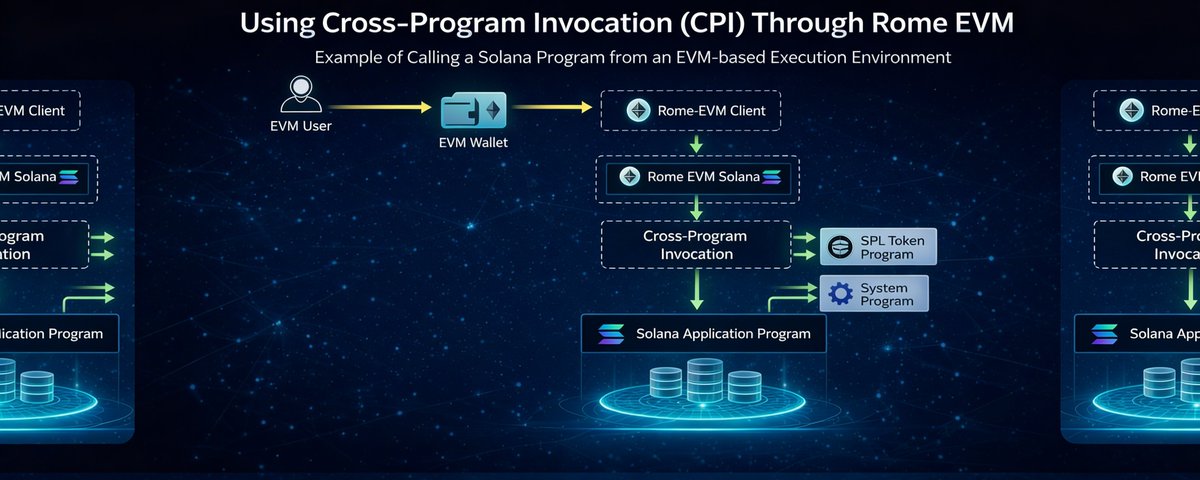
→ Solidity contracts can call Solana programs through CPI
→ both EVM and Solana wallets interact with the same application state
→ shared contracts and liquidity without a separate bridge hop
what makes this interesting is that Rome is simply bringing EVM execution inside Solana.
an EVM wallet and a Solana wallet can interact with the same application without maintaining separate versions of the application.
Rome is already live on Solana mainnet, with publicly available code and a Halborn audit.
my initial view is that this is a more interesting direction than asking which ecosystem wins.
because the next phase of onchain applications shouldn’t be about forcing developers and users to pick a side.
it should be about making both environments work together.
that’s the idea behind @RomeProtocol.
🤝 Paid partnership

Rome retweeted

What does an EVM running inside Solana actually unlock?
@RomeProtocol is starting to answer that with 10 live applications on Hadrian testnet and 5 on Rubicon mainnet.
🔹 Lending: @Aave v3 and @compoundfinance v3-based Aerarium
🔸 Trading: Rome DEX with shared EVM–Solana liquidity
🔹 RWAs: Bloom's permissioned asset issuance
🔸 DeFi access: Cardo connecting EVM wallets to @Solana applications
🔹 Infrastructure: Bridges, @PythNetwork oracles, explorers, and sovereign chain deployment
From deploying Solidity contracts to accessing Solana-native liquidity, Rome is building out the applications and infrastructure for cross-VM composability.

Rome retweeted

I think we’ve been looking at Solana and EVM from the wrong angle.
Solana has its own users, liquidity and DeFi apps. The EVM has Solidity, familiar development tools and a large community of builders.
Both have something developers can work with. The challenge has always been bringing them together.
That’s where @RomeProtocol comes in.
Rome runs an EVM execution environment inside Solana, allowing developers to deploy Solidity contracts while accessing Solana programs directly.
And the part that matters is how both sides work together.
An EVM user can connect through MetaMask, while a Solana user can use Phantom to access the same app and shared state.
For developers, this means they can use familiar Solidity tools and connect their contracts to Solana’s existing infrastructure, including programs like Jupiter and Meteora.
These interactions can happen within a single atomic transaction, so connected operations succeed or revert together.
Rome is already live on mainnet, making this more than a concept on paper.
The bigger opportunity is giving developers access to both ecosystems while allowing users to keep using the wallets they already know.
If Solana can serve as the foundation for a wider range of financial applications, making those applications accessible to EVM users opens another door for builders.
You can explore how Rome works and what you can build with it here 👇
docs.rome.builders

Rome retweeted

Crypto’s two largest application ecosystems still operate like separate worlds.
Builders duplicate products, institutions duplicate controls, and users and capital remain fragmented.
@RomeProtocol is turning that boundary into one connected market.

Rome retweeted

Portus (@RomeProtocol) is live. Base users can deposit into Kamino on Solana without leaving @base.
You sign on Base, USDC moves via CCTP, and withdrawals come back to the same address.

Portus is live portus.mainnet.romeprotocol.…
Base users can reach @solana with self-custody. They sign on @base without leaving it.
Deposit USDC into @kamino lending markets. Circle CCTP carries the USDC and the user's signed instructions to a contract on Rome. The contract deposits into Kamino and accounts for the position. Withdrawals return USDC to the same Base address. The app shows live market rates read from Solana.

Rome retweeted
LAUNCHES
■ @byzanlink Coinbase tokenized stocks are live on Byzanlink RWA Markets on Base.
■ @makinafi Seven Mag 7 Machines are live on Base, operated by Dialectic. Deposit the tokenized stock, receive a Machine Token, and earn yield. Covers Amazon, Meta, Alphabet, Tesla, Nvidia, Apple, and Microsoft.
■ @superformxyz Earn Stocks is live on Base, powered by Aave. Mag 7 tokenized stocks are used as collateral to borrow stablecoins and earn a carry spread.
■ @Zyfai_ Apple and Google SuperVaults by Superform are live inside Zyfai Yield Maxxing.
■ @TenorFinance Fixed-rate lend and borrow markets are live on Base, powered by Morpho.
■ @openlaunch_lol OpenLaunch has a new interface. Tokens can now launch paired with $TWIG. One-transaction launches on Base, Robinhood Chain, and Arc still take 0% platform fee.
■ @twigpine Tokenizing an app on Twigpine Playground is now free. One click pairs a token with $TWIG on Base.
■ @basepadsi BasePad is live. One transaction deploys a fixed-supply token, opens a Uniswap v4 pool, and locks 100% of liquidity. Creators keep 95% of fees. Stock pairs and agents launching on their own are now live.
■ @BaseStonk Creators can set a tax up to 10% each way and split it across holder dividends, auto-liquidity, buyback and burn, and their own wallet.
■ @bankrbot Authenticator-app MFA is live, alongside passkeys. The LLM Gateway now routes through Surplus when a cheaper path exists.
■ @baibai_cx BaiBai now supports Coinbase Tokenized Stocks on Base. @lifiprotocol integrated LI.FI to bring those stocks into BaiBai.
■ @RIFTHQ Rift is live on Base, with best-price execution into Base in one click and 0 added fees.
■ @norafinancexyz Introduced Reserva by @contavcbr. Earn 100% of CDI on $BRS (13.65% APY) through a fully onchain, non-custodial neobank.
■ @verantaxyz Launched 10 new assets on Base (ANET, STX, VST, ASTS, AXON, BA, BOT, UBER, GRAB, SOFI). Four are untradeable anywhere else.
■ @zothdotio zMAG7 is live. One stablecoin deposit holds AMZNc, AAPLc, NVDAc, GOOGLc, METAc, MSFTc, and TSLAc at equal weight, built on Coinbase Tokenized Stocks.
■ @RomeProtocol Portus is live. Base users can deposit USDC into Kamino lending markets on Solana with self-custody, signing on Base without leaving it.
■ @aeonframework BuyerWins is live on the aeon hook marketplace. Consecutive buys cut the fee from 0.30% to 0.04%; a dump breaks the combo and the exit fee goes to buyers.
■ @stambouli_o1 o1 is building a swarm of agents and cross-function calls, starting with @o1_bot.
■ @predofficial Gift boxes with $50K in rewards run October 9–26. Existing users and new users with onchain wallet history get a box; one trade claims it.
■ @credifi Launched a zkTLS verification iOS app and Chrome extension, starting with credit score screening from Experian, Credit Karma, and NerdWallet.
■ @OpenGradient Pushed private AI for chats, generated images, and videos on Dreamfort.


Rome retweeted
Private vault and Private order books are added, give it a try. you will need Solana devnet SOL & circle USDC which you can air drop from circle faucet.
Privacy DEX is live on Solana devnet.
Private swaps on Solana, built on @HeliusPrivacy. Pay USDC, receive SOL into a private balance. The token and amount you hold are encrypted on chain.
Built by Rome. Thanks @0xMert_ and the Helius team for the shielded pool.

Rome retweeted
Shipping product using AI? I've been on it 6 months — mostly with @claudeai and Claude Code (@ClaudeDevs), shipping on @RomeProtocol.
My most complex build yet is close to done. For this one I brought in @Gemini alongside Claude Code.
Here's what I found 👇
Rome retweeted

Our mission is to take any asset through its full financial lifecycle on Solana.
From launch, to spot, to derivatives.
With @RomeProtocol, that lifecycle is now accessible to every EVM user via a single Solidity wrapper, while all execution and liquidity stays anchored on Solana.
Excited to explore what this unlocks! 🔥


