

China Research Director @McLartyAssoc strategic consulting in Washington DC | SOPA judge | ex-Reporter @Dowjones @Bloomberg @SCMP in Beijing | #HoyaSaxa
Washington, DC
Joined September 2012
- Tweets1.7K
- Following3.4K
- Followers1.8K
- Likes1.7K


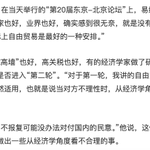


Li Daokui’s analysis didn’t surprise me. What surprised me was that it was he who stood out to paint a pessimistic picture when others stayed silent. In the past, he was almost always in the bullish camp and aligned with state narratives. I wonder what has changed.

Li Daokui's comments are important because there are so few domestic voices in China stating what (I think) is the obvious truth about the economy: the main problem is that aggregate demand is weak, growth is running below potential and macro policies are inappropriate.
This is not a novel, original or unusual insight: it's what lots of people (myself and others) have been saying for years, and is also in the most recent of the much-maligned IMF reports on China.
But it runs directly contrary to the official government diagnosis which is that aggregate demand is fine and the economy mainly suffers from "structural" problems.
It's hard to directly contradict the official view in Chinese discourse but Li is one of the few who have the standing and skills to do so effectively. I hope his intervention makes a difference...
Another round of Chinese stock market bailouts

The Chinese market regulator CSRC held an urgent market stabilization symposium yesterday, sending three strong signals:
• First, stabilizing the market does not mean bailing out junk stocks. The current focus is on addressing trading loopholes such as disorderly quantitative dumping, short selling via securities lending, and margin call liquidations to restore the overall market ecosystem. There will be no bailouts for overvalued, fundamentally weak stocks trading on hypes with no earnings.
• Second, financial performance should become a strict threshold for stock selection. The goal is to guide institutions to focus on fundamentals and adhere to long-term investing, while strictly cracking down on speculative trading.
• Third, hundreds of billions of yuan in state capital will increase their stakes in public companies. Funds from SASAC will be strictly allocated to undervalued, high-dividend, and strong SOE blue chips. Private, purely speculative small-cap stocks will be excluded from their purchases.

Congratulations to all the winners! It was an honor to be part of the judging process for another year and help recognize these outstanding works of journalism. #SOPAawards2026

The final batch of winners for the #SOPAwards2026 will now commence.
Be the first to get more details about the award winners, subscribe to the SOPA newsletter: bit.ly/SOPAmail 🏆


Interesting view! Wondering how #Board of Trade might be translated into Chinese. 经贸合作机制 seems to be one option as Board can mean a mechanism too in Chinese.

#Pan Shiyi’s remarks that China’s property sector is essentially a #Ponzi scheme had gone viral online before being removed. The ex-real estate guru sold off his projects in China before moving to the US. People are debating why he made this high profile interview at this timing.


From about a month to five weeks, to 5-6 weeks, and then, basically no clear timeline - #Trump-Xi summit

SCOOP: "The next dates for the Trump-Xi summit will only be proposed after the active part of the Iran conflict is over" via @politico @_AriHawkins @drdesrochers subscriber.politicopro.com/a…
very good question from @niubi and very good assessment from his newsletter: Who initiated the Trump-Xi call? - ...
"It matters because the narrative was set early Monday that Xi had requested the call in the context of the current crisis with Japan, when if it turns out that Trump requested it then it is more likely because the Chinese side has been slow walking parts of the trade deal and Trump wanted to remind Xi to fulfill what was promised, especially as the US side has said they expect to sign the deal this week."
This quoted post is unavailable.
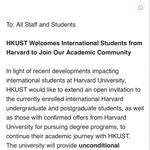
Hong Kong University of Science and Technology welcomes #Harvard international Students to transfer to their school.

Who was the mind behind this? US, China Fin Mins met in IMF basement for secret talks- needed to happen quietly, avoid intense media attention during IMF meeting, have someone familiar with the basement to lead them into it. A creative episode in US-China trade war.@Dimi

The #Geneva meeting between the US and China largely puts us back to the status of tariffs before the “Liberation Day”. Just thought of a Chinese proverb: 一夜回到解放前 (back to the time before Liberation overnight)
Victoria Ruan retweeted

The PBOC, NFRA and CSRC will hold a joint press con at 9am pre-market regarding “a basket of polices to stabilize market expectations”.
To hold a press con before market opens shows confidence, and at this stage the market expects nothing but good news, but it’s not yet certain that who will attend and speak at the conference. Obviously, in a culture of top-down management style, the more senior the rank, the stronger the signal.
If governor Pan Gongsheng would attend, it could reminisce about the conference held by the PBOC on Sept 24 last year that set off a powerful rally into the national holiday. $BABA $PDD $FXI $KWEB $EWH $PGJ $ASHR $CNH
China names former ambassador to the WTO Li Chenggang as new vice Commerce Minister and international trade negotiation representative, replacing Wang Shouwen. a signal that China is ready for trade negotiations? Unclear what new position 59-year-old Wang is taking next.
Learning Greek symbols has never been more important for decoding the “logic” behind reciprocal tariffs

This is truly amazing. The Deputy White House Press Secretary is claiming that I'm wrong, and that the "tariff rates" on Trump's chart were calculated by "literally" measuring every country's tariffs and non-tariff trade barriers.
To prove it, he screenshots the formula the USTR says was used to calculate the reciprocal tariffs we imposed on other countries. And when you back out the Greek symbols, what is that formula? Trade deficit/imports - exactly what I said it was.
I don't know if the Deputy Press Secretary was misinformed, or is just being misleading. Either way, the Trump administration did not "literally calculate tariff and non tariff barriers" to determine the tariff rates it's imposing on other countries. As I said, it divided our trade deficit with a country by our imports with that country, and then multiplied by 0.5 (because Trump was being "lenient").
Oh, and if our trade deficit/imports with a country is less than 10%, or we have a trade surplus with a country, Trump slapped a flat 10% tariff on that country.

So many people question how the tariff numbers are calculated.

Paul Krugman on Trump’s tariffs:
“It’s not just that he appears to be imposing much higher tariffs than almost anyone expected. He’s also making false claims about our trading partners — not sure in this case whether they’re lies, because he may be truly ignorant — that will both enrage them and make it very hard to back down.” 1/3
Really? This is how Trump’s tariff rates are calculated??
Just figured out where these fake tariff rates come from. They didn't actually calculate tariff rates + non-tariff barriers, as they say they did. Instead, for every country, they just took our trade deficit with that country and divided it by the country's exports to us.
So we have a $17.9 billion trade deficit with Indonesia. Its exports to us are $28 billion. $17.9/$28 = 64%, which Trump claims is the tariff rate Indonesia charges us. What extraordinary nonsense this is.
China’s #NeZha 2 is an incredible success- hitting CNY10B (over $1.4B) box office; projected to reach $2B, which would surpass Inside Out 2 and Lion King etc to become world’s highest grossing animated film of all time…. In Tyson’s AMC today, tickets almost sold out ⬇️

Chinese Foreign Minister Wang Yi used a proverb 好自为之 during his first phone call with new US Secretary of State Marco Rubio, who has remained on China’s sanction list.
The 4-character proverb is hard to translate accurately into English as it conveys multiple layers of meanings: 1) Hope you act judiciously; 2) if you don’t behave well, you know what’s waiting for you; 3) we wish you good luck.
Reuters’ translation so far is the most concise and closest to its original meaning: we hope you conduct yourself well; yet slightly condescending.
Mofa’s own translation is so soft that it barely contains any warning: we hope you act accordingly and make right decisions….
So. is the Chinese proverb only targeting domestic audiences?
