

I mostly share history, art, culture, food, attire, traditions, and heritage of the Indian Muslim community. Sometimes I delve into politics & current affairs.
Joined December 2023
- Tweets12.8K
- Following122
- Followers29.3K
- Likes14.6K






Indian Muslim Archives retweeted
Muslims (Mughal India Rep.) consisted of three primary classes: feudal, artisan and peasant -- with artisans forming the largest group (not peasants).
This might sound somewhat inaccurate until you understand few aspects:
1) Muslims population in India [rep] when Aurangzeb reigned was not more than 7.5% (it was 13.4 by 1941, about 2x increase).
2) As central Mughal authority fell, the industries [karkhanas] went into decline for various reasons (not our topic).
For comparison, Kashmir had 40,000 looms under Alamgir Bahadur, 12,000 under the Durranis, and 24,000 under Maharaja Ranjit Singh.
You see? Even a powerful regional ruler couldn't restore the Mughal-era flourishing of artisan industries. With looms directly tied to the Julaha biradari, one can imagine the impact on their livelihoods.
During a century of Company rule, Mughaliya karkhanas were systematically undermined. By 1921, after 62 years of Crown rule, one can imagine the extent of ruin suffered by Mughaliya artisans.
3) UP (United Provinces) is the most reliable basis for understanding Mughal demographics, having united parts of the imperial capital subahs of Dihli and Agra with Awadh (seat of the Nawab-Wazir) and Allahabad Subah (also under the Nawab-Wazir).
We have some statistics from the 1921 UP Census. (remember the earlier discussion on the ruins of Mughal-era industries, which ultimately diminished the artisan class and forced many into other occupations.. keep this in mind.)
So in 1921;
27.8% UP Muslims and 83.2% UP Hindus while were ordinary cultivators, foresters and fishermen.
3.4% UP Muslims and 1.4% UP Hindus were feudal aristocracy.
33.07% UP Muslims and 7.04% UP Hindus were engaged jn skilled/unskilled artisanry.
I think.. this is enough!
———
I would also like to clarify that there were not merely three primary classes (feudal, artisan and peasant) as I stated, but also numerically significant class of imperial servants (from foot soldiers and clerks to officers and bureaucrats).
I did not name them separately because they either arose from or were ultimately were assimilated into these classes.

This is straight up historical revisionism lol
>Armenians
>Greek Phanariots
>Marwaris
>Jains
>Parsis
>Jews
>Chettiars
These were the kafir market-dominant minorities who were indispensable in financing the major trade routes of the premodern Muslim world. Barring the few mercantile ethnicities, most of whom were littoral communities, Muslims were either part of the feudal equestrian class, or peasantry (latter being the majority).
Indian Muslim Archives retweeted
This khayal bandish was composed by Naimat Khan, a descendant of Nuabat Khan for Khalifah Muhammad Shah Bahadur:
"O charming Muhamad Shah! O my beloved, charming Muhammad Shah! Now that you are absent, my beloved, neither the days nor the nights hold any charm for me."


Indian Muslim Archives retweeted
What does a Gangetic Muslim and a Malayali Muslim have in common?
The very epic of the Indo-Muslim civilisation begins along the shores of Malabar.
Shahnamah-e Hind, the monumental Urdu poetic saga of Indo-Muslim civilisation begins with the legend of Zamorin (king of Malabar) witnessing upon the splitting moon.
Shared memory are what define and establish civilisational allegiance, and that is what Muslims of Malabar share with fellow Muslims of India.


Indian Muslim Archives retweeted
A man went to a tailor, handed him some fabrics to be stitched, and asked which day should he come to collect.
The tailor replied, "come any day except monday, tuesday, wednesday, thursday, friday, saturday, or sunday."


Indian Muslim Archives retweeted
"a dreadful terrorist like Sharjeel Imam"

This quoted post is unavailable.
Indian Muslim Archives retweeted

Tell me you've not read the Constitution without telling me you've not read the Constitution.
The American Constitution's First Amendment guarantees freedom of speech.
The Indian Constitution's First Amendment virtually kills it.
Thank you Nehru.
Indian Muslim Archives retweeted

One half brands him an Islamist terrorist and his ideas dangerous. The other dismisses his legitimate criticism as mere bitterness. Then you wonder why he sees both sides as part of the problem.

Mr Gupta, I’ve spent a little bit of time in jail. You’re lucky you haven’t.
When a man is locked up & deprived of his basic freedom to move for 6 years without trial, guess what? He will become bitter.
He doesn’t have the luxury of sipping on champagne & talking “Constitution” & “liberalism”.
Dont expect him to worship the Constitution when it hasn’t done jackshit for him in 6 years.
Cheap dog whistling but no one expects any better from you.
Indian Muslim Archives retweeted
The Rajput envoy draws a pointed contrast between Muslim and Maratha overlordship in Rajputana.
(The Maratha reporter is outraged with the Hindu-Muslim framing of the envoys, despite the prescence of Rane Khan ‘Bhai’).

Rane Khan ("Bhai Rana Khan"), who is famed as one of the most honoured, beloved, and distinguished noble and general of Rajah Mahadji Sindhia;
He was not a Bhisti.
He was a Maratha, born into a family of minor feudal aristocrats - the Patils of Devpur. His family had been Muslim for several generations.
(Tomb of Rane Khan)

Indian Muslim Archives retweeted
Indian Muslims possess a vast literary treasury (in Persian, Sanskrit, Hindavi, Urdu, Tamil, Malayalam, Bengali & more)
Imagine if their musicians turned them into music, as Iranians do.
Here are few verses from Rajvinod, the Sanskrit ballad of Sultan Mahmud Shah Muzaffarid. 🎧
Indian Muslim Archives retweeted
When even the ruins of Indo-Muslim architecture are so charming, one wonders how magnificent its monuments would look if restored in all their original colours, patterns and motifs.
— ft. Nawabate (later Kingdom) of Awadh
📍Faizabad Tomb (ruin]


Indian Muslim Archives retweeted
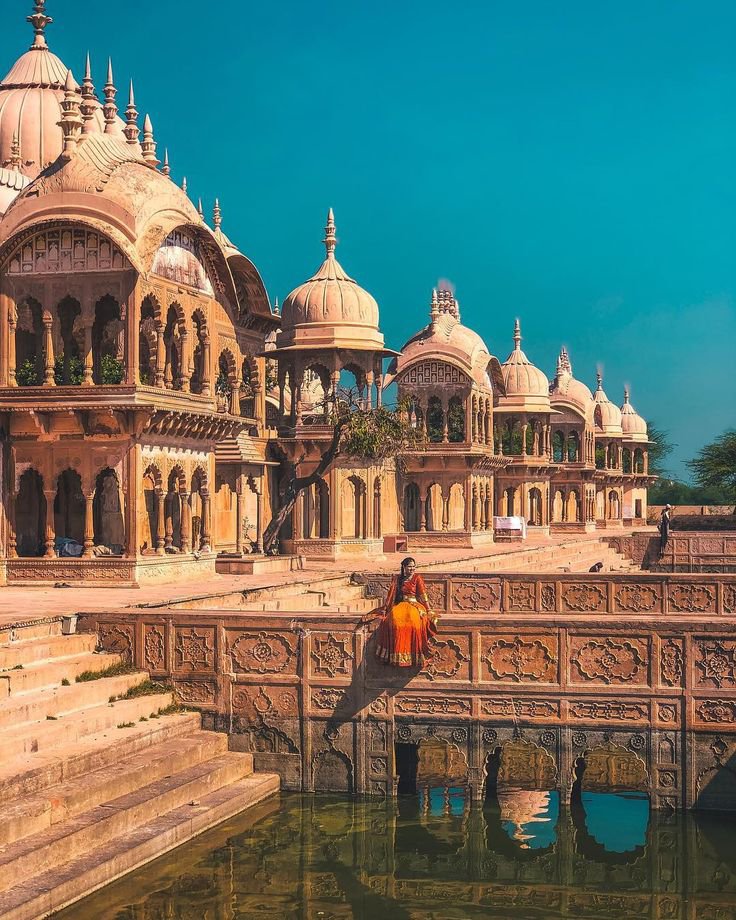
So, I was going through 18th-century letters and accidentally found a descendant of the Khanzadah dynasty of Mewat (to which the famous Hasan Khan Mewati belonged).
Here is all I have found so far.
Zulfiqar Khan, a resident of Mathura, was the hereditary Lord of Alinagar, commanding its fort and rich jagir (feudal estate), yielding ₹2 lakh per annum.
In 1786, Mahadji Sindhia ordered him to vacate Alinagar fort, which he wanted to garrisoned with the Mughal+Maratha troops. In return, Mahadji assigned an estate yielding ₹15,000 for the family of Zulfiqar and a haveli (mansion)!in Govardhan.
Zulfiqar's military establishment were stated to be 150 cavalry and three elephants, while his infantry strength isn't stated. Anyway, commanding 3 elephants and 150 horses surely means his total strength was easily over 1,000 men.
Anyway, in 1787, the Mughal-Rajput coalition defeated the Maratha-Mughal coalition at Lalsot, and the fort was again handed to Zulfiqar Khan by the victors.
In June 1788, when Mahadji Sindhia re-established his authority, he officially acknowledged Zulfiqar Khan's possession of the fort and estate of Alinagar, and did not disturb him.
——
This Zulfiqar Khan was a Khanzadah of Mewat.

Indian Muslim Archives retweeted
Rane Khan ("Bhai Rana Khan"), who is famed as one of the most honoured, beloved, and distinguished noble and general of Rajah Mahadji Sindhia;
He was not a Bhisti.
He was a Maratha, born into a family of minor feudal aristocrats - the Patils of Devpur. His family had been Muslim for several generations.
(Tomb of Rane Khan)
