

Official account of Huayang Center for Maritime Cooperation and Ocean Governance. Follows, RTs≠endorsement.
Haikou, China
Joined April 2023
- Tweets462
- Following72
- Followers110
- Likes265


Pinned Tweet
1. The Philippines cites the 1734 Velarde map (p1)("Panacot") to argue that Panacot = Huangyan Dao (Scarborough Shoal). In the map, Panacot is located in middle of the three shoals off the west coast of Luzon.
2. The English name "Scarborough Shoal" comes from the British East Indiaman Scarborough grounding there on 12 Sept 1748—after the Velarde map was published.
3. In 1775, French hydrographer Jean-Baptiste Nicolas Denis d'Après de Mannevillette published the expanded 2nd ed. of Le Neptune Oriental, including "A Chart of the China Sea"(p2) originally drawn by British cartographer Alexander Dalrymple, the first map to precisely mark the location of the "Scarboro," the island named after the English commercial ship, and the "Scarboro Shoal" is placed to the west of the "three shoals".
That means: "Scarboro" should not be wrongly confused with the "middle shoal" of that three-shoal group; it is hence distinct from the "Panacot" featured on the earlier Velarde map.
4. So if someone insists "Panacot is Huangyan Dao,” they must explain why the first explicit "Scarboro" plotting (1775) shows Scarboro separately—west of that three-shoal cluster.
5. Equating Panacot with Huangyan Dao is not a settled historical "fact," but a groundless interpretation that later charts directly refute.


Hey @jaytaryela, what happened to your daily lectures about the South China Sea?
You treat online attention like a measure of diplomatic success. But perhaps there's a difference between defending your country's interests and turning every maritime incident into your personal publicity campaign?
Quite a lesson in transparency, isn't it?

China wants us quiet for two reasons. First, transparency is the evidence that keeps like-minded states condemning its conduct and backing our security partnerships. Second, once the WPS fades from public view, the field is clear for a Beijing-friendly outcome in 2028.
Here is my opinion-editorial publsihed by @inquirerdotnet
inquirer.net/494905/why-beij…

33
🚢 Join leading experts from China and Europe for Part II of the Hai-Eu Dialogue Series as we explore how innovation, policy, and cooperation can shape a greener blue economy.
📅 November 23, 2026
🕟 4:30–5:30 PM (Beijing) | 9:30–10:30 AM (CET)
📲 Scan the QR code to register and join the conversation!

Huayang Center Holds International Seminar “Hosting the Secretariat of BBNJ Agreement: Progress and Prospects” in Haikou
On November 15, the Huayang Center for Maritime Cooperation and Ocean Governance held an international seminar titled “Hosting the Secretariat of BBNJ Agreement: Progress and Prospects” in Haikou. Wu Shicun, Chairman of the Huayang Center and the Academic Committee of the National Institute for South China Sea Studies, delivered the opening remarks and chaired the discussions.
The seminar drew more than 100 participants, both in person and online, from the Chinese mainland, Hong Kong SAR, the United Kingdom, Canada, Australia, Togo, Nigeria, Sri Lanka and elsewhere, including experts and scholars from think tanks, universities, research institutions and international organizations, as well as media representatives.
Participants discussed the potential implications of the joint bid for the Secretariat, whether the proposed division of functions was consistent with the Agreement, and what the choice of location for the Secretariat could mean for the Global South.
In his opening remarks, Wu noted that the joint bid by Belgium and Chile had introduced new uncertainty into the selection of the Secretariat’s location. He stressed that any arrangement should respect the decision-making authority of the Conference of the Parties. He called for a thorough assessment of the additional costs and coordination challenges that could arise from locating the Secretariat and the Clearing-House Mechanism in different cities, as well as the potential effects on the mechanism’s efficiency and transparency.
Experts at the seminar said geographical balance should also factor into the decision, given that Asia, particularly its developing countries, remains underrepresented in global ocean governance institutions. Some experts pointed to China’s position as a member of the Global South, the world’s largest developing country, and the world’s second-largest economy, and argued that hosting the Secretariat in Xiamen would offer a unique combination of advantages and facilitate implementation of the Agreement.
Participants unanimously agreed that the Secretariat’s location and functions should support the effective implementation of the Agreement. The Conference of the Parties should make its decision in accordance with the Agreement through a transparent, fair, and inclusive process, taking into account operational efficiency, financial sustainability, geographical representation, and accessibility for all Parties. Participants also agreed that the Secretariat should operate independently, impartially, transparently, inclusively, and efficiently. It should serve as a platform for capacity-building, the transfer of marine technology, the sharing of scientific knowledge, and international cooperation, helping developing countries, particularly small island developing States, strengthen their capacity to implement the Agreement and participate in global ocean governance.


🌊 Who should host the BBNJ Agreement Secretariat, and what should guide the decision?
On November 15, the Huayang Center brought together over 100 participants from China and abroad for an international seminar in Haikou to examine the Belgium–Chile joint bid, the proposed division of institutional functions, and the implications for the Global South.
Chaired by Wu Shicun, the discussions emphasized the need for a transparent, fair and inclusive selection process that prioritizes institutional efficiency, financial sustainability and geographical balance.
Experts also highlighted Xiamen’s potential advantages as a host city and the importance of ensuring that the Secretariat strengthens developing countries’ participation in global ocean governance.
#BBNJ #OceanGovernance #GlobalSouth

🌊 Huayang Seminar | Nov 15, 15:00–18:00 (GMT+8)
"Hosting the Secretariat of BBNJ Agreement: Progress and Prospects"
Experts will discuss Belgium and Chile’s “joint bid” for the BBNJ Secretariat, whether the proposed institutional split aligns with the Agreement’s rules, and implications for the Global South.
🔴 Join via Zoom:
us06web.zoom.us/j/8904216066…
SCS Comment retweeted

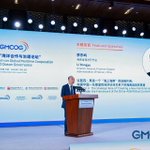
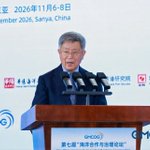
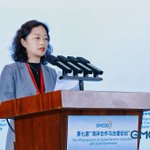
Thank you to @GMCOG_ for the invitation to come to the southernmost part of China and speak about maritime governance in the northernmost part of the world. What a pleasure to join a panel of international experts to discuss Arctic cooperation among the coconut palms of Sanya!


🌊 The Global Maritime Security Report 2025–2026, independently published by the Huayang Center, features eight studies by nine international experts, examining maritime security dynamics in the South China Sea, Indo-Pacific, and Indian Ocean, with insights into major powers’ strategies, regional stability, and maritime cooperation.
Read the full report: huayangmaritime.com/reader/a…

#Opinion: The 7th Symposium on Global Maritime Cooperation and Ocean Governance, which concluded on Saturday, released the Global Maritime Security Report 2025-2026, analyzing the interests of various stakeholders. It is hoped that all concerned parties move toward one another and work in concert to resolve disputes through peaceful means, safeguard peace and stability in the #SouthChinaSea, and build a common home of regional countries.
globaltimes.cn/page/202611/1…

1
81
SCS Comment retweeted

#Opinion: The 7th Symposium on Global Maritime Cooperation and Ocean Governance, which concluded on Saturday, released the Global Maritime Security Report 2025-2026, analyzing the interests of various stakeholders. It is hoped that all concerned parties move toward one another and work in concert to resolve disputes through peaceful means, safeguard peace and stability in the #SouthChinaSea, and build a common home of regional countries.
globaltimes.cn/page/202611/1…
SCS Comment retweeted

I recently participated in the 7th Symposium on Global Maritime Cooperation
and Ocean Governance organised by the Huayang Center for Maritime Cooperation and Ocean Governance at Sanya, Hainan, China.
@GMCOG_


Niklas Swanström (@niklasswanstrom Director of @ISDP_Sweden ): The oceans connect our economies, our societies, and increasingly our futures. In an era where strategic mistrust is growing, understanding different perspectives is itself a contribution to security. The future of maritime stability will not be determined by any single country, alliance, or institution. It will be shaped by our collective ability to manage disagreements while continuing to cooperate where our interests overlap. And those overlapping interests are significant.
The oceans have always connected civilizations. They can also connect solutions. At a moment when the international environment is becoming more complex and uncertain, this report reminds us that maritime security is not only about managing competition. It is also about creating opportunities for dialogue, cooperation, and responsible governance.
🌊 The Global Ocean Security Report 2025–2026 is officially launched!
Today, Xu Xiaodong, Executive Chairman of the Huayang Center, and Niklas Swanström @niklasswanstrom , Director of the Institute for Security and Development Policy (@ISDP_Sweden ), jointly launched the report.
Bringing together experts from China, the US, Europe, and across Asia, the report explores evolving maritime security challenges, shifting national strategies, and the future of ocean governance through the lens of the South China Sea.
📖 A global perspective on maritime security in an era of growing uncertainty.


Xu Xiaodong said: Maritime developments are increasingly extending beyond bilateral relations, with far-reaching implications for regional and global security.
The stability of the maritime order depends not only on shifts in the balance of power, but also on countries’ ability to manage disputes, maintain dialogue, and pursue practical cooperation.
🌊 The Global Ocean Security Report 2025–2026 is officially launched!
Today, Xu Xiaodong, Executive Chairman of the Huayang Center, and Niklas Swanström @niklasswanstrom , Director of the Institute for Security and Development Policy (@ISDP_Sweden ), jointly launched the report.
Bringing together experts from China, the US, Europe, and across Asia, the report explores evolving maritime security challenges, shifting national strategies, and the future of ocean governance through the lens of the South China Sea.
📖 A global perspective on maritime security in an era of growing uncertainty.
1
52
🌊 The Global Ocean Security Report 2025–2026 is officially launched!
Today, Xu Xiaodong, Executive Chairman of the Huayang Center, and Niklas Swanström @niklasswanstrom , Director of the Institute for Security and Development Policy (@ISDP_Sweden ), jointly launched the report.
Bringing together experts from China, the US, Europe, and across Asia, the report explores evolving maritime security challenges, shifting national strategies, and the future of ocean governance through the lens of the South China Sea.
📖 A global perspective on maritime security in an era of growing uncertainty.
SCS Comment retweeted

Day 2 of the 7th Global Symposium on Maritime Cooperation and Ocean Governance is now live!
Tune in for insightful discussions featuring Chinese and international experts on key issues shaping the future of maritime cooperation and ocean governance.
nitter.cf/i/broadcasts/2rJqgMQyk…

Live from the Scene | 7th GMCOG
Session 4 of the 7th GMCOG, “The Strategic Role of 'Creating a New Maritime Hainan': Hainan Free Trade Port under the Framework of the China-ASEAN Blue Economic Partnership,” is going on. Follow for live updates and expert insights! #GMCOG #SouthChinaSea

8
101
Preeda Youngsuksathaporn (Director General of the Fish Marketing Organization of the Ministry of Agriculture and Cooperatives, Thailand): Hainan can become a regional hub for seafood trade and maritime supply chains; Hainan can serve as a platform for sustainable fisheries and ocean resource management; Hainan can become a center for knowledge, innovation and institutional cooperation.
17
Guan Kejiang (President and Editor-in-Chief of the Global Times, China): China–ASEAN blue economy cooperation requires consensus and joint efforts from governments, businesses, civil society, think tanks and media. Deepening it is a grand undertaking that benefits over 2 billion people on both sides.

21
Wu Shicun: No quick-fix solution to the South China Sea disputes. The immediate priority is to manage risks and prevent the escalation of conflict. Efforts could begin in less sensitive areas—such as marine environmental protection, fisheries conservation, joint scientific research, ecological restoration, and collaborative ocean observation. By exploring viable paths toward joint development, the parties can steadily build mutual trust, thereby creating the conditions for an eventual resolution of the disputes.
17
Wu Shicun (Chairman of the Huayang Center for Maritime Cooperation and Ocean Governance; Chairman of Academic Committee of NISCSS, China): The initiative for peace and stability, rule-building and resource development in the South China Sea should be firmly held in the hands of regional countries.

1
20
Wu Shicun: The South China Sea should become a stage for cooperation rather than a frontier for confrontation. China is committed to working with regional countries to foster a sea of peace, friendship and cooperation in the South China Sea. This is a long-term strategy in line with the common interests of the region and highly consistent with the concept of a community with a shared future for the oceans.
13