

An Adobe Company. Helping 28M+ marketers be found everywhere search happens
Boston, MA
Joined February 2009
- Tweets214K
- Following10.7K
- Followers314K
- Likes38K






Your affiliate program may be shaping AI recommendations more than you think.
AI answers rely heavily on third-party reviews, roundups, and comparisons. In Semrush’s own affiliate program, roughly 1 in 5 partnered articles about Semrush is cited in tracked AI answers.
The strategic shift: measure affiliate partnerships not just by the sales they drive, but by how they shape your brand’s visibility in AI answers.
See how to turn affiliate partnerships into an AI visibility flywheel 👇
social.semrush.com/4zoe2jk.

Here are 234 ChatGPT prompts you can tweak to your needs for (almost) every industry, including prompts for marketing and SEO, plus tips on how to write your own 👇
social.semrush.com/4f7KzlD.

Original LinkedIn posts accounted for ~95% of the LinkedIn content cited by AI search.
We found this after analyzing 325,000 prompts across ChatGPT Search, and Google AI Mode, identifying 89,000 unique LinkedIn URLs cited in AI-generated answers.
We looked at citation frequency, content type, author signals, engagement, content length, search intent, and originality to understand which LinkedIn pages AI systems choose as sources.
The takeaway? Getting cited isn’t just about publishing more. AI systems can favor original content over reshares, making it important to understand which of your pages are actually earning citations and what characteristics they share.
Use these insights to identify your strongest AI-cited content, spot citation gaps, and build more of the content AI systems want to reference: social.semrush.com/3UAfQXk.

Is your schema markup telling Google the right story? Audit your page and generate validated JSON-LD with the Semrush MCP Schema Markup skill 👇
social.semrush.com/4yU6Fiw.

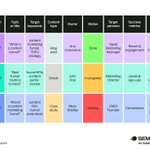
Map TOFU, MOFU, and BOFU content types, define target keywords and personas and track KPIs and stage-specific success metrics with our free content funnel planner template 👇
social.semrush.com/4BClyZH.

Want search engines and AI systems to understand your content more clearly?
Start with these 5 technical SEO steps:
1. Choose relevant schema – use Organization, Article, Product, or LocalBusiness markup to describe your page.
2. Add structured data – implement schema using a CMS plugin, AI-generated code, or JSON-LD.
3. Match markup to visible content – keep structured data consistent with what users see on the page.
4. Validate your implementation – check for errors before publishing and confirm your markup follows the guidelines.
5. Optimize the page itself – make content clear, crawlable, and easy for search systems to interpret.
Structured data helps search engines and AI systems interpret your content, giving your pages a clearer foundation for discovery and citation.
social.semrush.com/47ZcwIy.

BoFu tactics that drive decisions and conversions:
• Live, use-case-specific demos
• High-intent retargeting ads
• Automated email sequences triggered by user behavior
• Responsive customer support at the point of hesitation
• Free trial extensions that reduce friction before conversion
• Personalized outreach from sales or success teams
• Money-back guarantees that remove final risk
• Limited-time offers and time-bound discounts that create urgency
social.semrush.com/3WjkwBE.


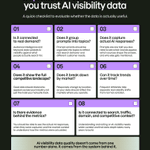
A million prompts can still miss your market 👀
When it comes to AI visibility, more data doesn't always mean better data. It needs context to help you understand where you stand and what to do next.
We put together a checklist with 8 questions worth asking about AI visibility data.
Save this if you're evaluating AI visibility tools or the data behind them 👇
social.semrush.com/4BCVTQr

AI search brought guest posting back to life.
The old playbook focused on backlinks. Now, guest posting has a new role: getting your brand into the articles, lists, and comparisons AI tools cite.
Watch Rita Cidre, Head of Semrush Academy, share a five-step playbook, from finding AI-cited sources to tracking off-site visibility.
social.semrush.com/4imklg0.

Managing SEO across multiple locations requires a system that can scale without losing local relevance.
Here's how to do it 👇
1. Create one source of truth for every location
2. Research search demand for each market
3. Build a scalable location-site architecture
4. Create a useful page for every real location
5. Optimize Google Business Profiles for every location
6. Add LocalBusiness structured data to each location
7. Build trust signals for each individual location
8. Keep business information consistent across the web
9. Measure SEO performance by location
social.semrush.com/4ipZwR2.

SEO works best when the fundamentals work together.
Use this 43-point checklist to strengthen your technical SEO, content, keyword strategy, and visibility across Google and AI search. Start with the biggest opportunities and work through the rest at your own pace 👇
social.semrush.com/4zh2TRj.

After analyzing 42,000 blog posts with an AI detector, content classified as fully human-written outperformed AI-generated or mixed content across the top 10 positions.
The gap is most striking at position 1: 80.5% probability of being human-written vs just 10% AI-generated.
This may appear to conflict with survey data showing that 72% of SEOs believe AI content ranks as well as human-written content. However, the data points to a more nuanced reality.
The key difference emerges at the very top of the rankings.
From position 5 onward, the performance gap between human-written and AI-generated content narrows significantly.
In other words, AI content performs competitively when the benchmark is ranking on page one.
However, in the highest-ranking positions, human-written content clearly leads.
Full study: social.semrush.com/4zlQ5cC.

If your site structure isn’t clear, AI won’t surface your content.
Improve visibility in AI search with our SEO guide (+ 6-month playbook template) 👇
social.semrush.com/4khUxo0.

Most content update processes break down at scale.
This workflow fixes it by splitting content updates into nine distinct skills, each handling a specific stage of the content lifecycle – from identifying what to update, to rewriting, structuring, and quality control.
Instead of relying on a single overloaded prompt, each step becomes a repeatable capability that AI can execute consistently.
Full breakdown: social.semrush.com/4yTTzSp.

Understand how to turn consideration into conversions with Middle of Funnel content ↓
social.semrush.com/48mdG0N.

92% of AI-using B2B professionals say AI shapes their vendor shortlist.
A security reviewer, finance lead, procurement manager, and end user can all evaluate the same vendor differently, which means your brand needs to show up across the questions that matter to each stakeholder.
B2B AEO means mapping those stakeholder-specific questions, building content around them, and strengthening the third-party sources AI relies on to evaluate your brand.
social.semrush.com/4jP8klN.

Once you own a topic in ChatGPT, you tend to hold it.
Our research found that clear category owners stayed on top in 90.4% of month-over-month comparisons.
But the lead matters. Brands with a narrow advantage were far more likely to lose their position, while wider leads created lasting authority.
Build and maintain topic authority in ChatGPT 👇
social.semrush.com/4iLqR1o.
