

SEO agency founder • Growing eCommerce brands with SEO + AEO • Schedule consultation call for your brand 👉 https://nitter.cf/t.co/pZjFjy6odn
Joined August 2018
- Tweets12.4K
- Following257
- Followers61.4K
- Likes14.7K






Want SEO that brings in buyers?
I helped a medical equipment brand go from $12k/month in organic revenue to its first ever $100k month.
The brand sells hyperbaric chambers, and the average order is over $20k.
Here are the 5 exact steps I used to do it 🧵:

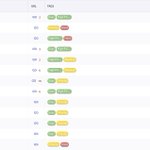
None of these keywords get a huge amount of search volume.
But when one order is worth $20k+, ranking for the right keywords matters a lot more than ranking for the biggest ones.
If you sell a high-ticket product, this is the playbook.
Need help with your brand’s SEO and AI visibility?
Schedule a call here and let’s see if we’re a fit to work together:
calendly.com/d/cnkj-mmn-m9d/…
This supplement brand now makes $190K/month from SEO.
A year ago, they were just making $61K/month. Insane.

If an ecom brand came to me tomorrow with zero organic traffic, here's exactly what I'd do in the first 90 days to get them ranking in Google and recommended in AI:
Days 1-7: Clean up the site and find the keywords
First, I'd run a Screaming Frog crawl and fix only what actually matters:
Redirect broken links
Redirect broken backlinks
Remove duplicate pages
Fix keyword cannibalization (two pages targeting the same keyword means neither ranks)
Delete blog content that gets no traffic and ranks for nothing
Ensure each page has an H1 tag
I'm not chasing Core Web Vitals scores, page speed scores, or alt-text. None of that moves rankings.
Then I'd find 3-5 competitors that are succeeding with SEO and plug each one into Ahrefs.
Go to “Organic keywords” and set these filters:
Intent: Non-branded
Lowest DR: Up to 39 in the top 5
KD: Up to 25
Now Ahrefs only shows keywords that weak sites are ranking at the top for.
If a weak site can rank at the top, so can the brand.
I'd grab every keyword on that list that's relevant to the brand's products.
Next, if the brand runs Google Ads, I'd pull its keyword data and grab every keyword that's converting.
Google Ads literally tells you which keywords turn into sales. Rank for them organically, and you get those sales without paying per click.
Last, I'd find every “best” keyword related to the brand's products:
best [product]
best [product] for [use case]
best [product] for [audience]
These become the target phrases for AI search.
They're what people type into ChatGPT when they're ready to buy.
Days 8-30: Build the pages that make money
I'd take every keyword from week one and map it to an existing page if one exists.
To decide which type of page, I'd Google the keyword and look at the top 5 results.
Product category pages ranking? Map it to a product category page. Product pages ranking? Map it to a product page.
The target keyword goes in the URL slug, meta title, H1, and meta description.
For every keyword that doesn’t have an existing page to map it to, I’d build a product category page.
Each product category page gets 500-600 words of content below the products:
What the product is
Who it's a good fit for
The brand's unique selling points
An FAQ
Internal links to other relevant product category pages
Then I'd add the most important product category pages to the main navigation menu
For AI, I'd take each “best” phrase and enter it into ChatGPT. Then look at the sources it cites to pull its product recommendations.
For product prompts, it's almost always “best X” listicles
So I'd open each one and analyze:
Average word count
How many products they feature
Which products they feature
The criteria they use to rank each product
How in-depth each product review is
Then I'd write 5-10 variations of a listicle that model them, with the brand's product ranked #1
Next, I'd look at the types of sites the cited listicles live on. And I'd pay similar sites with a DR of 30+ and real organic traffic to publish one of the listicle variations
Get 5-10 live for each phrase, and odds are a few will start getting cited and the brand’s products will start getting mentioned.
Days 31-90: Build authority
Build most of the links to the homepage. Homepage links raise the authority of the whole site, which lifts every page we built.
Product category pages get 1-2 links every other month. Anything more looks unnatural and gets pages penalized.
Then I'd publish blog content targeting:
[competitor] alternative
[brand] vs [competitor]
[competitor] vs [competitor]
In each one, I'd compare the brand to the competitors and position it as the best option to buy.
Then internally link to the relevant product category pages. And build a few backlinks to them as well.
That's it.
Do that, and the brand will start ranking for transactional keywords, generating more organic revenue, and seeing improvements in AI visibility within months.
What your account could look like using this EXACT SEO strategy:
nitter.cf/SEOKeval/status/211120…


A masterclass on how to rank #1 on Google in less than 4 months using this 5-step SEO process: nitter.cf/SEOKeval/status/211109…


My goal isn't to get Inbound Pursuit to $500k/month.
It's to make it the most trusted SEO and AI SEO agency for ecom brands on the planet.
That means delivering the best results and giving brands the best experience while we do it.
Here’s what that looks like:
1/ Stay at the forefront of AI search
How AI models recommend brands changes constantly.
So we're going to keep testing new AI SEO strategies before anyone else does.
That way, we can be the agency brands come to when they need to get cited in AI models.
2/ Distribution
X has been the agency's main growth engine, along with referrals.
Now I want to build YouTube into a growth channel too.
Long-form video lets me go a lot deeper into the strategies we use and the results we generate.
3/ Client experience
Client experience has always been important, but I want to emphasize making it even better.
Touch base with clients more frequently.
Make sure they’re always in the loop with what’s going on.
Bring issues to their attention before they find them, and map out a resolution plan.
Develop more custom dashboards to help clients better understand the numbers and the ROI they’re getting.
4/ Infrastructure
Better processes, better training on the newest SEO and AI SEO strategies, and more self-motivated team members.
And continue to give team members who own a major part of the process a percentage of the business.
When they win, the agency wins.
None of this happens in a quarter.
That’s fine.
I’m building this for decades.
The SEO strategy I used to 2x an ecom brand's organic revenue in 12 months:
I built a f*ck ton of Collection pages.
56 of them, to be exact.
The brand sold fireplaces.
So, I found keywords targeting every possible size, style, and configuration of those products:
> 36 inch electric fireplace
> 72 inch electric fireplace
> double sided fireplace
> corner gas fireplace
> outdoor gas fireplace
> most realistic electric fireplace
Built a Collection page targeting each of those keywords.
Added keyword-optimized content to each page.
Built backlinks to them.
And waited for Google to index and rank them.
Since a lot of these keywords were long-tail keywords, they were low-competition and easy to rank for.
12 months later, over half of the keywords moved to the top-5 spots.
And organic revenue went from $40k/month to $93k/month.
There's no better SEO strategy for DTC brands than this.

I was on FaceTime with my fiancée 6 months back when I just broke down crying.
I hadn't cried in probably a decade.
She stopped me and said, “Talk to me. What's wrong?” So I told her everything.
I don't talk about this much.
But the last few years, I've dealt with more anxiety than I have in my entire life.
It's made running a business a lot harder.
At one point, it got so bad that I seriously thought about selling my agency just to get out from under it.
And I think I know where it comes from.
I spent most of my life trying to prove to myself that I wasn't a failure.
Honestly, before I got into business, that's exactly where I was heading. Money and success made that feeling go away for a while.
But once I had them, a new fear crept in. What if I lose it all? What if I end up right back where I started, feeling like I'm not enough?
She let me get it all out. Then she said something I'll never forget.
She told me my self-worth was way too tied to my money and my business.
That I should be able to love myself for who I am, not for what I've built.
She also told me life is unpredictable.
There are going to be a lot of ups and downs.
But the Universe is on our side. It wants the best for us. And as long as we work with it, it'll guide us through the hard stuff and help us come out okay on the other side.
Now, I'm not religious by any means.
But that was the first time I ever considered trusting some divine entity that I can't see or touch.
And that conversation completely changed how I see things.
I'm more than my money.
More than my success.
More than my business.
The funny thing is, I got into business for freedom.
But the anxiety that came with it took away more freedom than any 9-5 ever did.
So from that day on, I made a conscious effort to separate myself from my business.
I'm Keval, who owns an SEO agency.
Not Keval, the SEO agency.
And man, it's been so freeing.
For the first time in a long time, I’ve been able to actually enjoy and appreciate each day...
Instead of dreading what could go wrong.
