

Yes on K! Nov 2020 campaign to authorize 10,000 units of municipal social housing in SF. Follow @SFCommHousing for more info on our post-2020 advocacy.
- Tweets185
- Following9
- Followers97
- Likes124
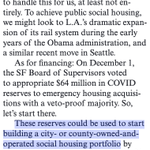



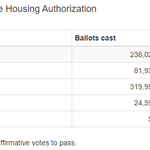



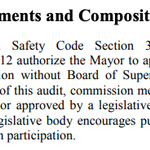



ALT Breakdown of Prop I Social Housing Budget Package. Includes a Certificate of Participation (long-term debt financing tool) for $122 million, to fund acquisition of land ($60M), construction ($20M), repairs and upgrades at public housing and co-ops ($20M), educator housing ($12M), and urgent repairs at SROs for elevator installation and upgrades ($10M). A separate budget add-back ask for $9 million includes support for underfunded housing strategies to meet affordability goals. These include pre-development outreach for non tax-credit projects, feasibility studies for new social housing typologies including municipal housing, revolving loan funds, and permanent real-estatae cooperatives, and expanding COPA (Community Opportunity to Purchase Act) capacity to identify sites and maximize purchase opportunities. Link to full flier at end of thread.


ALT Graphic with Mayor London Breed on the right-hand side, and text in the center-left. Text reads: Mayor Breed's Budget For two budget cycles in a row, the Mayor's office has: - Refused to allocate money specifically towards social housing - Failed to act on Prop K, which authorized 10,000 units of Public Housing for All - Refused to even study a new dept for Public Housing for All, which would cost under $300,000 out of a $14 BILLION budget. This is an anti-housing budget. Take action today!

ALT Graphic with "Mayor Breed's budget" on the left. A bar chart in the middle labeled "$708M for Police" shows a $51 million increase in the Police Department's budget in the next fiscal year. A bar chart labeled "$0 for Public Housing for All" is included on the right-hand side, and pales in comparison.

ALT Page 1 of a letter from the SF Berniecrats to the Board of Supervisors on fulfilling the HSFOB's social housing recommendations through the add-back process. This page urges Supervisors to fund $300,000 for a study on a Public Housing for All department through the add-back process. It also urges Supervisors to fund other social housing recommendations that were not funded by the Mayor, and reminds the Supervisors about the voter mandate with which Props I and K passed in November 2020. To read the full letter, see https://drive.google.com/file/d/1yqjh8T2rit1hf-1fxr3fLbFSYC6YADex/view?usp=sharing

ALT Page 2 of a letter from the SF Berniecrats to the Board of Supervisors on fulfilling the HSFOB's social housing recommendations through the add-back process. This page describes how a $300,000 study would allow the City to hire a consultant to develop recommendations for a dedicated enterprise agency tasked with owning and operating municipal social housing (Public Housing for All). To read the full letter, see https://drive.google.com/file/d/1yqjh8T2rit1hf-1fxr3fLbFSYC6YADex/view?usp=sharing


ALT Position letter from SF Berniecrats on AB 2053 (Lee) to Support with Qualifications (or "Support if Amended"). Sent April 7, 2022 to the Assembly Housing and Community Development Committee. This letter describes the amendments the SF Berniecrats successfully suggested, and remaining concerns. Our most significant concern with the bill is the lack of clear provision of housing for Extremely Low-Income (0-30% Area Median Income) and Very Low-Income (30-50% AMI) households. A second concern is about how above-moderate-income households are currently exempted from the sole residence requirement. To read the full letter, visit https://drive.google.com/file/d/1LV-oUmp0jj-KC09UWcnEdC3k6pOIWWYg/view?usp=sharing


ALT Bar chart titled New Scale of Commitment Funding Gap. Chart shows the funding gap to meet affordable housing targets in San Francisco, from 2015 through 2030. There is a clear increase between 2020-22 (roughly $50-150 million/year) and 2023 ($1.5 billion/year). After 2025, the funding shortfall is $2 billion/year. The chart suggests potential funding sources to address the gap: gross receipts taxes, real estate transfer taxes, local housing bonds, regional funds such as BAHFA, and Prop 13 tax reforms.


ALT Simone Manganelli, coauthor of Prop K, speaks at City Hall steps on the importance of funding Public Housing for All studies and the full slate of $136 million in social housing recommendations. In foreground: banners of the SF Labor Council and SEIU 2015 long-term caregivers.

ALT Simone Manganelli, coauthor of Prop K, speaks at City Hall steps on the importance of funding Public Housing for All studies within the full slate of Prop I social housing recommendations. In foreground: SEIU 2015 member holding SF Labor Council banner.

ALT Community supporters rally in support of Prop I social housing recommendations on City Hall steps. In foreground, banners of Senior & Disability Action, SEIU 2015, Council of Community Housing Organizations, and a poster saying "$ billions upon billions for war, pennies for senior housing."

ALT Community supporters rally with banners in front of City Hall steps. In foreground: banners for Jobs with Justice SF and SF Labor Council. In background: banners for SEIU 2015 and Housing Rights Committee of San Francisco.
ALT Simone Manganelli, coauthor of Prop K, speaks at City Hall steps on the importance of funding Public Housing for All studies and the full slate of $136 million in social housing recommendations. In foreground: banners of the SF Labor Council and SEIU 2015 long-term caregivers.
ALT Simone Manganelli, coauthor of Prop K, speaks at City Hall steps on the importance of funding Public Housing for All studies within the full slate of Prop I social housing recommendations. In foreground: SEIU 2015 member holding SF Labor Council banner.
ALT Community supporters rally in support of Prop I social housing recommendations on City Hall steps. In foreground, banners of Senior & Disability Action, SEIU 2015, Council of Community Housing Organizations, and a poster saying "$ billions upon billions for war, pennies for senior housing."
ALT Community supporters rally with banners in front of City Hall steps. In foreground: banners for Jobs with Justice SF and SF Labor Council. In background: banners for SEIU 2015 and Housing Rights Committee of San Francisco.


